


Smart Implant Companies Transforming Connected Healthcare
The top smart implant companies are advancing connected cardiac, neural, hearing, and orthopedic devices through sensors, AI, and remote monitoring tools.
Introduction
Overview of the Global Smart Implant Industry
The global smart implant industry combines implantable medical hardware with sensors, microprocessors, wireless communication, programmable therapy, cloud-connected monitoring, and patient-specific software. Its products include cardiac pacemakers, implantable defibrillators, cochlear implants, neurostimulators, sensor-enabled orthopedic joints, implantable cardiac monitors, and responsive epilepsy devices. Current demand is supported by 430 million people requiring rehabilitation for disabling hearing loss, including 34 million children. By 2050, the affected population is projected to reach 700 million, equivalent to 1 in every 10 people. Smart implant adoption is concentrated in tertiary hospitals, electrophysiology centers, orthopedic surgery facilities, hearing clinics, and specialist neuroscience programs.
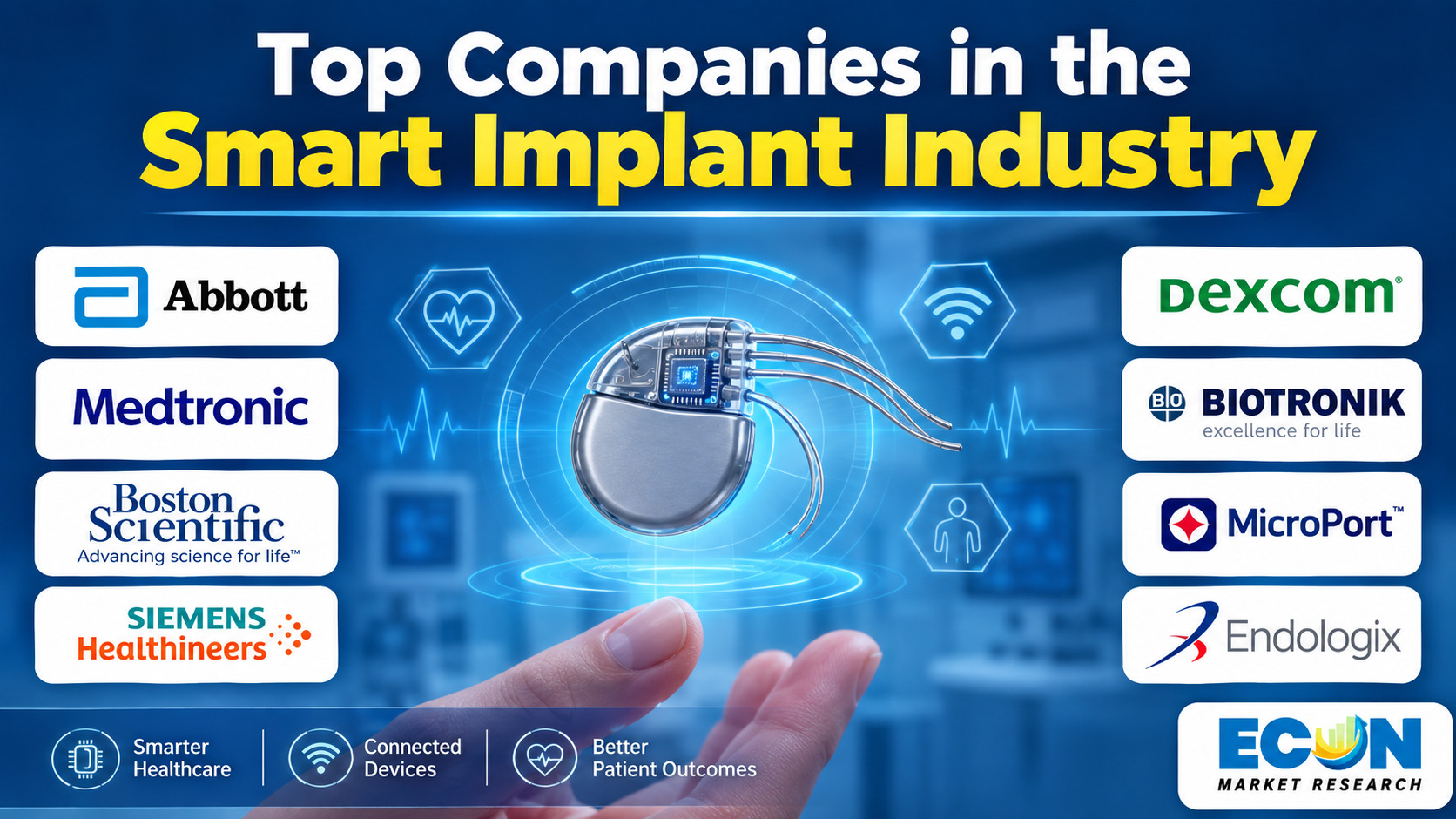
The sector has reached measurable operating scale across multiple therapeutic categories. Cochlear has supplied 750,000 implantable hearing devices across 180 countries since 1981, while BIOTRONIK has supported 1 million remotely monitored cardiac implants in 65 countries since launching Home Monitoring in 2000. Medtronic’s Tolochenaz manufacturing site produced its 10 millionth implantable device in February 2026 and operates at an output rate of 2,000 devices per day. These figures demonstrate that smart implants have progressed beyond experimental medicine into established clinical infrastructure, although adoption remains uneven between high-income health systems and regions with limited specialist capacity.
Market Evolution and Growth Drivers
Smart implant development can be traced through several technology milestones. A microelectronic multichannel cochlear implant was implanted in 1977, remote cardiac implant monitoring entered commercial use in 2000, the NeuroPace RNS System received U.S. approval in 2013, Persona IQ obtained FDA De Novo authorization in 2021, and Abbott’s dual-chamber AVEIR DR leadless pacemaker received FDA approval in 2023. Cochlear extended the technology model in 2025 by introducing an implant with internal memory for securely storing individualized hearing settings. Each milestone shifted implants from passive replacements toward programmable, connected, and data-producing therapeutic systems.
Adoption is also being driven by regulatory and clinical requirements. The European Union’s Medical Device Regulation 2017/745 became applicable in May 2021 and requires stronger clinical evidence, risk management, traceability, and post-market surveillance for high-risk devices. In June 2025, the FDA updated its cybersecurity guidance for connected medical devices, covering secure design, labeling, documentation, vulnerability management, and resilience. These requirements affect every wireless implant that exchanges data with hospital programmers, mobile applications, or cloud platforms. At the same time, aging populations, rising joint-replacement volumes, chronic neurological disease, and demand for remote follow-up are increasing the need for implants that can monitor performance without relying exclusively on hospital visits.
Top 5 Latest Trends in the Smart Implant Industry
Leadless and wirelessly coordinated cardiac implants
Closed-loop and responsive neuromodulation
Sensor-enabled orthopedic implants
Upgradeable smart cochlear implant systems
Cybersecure remote monitoring and long-term compatibility
Trend 1: Leadless and Wirelessly Coordinated Cardiac Implants
Leadless pacing became commercially significant after single-chamber systems demonstrated that a pacemaker could be placed directly inside the heart without a conventional pulse-generator pocket or transvenous lead. The technology advanced again in 2023 when the FDA approved Abbott’s AVEIR DR, a dual-chamber leadless system using 2 implanted devices that communicate through the conductive properties of blood. Dual-chamber capability matters because 80% of pacemaker recipients require pacing coordination between 2 heart chambers. Abbott expanded availability with an Indian launch of AVEIR VR in November 2024 and AVEIR DR in October 2025, illustrating how leadless systems are moving from initial U.S. authorization into additional national cardiac-care networks.
Trend 2: Closed-Loop and Responsive Neuromodulation
Closed-loop neuromodulation allows an implant to detect abnormal physiological activity and deliver stimulation only when programmed conditions are identified. NeuroPace’s RNS System monitors brain activity 24 hours per day, recognizes patient-specific seizure patterns, delivers responsive stimulation, and records intracranial EEG data for clinical review. A 2025 post-approval study involving 324 implanted patients at 32 centers recorded a median seizure reduction of 82% after 3 years. The same study reported that 42% of participants experienced seizure-free periods lasting at least 6 months. These results are accelerating interest in personalized implant algorithms for epilepsy, movement disorders, chronic pain, depression, and other neurological conditions.
Trend 3: Sensor-Enabled Orthopedic Implants
Sensor-enabled orthopedic implants are converting joint replacements into continuous sources of functional recovery data. Persona IQ received FDA De Novo authorization in 2021 as a smart knee system combining Zimmer Biomet’s Persona knee implant with Canary Medical’s canturio tibial extension and CHIRP reporting platform. The system records measurements such as cadence, step count, walking speed, stride length, and range of motion after total knee arthroplasty. Unlike conventional follow-up based on periodic examinations and patient-reported progress, the implanted sensor can generate objective kinematic information throughout recovery. This development is important because orthopedic manufacturers can use longitudinal data to identify abnormal mobility patterns, evaluate rehabilitation progress, and support earlier clinical intervention.
Trend 4: Upgradeable Smart Cochlear Implant Systems
The cochlear implant segment entered a new phase in July 2025 when the FDA approved the Nucleus Nexa System. The implant incorporates internal memory that securely stores an individual recipient’s hearing settings, known as MAPs, so the configuration can be transferred to another compatible processor if an external unit is lost, replaced, or damaged. The system also works with Kanso 3 processors, SmartNav, the Nucleus Smart App, and updated clinical programming software. This architecture separates permanent implanted hardware from upgradeable external computing and sound-processing components. The trend is commercially important because cochlear recipients may use an implant for decades, making backward compatibility, software continuity, and external processor upgrades central purchasing considerations.
Trend 5: Cybersecure Remote Monitoring and Long-Term Compatibility
Smart implants are increasingly managed as connected digital systems rather than isolated medical devices. BIOTRONIK introduced Home Monitoring in 2000 and has since connected 1 million implanted pacemakers, defibrillators, cardiac resynchronization systems, and cardiac monitors across 65 countries. Remote monitoring can reduce routine clinic dependence by transmitting device status and clinically relevant events to care teams. Connectivity also creates cybersecurity obligations, particularly when implants exchange data with smartphones, hospital programmers, or cloud services. FDA guidance updated in June 2025 calls for cybersecurity documentation and resilient device design, while European rules require lifecycle risk management and post-market surveillance. Manufacturers must therefore support implants through software updates, vulnerability monitoring, compatibility testing, and secure data governance.
Top 10 Companies in the Smart Implant Industry
The following 10 companies are not presented as a strict financial or market-share ranking. They were selected according to implant relevance, technological capability, regulatory approvals, deployment scale, manufacturing expertise, remote-monitoring infrastructure, geographic presence, and contribution to connected or programmable implant development.
1. Medtronic
Company Overview: Medtronic was founded in 1949 and maintains its legal headquarters in Dublin, Ireland. The company employs 95,000 people and operates across 150 countries. Its Tolochenaz facility in Switzerland reached cumulative production of 10 million implantable devices in February 2026 and manufactures 2,000 units per day. Core Smart Implant Expertise: Medtronic develops cardiac rhythm devices, leadless pacemakers, deep-brain stimulation systems, spinal-cord stimulators, implantable drug-delivery systems, and connected programming platforms. Major Products and Services: Its portfolio includes Micra AV2 and VR2 leadless pacemakers, Percept PC deep-brain stimulation with BrainSense technology, Intellis spinal-cord stimulation, implantable defibrillators, and remote cardiac monitoring services.
2. Abbott
Company Overview: Abbott was established in 1888 and is headquartered at Abbott Park in Illinois, United States. Its 122,000 employees support operations in 160 countries and serve 2 billion people through the company’s broader healthcare portfolio. Core Smart Implant Expertise: Abbott specializes in cardiac rhythm management, leadless pacing, implantable cardiac monitoring, spinal-cord stimulation, deep-brain stimulation, and pressure-sensing cardiovascular implants. Major Products and Services: AVEIR DR became the first FDA-approved dual-chamber leadless pacemaker in 2023, while AVEIR VR provides single-chamber pacing. Abbott also supplies CardioMEMS pulmonary-artery pressure monitoring, Proclaim and Eterna neurostimulation systems, and Infinity deep-brain stimulation. An FDA approval dated May 30, 2024 expanded MRI access for selected Abbott spinal-cord stimulation systems.
3. Boston Scientific
Company Overview: Boston Scientific was founded in 1979 and is headquartered in Marlborough, Massachusetts, United States. The company reported 59,000 employees in 2025, with 60% working outside the United States, and maintained commercial representation in 127 countries. Core Smart Implant Expertise: Its implant activities cover cardiac rhythm management, neuromodulation, deep-brain stimulation, spinal-cord stimulation, sacral neuromodulation, and implantable cardiac diagnostics. Major Products and Services: The portfolio includes EMBLEM subcutaneous defibrillators, LUX-Dx insertable cardiac monitors, Vercise deep-brain stimulation, WaveWriter Alpha spinal-cord stimulation, and Axonics sacral neuromodulation technologies. Boston Scientific also publishes 2 product-performance report editions during 2025 to support reliability monitoring for implanted rhythm-management devices.
4. Cochlear Limited
Company Overview: Cochlear began commercial operations in 1981 and is headquartered in Sydney, Australia. The company has supplied 750,000 implantable hearing devices in 180 countries and maintains employees in 50 countries. Core Smart Implant Expertise: Cochlear develops cochlear implants, bone-conduction implants, sound processors, fitting software, smartphone applications, remote-care tools, and surgical navigation support. Major Products and Services: The Nucleus Nexa System received FDA approval in July 2025 and incorporates internal memory for storing patient-specific hearing settings. Its ecosystem includes Nucleus implants, Kanso 3 sound processors, SmartNav, Custom Sound Pro, the Nucleus Smart App, and the Osia bone-conduction system. Annual reliability reporting follows the ANSI/AAMI CI86 framework.
5. MED-EL
Company Overview: MED-EL was founded in 1989, hired its first employees in 1990, and is headquartered in Innsbruck, Austria. Its technologies originated from cochlear implant research that produced a microelectronic multichannel device implanted in 1977. The company is represented in 140 countries, exports 95% of its hearing implants, and serves 5,630 clinics. Core Smart Implant Expertise: MED-EL develops cochlear, middle-ear, bone-conduction, electric-acoustic, and auditory-brainstem implant systems. Major Products and Services: Its portfolio includes SYNCHRONY cochlear implants, SONNET and RONDO processors, BONEBRIDGE, VIBRANT SOUNDBRIDGE, and surgical technologies developed with CASCINATION. A 2025 U.S. indication expanded cochlear implantation access to children aged 7 months.
6. Zimmer Biomet
Company Overview: Zimmer was founded in 1927, combined with Biomet in 2015, and retains its headquarters in Warsaw, Indiana, United States. The company focuses on knee, hip, shoulder, sports-medicine, trauma, and robotic orthopedic systems. Core Smart Implant Expertise: Zimmer Biomet integrates implant engineering with embedded sensors, remote patient monitoring, robotic surgery, navigation, and digital recovery management. Major Products and Services: Persona IQ obtained FDA De Novo authorization in 2021 and captures gait, cadence, step, walking-speed, stride-length, and range-of-motion information after knee replacement. The implant connects with Canary Medical’s CHIRP platform and Zimmer Biomet’s digital-care infrastructure. In 2026, the company also initiated full commercial release of ROSA Knee with OptimiZe.
7. Canary Medical
Company Overview: Canary Medical was founded in 2013 and is headquartered in Vancouver, Canada, with an additional U.S. location in Carlsbad, California. The company develops implantable sensor, data-transmission, and orthopedic analytics technology. Core Smart Implant Expertise: Its platform places sensing electronics within implanted orthopedic components and transmits recovery information to secure clinical dashboards. Major Products and Services: The canturio tibial extension was introduced commercially in 2021 as the sensing component of Persona IQ. It measures objective kinematic data after total knee arthroplasty and sends information through the Canary Health Implanted Reporting Process. In 2024, Canary received FDA Breakthrough Device designation for a smart-spine lumbar cartridge, extending its development strategy beyond 1 joint-replacement category.
8. BIOTRONIK
Company Overview: BIOTRONIK was founded in Berlin in 1963 after its founders developed the first German pacemaker. The company remains headquartered in Berlin and operates in 100 countries, with research and manufacturing capabilities in Germany, Switzerland, and the United States. Core Smart Implant Expertise: BIOTRONIK develops pacemakers, implantable defibrillators, cardiac resynchronization systems, implantable monitors, remote-monitoring platforms, and neuromodulation technologies. Major Products and Services: Home Monitoring has supported 1 million implanted devices in 65 countries since 2000. The BIOMONITOR IV implantable cardiac monitor completed its first global implantation in 2023, while Solia CSP S entered the market in 2025 as a dedicated conduction-system pacing lead.
9. NeuroPace
Company Overview: NeuroPace was founded in 1997 and is based in Mountain View, California, where it leases a 53,000-square-foot headquarters and manufacturing facility. By December 31, 2025, the RNS System had been implanted in 8,000 patients, while U.S. insurance policies covering responsive neuromodulation addressed 200 million covered lives. Core Smart Implant Expertise: NeuroPace focuses on brain-responsive stimulation, continuous intracranial EEG recording, seizure-pattern detection, remote data review, and individualized programming. Major Products and Services: The RNS System monitors brain activity 24 hours per day and responds in real time to detected patterns. A 3-year study reported an 82% median seizure reduction among implanted patients.
10. LivaNova
Company Overview: LivaNova was formed in 2015 through the merger of Sorin Group and Cyberonics. It is headquartered in London, United Kingdom, employs 3,300 people representing 80 nationalities, and maintains operations or commercial presence in 100 countries. Core Smart Implant Expertise: The company specializes in vagus-nerve stimulation, implantable pulse generators, cardiac surgery devices, and data-supported neuromodulation. Major Products and Services: LivaNova’s VNS Therapy platform has treated 120,000 epilepsy patients, including 30,000 children. Its portfolio includes SenTiva and Symmetry implantable generators for drug-resistant epilepsy and treatment-resistant depression. A 2025 real-world CORE-VNS program expanded the clinical evidence base across different seizure types.
Regional Outlook
North America
North America has the broadest concentration of commercially authorized connected implants, specialist implant centers, reimbursement pathways, and clinical data infrastructure. U.S. regulatory milestones include NeuroPace RNS approval in 2013, Persona IQ De Novo authorization in 2021, AVEIR DR approval in 2023, expanded Abbott spinal-cord stimulation approval in 2024, and Nucleus Nexa approval in 2025. NeuroPace reported insurance coverage policies addressing 200 million U.S. lives by the end of 2025, demonstrating how reimbursement influences adoption of high-complexity implants. The region also has established remote-monitoring networks for cardiac rhythm devices, neurological implants, and post-surgical orthopedic recovery.
The United States leads regional commercialization because it combines FDA review pathways, implant-trained clinicians, medical-device manufacturing, cloud infrastructure, and specialist hospital systems. Canada contributes orthopedic sensor development through Canary Medical’s Vancouver headquarters, while Mexico supports medical-device manufacturing and cross-border supply chains. Cybersecurity became a stronger procurement factor after the FDA’s June 2025 guidance clarified expectations for cyber-device submissions. The main North American challenges include high procedural complexity, specialist shortages, long-term software-support obligations, and uneven access outside major metropolitan health systems. A smart implant may remain inside a patient for 10 years or longer, requiring manufacturers to plan beyond the initial surgical sale.
Europe
Europe combines established implant manufacturers with a demanding regulatory structure. Regulation 2017/745 became applicable in May 2021, replacing the previous directive-based framework for medical devices. Class III and active implantable devices face extensive clinical evaluation, risk management, traceability, and post-market obligations. The region contains major implant-development centers in Germany, Switzerland, Austria, France, Italy, and the United Kingdom. BIOTRONIK operates research and manufacturing in Germany and Switzerland, MED-EL supplies 5,630 clinics from Austria, LivaNova maintains operating capabilities in the United Kingdom and Italy, and Medtronic’s Swiss facility produces 2,000 implants each day.
European development is moving toward MRI-compatible implants, secure remote monitoring, evidence-based software updates, and stronger lifecycle surveillance. The European Commission’s 2025 post-market guidance states that Class IIa, IIb, and III devices require periodic safety update reporting under Article 86 of the MDR. Medtronic received a CE mark and completed the first European commercial implants of its OmniaSecure defibrillation lead in 2026. The region’s principal opportunity is integration between implants, national digital-health systems, and long-term clinical registries. Its principal challenge is maintaining product availability while manufacturers transition legacy devices into the stricter MDR certification structure.
Asia-Pacific
Asia-Pacific contains major implant markets, manufacturing ecosystems, hearing-technology research centers, and populations experiencing rapid demographic aging. Australia is the headquarters of Cochlear, which has distributed 750,000 hearing devices across 180 countries. India has become an important leadless-pacing launch market: Abbott introduced AVEIR VR in November 2024 and AVEIR DR in October 2025. China recorded its first clinical implantation of AVEIR DR in May 2025 through a hospital in Hainan. These launches demonstrate that advanced implant technologies are entering Asia-Pacific through specialist cardiology hospitals before broader national adoption.
Japan, South Korea, Singapore, Taiwan, and Australia have mature regulatory and clinical environments for cardiac, neurological, orthopedic, and hearing implants, while India and Southeast Asia provide larger volumes but greater variation in reimbursement and specialist access. Abbott has operated in India since 1910 and now employs 12,000 people in the country, providing a substantial commercial and clinical-support base. Regional opportunities include localized manufacturing, lower-power electronics, multilingual patient applications, and telemedicine-linked implant follow-up. Supply-chain risks include dependence on medical-grade batteries, semiconductor packaging, hermetic enclosures, rare materials, and sterilization capacity distributed across multiple countries.
Middle East & Africa
The Middle East and Africa present sharply different implant-access conditions across the region’s 6 Gulf Cooperation Council countries and 54 African states. Gulf health systems in Saudi Arabia, the United Arab Emirates, and Qatar have expanded specialist hospitals and digital-care infrastructure, creating opportunities for connected cardiac, neurological, and cochlear implants. Israel and South Africa maintain established clinical research and implant programs, while Egypt, Kenya, and Nigeria serve as regional referral markets. BIOTRONIK, LivaNova, Medtronic, Cochlear, and MED-EL each operate across broad international networks that include parts of the region, reducing dependence on a single distribution model.
Access remains constrained across much of Africa, where 40 million people live with hearing loss, representing 3.6% of the regional population. Implant adoption is limited by shortages of audiologists, electrophysiologists, neurologists, surgical centers, rehabilitation services, device programmers, and long-term maintenance funding. Smart implants require capabilities beyond surgery, including patient selection, programming, remote monitoring, battery management, cybersecurity support, and complication management. Regional expansion will therefore depend on implant-center networks, clinician training, shared telemedicine services, and partnerships between governments, universities, hospitals, and manufacturers rather than device distribution alone.
Future Opportunities in the Smart Implant Industry
Future opportunities in the Top Companies in the Smart Implant Industry will center on devices that sense biological activity, process signals locally, personalize therapy, and communicate only clinically useful information. Closed-loop stimulation could extend beyond epilepsy into movement disorders, chronic pain, depression, bladder dysfunction, and cardiovascular regulation. Orthopedic systems may add force, temperature, alignment, and implant-stability measurements to existing gait data. Self-powered sensing is also moving through research pipelines; a 2024 experimental orthopedic system demonstrated wireless communication using power output as low as 0.1 picowatts. These developments could reduce dependence on conventional implant batteries, although clinical validation and manufacturing scalability remain necessary before commercial adoption.
Artificial intelligence will increasingly support signal classification, alert prioritization, rehabilitation analysis, and clinician decision support, but treatment control will remain subject to regulated safety limits. NeuroPace is developing AI-supported software, while BIOTRONIK has incorporated algorithmic analysis into implantable cardiac monitoring. Hearing implants are likely to adopt stronger onboard memory, processor interoperability, and remote programming, responding to a population projected to include 700 million people with disabling hearing loss by 2050. Supply-chain localization will also become strategic because active implants depend on batteries, ceramic feedthroughs, semiconductor packaging, sensors, antennas, hermetic sealing, and sterile manufacturing. Companies able to support 10-year device lifecycles will hold a stronger position than suppliers focused only on implantation-day performance.
Conclusion
The smart implant industry now spans cardiac rhythm management, neurological stimulation, hearing restoration, orthopedic reconstruction, and implantable physiological monitoring. Its maturity is demonstrated by 10 million devices produced at Medtronic’s Swiss facility, 750,000 Cochlear hearing devices distributed across 180 countries, 1 million BIOTRONIK remotely monitored cardiac implants, and 8,000 NeuroPace RNS recipients by the end of 2025. The 5 defining trends—leadless pacing, responsive neuromodulation, sensor-enabled orthopedics, upgradeable cochlear systems, and cybersecure remote monitoring—are transforming implants from passive hardware into long-term digital-care platforms.
The 10 Top Companies in the Smart Implant Industry compete through different strengths rather than a single technology model. Medtronic, Abbott, Boston Scientific, and BIOTRONIK provide broad cardiac and neuromodulation capabilities; Cochlear and MED-EL specialize in implantable hearing; Zimmer Biomet and Canary Medical connect orthopedics with recovery analytics; NeuroPace focuses on brain-responsive therapy; and LivaNova applies vagus-nerve stimulation across neurological indications. North America leads commercialization, Europe emphasizes regulatory evidence and lifecycle surveillance, Asia-Pacific combines expanding demand with manufacturing depth, and the Middle East and Africa require stronger specialist infrastructure. Long-term competitiveness will depend on clinical outcomes, cybersecurity, compatibility, remote support, and reliable performance across each implant’s full operating life.