


Robotic Surgery Systems Companies Transforming Modern Operating Rooms
The robotic surgery systems industry features 10 companies advancing soft-tissue, orthopedic, spine, AI-guided, and telesurgery platforms worldwide today.
Introduction
Overview of the Global Robotic Surgery Systems Industry
The global robotic surgery systems industry includes surgeon-controlled platforms used in soft-tissue procedures, joint replacement, spinal fixation, neurosurgery, bronchoscopy, and other minimally invasive interventions. These systems do not perform surgery independently; the surgeon remains responsible for every clinical action while software, mechanical arms, navigation tools, and imaging technologies assist with instrument positioning and procedural execution. Commercial penetration reached a substantial scale by June 2026, when Intuitive’s installed base included 11,710 da Vinci systems and 1,096 Ion systems. Stryker had supported 2.5 million Mako procedures in 47 countries, while Zimmer Biomet’s ROSA portfolio was approaching 2,000 installations.
Clinical use now extends well beyond prostatectomy and hysterectomy. Robotic platforms support general surgery, colorectal procedures, thoracic surgery, cardiac interventions, hip and knee replacement, spinal instrumentation, brain surgery, and endoluminal diagnosis. Intuitive recorded 3.153 million da Vinci procedures during 2025, CMR Surgical reported 45,000 Versius procedures across over 30 countries by March 2026, and MicroPort MedBot had close to 130 Toumai installations from more than 200 commercial orders. Smith+Nephew ended 2025 with over 1,100 CORI systems installed worldwide, demonstrating that both large console-based systems and compact handheld robots are achieving routine utilization.
The industry’s competitive structure includes established medical-technology groups, specialist robotics developers, implant manufacturers, visualization companies, and digital-surgery providers. Systems generally fall into 4 categories: multi-arm soft-tissue robots, orthopedic robotic platforms, spine and neurosurgical navigation robots, and robot-assisted endoluminal systems. Product differentiation is based on instrument articulation, imaging quality, haptic control, operating-room footprint, procedure coverage, implant compatibility, data analytics, and training requirements. FDA-authorized systems may be used only for specified indications, and the agency emphasizes that robotic devices require direct human control and model-specific surgeon training.
Market Evolution and Growth Drivers
Robotic surgery evolved through more than 25 years of commercial clinical use. Intuitive was established in 1995, Stryker introduced the Mako platform in 2006, and Zimmer Biomet expanded the ROSA platform into orthopedic and neurosurgical applications during the following decade. Competition accelerated after 2014 as CMR Surgical, MicroPort MedBot, and other developers introduced modular, portable, image-free, and remotely operated systems. The industry entered another development phase between 2024 and 2026 when da Vinci 5, Hugo, Versius Plus, OTTAVA, enhanced ROSA technology, and new Mako platforms obtained regulatory clearances or entered wider commercial release.
Demand is supported by the expansion of minimally invasive surgery, aging populations requiring joint replacement, pressure to improve operating-room efficiency, and hospital interest in reproducible surgical planning. Robotic systems can filter hand tremor, scale instrument movement, display 3D anatomy, constrain cutting tools within planned boundaries, and record procedural data. Da Vinci 5 introduced over 150 design innovations and 10,000 times the computing power of the da Vinci Xi, while Smith+Nephew’s updated CORI platform offers twice the cutting volume, 29% faster bone resection, and a tracking refresh rate improved by 458% compared with its referenced predecessor configuration.
Regulation is also shaping product development. The FDA recognizes IEC 80601-2-77 Edition 1.1 for the basic safety and essential performance of robotically assisted surgical equipment, while declarations based on the earlier edition remain accepted only through July 2, 2028. European manufacturers must manage Medical Device Regulation requirements and mandatory EUDAMED use beginning May 28, 2026. China’s 2025 high-end medical-device measures specifically identified medical robots as a priority category requiring clearer classification, product naming, core-component oversight, and whole-lifecycle regulation.
Top 5 Latest Trends in the Robotic Surgery Systems Industry
Modular and space-efficient robotic platforms
AI-enabled surgical data and real-time guidance
Handheld and image-free orthopedic robotics
Force feedback and advanced sensory control
Telesurgery and connected operating rooms
Trend 1: Modular and Space-Efficient Robotic Platforms
Modular architecture has become a defining trend among the Top Companies in the Robotic Surgery Systems Industry because hospitals want to deploy robotic technology without permanently dedicating a large operating room. Medtronic’s Hugo uses independent arm carts and can be configured with 1, 3, or 4 robotic arms according to the procedure. CMR Surgical’s Versius uses portable bedside units that can move between departments, while Johnson & Johnson’s OTTAVA integrates 4 robotic arms into an operating table. These designs allow clinical teams to modify port placement, retain patient access, and match system configuration to case complexity. OTTAVA was evaluated in rooms measuring from 243 to 694 square feet before receiving authorization for 10 upper-abdominal procedures in July 2026.
Trend 2: AI-Enabled Surgical Data and Real-Time Guidance
Robotic surgery systems are developing into connected data platforms capable of supporting planning, workflow analysis, training, and intraoperative decision assistance. Da Vinci 5 combines edge computing with force measurements, procedure analytics, and over 150 hardware and software enhancements. Zimmer Biomet’s OptimiZe software adds personalized planning, positioning, alignment, and tracking features to ROSA Knee, while Smith+Nephew’s CORIOGRAPH services simulate patient-specific anatomy and functional movement. CMR Surgical demonstrated an NVIDIA-supported simulation environment in 2026, and future systems are expected to identify surgical phases, recognize instruments, and provide context-specific alerts. These functions remain assistive rather than autonomous because every operative decision continues to require qualified surgeon control.
Trend 3: Handheld and Image-Free Orthopedic Robotics
Handheld robotics is expanding access to digitally planned joint replacement in hospitals and ambulatory surgical centers that may not require a large fixed robotic arm. Smith+Nephew had installed over 1,100 CORI systems by the end of 2025, and 36% of the company’s United States knee implants were completed using CORI during that year. The platform builds an intraoperative 3D model without requiring a preoperative CT scan and supports total knee, partial knee, revision knee, and computer-guided hip procedures. Stryker commercially launched Mako RPS in July 2026, combining intraoperative planning with a robotically enabled handheld saw. Zimmer Biomet also offers TMINI, a wireless CT-based miniature robot for total knee replacement.
Trend 4: Force Feedback and Advanced Sensory Control
Force sensing is addressing the loss of natural touch that occurs when surgeons operate instruments remotely from a console. Intuitive’s da Vinci 5 measures forces near the instrument tip and transmits feedback through the surgeon controls. Preclinical testing recorded up to 43% lower tissue force when the feature was used, creating a measurable basis for evaluating tissue handling and technical proficiency. Orthopedic systems use a different form of sensory control: Mako’s haptic boundaries restrict cutting tools to a planned anatomical zone, while CORI provides real-time gap balancing and bone-resection information. The combination of force data, tool tracking, and haptic constraints could improve training by replacing subjective assessments with quantified measures collected during thousands of procedures.
Trend 5: Telesurgery and Connected Operating Rooms
Telesurgery is progressing from controlled demonstrations toward regulated clinical deployment. MicroPort MedBot reported nearly 800 remote Toumai procedures across over 20 countries by February 2026, with its remote platform approved in close to 10 national markets. The system uses encrypted data transmission, network optimization, and low-latency imaging to connect a surgeon console with a distant patient-side robot. Commercial adoption still requires a trained local team, redundant connectivity, emergency conversion protocols, and separate regulatory permission in each jurisdiction. Connected operating rooms are also linking robots with imaging, electrosurgery, video management, and analytics. KARL STORZ’s acquisition of Asensus added over 200 robotics employees and positioned its visualization portfolio alongside Senhance and the developing LUNA platform.
Top 10 Companies in the Robotic Surgery Systems Industry
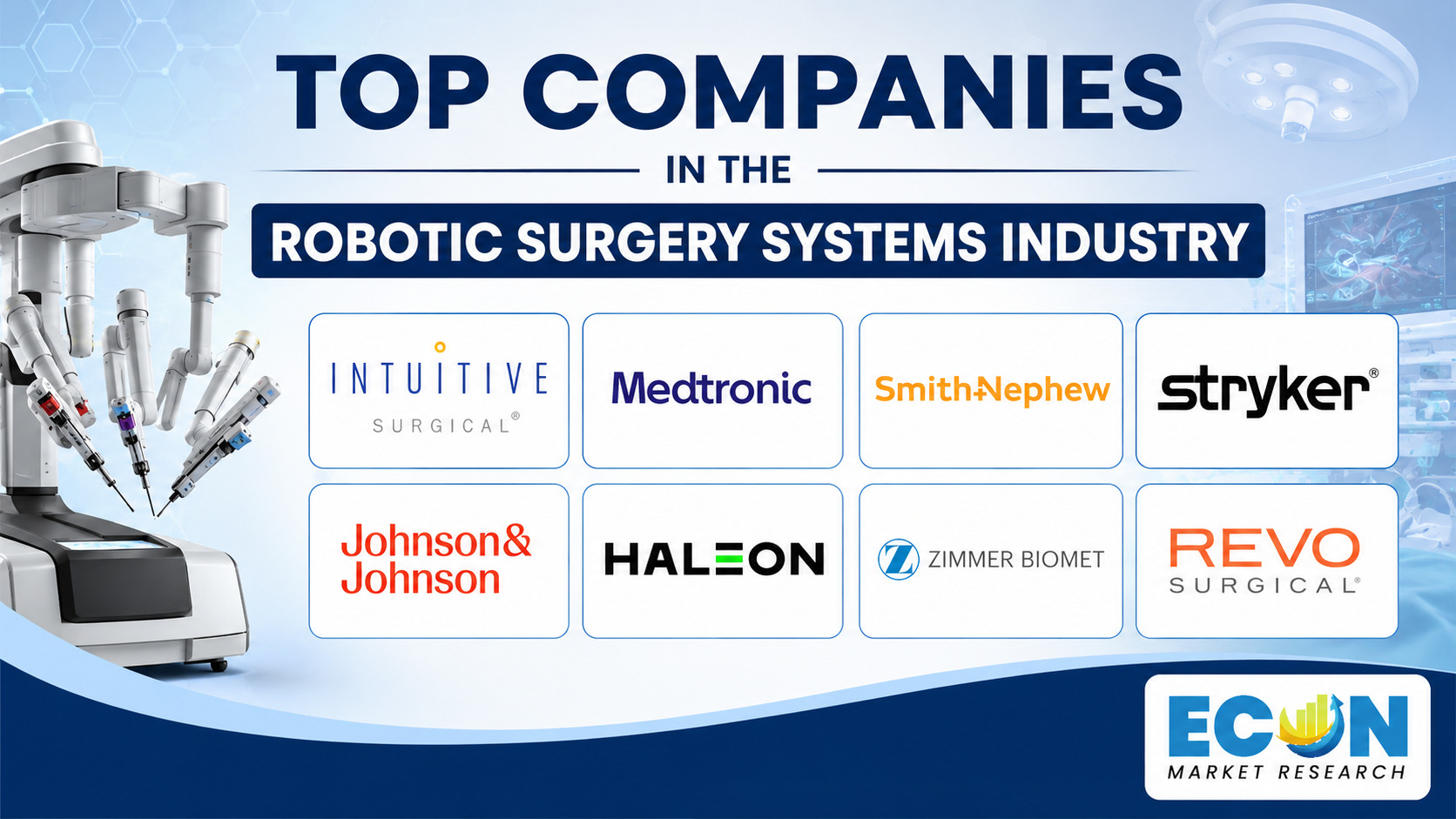
The following companies are presented without a strict ranking. Selection reflects active products, regulatory progress, technical capabilities, clinical deployment, procedure coverage, geographic reach, and relevance to robotic-assisted surgery.
1. Intuitive Surgical
Company Overview: Intuitive was founded in 1995 and is headquartered in Sunnyvale, California, United States. Its da Vinci installed base reached 11,710 systems by June 30, 2026, while the Ion endoluminal installed base reached 1,096 systems. Core Robotic Surgery Systems Expertise: The company develops multi-port, single-port, and endoluminal systems supported by articulated instruments, immersive 3D visualization, simulation, data analytics, and force sensing. Major Products and Services: Da Vinci 5, da Vinci Xi, da Vinci X, da Vinci SP, Ion, SimNow, and digital case-analysis tools form its principal portfolio. Surgeons performed 3.153 million da Vinci procedures during 2025, and the fifth-generation system provides 10,000 times the computing power of Xi with over 150 design innovations.
2. Medtronic
Company Overview: Medtronic was founded in 1949, maintains administrative headquarters in Dublin, Ireland, and operates from more than 350 locations in over 150 countries. Core Robotic Surgery Systems Expertise: Its robotics activities combine modular surgical arms, electrosurgery, stapling, vessel sealing, operating-room video, simulation, procedural data, and clinical training. Major Products and Services: The Hugo robotic-assisted surgery system uses independent arm carts, an open surgeon console, 3D visualization, and Touch Surgery digital capabilities. Hugo received FDA clearance in December 2025 for urological procedures including prostatectomy, nephrectomy, and cystectomy, which together account for an estimated 230,000 United States procedures annually. The first commercial United States Hugo case was completed at Cleveland Clinic in February 2026.
3. Johnson & Johnson MedTech
Company Overview: Johnson & Johnson was established in 1886 and is headquartered in New Brunswick, New Jersey, United States. Its surgical robotics development draws on more than 140 years of experience across surgical instruments, energy devices, stapling, and minimally invasive care. Core Robotic Surgery Systems Expertise: The company specializes in table-integrated soft-tissue robotics, multi-quadrant access, automatic arm positioning, surgical instruments, and operating-room workflow integration. Major Products and Services: OTTAVA incorporates 4 robotic arms into a standard-size operating table and requires 30% to 50% less operating-room space than referenced cart or boom configurations. In July 2026, the FDA granted De Novo authorization for 10 procedures, including gastrectomy, cholecystectomy, appendectomy, gastric bypass, and small-bowel resection.
4. Stryker
Company Overview: Stryker began operations in 1941 and had 56,000 employees across 61 countries at the end of 2025. The company reports that its technologies affect over 150 million patients annually. Core Robotic Surgery Systems Expertise: Stryker develops robotic-arm and handheld orthopedic systems combining CT-based planning, haptic control, implant integration, intraoperative navigation, and surgical power tools. Major Products and Services: Mako 4 supports total knee, partial knee, total hip, spine, and developing shoulder applications, while Mako RPS extends robotic execution to a handheld total-knee workflow. The Mako platform has supported over 2.5 million procedures in 47 countries during 20 years of use and is associated with more than 2,000 patents and patent applications.
5. Zimmer Biomet
Company Overview: Zimmer Biomet traces its history to 1927 and is headquartered in Warsaw, Indiana, United States. Core Robotic Surgery Systems Expertise: The company integrates orthopedic implants with image-free robotics, CT-based handheld systems, mixed-reality guidance, AI-assisted imaging, neurosurgical navigation, and recovery analytics. Major Products and Services: The ROSA portfolio includes ROSA Knee, ROSA Partial Knee, ROSA Hip, ROSA Shoulder, and ROSA ONE Brain. The platform was approaching 2,000 installations in 2025. Zimmer Biomet also offers TMINI and acquired Monogram Technologies in October 2025, adding a CT-based semi-autonomous total-knee system cleared in March 2025 and a surgeon-guided autonomous version undergoing clinical evaluation. ROSA Knee with OptimiZe obtained FDA clearance in November 2025.
6. Smith+Nephew
Company Overview: Smith+Nephew was founded in Hull, United Kingdom, in 1856 and employed 17,000 people across close to 100 countries in 2025. Core Robotic Surgery Systems Expertise: The company develops portable handheld robotics, image-free joint mapping, implant planning, soft-tissue balancing, navigation, and connected postoperative analytics. Major Products and Services: CORI supports total knee, partial knee, revision knee, and computer-guided hip applications. Smith+Nephew had installed over 1,100 CORI systems by December 2025, while 36% of its United States knee implants were placed using the system. CORI’s enhanced handpiece delivers twice the cutting volume and 29% faster resection, while the tracking system provides a 458% faster refresh rate compared with the referenced earlier configuration.
7. Globus Medical
Company Overview: Globus Medical was founded in 2003 and operates as a musculoskeletal technology company focused on spine, trauma, orthopedic implants, navigation, imaging, and robotics. Its United States headquarters is in Audubon, Pennsylvania. Core Robotic Surgery Systems Expertise: The company develops robotic navigation for spinal fixation, cranial procedures, real-time instrument tracking, powered drilling, implant planning, and imaging integration. Major Products and Services: ExcelsiusGPS combines a rigid robotic arm with surgical navigation and supports 3 imaging workflows. Surgeons use preoperative or intraoperative images to plan screw dimensions and trajectories before the robotic arm positions an instrument pathway. The Globus Power+ system connects navigated drilling, tapping, and screw-driving tools to the robotic platform while providing continuous depth information during instrument use.
8. CMR Surgical
Company Overview: CMR Surgical was founded in 2014 by 5 founders and is headquartered in Cambridge, United Kingdom. Versius had supported over 45,000 procedures in more than 30 countries by March 2026. Core Robotic Surgery Systems Expertise: The company focuses on modular soft-tissue robotics, open-console ergonomics, portable bedside units, wristed instrumentation, procedure analytics, simulation, and multi-specialty clinical training. Major Products and Services: Versius and Versius Plus support general, colorectal, gynecological, urological, and thoracic surgery in approved markets. Versius Plus received FDA clearance for cholecystectomy in December 2025, followed by a 2026 application for benign gynecological indications. Its compact architecture allows hospitals to move the system between operating rooms rather than maintaining 1 permanently dedicated robotic suite.
9. MicroPort MedBot
Company Overview: MicroPort MedBot began laparoscopic-robot development in 2014 and was formally established in Shanghai, China, in 2015. Core Robotic Surgery Systems Expertise: Its portfolio covers laparoscopic, orthopedic, endovascular, natural-orifice, and percutaneous robotics, supported by remote control, encrypted networking, intelligent imaging, and surgical training. Major Products and Services: Toumai surpassed 200 commercial orders across close to 50 countries by February 2026, with almost 130 systems installed. More than 96% of cumulative reported procedures involved Level III or Level IV complexity, and nearly 800 remote operations had been completed in over 20 countries. Additional platforms include SkyWalker for orthopedic surgery and Toumai SP for single-port procedures.
10. KARL STORZ
Company Overview: KARL STORZ was founded in 1945 in Tuttlingen, Germany, and employs 9,400 people in over 40 countries. Its portfolio includes 13,000 products and manufacturing locations in Germany, the United States, Switzerland, and Estonia. Core Robotic Surgery Systems Expertise: The company combines endoscopy, 3D and fluorescence visualization, integrated operating rooms, digital laparoscopy, augmented intelligence, and robotic instrument control. Major Products and Services: KARL STORZ acquired Asensus Surgical in August 2024, adding over 200 robotics specialists and the Senhance platform to its capabilities. Senhance incorporates eye-tracking camera control, haptic feedback, reusable instruments, and augmented-intelligence features. The second-generation LUNA system remains under development and had not received regulatory authorization at the time of the acquisition announcement.
Regional Outlook
North America
North America remains the most established commercial region for robotic surgery because the United States combines large procedure volumes, advanced hospital infrastructure, specialist training programs, and an active regulatory pathway. By June 2026, Intuitive’s global da Vinci installed base had reached 11,710 systems, with the United States representing its most developed procedure environment. The competitive landscape expanded between 2024 and 2026 as da Vinci 5, Dexter, Hugo, Versius Plus, enhanced ROSA technology, Mako RPS, and OTTAVA received clearances or commercial releases for defined applications. The FDA recognizes IEC 80601-2-77 Edition 1.1 as a safety and essential-performance standard for robotic surgical equipment.
United States adoption is divided between soft-tissue robots used in general surgery and urology, orthopedic platforms used for joint replacement, and navigation robots used in spinal and cranial procedures. Stryker’s Mako had supported 2.5 million procedures worldwide by 2026, Smith+Nephew reported that 36% of its United States knee implants were completed with CORI during 2025, and Medtronic identified 230,000 annual United States procedures covered by Hugo’s initial urology indication. Ambulatory surgical centers are attracting compact and handheld systems because they operate with smaller room footprints and high procedure turnover.
Canada has authorized robotic systems through its national medical-device framework, but adoption remains concentrated in academic and metropolitan hospitals. Mexico is developing through private hospital groups, teaching institutions, and direct distribution networks; KARL STORZ expanded its Mexican operating-room business in 2025. Regional challenges include training costs, differences between system models, instrument availability, cybersecurity, and the need to maintain adequate annual procedure volumes. The FDA specifically recommends model-specific training and post-market reporting because robotic systems differ in controls, instruments, indications, and failure modes.
Europe
Europe supports a diverse robotics ecosystem that includes CMR Surgical in the United Kingdom, Distalmotion and major orthopedic research activity in Switzerland, Moon Surgical in France, and KARL STORZ in Germany. Versius had supported 45,000 procedures across more than 30 countries by March 2026, while Zimmer Biomet’s ROSA platform achieved a large proportion of its close to 2,000 installations outside the United States. European hospitals use robotic systems in urology, colorectal surgery, gynecology, thoracic surgery, joint replacement, and spinal procedures. The region also provides extensive surgeon-training infrastructure through universities, national health systems, professional societies, and manufacturer-operated centers.
Regulatory compliance is a major competitive factor. Medical-device manufacturers must manage the EU Medical Device Regulation, notified-body review, clinical evidence, post-market surveillance, cybersecurity, and unique device identification. EUDAMED use became mandatory for relevant modules from May 28, 2026, increasing the importance of structured product, certificate, and vigilance data. Robotic systems also require compliance with electrical safety, software lifecycle, usability, risk management, and essential-performance standards. These requirements favor manufacturers with local regulatory teams and the capacity to maintain documentation across multiple product generations and approved indications.
Adoption differs across the United Kingdom, Germany, France, Italy, Spain, the Netherlands, and Nordic countries because procurement and reimbursement are managed through separate national systems. Public hospitals frequently require evidence of utilization, clinical outcomes, training, and total operating-room impact before expanding a robotic program. Compact systems can address this challenge by serving more than 1 department, while reusable instruments and lower-energy architectures may support hospital sustainability targets. Europe’s opportunity lies in multi-institution clinical registries, cross-border training, modular deployment, and robotic platforms designed for both tertiary hospitals and regional surgical centers.
Asia-Pacific
Asia-Pacific has become an important manufacturing, commercialization, and telesurgery region. China’s MicroPort MedBot recorded over 200 Toumai commercial orders across close to 50 countries by February 2026, with almost 130 installations completed. The company’s portfolio also includes orthopedic and endovascular platforms, reflecting China’s strategy of developing complete domestic surgical-robot ecosystems. China’s NMPA identified medical robots as a high-end medical-device priority in 2025 and committed to clearer classification, naming, component oversight, conditional approval, and whole-lifecycle regulation.
Japan maintains strong capabilities in precision mechanics, medical imaging, endoscopy, and industrial robotics. South Korea contributes advanced imaging, electronics, and hospital-based robotic research, while Singapore and Australia serve as early regulatory and clinical-evaluation markets for international platforms. India is expanding through imported systems and domestic development, with MicroPort MedBot recording 14 Toumai orders in India by February 2026. The region’s large population creates demand in urology, oncology, gynecology, joint replacement, and high-volume general surgery, but adoption remains concentrated in metropolitan hospitals with suitable training and maintenance infrastructure.
Telesurgery is particularly relevant across countries containing remote islands, large rural populations, and uneven specialist distribution. Toumai had completed nearly 800 remote procedures across over 20 countries, demonstrating technical feasibility under controlled clinical conditions. However, practical expansion requires reliable low-latency networks, local backup surgeons, cybersecurity, and nationally accepted liability rules. Asia-Pacific also faces supply-chain risks involving precision sensors, processors, optical components, sterilized instruments, and imported maintenance parts. Local manufacturing and regional training centers could reduce these constraints while enabling platforms to support thousands of hospitals outside capital cities.
Middle East & Africa
Robotic surgery adoption in the Middle East is centered on tertiary hospitals in Saudi Arabia, the United Arab Emirates, Qatar, Israel, and Turkey. Gulf healthcare systems are developing specialist centers in urology, oncology, gynecology, bariatric surgery, and orthopedics, creating demand for both soft-tissue and joint-replacement robots. The 6 Gulf Cooperation Council countries offer concentrated opportunities for supplier training programs and regional service hubs, but each jurisdiction maintains separate registration and purchasing requirements. International manufacturers commonly enter through flagship hospitals before expanding to additional facilities once sufficient procedure volume and trained teams are established.
The Middle East is also positioned to support telesurgery and remote mentoring because advanced hospitals are investing in 5G networks, digital imaging, and connected operating rooms. Toumai’s remote system had received approval in close to 10 countries by January 2026 and had performed over 700 procedures across more than 20 national markets at that stage. Israel and Turkey contribute surgical-technology research and training capabilities, while Saudi Arabia and the United Arab Emirates can serve as regional demonstration locations for newly authorized systems.
African deployment remains limited but is developing in Morocco, South Africa, Egypt, Angola, Kenya, and selected private hospital networks. MicroPort MedBot demonstrated remote Toumai procedures in Angola and has used international training partnerships to introduce robotic techniques in emerging markets. Barriers include inconsistent electricity, limited broadband, shortages of robotic surgeons, import dependence, and inadequate local maintenance capacity. Modular systems with 3-arm configurations, reusable instruments, remote diagnostics, and smaller room requirements may fit the region better than permanently installed platforms. Sustainable expansion will require at least 4 supporting elements: trained surgical teams, local technical service, sufficient procedure volumes, and national regulatory pathways.
Future Opportunities in the Robotic Surgery Systems Industry
The strongest future opportunity for the Top Companies in the Robotic Surgery Systems Industry lies in combining robotic control with clinically validated artificial intelligence. Current systems already capture instrument motion, camera position, tissue force, implant alignment, and procedural timing. Da Vinci 5 provides 10,000 times the computing power of Xi, while ROSA OptimiZe and CORIOGRAPH use patient-specific data to support surgical planning. Future applications may identify procedural stages, automate camera positioning, warn about instrument proximity, assess technical performance, and recommend workflow adjustments. These capabilities must remain within authorized indications and under surgeon control because the FDA states that current robotic systems cannot perform surgery independently.
Orthopedic robotics offers opportunities in revision surgery, shoulder replacement, spine, and autonomous bone preparation. Zimmer Biomet acquired Monogram Technologies after its semi-autonomous total-knee platform received FDA clearance in March 2025, and a surgeon-guided autonomous version remains under clinical study. Stryker is extending Mako from hip and knee procedures into spine and shoulder applications, while Smith+Nephew has expanded CORI into revision knee and computer-guided hip workflows. These developments indicate that future competition will involve procedural breadth and implant compatibility rather than a single primary joint application.
Access models will also evolve. Portable robots, per-procedure agreements, leasing, shared-service programs, and regional training centers can help smaller hospitals adopt technology without maintaining 1 dedicated robotic operating room. Telesurgery may eventually connect specialists with remote hospitals, but verified deployment will require redundant networks and a complete local surgical team. Sustainability will influence instrument reuse, packaging, energy consumption, and equipment lifecycle management. The FDA’s transition to the updated IEC robotic-equipment standard by July 2, 2028 will also encourage manufacturers to modernize safety engineering, essential-performance testing, and technical documentation.
Conclusion
The Top Companies in the Robotic Surgery Systems Industry now compete across soft-tissue surgery, orthopedics, spine, neurosurgery, endoluminal care, and connected operating-room technology. Intuitive maintained 11,710 da Vinci systems by June 2026, Stryker supported 2.5 million Mako procedures in 47 countries, Zimmer Biomet approached 2,000 ROSA installations, Smith+Nephew exceeded 1,100 CORI placements, CMR Surgical reached 45,000 Versius procedures, and MicroPort MedBot secured more than 200 Toumai orders. These figures show that robotic surgery is no longer represented by 1 platform architecture or 1 clinical specialty.
The 5 major trends—modular systems, AI-enabled guidance, handheld orthopedic robotics, force feedback, and telesurgery—are shifting competition toward workflow performance and measurable clinical integration. North America remains the deepest commercial market, Europe combines strict regulation with a strong development ecosystem, Asia-Pacific is expanding domestic production and remote surgery, and the Middle East and Africa are building focused programs around specialist hospitals. Future success will depend on surgeon training, cybersecurity, service availability, validated outcomes, and compliance with standards extending through 2028. Robotic technology will deliver sustainable clinical value when it augments human expertise without obscuring the surgeon’s responsibility for every procedure.