


Top Companies in the Machine Identity Management Industry
The article profiles top machine identity management companies, their certificate platforms, key products, regional presence, and future industry opportunities.
Introduction
Overview of the Global Machine Identity Management Industry
Machine identity management has moved from a niche PKI discipline into a core enterprise security function, driven by a workload population that now dwarfs the human workforce. Industry research published in 2026 found that organizations manage an average of 109 machine identities for every human identity, with certificates, tokens, keys, and secrets authenticating service accounts, containers, APIs, and a growing population of AI agents.
A 2026 Ponemon-Sullivan study reported an average of 114,591 internal certificates under management per organization, and more than 8,000 unique machine certificate types are now tracked across enterprise platforms. Financial services, healthcare, government, telecommunications, and cloud-native technology companies remain the heaviest adopters, reflecting the concentration of regulated data and distributed infrastructure in these sectors.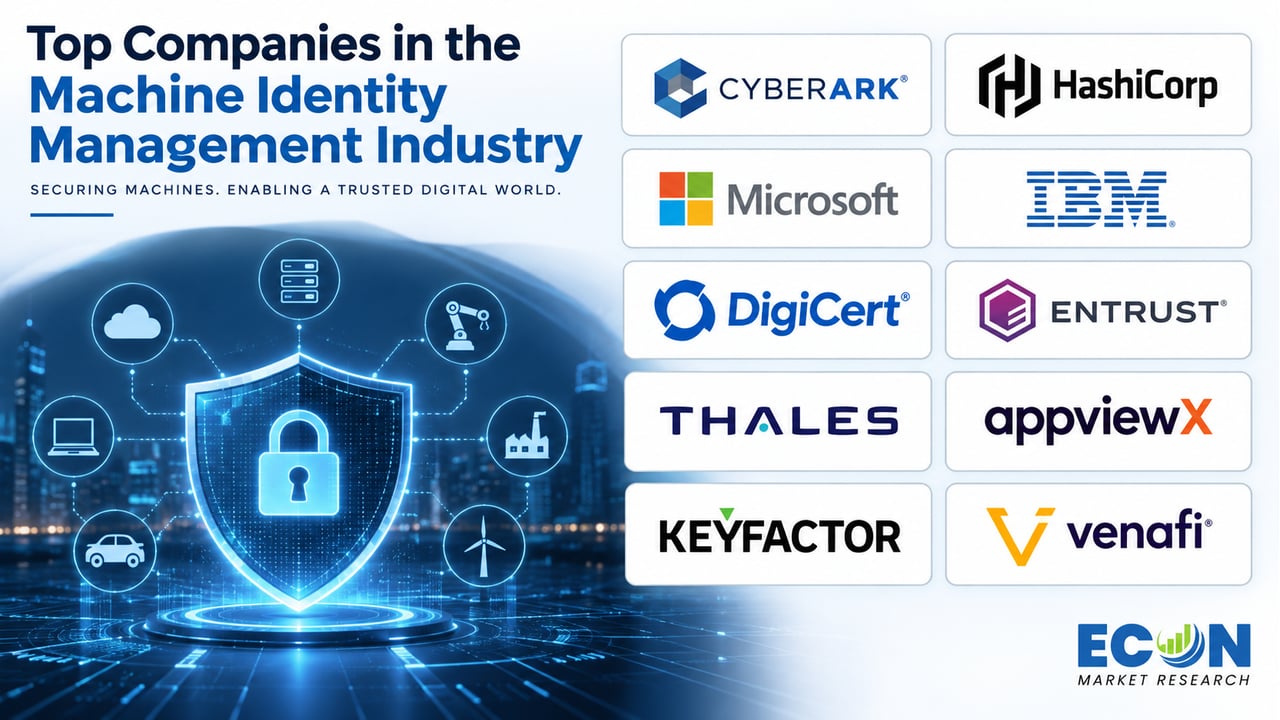
Market Evolution and Growth Drivers
The discipline has evolved from manual certificate spreadsheets into automated, API-driven platforms because manual processes can no longer keep pace with certificate volume or the shrinking validity windows regulators now require. The CA/Browser Forum's SC-081v3 ballot, approved on April 11, 2025, with 25 votes in favor and none against, will cut the maximum public TLS certificate lifespan from 398 days to 200 days as of March 15, 2026, to 100 days on March 15, 2027, and to 47 days by March 15, 2029.
NIST finalized three post-quantum cryptography standards in August 2024: ML-KEM (FIPS 203), ML-DSA (FIPS 204), and SLH-DSA (FIPS 205) closing an eight-year evaluation process and giving vendors a fixed algorithmic target. The NSA's CNSA 2.0 suite requires new national security systems to support quantum-safe algorithms by January 2027, with full migration due by 2035, a timeline now shaping enterprise cryptographic-agility roadmaps as well.
Top 5 Latest Trends in the Machine Identity Management Industry
Non-Human and AI Agent Identity Governance
Short-Lived Certificates and Automated Lifecycle Management
Post-Quantum Cryptography Readiness
Secrets Management Convergence with Certificate and Key Management
Sovereign and Region-Specific Digital Identity Frameworks
Trend 1: Non-Human and AI Agent Identity Governance
The proliferation of autonomous AI agents has forced identity vendors to treat non-human identity as a distinct governance category rather than an extension of privileged access management. Palo Alto Networks' 2026 Identity Security Landscape report, based on a survey of 2,930 cybersecurity decision-makers, found that machine identities now outnumber human identities 109 to 1 and are projected to grow 77% over the next 12 months, with AI agent identities alone expected to grow 85%.
The same research found that roughly 90% of organizations experienced at least one identity-related breach in the past year. In response, Microsoft made its Entra Agent ID platform generally available in April 2026, introducing purpose-built identity constructs and OAuth flows specifically for AI agents. This trend matters because organizations that fail to inventory and govern agent identities face a rapidly expanding, largely invisible attack surface.
Trend 2: Short-Lived Certificates and Automated Lifecycle Management
Regulatory pressure has made certificate automation a operational necessity rather than a convenience. Under the CA/Browser Forum's phased schedule, an organization managing 1,000 public TLS certificates that once performed two or three renewals a month will need to perform roughly 21 renewal operations every business day once the 47-day validity period takes effect in 2029. Domain Control Validation reuse periods fall in parallel, from 398 days down to just 10 days by the same date. This shift, which became commercially significant with the first 200-day milestone on March 15, 2026, is pushing enterprises toward certificate lifecycle automation platforms capable of processing thousands of renewals without manual intervention, since outages caused by expired certificates carry direct operational and reputational cost.
Trend 3: Post-Quantum Cryptography Readiness
Quantum-safe migration has become a concrete engineering project rather than a theoretical concern since NIST finalized FIPS 203, 204, and 205 in August 2024 after evaluating 82 candidate algorithms submitted by researchers from 25 countries. The NSA's CNSA 2.0 timeline requires quantum-safe algorithms in all new national security systems by January 2027 and complete infrastructure migration by 2035, while France's ANSSI has stated that from 2027 products will not receive French cybersecurity certification without post-quantum support. Vendors including Keyfactor have already updated open-source PKI tools such as EJBCA and SignServer to support NIST-standardized post-quantum algorithms. Because certificates and keys are the artifacts that must be reissued under new algorithms, machine identity platforms sit directly on the critical path of this multi-year migration.
Trend 4: Secrets Management Convergence with Certificate and Key Management
Enterprises increasingly expect a single control plane for certificates, cryptographic keys, and DevOps secrets rather than three separate tools. Providers such as Akeyless, founded in 2018 and headquartered with operations in Tel Aviv-Yafo and New York, market a unified secrets and machine identity platform combining vaultless secrets management, certificate lifecycle management, secure remote access, and encryption key management in one product.
HashiCorp's Vault, in production since 2012 and now an IBM subsidiary following a $6.4 billion acquisition completed in February 2025, similarly spans secrets management alongside certificate issuance for dynamic cloud workloads. This convergence reflects the operational reality that a single container or serverless function may require API keys, database credentials, and X.509 certificates simultaneously, and managing these separately multiplies the chance of a missed rotation.
Trend 5: Sovereign and Region-Specific Digital Identity Frameworks
Governments are increasingly building or mandating national digital trust infrastructure that machine identity vendors must plug into. The European Union's eIDAS 2.0 regulation, formally Regulation (EU) 2024/1183, requires all 27 member states to make a certified European Digital Identity Wallet available to citizens and residents by December 2026, following four large-scale pilot programs involving more than 360 organizations across 26 member states.
India's Controller of Certifying Authorities, operating under the IT Act 2000 since November 1, 2000, continues to update its PKI guidelines, including Identity Verification Guidelines revised in February 2026. This trend will influence product roadmaps because certificate authorities and machine identity platforms must certify against an expanding set of national and regional trust frameworks rather than a single global standard.
Top 10 Companies in the Machine Identity Management Industry
The following companies are presented based on product capabilities, technical expertise, geographic presence, innovation, and deployment scale rather than a strict ranking, since verifiable market-share data at the company level is limited.
1. CyberArk
Company Overview: CyberArk has expanded into machine identity through its acquisition of Venafi, a category-creating vendor in machine identity management, which closed on October 1, 2024, after being announced on May 20, 2024. The combined company serves customers across financial services, healthcare, government, and technology sectors.
Headquarters: Newton, Massachusetts, United States, with a co-headquarters function in Petach Tikva, Israel.
Core Machine Identity Management Expertise: CyberArk's platform orchestrates cryptographic keys and digital certificates across SSL/TLS, SSH, code signing, mobile, and IoT identity types, providing global visibility into machine identities across on-premises, virtual, cloud, and IoT environments.
Major Products and Services: The company's Machine Identity Security offering, expanded in 2026 with enhanced workload identity protection and automated certificate lifecycle management, addresses machine identities across hybrid and multi-cloud environments. It integrates with CyberArk's broader identity security suite, which also spans privileged access management for human identities.
2. Keyfactor
Company Overview: Founded in 2001 in Cleveland, Ohio, as a professional services firm, Keyfactor shifted to a product-centric software model in 2014 and rebranded the following year. The company employs approximately 357 people and serves enterprises managing certificate inventories at scale.
Headquarters: Independence, Ohio, United States.
Core Machine Identity Management Expertise: Keyfactor specializes in PKI-as-a-Service and certificate lifecycle automation, combining decades of hands-on PKI consulting experience with software that discovers, controls, and automates keys and certificates.
Major Products and Services: Its platform includes cryptographic APIs, a Secure Execution Environment, and Identity Authority Manager, alongside the open-source EJBCA and SignServer tools acquired through its 2021 purchase of PrimeKey. In 2026, Keyfactor updated EJBCA 9.1 and SignServer 7.1 Community Editions to support NIST-standardized post-quantum cryptography algorithms, and it partners with hardware security module maker Utimaco to integrate HSM appliances with its certificate management stack.
3. AppViewX
Company Overview: Founded in 2008, AppViewX has grown to roughly 516 employees operating from offices in New York, Seattle, London, Coimbatore, and Chennai. The company states that six of the top 10 global banks and five of the top 10 healthcare providers use its platform.
Headquarters: New York, New York, United States.
Core Machine Identity Management Expertise: AppViewX focuses on automated certificate lifecycle management and PKI operations, providing abstraction and standardization across X.509 certificates, SSH keys, and related cryptographic technologies.
Major Products and Services: Its CERT+ suite simplifies certificate management with centralized policy enforcement and self-service PKI, while its ADC+ product automates application delivery controller lifecycle management across on-premises, cloud, and container environments. The platform distributes through a network described as vendor-agnostic across hybrid infrastructure.
4. Sectigo
Company Overview: Tracing its roots to Comodo CA, founded in 1998, the company rebranded as Sectigo in 2018 following its 2017 carve-out acquisition by Francisco Partners. Sectigo has issued more than 100 million SSL certificates across more than 200 countries and serves a network of over 2,700 partners.
Headquarters: Scottsdale, Arizona, United States (with an earlier corporate address in Roseland, New Jersey).
Core Machine Identity Management Expertise: As one of the longest-established commercial certificate authorities, Sectigo specializes in automated, cloud-native certificate lifecycle management issued and managed across multiple certificate authorities, not solely its own.
Major Products and Services: The Sectigo Certificate Manager platform issues and manages public and private digital certificates across a single dashboard, and in January 2025 Sectigo acquired Entrust's public certificate business, completing customer migration to its own platform by September 29, 2025. Sectigo has filed 8 patents and holds certifications tied to CA/Browser Forum, ETSI, and PCI-DSS standards.
5. DigiCert
Company Overview: Founded in 2003, DigiCert has grown to between 1,001 and 5,000 employees and serves e-commerce companies, government agencies, financial institutions, and healthcare organizations globally.
Headquarters: Lehi, Utah, United States.
Core Machine Identity Management Expertise: DigiCert combines high-assurance public certificate issuance with CA-agnostic private PKI services, positioning itself around unified digital trust rather than certificates alone.
Major Products and Services: Its Trust Lifecycle Manager, introduced in January 2023, unifies certificate discovery, automation, and integration with private certificate issuance for users, devices, and servers, deployable in cloud, on-premises, or hybrid configurations. The platform supports SCEP-based mobile device management integrations with tools such as Intune and Kandji for automated certificate enrollment.
6. HashiCorp
Company Overview: Founded in 2012 by Mitchell Hashimoto and Armon Dadgar, HashiCorp grew to approximately 2,200 employees before its acquisition by IBM for $6.4 billion closed on February 27, 2025.
Headquarters: San Francisco, California, United States (operating as an IBM subsidiary).
Core Machine Identity Management Expertise: HashiCorp's expertise centers on dynamic secrets and certificate issuance for ephemeral cloud-native workloads, integrating identity into infrastructure-as-code and service networking rather than treating certificates as a standalone discipline.
Major Products and Services: Vault, in production for over a decade, provides secrets management, encryption, and dynamic certificate issuance; Consul extends this into service networking with mutual TLS between services. IBM has stated its intent to integrate HashiCorp's capabilities across Red Hat, watsonx, and its broader IT automation and data security portfolio, and nearly 75% of enterprises now operate in hybrid cloud environments that these tools are designed to secure.
7. Akeyless
Company Overview: Founded in 2018 by Oded Hareven, Shai Onn, and Refael Angel, Akeyless has raised approximately $80 million through its Series B round and operates with roughly 92 to 108 employees.
Headquarters: Tel Aviv-Yafo, Israel, with a U.S. office in New York.
Core Machine Identity Management Expertise: Akeyless applies proprietary Distributed Fragments Cryptography, a patent-pending technique, to deliver a SaaS-based root of trust without a centralized vault, aiming to reduce the attack surface associated with traditional secrets storage.
Major Products and Services: Its Unified Secrets and Machine Identity Platform integrates vaultless secrets management, certificate lifecycle management, secure remote access positioned as next-generation privileged access management, and encryption key management. The company states its platform is trusted by Fortune 100 companies and uses FIPS-certified virtual HSM technology.
8. Entrust
Company Overview: Entrust traces its lineage to Datacard Corporation, founded in 1969, and Entrust Inc., founded in 1994 as a spin-out from Bell-Northern Research; the combined entity rebranded as Entrust in 2020. The company employs around 3,000 people and serves customers in more than 150 countries.
Headquarters: Shakopee, Minnesota, United States.
Core Machine Identity Management Expertise: Entrust combines PKI, hardware security modules, and certificate and key lifecycle management, and it maintains recognized status as a WebTrust-audited certificate authority alongside its identity verification business.
Major Products and Services: Its Certificate Authority software supports post-quantum readiness, including ML-DSA for certificate authority key generation and revocation list signing and ML-KEM for encryption, without disrupting deployed infrastructure. Entrust sold its public certificate authority business to Sectigo in January 2025 while continuing to offer private and managed PKI software, and its nShield hardware security module line remains a core product following the 2019 acquisition of nCipher.
9. SSH Communications Security
Company Overview: Founded in 1995 by Tatu Ylönen, the inventor of the Secure Shell protocol, the company has grown to roughly 140 to 531 employees depending on reporting basis and serves more than 3,000 customers, including 25% of Fortune 100 companies.
Headquarters: Helsinki, Finland, with additional offices in New York and Singapore.
Core Machine Identity Management Expertise: The company specializes in certificate-based, ephemeral privileged access and secure communications for machine-to-machine and human-to-machine connections, an area closely tied to SSH key sprawl management within machine identity programs.
Major Products and Services: Its PrivX platform, in development since around 2017, delivers just-in-time, agentless privileged access management with secret vault capabilities and CI/CD pipeline integrations. In 2026, SSH announced expanded support for agentic AI access security and non-human identity governance within PrivX, and Italian aerospace and defense group Leonardo S.p.A. invested 20 million euros in the company, becoming its largest shareholder.
10. Palo Alto Networks
Company Overview: Palo Alto Networks has expanded from network security into identity governance, publishing its 2026 Identity Security Landscape report based on a survey of 2,930 global cybersecurity decision-makers.
Headquarters: Santa Clara, California, United States.
Core Machine Identity Management Expertise: The company applies cloud infrastructure entitlement management and identity threat detection specifically to non-human identities, including service accounts, automation roles, APIs, and AI workloads that the company's research indicates traditional tools often miss.
Major Products and Services: Its Idira identity security platform, generally available since May 12, 2026, addresses machine and agent identity discovery, dynamic access controls, and just-in-time privilege. Cortex Cloud, its cloud security platform, was named a Leader and Outperformer in a 2026 industry radar for cloud infrastructure entitlement management, and the company's Next-Generation Trust Security offerings extend into quantum-safe security for machine identities.
Regional Outlook
North America
North America remains the largest concentration of machine identity management deployment activity, anchored by the presence of major certificate authorities, cloud hyperscalers, and financial institutions that manage some of the largest certificate inventories in the world. The United States hosts the headquarters of at least seven of the ten companies profiled above, including CyberArk's Massachusetts base, Keyfactor and Sectigo's Ohio and Arizona operations, and DigiCert's Utah headquarters, reflecting decades of concentrated PKI and certificate authority expertise. Regulatory pressure is intensifying: the CA/Browser Forum, whose 30 voting members include major U.S.-headquartered certificate authorities and browser vendors such as Google, Apple, and Microsoft, approved the phased reduction of TLS certificate lifespans to 200 days from March 15, 2026, directly affecting every organization operating a public-facing website in the region.
Government adoption is a significant driver. NIST's finalization of three post-quantum cryptography standards in August 2024 and the NSA's CNSA 2.0 mandate, requiring quantum-safe algorithms in new national security systems by January 2027 and full infrastructure migration by 2035, are pushing U.S. federal agencies and their contractors toward accelerated certificate and key rotation programs. Canada and Mexico follow U.S. regulatory cues more loosely, with adoption concentrated among multinational subsidiaries and financial institutions that must comply with cross-border data protection requirements; Canadian federal guidance increasingly references the same NIST algorithm suite used domestically in the United States.
Workforce capability in the region is substantial, with established PKI engineering talent clustered around long-standing certificate authority operations in the Midwest and Southwest United States, alongside cloud security specialists concentrated in California and the Pacific Northwest. Challenges include the sheer scale of legacy certificate inventories inherited from decades of manual PKI operations the 114,591 average internal certificates per organization reported by the 2026 Ponemon-Sullivan study is a North American-weighted figure and the operational disruption risk created by compressed renewal cycles. Opportunities lie in automating these legacy environments before the 47-day certificate validity mandate takes full effect in March 2029, and in expanding machine identity governance to cover the fast-growing population of AI agents now being deployed across U.S. enterprises.
Europe
Europe's machine identity management landscape is shaped heavily by regulation, most notably eIDAS 2.0, formally Regulation (EU) 2024/1183, which entered into force on May 20, 2024, and requires all 27 EU member states to make at least one certified European Digital Identity Wallet available to citizens and residents by December 2026. Four large-scale pilot programs involving more than 360 organizations across 26 member states have tested wallet prototypes covering payments, travel, education credentials, and digital signatures, and member state readiness varies considerably: Germany has targeted its state wallet for early January 2027, France plans public testing in the second half of 2026, and Poland is integrating the wallet into its existing mObywatel digital identity application.
Country-level activity extends well beyond the wallet initiative. Qualified Trust Service Providers across the bloc face a re-certification challenge tied to 2025 implementing acts that set binding reference standards for qualified certificates, remote signature device management, and timestamps, with remote identity proofing required to comply with newly certified requirements since May 2026. Germany, the United Kingdom, France, and the Nordic countries maintain some of the region's most mature public key infrastructure ecosystems, supported by national certificate authorities and research programs tied to the European Union Agency for Cybersecurity's post-quantum cryptography guidance, which parallels NIST's August 2024 standards.
Sustainability and industrial standards intersect with machine identity through data-center efficiency requirements embedded in EU digital infrastructure policy, though the primary driver remains regulatory compliance rather than environmental targets. Manufacturing capacity for hardware security modules and smart card-based credentials remains concentrated in a handful of specialized European vendors, creating a moderate supply-chain dependency for national digital identity programs. Regional challenges include the uneven pace of member-state wallet readiness fewer than a third of member states currently meet Commission-defined readiness benchmarks and the compliance burden facing regulated enterprises that must prepare to accept EUDI Wallet authentication roughly 12 months after the December 2026 issuance deadline. Opportunities include the emergence of a genuinely interoperable, cross-border digital trust framework that machine identity vendors can integrate against, reducing the current fragmentation across 27 distinct national implementations.
Asia-Pacific
Asia-Pacific's machine identity management activity is driven by large-scale national digital identity programs and rapid cloud adoption across manufacturing and financial services. India's Controller of Certifying Authorities, established under section 17 of the Information Technology Act, 2000, and operational since November 1, 2000, continues to expand its national PKI framework through licensed Certifying Authorities operating under the Root Certifying Authority of India. The CCA published updated Interoperability Guidelines for Digital Signature Certificates in February 2026 and revised Identity Verification Guidelines the same month, reflecting continuous modernization of the country's certificate ecosystem, which underpins both government e-governance services and the Aadhaar-linked eSign framework used for identity verification.
China, Japan, South Korea, and Singapore represent the region's most mature technology adoption markets, with Japan's government cybersecurity strategy emphasizing secure cryptographic solutions and hardware-based security modules across manufacturing, transportation, and healthcare sectors. Manufacturing ecosystems across the region, particularly in East and Southeast Asia, increasingly require machine identity for IoT device authentication as industrial automation expands; export-oriented electronics and automotive manufacturers are early adopters of certificate-based device identity to meet international customer security requirements. Government initiatives supporting digital public infrastructure, following patterns established by India's Aadhaar system, are extending into other Southeast Asian markets, creating new addressable demand for certificate lifecycle automation vendors.
Workforce availability for PKI and cryptographic engineering is growing but remains concentrated in a handful of technology hubs, including Bangalore, Singapore, and Tokyo, where several of the profiled vendors, including AppViewX, maintain research and development operations. Research activity is increasingly tied to post-quantum cryptography, mirroring the NIST standardization timeline, as regional certificate authorities plan algorithm transitions. Supply-chain strengths include the region's dominant position in semiconductor and IoT device manufacturing, which creates natural demand for embedded machine identity, though this concentration also creates risk if geopolitical trade tensions disrupt cross-border technology transfer. Country-specific opportunities include expanding certificate automation into India's rapidly growing digital payments and government services sector and supporting Japan's industrial automation initiatives with quantum-readiness services ahead of the NSA's 2035 full-migration deadline referenced by regional government contractors.
Middle East & Africa
Digital identity infrastructure in the Middle East has developed around large national identity programs that predate much of today's machine identity management market. Saudi Arabia's national digital identity platform, operated through the National Information Center under the Ministry of Interior, targets 60 million users and continues to expand physical and digital identity infrastructure across government services. The country's National Cybersecurity Authority reported maintaining its leadership position in a global cybersecurity ranking for the third consecutive year as of mid-2026, reflecting sustained government investment in digital trust infrastructure across the Gulf Cooperation Council.
The United Arab Emirates has built its national digital identity program, UAE Pass, on PKI foundations dating back to Emirates Identity Authority initiatives from 2011, and the country's 2026 CyberFirst UAE Summit highlighted a nearly 40% year-on-year rise in cyber incidents across the GCC, underscoring growing demand for automated machine identity controls. The UAE Cyber Security Council has partnered with technology providers to establish dedicated centers focused on post-quantum cryptography and quantum key distribution, positioning the country among the region's more advanced adopters of quantum-readiness planning. Qatar and Israel maintain smaller but technically sophisticated digital identity ecosystems, with Israel in particular serving as headquarters or co-headquarters for machine identity vendors including CyberArk and Akeyless.
South Africa, Egypt, Kenya, and Nigeria represent earlier-stage markets where national digital transformation programs are beginning to incorporate PKI and certificate-based authentication, though infrastructure gaps and import dependence on foreign hardware security modules remain common barriers. Skills shortages in cryptographic engineering are more pronounced across the African continent than in the Gulf states, slowing the pace of automated certificate lifecycle adoption even where government mandates exist on paper. Regional barriers also include climate-related infrastructure resilience concerns for data centers in parts of the Gulf and inconsistent regulatory harmonization across the more than 15 countries typically grouped under Middle East and Africa reporting. Opportunities include extending Gulf state digital identity investment models to broader public-sector and industrial diversification programs, and positioning certificate lifecycle automation as a foundational layer for the region's expanding smart city and energy sector digitization initiatives.
Future Opportunities in the Machine Identity Management Industry
The clearest near-term opportunity lies in automating certificate operations ahead of the CA/Browser Forum's binding deadlines, with the 100-day maximum validity period taking effect March 15, 2027, and the 47-day period following on March 15, 2029; vendors that can demonstrate reliable automated renewal at scale will be positioned to capture demand from organizations currently relying on manual or semi-automated processes. Post-quantum cryptography migration represents a second major opportunity, as NIST's August 2024 standards and the NSA's CNSA 2.0 deadlines, including full national security system migration by 2035, create a multi-year window during which every certificate authority and enterprise PKI must be re-architected for hybrid or fully quantum-safe algorithms.
AI agent identity governance is an emerging application area with substantial headroom: Palo Alto Networks' 2026 research projects AI agent identities to grow 85% within 12 months, and Microsoft's April 2026 general availability release of Entra Agent ID signals that major platform vendors are only beginning to build purpose-built controls for this category. Vendors that extend existing certificate and secrets management platforms to cover agent-specific authentication and authorization stand to address a genuinely new identity class rather than merely automating an existing one.
Cloud and edge technology adoption continues to expand the addressable surface for machine identity vendors, particularly as containerized and serverless architectures multiply the number of short-lived workloads requiring dynamic certificate issuance. Regulatory compliance tied to eIDAS 2.0's December 2026 wallet deadline in the European Union and evolving national PKI frameworks in India and the Gulf states will likely sustain demand for vendors capable of certifying against multiple regional trust frameworks simultaneously. New geographic markets, particularly in Southeast Asia and parts of Africa where national digital identity programs remain early-stage, offer expansion opportunities for vendors willing to adapt products to local regulatory and infrastructure conditions. Small and medium-sized enterprises, historically underserved by enterprise-grade PKI tooling, represent a further growth segment as SaaS-delivered, vaultless secrets and certificate platforms lower the operational complexity previously required to run PKI in-house. These are analytical expectations based on current regulatory timelines and reported adoption trends rather than guaranteed outcomes, and actual adoption speed will depend on enterprise budget cycles and the pace of AI agent deployment across industries.
Conclusion
Machine identity management has become a foundational security discipline as machine identities now outnumber human identities by a ratio of 109 to 1 according to 2026 industry research, with organizations managing an average of 114,591 internal certificates and more than 8,000 distinct certificate types. The five trends outlined above non-human and AI agent identity governance, short-lived certificate automation, post-quantum cryptography readiness, secrets management convergence, and sovereign digital identity frameworks are each tied to concrete regulatory deadlines, including the CA/Browser Forum's phased reduction to 47-day certificate lifespans by March 2029 and the NSA's 2035 post-quantum migration deadline for national security systems.
The ten companies profiled, spanning established certificate authorities such as Sectigo and DigiCert, converged secrets and identity platforms from CyberArk, Keyfactor, AppViewX, HashiCorp, and Akeyless, credential infrastructure specialists Entrust and SSH Communications Security, and newer entrants like Palo Alto Networks extending into machine and agent identity governance, illustrate the breadth of technical approaches now competing in this space. Regional dynamics differ meaningfully: North America benefits from concentrated PKI expertise and hyperscaler presence, Europe is being reshaped by the eIDAS 2.0 wallet mandate ahead of its December 2026 deadline, Asia-Pacific is scaling through national identity programs such as India's CCA framework, and the Middle East is investing heavily in sovereign digital identity and post-quantum readiness. Looking ahead, the strongest opportunities for major companies in the machine identity management industry lie in AI agent governance, automated certificate lifecycle management, and post-quantum migration services, each grounded in verified regulatory timelines rather than speculative demand, positioning the sector for continued technical evolution through the remainder of the decade.
Want this saved as a downloadable Word document or Markdown file instead of staying here in the chat?