


Liquid Biopsy Companies Advancing Precision Oncology
The liquid biopsy industry is advancing cancer screening, genomic profiling, MRD detection, companion diagnostics, and blood-based treatment monitoring.
Introduction
Overview of the Global Liquid Biopsy Industry
The liquid biopsy industry uses blood, urine, cerebrospinal fluid, pleural fluid, and other biological samples to detect circulating tumour DNA, circulating tumour cells, extracellular vesicles, RNA, proteins, and epigenetic signals associated with cancer. Its clinical applications include comprehensive genomic profiling, companion diagnostics, treatment selection, therapy-response monitoring, molecular residual disease detection, recurrence surveillance, and cancer screening. Global demand is supported by a cancer burden that produced 20 million new cases and 9.7 million deaths in 2022, while 53.5 million people were alive within 5 years of a cancer diagnosis. These figures create a large population requiring repeated testing across diagnosis, treatment, remission, and surveillance.
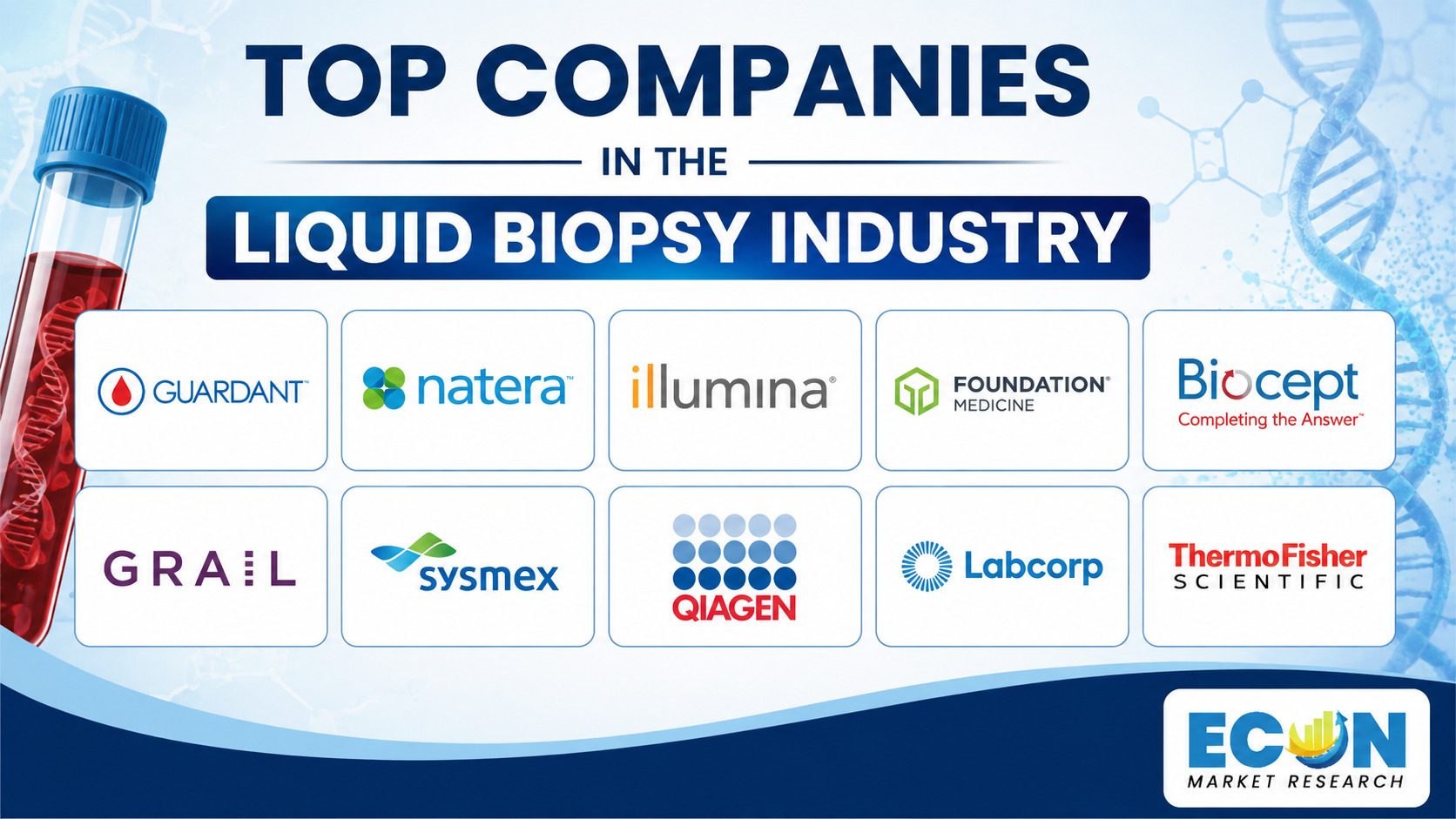
The Top Companies in the Liquid Biopsy Industry operate through central reference laboratories, hospital laboratories, sequencing platforms, digital PCR systems, sample-preparation kits, companion diagnostic partnerships, and direct physician-ordering networks. Guardant Health secured FDA approval for Shield in 2024, Foundation Medicine’s blood-based comprehensive genomic profiling assay evaluates 324 genes, Natera has processed over 16 million tests across its cell-free DNA portfolio, and GRAIL’s NHS study enrolled 140,000 participants. Liquid biopsy has therefore progressed beyond small research cohorts into regulated diagnostics and population-scale clinical studies, although adoption still differs by cancer type, tumour shedding level, laboratory infrastructure, reimbursement, and regulatory status.
Liquid biopsy does not eliminate the need for tissue pathology, imaging, colonoscopy, or confirmatory diagnostic procedures. Shield is authorised for average-risk adults aged 45 years and older but requires colonoscopic follow-up after a positive result. Some tumours release limited ctDNA, particularly at an early stage, and non-cancerous clonal haematopoiesis can create variants that require careful bioinformatic filtering. The industry’s competitive structure consequently includes companies focused on complete clinical tests and companies supplying sequencing, PCR, extraction, automation, and analytical infrastructure to laboratories that develop their own assays.
Market Evolution and Growth Drivers
The commercial evolution of liquid biopsy has followed 3 stages. Early assays concentrated on known mutations such as EGFR and RAS in advanced cancers. The second stage expanded to multi-gene next-generation sequencing panels for treatment selection, including the 2020 FDA approval of FoundationOne Liquid CDx. The third stage now includes molecular residual disease, multi-cancer detection, and blood-based population screening. Shield received FDA approval on July 26, 2024, and Guardant360 Liquid CDx gained approval in May 2026 with a genomic and epigenomic footprint reported as 100 times broader than the preceding Guardant360 CDx panel.
Technology improvements are increasing sensitivity while reducing sample and workflow requirements. Thermo Fisher’s Oncomine Precision Assay can use 10 ng of DNA or RNA and profile 50 cancer-related genes from tissue or liquid biopsy samples. Bio-Rad mutation assays can detect variant fractions of 0.5% or lower, while multi-well strategies can reach ranges between 0.005% and 0.1%. Illumina’s TruSight Oncology 500 ctDNA v2 analyses 523 genes and can complete its workflow in 2.5 to 4 days. These capabilities allow laboratories to examine rare variants that may be missed when tumour-derived DNA represents only a small fraction of total cell-free DNA.
Clinical demand is also being driven by the limitations of tissue acquisition. Illumina has reported that sufficient tissue may be unavailable in up to 25% of relevant cases, while repeated surgery or needle biopsy can be impractical for longitudinal monitoring. The projected global cancer burden strengthens this requirement: annual cases are expected to reach 35 million by 2050, representing a 77% increase from 2022. Liquid biopsy offers a repeatable sampling model that can track molecular changes across multiple treatment cycles, but clinical interpretation must remain linked to tumour biology, imaging, pathology, and evidence-based treatment guidelines.
Top 5 Latest Trends in the Liquid Biopsy Industry
Blood-based cancer screening and multi-cancer detection
Tumour-informed molecular residual disease testing
Broader genomic and epigenomic companion diagnostics
Multi-analyte testing and alternative biofluids
Automated, decentralised, and AI-supported laboratory workflows
Trend 1: Blood-Based Cancer Screening and Multi-Cancer Detection
Blood-based screening became commercially important when liquid biopsy expanded from patients with diagnosed cancer to asymptomatic populations. The FDA approved Guardant Health’s Shield test in 2024 for colorectal cancer screening among average-risk adults aged 45 years and older. Shield detects somatic mutations and epigenomic alterations, including methylation and fragmentation patterns. It is not a substitute for diagnostic colonoscopy, but it enables blood collection during a routine healthcare visit. Guardant subsequently collaborated with Quest Diagnostics to provide access through 2,000 patient service centres and 6,000 in-office phlebotomists in the United States.
Multi-cancer early detection is extending this concept beyond a single organ. GRAIL’s Galleri test searches for cancer-associated methylation patterns and predicts the likely tissue of origin for signals associated with over 50 cancer types. The NHS-Galleri randomised trial enrolled 140,000 participants in England, while PATHFINDER 2 results reported that 53.5% of newly detected cancers were identified at stage I or II and 69.3% at stages I through III. In 2026, NHS-Galleri results indicated reductions in stage IV diagnoses across a prespecified group of 12 high-mortality cancers after repeated screening rounds.
Trend 2: Tumour-Informed Molecular Residual Disease Testing
Tumour-informed molecular residual disease testing creates a patient-specific molecular fingerprint from surgically removed tumour tissue and then searches for matching ctDNA in later blood samples. Natera’s Signatera platform follows this model and has accumulated over 100 peer-reviewed publications across colorectal, breast, lung, bladder, melanoma, and other cancers. MRD testing can indicate whether microscopic disease remains after treatment, support risk assessment, and identify molecular recurrence before it becomes visible through conventional imaging. Its value is greatest when serial results are interpreted within a defined postoperative or treatment-monitoring pathway.
Abbott’s Oncodetect, developed through Exact Sciences, uses a tumour-informed approach that can monitor up to 200 ctDNA variants associated with an individual tumour. The test has been described as detecting colorectal cancer recurrence as much as 2 years earlier than conventional surveillance methods. Bio-Rad is also supporting tumour-informed MRD studies through droplet digital PCR, including a collaboration with a 14-hospital U.S. network and a colorectal cancer study at Aarhus University Hospital. The trend is moving liquid biopsy from occasional testing toward longitudinal programs containing multiple post-treatment blood draws.
Trend 3: Broader Genomic and Epigenomic Companion Diagnostics
Liquid companion diagnostics are increasing the number and types of biomarkers analysed from a single blood sample. FoundationOne Liquid CDx evaluates 324 genes and is authorised to report short variants in 311 genes, rearrangements in 8 genes, and copy-number alterations in 3 genes. Guardant360 Liquid CDx gained FDA approval in 2026 as a genomic and epigenomic assay carrying 7 previously authorised companion diagnostic indications from Guardant360 CDx. These tests help identify patients who may benefit from specific targeted therapies when tumour tissue is unavailable or inadequate.
The inclusion of epigenomic information represents an important technical shift. Genomic panels identify mutations, insertions, deletions, amplifications, and rearrangements, while epigenomic analysis can examine methylation and DNA-fragmentation patterns. Combining these signal classes may improve ctDNA detection when mutation-only approaches encounter low tumour fractions. Roche’s research portfolio illustrates the range of panel strategies available to laboratories: AVENIO Targeted V2 contains 17 genes, Expanded V2 contains 77 genes, and Surveillance V2 examines 471 regions across 197 genes for longitudinal tumour-burden and MRD research.
Trend 4: Multi-Analyte Testing and Alternative Biofluids
Liquid biopsy is expanding beyond plasma ctDNA into cell-free RNA, circulating tumour cells, extracellular vesicles, methylation markers, proteins, and DNA-fragment characteristics. Thermo Fisher’s cell-free nucleic-acid assays are designed for specimens including blood, bile, cerebrospinal fluid, and urine. QIAGEN supplies kits for isolating free-circulating DNA and RNA from plasma or serum, while Bio-Rad’s cell-isolation systems can recover rare circulating tumour cells for further analysis. Multi-analyte strategies may increase biological coverage because 2 signal classes can capture information that a single mutation panel does not detect.
Alternative biofluids are particularly relevant when the anatomical location of a tumour limits DNA release into peripheral blood. Cerebrospinal fluid may provide stronger signals for selected central nervous system tumours, while urine can support urological biomarker research. The analytical challenge is that each specimen type has different collection, stabilisation, background-DNA, and extraction requirements. QIAGEN’s automated circulating DNA cartridges support sample volumes ranging from 1,000 µL to 10,000 µL and provide configurations for 96 or 192 preparations, showing how pre-analytical workflow design can influence downstream assay sensitivity.
Trend 5: Automated, Decentralised, and AI-Supported Laboratory Workflows
Liquid biopsy is moving from specialised reference laboratories toward automated workflows that can be installed in regional molecular laboratories. Thermo Fisher’s Genexus workflow can analyse a 50-gene Oncomine panel and generate results within 1 day, reducing manual library preparation and reporting steps. Illumina’s TruSight Oncology 500 ctDNA v2 can operate on the benchtop NextSeq 2000 platform, although some ctDNA applications require sequencing depths of 20,000 times or higher. QIAGEN’s QIAsymphony systems automate nucleic-acid purification and assay setup, supporting laboratories that need reproducible processing across larger sample batches.
AI and bioinformatics are becoming essential because broad liquid biopsy panels generate thousands of candidate observations from low-frequency signals. Illumina’s ctDNA workflow analyses over 2,300 homopolymer sites for blood-based microsatellite instability and applies filtering for germline and clonal-haematopoiesis-associated variants. GRAIL uses machine learning to classify methylation signals and predict cancer-signal origin, while Guardant integrates genomic, epigenomic, real-world, and clinical data. Competitive advantage increasingly depends on validated algorithms, version control, transparent quality thresholds, and the ability to distinguish biological noise from clinically meaningful tumour signals.
Top 10 Companies in the Liquid Biopsy Industry
The following 10 companies are not presented as a strict ranking. They were selected according to regulated product availability, clinical evidence, technological capabilities, geographic reach, laboratory scale, companion diagnostic activity, research infrastructure, and direct relevance to the liquid biopsy workflow.
1. Guardant Health
Company Overview: Guardant Health was founded in 2012 and is headquartered in Palo Alto, California, United States. Core Liquid Biopsy Expertise: The company specialises in blood-based cancer screening, comprehensive genomic profiling, therapy selection, MRD testing, recurrence monitoring, and genomic data analytics. Major Products and Services: Shield received FDA approval in 2024 for colorectal cancer screening in average-risk adults aged 45 years and older. Guardant360 Liquid CDx received FDA approval in 2026 with a genomic and epigenomic footprint stated to be 100 times broader than the preceding CDx assay and retained 7 companion diagnostic indications. Guardant Reveal supports residual-disease and treatment-response monitoring across solid tumours.
2. GRAIL
Company Overview: GRAIL was established as an early cancer detection company in 2016 and became an independent publicly traded organisation in 2024, with headquarters in Menlo Park, California, United States. Core Liquid Biopsy Expertise: It applies next-generation sequencing, methylation analysis, population-scale clinical studies, automation, and machine learning to multi-cancer early detection. Major Products and Services: Galleri is designed to identify signals associated with over 50 cancers and predict their likely origin. GRAIL delivered 100,000 commercial Galleri reports by 2023, supported a 140,000-participant NHS trial, and reported PATHFINDER 2 findings in which 53.5% of newly detected cancers were stage I or II.
3. Natera
Company Overview: Natera was founded in 2004 and is headquartered in Austin, Texas, United States. It employs over 3,000 people and has processed more than 16 million tests through CAP- and CLIA-certified laboratories. Core Liquid Biopsy Expertise: Natera develops personalised cell-free DNA tests for oncology, organ health, women’s health, and rare disease. Major Products and Services: Signatera is a tumour-informed ctDNA assay used for MRD assessment, recurrence surveillance, and treatment-response monitoring. The platform is supported by over 100 Signatera-related peer-reviewed publications, while Natera’s wider technology portfolio is supported by over 350 publications. Its oncology studies include the large prospective CIRCULATE research program.
4. Roche
Company Overview: Roche was founded in 1896 and is headquartered in Basel, Switzerland. Core Liquid Biopsy Expertise: Roche combines diagnostic reagents, sequencing assays, companion diagnostics, automated laboratory systems, bioinformatics, and Foundation Medicine’s clinical genomic testing. Major Products and Services: FoundationOne Liquid CDx analyses 324 genes from circulating cell-free DNA and reports defined short variants, rearrangements, and copy-number changes. Roche’s AVENIO V2 research portfolio includes 17-gene targeted, 77-gene expanded, and 197-gene surveillance panels. The surveillance assay covers 471 recurrently mutated regions and supports longitudinal lung and colorectal cancer research.
5. Abbott
Company Overview: Abbott traces its history to 1888, is headquartered at Abbott Park in Illinois, United States, and employs 122,000 people across over 160 countries. Abbott completed its acquisition of Exact Sciences in 2026. Core Liquid Biopsy Expertise: The combined organisation develops cancer-screening, multi-cancer detection, MRD, genomic profiling, and treatment-guidance tests. Major Products and Services: Cancerguard is designed to detect signals associated with over 50 cancer types, while Oncodetect is a tumour-informed MRD test that can track up to 200 ctDNA variants. Abbott has retained the existing Exact Sciences testing portfolio following the acquisition, adding global diagnostic distribution and laboratory capabilities.
6. QIAGEN
Company Overview: QIAGEN was founded in 1984 and maintains its corporate headquarters in Venlo, Netherlands, with a major operational base in Hilden, Germany. The company employed about 5,700 people across over 35 locations in 2025 and served more than 500,000 customers. Core Liquid Biopsy Expertise: QIAGEN supports sample extraction, circulating nucleic-acid purification, PCR, sequencing preparation, companion diagnostics, automation, and bioinformatics. Major Products and Services: The QIAamp Circulating Nucleic Acid Kit isolates free-circulating DNA and RNA, while QIAsymphony DSP Circulating DNA cartridges support 96 or 192 preparations across sample inputs reaching 10,000 µL. QIAGEN also collaborates with pharmaceutical companies on blood-based companion diagnostic development.
7. Thermo Fisher Scientific
Company Overview: Thermo Fisher Scientific was formed in 2006 and is headquartered in Waltham, Massachusetts, United States. Core Liquid Biopsy Expertise: The company supplies Ion Torrent sequencing systems, targeted oncology panels, PCR technologies, sample-preparation tools, bioinformatics, and automated laboratory workflows. Major Products and Services: The Oncomine Precision Assay evaluates alterations across 50 genes from tissue or liquid biopsy samples and can work with 10 ng of DNA or RNA. Its Genexus implementation supports a specimen-to-report workflow within 1 day. Oncomine cell-free assays analyse cfDNA and cfRNA from blood, bile, cerebrospinal fluid, and urine for breast, colorectal, lung, and pan-cancer research applications.
8. Bio-Rad Laboratories
Company Overview: Bio-Rad Laboratories was founded in 1952 and is headquartered in Hercules, California, United States. The company employed 7,400 people in 2025, operated in over 30 countries, and served customers across more than 100 regions. Core Liquid Biopsy Expertise: Bio-Rad develops droplet digital PCR systems, mutation assays, rare-variant quantification technologies, and circulating tumour cell isolation tools. Major Products and Services: Its multiplex kits can detect variant fractions of 0.5% or lower, while selected multi-well assays can reach 0.005% to 0.1%. The ddPLEX EGFR/KRAS/BRAF kit covers 37 variants, and Bio-Rad’s digital PCR technology has appeared in over 8,000 peer-reviewed publications.
9. Illumina
Company Overview: Illumina was founded in 1998 and is headquartered in San Diego, California, United States. In 2025, it employed 8,600 people, served over 165 countries, and maintained an active installed base of about 21,000 sequencing systems. Core Liquid Biopsy Expertise: Illumina supplies sequencing instruments, oncology assays, DRAGEN bioinformatics, connected analytics, and automation for cell-free DNA research. Major Products and Services: TruSight Oncology 500 ctDNA v2 analyses 523 cancer-related genes, reports genomic and immuno-oncology biomarkers, and completes workflows in 2.5 to 4 days. The assay can detect blood-based MSI at a tumour fraction of 0.3% and supports NovaSeq 6000, NovaSeq X, and NextSeq 2000 platforms.
10. Sysmex Corporation
Company Overview: Sysmex was founded in 1968 and is headquartered in Kobe, Japan. The company supplies in vitro diagnostic products and services across over 190 countries and regions. Core Liquid Biopsy Expertise: Through Sysmex Inostics, it develops BEAMing digital PCR, SafeSEQ-based sequencing, companion diagnostics, central laboratory services, and blood-based mutation assays. Major Products and Services: Sysmex Inostics was established in 2008 and joined Sysmex in 2013. OncoBEAM RAS received European CE marking in 2016 and Japanese manufacturing and marketing approval in 2019. The company also offers Plasma-SeqSensei assays and reported a 2-fold higher T790M mutation-detection result in a comparison involving 183 lung cancer patients.
Regional Outlook
North America
North America has the most developed combination of regulated liquid biopsy products, private molecular laboratories, cancer centres, sequencing infrastructure, reimbursement pathways, and biopharmaceutical partnerships. The United States authorised FoundationOne Liquid CDx in 2020, Shield in 2024, and Guardant360 Liquid CDx in 2026. The National Cancer Institute’s Vanguard Study plans to enrol up to 24,000 people to determine how multi-cancer detection tests should be evaluated in a larger randomised trial. This work is intended to assess both benefits and harms rather than relying only on analytical sensitivity or the number of cancers covered.
Distribution infrastructure is also expanding beyond specialist oncology clinics. Quest Diagnostics plans to support Shield access through 2,000 patient service centres and 6,000 in-office phlebotomists, while central laboratories operated by Guardant, Natera, Foundation Medicine, and Abbott process samples from national physician networks. Canada supports precision oncology through provincial health systems and academic laboratories, but reimbursement decisions differ among its provinces. Mexico has growing private oncology and molecular diagnostic capacity, although advanced sequencing commonly remains concentrated in urban reference laboratories and cross-border networks serving the region’s 3 North American countries.
North America’s primary opportunity is to integrate liquid biopsy with guideline-based treatment, colorectal screening, postoperative MRD surveillance, and clinical trials. Its main challenge is proving clinical utility for each intended use. A test that identifies a molecular signal does not automatically demonstrate reduced mortality, improved survival, or a beneficial treatment change. The 24,000-person Vanguard Study and post-approval data for adults aged 45 years and older illustrate the region’s shift toward larger outcome-focused evidence programs.
Europe
Europe combines major molecular diagnostics companies with national health systems capable of running population-scale trials. England’s NHS-Galleri study enrolled 140,000 participants and collected repeated blood samples over 3 years to assess whether Galleri can reduce late-stage cancer diagnoses when used alongside existing screening programs. Results announced in 2026 reported a reduction in stage IV diagnoses across a prespecified group of 12 high-mortality cancers, with the effect becoming stronger during the second and third screening rounds.
The 27-member European Union regulates liquid biopsy products through Regulation 2017/746 on in vitro diagnostic medical devices. The IVDR applies risk-based classification, performance evaluation, notified-body oversight, post-market surveillance, and companion diagnostic requirements. This framework affects liquid biopsy kits, software, reagents, and complete diagnostic systems differently according to intended use. Roche, QIAGEN, Bio-Rad, Illumina, Thermo Fisher, and Sysmex maintain European laboratory, manufacturing, support, or research operations, providing the region with expertise across the complete sample-to-result workflow.
Country-level adoption differs according to reimbursement and laboratory organisation. The United Kingdom has prioritised multi-cancer trials, Germany supports molecular diagnostic manufacturing and central laboratories, Switzerland hosts Roche, and Nordic research centres are generating MRD evidence. Bio-Rad’s collaboration at Aarhus University Hospital applies droplet digital PCR to colorectal cancer MRD research, while the NHS trial tests screening in people aged 50 to 77 years at enrolment. Europe’s strongest opportunity is coordinated evidence generation; its primary challenge is transitioning products and laboratory-developed workflows into the stricter IVDR environment.
Asia-Pacific
Asia-Pacific contains large cancer populations, sequencing manufacturers, electronics supply chains, government genomics initiatives, and rapidly expanding precision oncology networks. Japan has established a regulated liquid biopsy pathway, approving Sysmex’s OncoBEAM RAS testing for colorectal cancer in 2019 after the assay received European CE marking in 2016. Sysmex supports customers across over 190 countries and operates liquid biopsy laboratory services in Japan, Germany, and the United States. This structure allows technologies developed in Asia to support multinational companion diagnostic and clinical trial programs.
China, Japan, South Korea, Australia, Singapore, Taiwan, and India are expanding sequencing and molecular oncology infrastructure, but access varies between major cancer centres and regional hospitals. Illumina has worked with the National Cancer Center Japan to apply its 523-gene ctDNA platform across Asian populations, while Guardant launched a Shield multi-cancer detection offering in multiple Asian markets in 2026. Regional laboratories are also adopting automated platforms capable of producing a 50-gene result within 1 day, reducing dependence on sample shipment to the United States or Europe.
Asia-Pacific opportunities include population-specific biomarker validation, locally manufactured reagents, colorectal and lung cancer testing, and integration with national genomic databases. Challenges include differences among national regulatory systems, uneven reimbursement, sample-export restrictions, and population-specific clonal or germline variants that can affect interpretation. A liquid biopsy model validated in 1 country cannot automatically be assumed to perform identically across every Asian population, making regional clinical cohorts and locally trained bioinformatics models strategically important.
Middle East & Africa
The Middle East and Africa have substantial unmet need but limited access to high-complexity molecular testing outside major urban centres. The Eastern Mediterranean region recorded 803,610 new cancer cases and 474,767 deaths in 2024, with 1.77 million people living within 5 years of diagnosis. Africa recorded 1.22 million new cases and 726,856 deaths during the same reference year. These figures support demand for earlier diagnosis and treatment selection, but liquid biopsy adoption depends on oncology capacity, pathology services, sequencing infrastructure, reliable logistics, and the ability to fund confirmatory testing.
Saudi Arabia, the United Arab Emirates, Qatar, and Israel have the region’s strongest infrastructure for advanced genomic testing, while South Africa, Egypt, Kenya, and Nigeria serve as important African diagnostic hubs. Multinational suppliers including Roche, Abbott, QIAGEN, Bio-Rad, Illumina, Thermo Fisher, and Sysmex provide regional distribution or laboratory support. Sysmex reaches over 190 countries, Abbott operates in over 160, and Illumina serves over 165, but commercial presence does not guarantee equitable test availability across smaller hospitals or rural populations.
The strongest regional opportunity is a hub-and-spoke system in which blood is collected locally and processed by accredited central laboratories. This approach can reduce the need to establish a 20,000-times-depth sequencing workflow at every hospital. Barriers include delayed sample transportation, plasma stability, shortage of molecular pathologists, imported reagent dependence, and limited access to follow-up imaging or surgery. Africa’s 726,856 annual cancer deaths show why a positive molecular result must be connected to a complete diagnostic and treatment pathway rather than offered as an isolated laboratory service.
Future Opportunities in the Liquid Biopsy Industry
Future opportunities will extend across screening, treatment selection, MRD, recurrence monitoring, and clinical drug development. The global cancer burden is projected to reach 35 million new cases by 2050, while the NCI Vanguard Study is enrolling up to 24,000 people to prepare for a larger multi-cancer detection trial. A favourable future screening model would need to demonstrate acceptable false-positive rates, reliable tissue-of-origin prediction, earlier-stage diagnosis, manageable diagnostic follow-up, and a measurable reduction in cancer mortality. The strongest commercial opportunity will therefore come from clinically validated screening pathways rather than tests promoted only by the number of detectable cancers.
MRD represents another major opportunity because it can be used repeatedly after surgery, chemotherapy, radiotherapy, targeted treatment, or immunotherapy. Natera has built over 100 publications around Signatera, Abbott’s Oncodetect can track up to 200 personalised variants, and Bio-Rad is developing tumour-informed digital PCR evidence through multicentre collaborations. Future clinical pathways may use serial ctDNA results to intensify, reduce, extend, or switch treatment, but each strategy requires prospective trials showing that ctDNA-guided action improves outcomes compared with standard management.
Decentralised laboratory testing creates opportunities for hospitals and regional centres. A 50-gene Genexus workflow can produce results within 1 day, QIAGEN supports automated batches of 96 or 192 circulating DNA preparations, and Illumina’s 523-gene ctDNA assay can run on a benchtop NextSeq 2000. Smaller laboratories may adopt focused panels for common actionable variants, while central laboratories retain ultra-deep sequencing, multi-cancer methylation, and personalised MRD workflows. Standardised controls, proficiency testing, cloud bioinformatics, and automated quality checks will determine whether decentralisation preserves analytical consistency.
AI, fragmentomics, methylation, extracellular vesicles, circulating tumour cells, cell-free RNA, and alternative biofluids will broaden product design. Illumina already evaluates over 2,300 homopolymer sites for blood-based MSI, while Guardant360 Liquid CDx integrates genomic and epigenomic signals. The Top Companies in the Liquid Biopsy Industry can use these approaches to improve sensitivity in low-shedding and early-stage disease. Verified progress must still be separated from analytical expectation: detecting a signal at a 0.3% tumour fraction or a 0.005% variant fraction does not by itself establish clinical benefit for every tumour type or treatment decision.
Conclusion
The liquid biopsy industry has developed from single-mutation blood assays into an ecosystem covering cancer screening, 324-gene clinical profiling, 523-gene research panels, personalised MRD, digital PCR, multi-cancer methylation, and automated sample processing. Its importance is reinforced by 20 million new cancer cases recorded in 2022 and a projected burden of 35 million cases by 2050. The 5 defining trends—blood-based screening, tumour-informed MRD, broader companion diagnostics, multi-analyte testing, and decentralised automation—are expanding the number of decisions that can be supported through blood and other biological fluids.
The 10 selected companies contribute distinct capabilities. Guardant Health and GRAIL focus on blood-based screening and advanced signal classification; Natera specialises in personalised MRD; Roche and Abbott combine clinical testing with global diagnostic infrastructure; QIAGEN supports extraction and automation; Thermo Fisher and Illumina provide sequencing workflows; Bio-Rad supplies highly sensitive digital PCR; and Sysmex applies BEAMing and SafeSEQ technologies across over 190 countries. North America leads regulated commercial deployment, Europe operates a 140,000-person screening trial, Asia-Pacific combines clinical adoption with manufacturing expertise, and Africa faces 1.22 million annual cases alongside infrastructure constraints.
Long-term leadership among the Top Companies in the Liquid Biopsy Industry will depend on more than analytical sensitivity. Successful platforms must demonstrate clinical utility, reliable pre-analytical processing, validated bioinformatics, regulatory compliance, secure data handling, reproducible results, and access to confirmatory care. A blood test can reduce the burden of repeated tissue sampling, but its value ultimately depends on whether the result leads to an earlier diagnosis, a more appropriate therapy, better surveillance, or an improved patient outcome.