


Top Companies in Advancing the Humanoid Surgical Robot Industry
The humanoid surgical robot industry includes 10 key companies advancing modular platforms, AI-assisted procedures, telesurgery, and minimally invasive care.
Introduction
Overview of the Global Humanoid Surgical Robot Industry
The humanoid surgical robot industry consists primarily of surgeon-controlled systems that reproduce human wrist, hand, and arm movements through articulated instruments, multi-jointed robotic arms, high-definition vision, and computerized motion control. These systems are not autonomous human-shaped machines; most commercial platforms use between 2 and 5 robotic arms controlled from an open or immersive console. The industry reached a substantial clinical scale by 2025, when surgeons completed 3.153 million procedures using da Vinci systems alone. By December 2025, Intuitive’s installed base had reached 11,106 da Vinci systems, while CMR Surgical’s Versius platform had treated 45,000 patients across over 30 countries by March 2026.
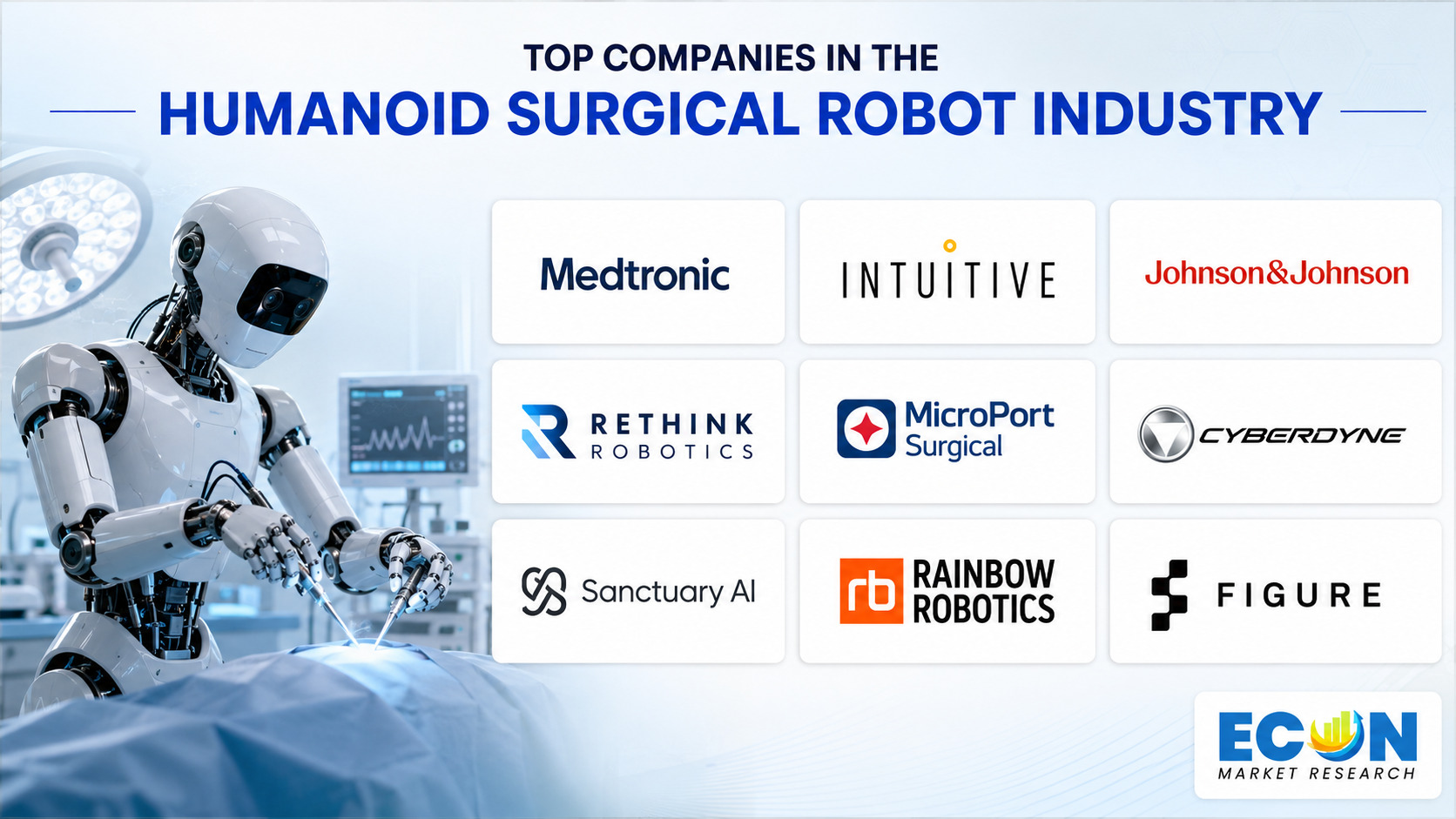
Current adoption is concentrated in urology, gynecology, general surgery, colorectal surgery, thoracic surgery, bariatric procedures, cardiac surgery, and head-and-neck interventions. The competitive structure now includes established medical-device corporations and specialized robotics companies offering modular, table-integrated, single-port, and laparoscopic-assistance platforms. Medtronic’s Hugo system has completed tens of thousands of procedures in over 30 countries, MicroPort MedBot had close to 130 Toumai systems installed by February 2026, and Distalmotion’s Dexter had supported almost 2,000 European procedures by April 2025. These deployment figures demonstrate that robotic surgery has progressed beyond a single-platform market, although adoption remains uneven across hospitals, specialties, and geographic regions.
Market Evolution and Growth Drivers
The industry developed from early telemanipulation research into regulated, multi-specialty operating-room platforms over a period of 3 decades. Intuitive was founded in 1995, the first da Vinci platform entered clinical use near the beginning of the 21st century, and more than 20 million patients had undergone da Vinci-assisted procedures by the end of 2025. New entrants accelerated competition after 2014, when CMR Surgical was established, followed by companies including MicroPort MedBot in 2015, Moon Surgical in 2020, and Ronovo Surgical in 2019. This broader supplier base has introduced portable carts, open consoles, single-port access, advanced visualization, force feedback, and digitally connected training systems.
Adoption is being driven by the demand for less-invasive procedures, hospital interest in shorter recovery pathways, expansion into ambulatory surgical centers, and the need to improve surgeon ergonomics. Technology performance has also advanced sharply: da Vinci 5 contains over 150 enhancements and delivers 10,000 times the computing power of the da Vinci Xi, while its force-feedback instruments reduced tissue forces by up to 43% in preclinical testing. At the same time, modular systems such as Hugo, Versius, Carina, and SSi Mantra allow hospitals to deploy only the number of arms required for a specific procedure. Regulatory competition intensified during 2025 and 2026 as Hugo, Versius Plus, and OTTAVA obtained United States market clearances.
Top 5 Latest Trends in the Humanoid Surgical Robot Industry
Modular and portable robotic architectures
Artificial intelligence and surgical-data platforms
Force feedback and advanced surgeon sensing
Single-port and reduced-incision surgery
Telesurgery and remote clinical collaboration
Trend 1: Modular and Portable Robotic Architectures
Modularity has become one of the most influential trends among the Top Companies in the Humanoid Surgical Robot Industry because hospitals want robotic capability without permanently dedicating a large operating room. Medtronic’s Hugo supports 1-arm, 3-arm, and 4-arm configurations, while SSi Mantra 3 can connect 3, 4, or 5 individual patient-side arm carts. CMR’s Versius uses separate portable bedside units, Distalmotion’s Dexter can dock in 4 minutes, and Ronovo’s Carina received Chinese approval in 2025 as a configurable platform covering 4 surgical specialties. Modular architectures enable hospitals to move systems between rooms, modify port placement, retain access to the patient, and use fewer arms for less-complex procedures.
Trend 2: Artificial Intelligence and Surgical-Data Platforms
Artificial intelligence is shifting surgical robots from mechanical instrument controllers into data-generating clinical platforms. In July 2026, Medtronic introduced Touch Surgery Aide, which can run multiple AI applications during a procedure, including an FDA-cleared computer-vision feature that warns when selected instruments leave the visible field. CMR Surgical demonstrated an NVIDIA-based simulation environment in 2026 designed to help Versius Plus anticipate how a procedure may evolve under different actions. Moon Surgical’s ScoPilot received FDA clearance in 2025 for AI-enhanced scope control, while da Vinci 5 integrates edge computing, procedural analytics, in-console replay, and force measurements. These capabilities create measurable datasets for training, workflow analysis, safety alerts, and future semi-automated functions.
Trend 3: Force Feedback and Advanced Surgeon Sensing
Force feedback is addressing a long-standing limitation of robotic surgery: the reduction of natural tactile information when surgeons manipulate tissue through remote instruments. Da Vinci 5 became the first widely commercialized soft-tissue platform to provide instruments capable of measuring forces and transmitting tactile feedback to the surgeon. Preclinical testing involving surgeons with different experience levels recorded up to 43% less force on tissue when the technology was used. The system also adds a force gauge and incorporates more than 150 hardware and software improvements. This trend is important because measurable force data can support safer tissue handling, more consistent suturing, objective training metrics, and future AI models capable of identifying excessive traction or instrument pressure during complex procedures.
Trend 4: Single-Port and Reduced-Incision Surgery
Single-port robotics is allowing multiple articulated instruments and an endoscope to enter the body through 1 access point. Intuitive’s da Vinci SP expanded its United States indications during 2025 to include transanal excision, inguinal hernia repair, cholecystectomy, and appendectomy, adding to existing applications in urology, thoracic, colorectal, and transoral surgery. MicroPort MedBot’s Toumai SP received Chinese approval in March 2025 and uses a 2.5-centimeter umbilical incision for 3 snake-shaped instruments and 1 flexible endoscope. These systems are designed for narrow anatomical spaces where conventional multi-port arm positioning can be difficult. Reduced-port architectures can limit external arm collisions, decrease the number of incisions, and support procedures performed through natural or concealed access points.
Trend 5: Telesurgery and Remote Clinical Collaboration
Telesurgery became commercially significant after 2024 as robotic platforms demonstrated stable control across cities, countries, and continents. MicroPort MedBot reported nearly 800 Toumai remote procedures across over 20 countries by February 2026, with international communication latency maintained below 150 milliseconds in earlier network testing. The platform received Chinese approval for commercial telesurgery in 2025 and supported 5 simultaneous remote operations across 5 hospitals during the same year. Medicaroid demonstrated a remote procedure between Europe and Japan in 2025, while SSi Mantra has been evaluated using a dual-console telesurgery configuration. Remote capability could extend specialist access, but deployment requires redundant communications, local surgical teams, cybersecurity controls, patient consent, and regulatory approval in every participating jurisdiction.
Top 10 Companies in the Humanoid Surgical Robot Industry
The following 10 companies are not presented as a strict ranking. They were selected according to clinical deployment, active product development, regulatory status, technical specialization, geographic presence, multi-specialty capability, training infrastructure, and direct relevance to articulated soft-tissue surgical robotics.
1. Intuitive Surgical
Company Overview: Intuitive was founded in 1995 and its systems had supported procedures involving over 20 million patients by the end of 2025. The company placed 1,721 da Vinci systems during 2025 and finished the year with an installed base of 11,106 systems. Headquarters: Sunnyvale, California, United States. Core Humanoid Surgical Robot Expertise: Intuitive specializes in surgeon-controlled multi-port and single-port robotic systems, wristed instruments, 3D visualization, force sensing, simulation, procedural analytics, and operating-room integration. Major Products and Services: Its portfolio includes da Vinci 5, da Vinci Xi, da Vinci X, da Vinci SP, SimNow, Case Insights, Intuitive Hub, and force-feedback instruments. Da Vinci 5 provides 10,000 times the computing power of Xi and received expanded cardiac indications in January 2026.
2. Medtronic
Company Overview: Medtronic was founded in 1949 and serves healthcare systems in over 150 countries through more than 150 facilities. Hugo has been used for tens of thousands of procedures across over 30 countries and 5 continents. Headquarters: The company maintains its administrative headquarters in Ireland and operational headquarters in Minneapolis, Minnesota, United States. Core Humanoid Surgical Robot Expertise: Medtronic integrates modular robotic arms, surgical energy, instrumentation, video capture, AI computing, training, and enterprise analytics. Major Products and Services: Hugo includes independent arm carts, an open 3D HD console, a central tower, a task simulator, and Touch Surgery software. The system received FDA clearance for urological procedures in December 2025, while the LigaSure robotic vessel-sealing instrument obtained a European CE Mark in July 2025 after the underlying technology had been used in over 35 million procedures.
3. Johnson & Johnson MedTech
Company Overview: Johnson & Johnson was founded in 1886 and brings over 140 years of surgical-product experience to its robotic program. Headquarters: New Brunswick, New Jersey, United States. Core Humanoid Surgical Robot Expertise: The company develops table-integrated soft-tissue robotics, automated arm positioning, multi-quadrant access, advanced surgical instruments, and digitally connected operating-room systems. Major Products and Services: OTTAVA incorporates 4 arms into a standard-size operating table and occupies 30% to 50% less space than traditional boom-mounted or cart-based systems. The FDA granted De Novo authorization in July 2026 for 10 upper-abdominal general-surgery applications. An earlier 30-patient study across 6 hospitals completed every procedure robotically without conversion, including operations performed in rooms measuring from 243 to 694 square feet.
4. CMR Surgical
Company Overview: CMR Surgical was founded in 2014 by 5 founders and is headquartered in Cambridge, United Kingdom. Versius had treated over 45,000 patients across more than 30 countries by March 2026. Headquarters: Cambridge, England, United Kingdom. Core Humanoid Surgical Robot Expertise: CMR develops modular bedside units, open-console controls, wristed instruments, digital telemetry, case-video analysis, simulation, and multi-specialty robotic workflows. Major Products and Services: Versius and Versius Plus support general, colorectal, urological, gynecological, and thoracic applications in approved markets. Versius Plus received FDA clearance for cholecystectomy in December 2025, and CMR submitted a gynecology application in April 2026. The company’s training pathway contains 7 stages, while its virtual simulator includes 13 task-oriented modules.
5. Distalmotion
Company Overview: Distalmotion was founded in 2012 and employs a multinational workforce representing over 25 nationalities and 15 languages. Headquarters: Lausanne, Switzerland. Core Humanoid Surgical Robot Expertise: The company specializes in hybrid robotic-laparoscopic surgery, compact mobile architecture, open workflow, patient-side access, and outpatient deployment. Major Products and Services: Dexter allows surgeons to alternate between conventional laparoscopy and robotic assistance during the same operation. The platform had supported almost 2,000 procedures across 30 procedure types in Europe by April 2025. Dexter received United States authorization for inguinal hernia repair in 2024 and later added cholecystectomy and benign gynecological indications, including hysterectomy-related procedures. Its mobile system can be docked in 4 minutes and does not require a permanently dedicated robotic operating room.
6. Moon Surgical
Company Overview: Moon Surgical was established in Paris in 2020 under the original name MastOR, beginning with an 8-person technical team in 2021. It completed 50 first-in-human procedures during 2022 and passed 200 European commercial-pilot procedures in 2024. Headquarters: Paris, France, with a United States office in San Carlos, California. Core Humanoid Surgical Robot Expertise: Moon Surgical develops robotic laparoscopic assistance, intelligent scope control, procedural data capture, lightweight arm positioning, and ambulatory-surgery workflows. Major Products and Services: Maestro supports commercially available 5-millimeter and 10-millimeter instruments, provides same-day training, and reports a learning curve of 3 to 5 procedures. The company has listed 18 United States patents for Maestro-related technology and 1 patent for ScoPilot, its FDA-cleared AI-enhanced scope-control system.
7. MicroPort MedBot
Company Overview: MicroPort MedBot began laparoscopic-robot research in 2014 and was incorporated in Shanghai in 2015. By February 2026, Toumai had secured over 200 orders across close to 50 countries, with nearly 130 systems installed. Headquarters: Shanghai, China. Core Humanoid Surgical Robot Expertise: The company develops multi-port and single-port surgery, fluorescence imaging, robotic control algorithms, remote surgery, encrypted communication, and multi-specialty instrumentation. Major Products and Services: Toumai supports urology, general surgery, thoracic surgery, gynecology, and head-and-neck procedures. Over 96% of reported cases involved Level III or Level IV complexity, and nearly 800 remote procedures had been completed across more than 20 countries. Toumai SP received approval in 2025 for surgery through a 2.5-centimeter umbilical incision.
8. Medicaroid
Company Overview: Medicaroid was created as a joint venture between Kawasaki Heavy Industries and Sysmex, combining industrial-robot engineering with medical-diagnostics experience. Headquarters: Kobe, Japan. Core Humanoid Surgical Robot Expertise: The company focuses on compact robotic arms, Japanese manufacturing, network monitoring, telesurgery, training, and multi-specialty minimally invasive procedures. Major Products and Services: Hinotori received its first Japanese regulatory approval and entered clinical use in 2020. Its approved Japanese applications expanded to general surgery and gynecology in 2022 and thoracic surgery in 2024. International authorization followed in Singapore in 2023, Malaysia in 2024, Vietnam in June 2026, and Europe through MDR CE marking in July 2026. The company operates training facilities in Kobe, Nagoya, Tokyo, Belgium, and France, while its support service is available 24 hours per day.
9. SS Innovations International
Company Overview: SS Innovations has worked in medical robotics for over 10 years under the direction of robotic cardiac surgeon Dr. Sudhir Srivastava. The first SSi Mantra system was installed at Rajiv Gandhi Cancer Institute in July 2022 and completed 25 complex procedures during its early clinical program. Headquarters: The company operates through United States and Indian corporate entities, with its principal research and manufacturing activity in India. Core Humanoid Surgical Robot Expertise: Its capabilities include modular arm carts, cardiac robotic instruments, open-console ergonomics, telesurgery, mixed-reality training, and multi-specialty surgery. Major Products and Services: SSi Mantra 3 supports 3-arm, 4-arm, and 5-arm configurations, 3D 4K imaging, fluorescence visualization, and over 30 SSi Mudra surgical tools. The system is manufactured under an ISO 13485:2016-certified quality framework.
10. Ronovo Surgical
Company Overview: Ronovo Surgical was founded in 2019 and moved from concept development to commercialization of its Carina platform within 4 years. Its intellectual-property portfolio includes over 200 global patent applications. Headquarters: Shanghai, China. Core Humanoid Surgical Robot Expertise: Ronovo develops configurable robotic modules, open surgeon controls, laparoscopic instruments, training infrastructure, and digital-surgery systems intended for different operating-room sizes and procedural requirements. Major Products and Services: Carina received NMPA approval in March 2025 for general surgery, gynecology, urology, and thoracic surgery, making it the first Chinese modular platform to obtain simultaneous initial approval across 4 major specialties. Ronovo established a United States training institute in Orlando in 2024 and opened a manufacturing, clinical-research, and training base in Yangzhou during the same year.
Regional Outlook
North America
North America has the deepest concentration of established robotic-surgery programs, training centers, clinical trials, and regulatory clearances. The United States market changed materially between 2024 and 2026 as da Vinci 5, Dexter, Hugo, Versius Plus, Maestro, and OTTAVA obtained authorizations for selected procedures. Intuitive placed 1,721 da Vinci systems globally during 2025, including 870 da Vinci 5 systems, while its total installed base reached 11,106 units. OTTAVA’s 2026 authorization added a table-integrated competitor with 4 arms and 10 approved upper-abdominal procedure categories. Ambulatory surgical centers are becoming more important as compact platforms such as Dexter and Maestro target high-volume cholecystectomy, hernia, and gynecological workflows.
Canada licensed the Hugo platform before its United States clearance, but robotic penetration was reported at only 1% to 2% of Canadian surgeries when Hugo entered the country. Mexico’s adoption remains more concentrated in major private and academic hospitals, while the United States supports the largest number of active commercial and investigational platforms. Regional barriers include the need for trained operating-room teams, cybersecurity protections, evidence for each procedure, and sufficient case volume to maintain proficiency. The strongest North American opportunity lies in using 1 mobile platform across multiple operating rooms, expanding robotic access beyond tertiary hospitals, and applying real-time analytics to reduce setup variation and procedure delays.
Europe
Europe is both a major development center and an early commercialization region for modular surgery robots. CMR Surgical is headquartered in the United Kingdom, Distalmotion and Medtronic maintain major European operations, Moon Surgical originated in France, and Medicaroid obtained MDR CE marking in July 2026. Versius has treated 45,000 patients in over 30 countries, Dexter has clinical experience across more than 30 minimally invasive procedure types, and Hugo is approved for urological, gynecological, and general-surgery applications in relevant European markets. The region’s research institutions also support robotic training through organizations in France, Belgium, Switzerland, Germany, Italy, and the United Kingdom.
European deployment is influenced by MDR evidence requirements, country-level procurement systems, operating-room capacity, and hospital interest in platforms that can move between departments. CMR’s training program includes 7 stages and a 3-day residential component, while Medicaroid has established training locations in Belgium and France. Germany, France, Italy, Spain, the Netherlands, and Nordic countries have suitable minimally invasive surgery infrastructure, but national reimbursement and purchasing processes remain fragmented across more than 25 healthcare systems. Europe offers strong opportunities for compact robots, digital registries, energy-efficient hardware, and cross-border clinical studies, although suppliers must maintain multilingual training, local service engineers, and regulatory documentation throughout the product lifecycle.
Asia-Pacific
Asia-Pacific has become a major manufacturing, deployment, and telesurgery region. China-based MicroPort MedBot recorded over 200 Toumai orders across close to 50 countries by February 2026, while more than 96% of its reported procedures were classified as Level III or Level IV cases. Ronovo’s Carina gained Chinese approval for 4 specialties in March 2025, and Toumai SP received approval for surgery through a 2.5-centimeter access point during the same year. Japan’s hinotori system expanded from urology in 2020 to general surgery, gynecology, and thoracic surgery, while South Korea’s first Hugo installation supported prostatectomy and pancreaticoduodenectomy procedures in May 2025.
India is developing a distinct domestic ecosystem through SSi Mantra and imported platforms such as Toumai and Hugo. One Indian hospital completed over 50 Toumai urology procedures within its first month, while Toumai had accumulated 14 Indian orders by February 2026. Singapore, Malaysia, and Vietnam have authorized hinotori, and Thailand hosts a national Toumai training center. Regional strengths include engineering talent, electronics supply chains, large surgical populations, and national interest in remote care. Risks include uneven hospital infrastructure, differences in regulation, limited specialist availability outside metropolitan centers, and dependence on imported precision components. Telesurgery, local manufacturing, and modular systems are particularly relevant across countries containing thousands of geographically dispersed hospitals.
Middle East & Africa
The Middle East is adopting surgical robots through advanced tertiary hospitals, national health-transformation programs, and regional training partnerships. Toumai has been deployed at Cleveland Clinic Abu Dhabi, while Turkey functions as a training hub for the Middle East and Africa. Gulf hospitals are attractive early adopters because selected facilities have modern operating rooms, internationally trained surgeons, and centralized procurement. The region’s 6 Gulf Cooperation Council countries also provide opportunities for remote mentoring and cross-border training, although regulatory approval must be secured individually. Israel contributes surgical-robotics engineering and clinical research capabilities, while the United Arab Emirates, Saudi Arabia, and Qatar are expanding digitally connected specialty-care infrastructure.
African adoption remains limited but measurable in selected markets. MicroPort MedBot reported 4 Toumai installations and over 500 procedures in Morocco by October 2025, demonstrating that a single national cluster can develop meaningful robotic-surgery volume. South Africa, Egypt, Kenya, and Nigeria have potential demand in urology, oncology, gynecology, and general surgery, but deployment is constrained by limited trained personnel, maintenance capacity, financing models, and inconsistent infrastructure. Systems that require fewer permanent room modifications, support 3-arm configurations, or provide remote technical assistance may be more practical than fixed installations. Regional expansion will depend on local training centers, service-parts availability, reliable networks, and clinical programs capable of sustaining sufficient annual case volumes.
Future Opportunities in the Humanoid Surgical Robot Industry
The strongest future opportunity for the Top Companies in the Humanoid Surgical Robot Industry lies in moving from remote mechanical control toward context-aware surgical assistance. Da Vinci 5 already provides 10,000 times the computing power of its predecessor, Medtronic’s Touch Surgery Aide can operate multiple AI applications during a live procedure, and CMR is testing simulation models that predict how the operating environment may change. Future systems may support automated camera movement, instrument tracking, anatomy recognition, procedural phase identification, digital measurement, setup recommendations, and safety alerts. These functions will require prospective validation and should remain under surgeon supervision rather than being presented as fully autonomous surgery.
Telesurgery offers a second opportunity, particularly for countries with large distances between specialist centers. Toumai has completed nearly 800 remote procedures across more than 20 countries, and its international network testing has reported latency below 150 milliseconds. Verified progress does not mean universal readiness: commercial deployment will require redundant connectivity, on-site backup surgeons, cybersecurity testing, standardized emergency conversion procedures, and regulatory agreements covering both locations. Training can expand faster through dual consoles, simulation, mixed reality, and tele-mentoring. CMR uses a 7-stage training model, Moon Surgical reports a 3-to-5-procedure learning curve for Maestro, and SS Innovations offers extended-reality training through SSi Maya.
Sustainability and operating-room efficiency will also influence future platform design. Compact robots can reduce renovation requirements, modular systems can be shared across multiple rooms, and reusable or extended-use instruments may lower material consumption. Moon Surgical has established a target to reduce emissions per employee by at least 20% within 5 years and to reduce or offset 30% of manufacturing and logistics emissions by 2028. Analytical opportunities also exist in outpatient surgery, cardiac robotics, natural-orifice access, pediatric procedures, and single-port surgery. Commercial success will depend less on the number of robotic arms alone and more on measurable clinical outcomes, service reliability, training quality, instrument availability, and total workflow performance.
Conclusion
The Top Companies in the Humanoid Surgical Robot Industry now operate in a competitive field containing at least 10 active platforms or development programs with distinct architectures. Intuitive ended 2025 with 11,106 da Vinci systems and over 20 million cumulative patients, CMR reached 45,000 Versius cases, MicroPort MedBot recorded more than 200 Toumai orders, and Medtronic deployed Hugo in over 30 countries. The 5 defining trends—modular architecture, AI-enabled data systems, force feedback, single-port access, and telesurgery—are reshaping how hospitals evaluate robotic platforms. Competition is expanding beyond instrument dexterity to include room utilization, training, analytics, network security, service coverage, and multi-specialty flexibility.
Regional conditions will continue to shape adoption. North America has added multiple FDA-authorized competitors since 2024, Europe supports a broad modular-robotics ecosystem, Asia-Pacific combines domestic manufacturing with remote-surgery development, and Africa is beginning to establish concentrated programs such as Morocco’s 4-system Toumai network. The strongest opportunities involve clinically supervised AI, portable robots, reduced-port procedures, remote collaboration, and systems that can operate across existing rooms without major reconstruction. Future industry credibility will depend on transparent clinical evidence, measurable surgeon proficiency, reliable post-market monitoring, and recognition that every robotic procedure remains directed by a trained surgical team responsible for patient care.