

Top Companies in the Frozen Bakery Industry and Their Key Capabilities
The top companies in the frozen bakery industry are profiled by product expertise, manufacturing strengths, regional presence, trends, and future opportunities.
Introduction
Overview of the Global Frozen Bakery Industry
The global frozen bakery industry supports high-volume retail, foodservice, hospitality, institutional catering, convenience-store, and quick-service restaurant operations across more than 100 countries. Frozen bread, rolls, croissants, doughnuts, pizza bases, cakes, pastries, muffins, cookies, and savoury snacks are distributed as raw dough, pre-proofed dough, part-baked products, ready-to-bake items, or thaw-and-serve products. Major producers now operate manufacturing networks containing more than 20 production facilities, while individual bakery complexes can use over 20 processing lines and manufacture more than 10 million items per day. These operating characteristics make temperature control, production consistency, logistics reliability, and local finishing capability central competitive factors.
Frozen bakery products generally remain stable through a controlled supply chain maintained at approximately –18°C, enabling manufacturers and customers to separate production schedules from final consumption. European rules require quick-frozen foods to be maintained at –18°C or below, with only limited temperature deviations during local distribution. This operating model allows a supermarket, hotel, café, hospital, or restaurant to finish products in batches rather than produce every item from raw ingredients. Large suppliers have built portfolios containing more than 1,000 bakery products, while specialist catalogues may contain over 200 viennoiserie lines and more than 100 bread products. Competition therefore combines manufacturing scale with recipe diversity, local adaptation, clean-label development, and reliable bake-off performance.
Market Evolution and Growth Drivers
The frozen bakery industry evolved from centralized bread and pastry manufacturing into a technologically controlled system connecting industrial bakeries with thousands of decentralized baking points. Products that once required skilled preparation at each outlet can now arrive pre-proofed, part-baked, or fully baked and be finished within approximately 20 minutes. Commercial significance increased as retailers expanded in-store bakeries, international hotel groups standardized breakfast menus, and foodservice operators sought consistent products across multiple locations. Some global suppliers now serve more than 50,000 customers, while bakery groups operate over 100 production lines and distribute products in more than 60 markets. These measurable networks demonstrate how frozen formats have moved from a storage solution to an operating platform for multi-site food businesses.
Changing consumer expectations are accelerating product reformulation and production investment. Research involving more than 2,500 consumers found that 4 in 5 respondents valued baked goods connected with childhood memories, while almost 80% purchased bakery items for social gatherings. More than 50% also considered the values represented by a bakery brand, and 60% showed loyalty toward businesses prioritizing sustainability. Product development is simultaneously responding to plant-based eating, ingredient transparency, portion control, food allergies, protein demand, and social-media-driven discovery. Approximately 21% of recent bakery launches carried a plant-based claim, while 24% of plant-based introductions also used no-additive or no-preservative positioning, illustrating how technical reformulation and lifestyle expectations increasingly overlap.
Top 5 Latest Trends in the Frozen Bakery Industry
The 5 most important current trends influencing the Top Companies in the Frozen Bakery Industry are:
Expansion of bake-off and thaw-and-serve operating models
Clean-label, plant-based, and nutrition-focused reformulation
Automation, artificial intelligence, and data-controlled production
Food-waste, energy, and packaging reduction
Premium formats, global flavours, and social-media-led innovation
Trend 1: Expansion of Bake-Off and Thaw-and-Serve Operating Models
Bake-off products are becoming strategically important because they transfer complex mixing, fermentation, lamination, proofing, and partial baking into an industrial environment while preserving freshness at the customer location. A pre-proofed croissant or part-baked baguette can be stored frozen, finished in batches, and served shortly after baking, reducing the need for a full production team at every outlet. Specialist suppliers offer more than 200 ready-to-bake products and over 100 part-baked options, while some clean-label ranges can move from freezer to finished product in 20 minutes or less. The model is particularly relevant for hotels, convenience stores, petrol stations, cafés, supermarkets, hospitals, universities, and quick-service chains operating extended hours.
Commercial adoption is being supported by larger manufacturing networks and more localized frozen distribution. One European bakery complex operates 5 plants and 23 lines capable of producing between 10 million and 15 million items per day, demonstrating the scale achievable through standardized bake-off production. Another global group operates more than 100 lines across over 30 bakeries, enabling regional adaptation without abandoning industrial controls. For customers, the measurable benefits include smaller production batches, fewer unsold finished items, more consistent dimensions, and simpler workforce training. For manufacturers, bake-off products support longer production runs, centralized quality assurance, automated packaging, and cross-border distribution through cold-chain systems maintained near –18°C.
Trend 2: Clean-Label, Plant-Based, and Nutrition-Focused Reformulation
Clean-label reformulation has moved beyond removing artificial colours because frozen dough performance depends on interactions among flour, fats, yeast, enzymes, emulsifiers, water, temperature, and storage time. Manufacturers must simplify ingredient declarations without weakening dough tolerance, lamination, volume, crumb softness, or post-thaw stability. One specialist supplier has developed more than 280 clean-label products and excludes over 300 specified ingredients from its North American clean-label standard. Plant-based development is also expanding: 21% of bakery launches recently carried plant-based claims, and nearly 1 in 4 plant-based introductions highlighted the absence of additives or preservatives. These figures indicate that consumers increasingly expect ingredient simplicity and dietary positioning within the same product.
Nutrition-focused innovation includes higher-fibre bread, sourdough fermentation, portion-controlled pastries, gluten-free cakes, vegan fillings, reduced-sugar toppings, and protein-enriched bakery formats. One international catalogue includes 78 fibre-source products and 49 sourdough products, showing how nutritional and artisanal characteristics are being industrialized for frozen distribution. More than 1 in 5 consumers now view bakery products as a preferred potential source of protein, creating development opportunities in breakfast rolls, snacks, flatbreads, and individually wrapped products. In the United Kingdom, approximately 44% of consumers identify as flexitarian, compared with around 4% identifying as vegan, suggesting that products offering familiar taste with plant-based ingredients may achieve broader adoption than narrowly positioned specialist items.
Trend 3: Automation, Artificial Intelligence, and Data-Controlled Production
Frozen bakery production is becoming more automated because commercial lines must manage dough temperature, mixing energy, fermentation time, sheeting thickness, fat distribution, cutting accuracy, proofing humidity, oven conditions, freezing rates, metal detection, and packaging integrity. A facility producing 10 million to 15 million products per day cannot depend exclusively on manual inspection. Digital sensors and machine-vision systems can identify dimensional variation, topping distribution, colour differences, seal defects, and line stoppages before large batches are affected. Predictive-maintenance systems also use vibration, temperature, motor-load, and downtime data to identify equipment deterioration, helping operators schedule maintenance around planned production rather than respond after an unexpected failure.
Artificial intelligence is expected to support demand forecasting, recipe optimization, production sequencing, inventory allocation, and energy management, although human bakery expertise remains necessary for ingredient variability and sensory quality. Manufacturers operating 29 plants or more than 100 production lines generate sufficient operational data to compare waste, throughput, baking performance, freezer utilization, and changeover time across facilities. Retailers can combine sales by hour, weather conditions, local events, and historical waste to determine how many frozen units should be baked during each period. Even a 1% improvement in yield becomes operationally relevant when a line produces millions of units, while more accurate forecasting can reduce the number of finished products remaining unsold at closing time.
Trend 4: Food-Waste, Energy, and Packaging Reduction
Food-waste reduction is a central frozen bakery trend because approximately 1.05 billion tonnes of food were wasted globally in 2022, equivalent to around 132 kilograms per person and nearly one-fifth of the food available to consumers. Food loss and waste also account for an estimated 8% to 10% of global greenhouse-gas emissions, use approximately 28% of agricultural land, and consume about one-quarter of agricultural freshwater. Frozen bakery systems can address part of this problem by allowing outlets to bake smaller batches in response to actual demand. However, the environmental benefit depends on efficient freezing, full truck utilization, low product damage, recyclable packaging, and disciplined stock rotation.
European regulation is accelerating measurable action. The European Union generated approximately 58.2 million tonnes of food waste in 2023, or about 130 kilograms per person; manufacturing contributed 19%, foodservice 11%, and retail 8%. Binding targets adopted in 2025 require a 10% reduction in processing and manufacturing food waste by 2030 and a 30% per-capita reduction across retail, restaurants, food services, and households. Packaging requirements are also changing: rules entering broad application on 12 August 2026 aim to make packaging economically recyclable by 2030. Frozen bakery manufacturers are therefore redesigning cartons, films, trays, pallet patterns, refrigeration systems, and waste-measurement processes together rather than treating each issue as a separate project.
Trend 5: Premium Formats, Global Flavours, and Social-Media-Led Innovation
Premium frozen bakery innovation increasingly combines familiar formats with distinctive flavours, textures, shapes, toppings, and cultural references. Croissants may use multiple fillings, doughnuts may feature seasonal decoration, and savoury pastries may incorporate regional cheeses, spices, vegetables, or proteins. Consumer research indicates that 4 in 5 people value baked goods associated with childhood memories, while nearly 80% purchase bakery items for social occasions. This encourages manufacturers to combine nostalgia with novelty, such as updating traditional buns, conchas, cinnamon products, brioche, focaccia, or filled pastries for modern retail and foodservice channels. Frozen manufacturing makes limited-edition ranges more practical because standardized products can be distributed across multiple markets and finished close to consumption.
Digital discovery is shortening the cycle between visual trends and commercial product development. Approximately 60% of consumers report that social media influences bakery purchases, and almost 50% expect the ability to order food directly through social platforms. The measurable importance of appearance has consequently increased for laminated layers, icing finishes, contrasting fillings, product height, colour, and packaging photography. Manufacturers serving more than 30 or 40 countries can observe emerging flavour combinations across regions and adapt successful concepts for other markets. However, commercially viable innovation still requires reliable freezing, transport, thawing, baking, allergen control, and shelf performance; a visually attractive product must remain consistent after travelling through a supply chain maintained at approximately –18°C.
Top 10 Companies in the Frozen Bakery Industry
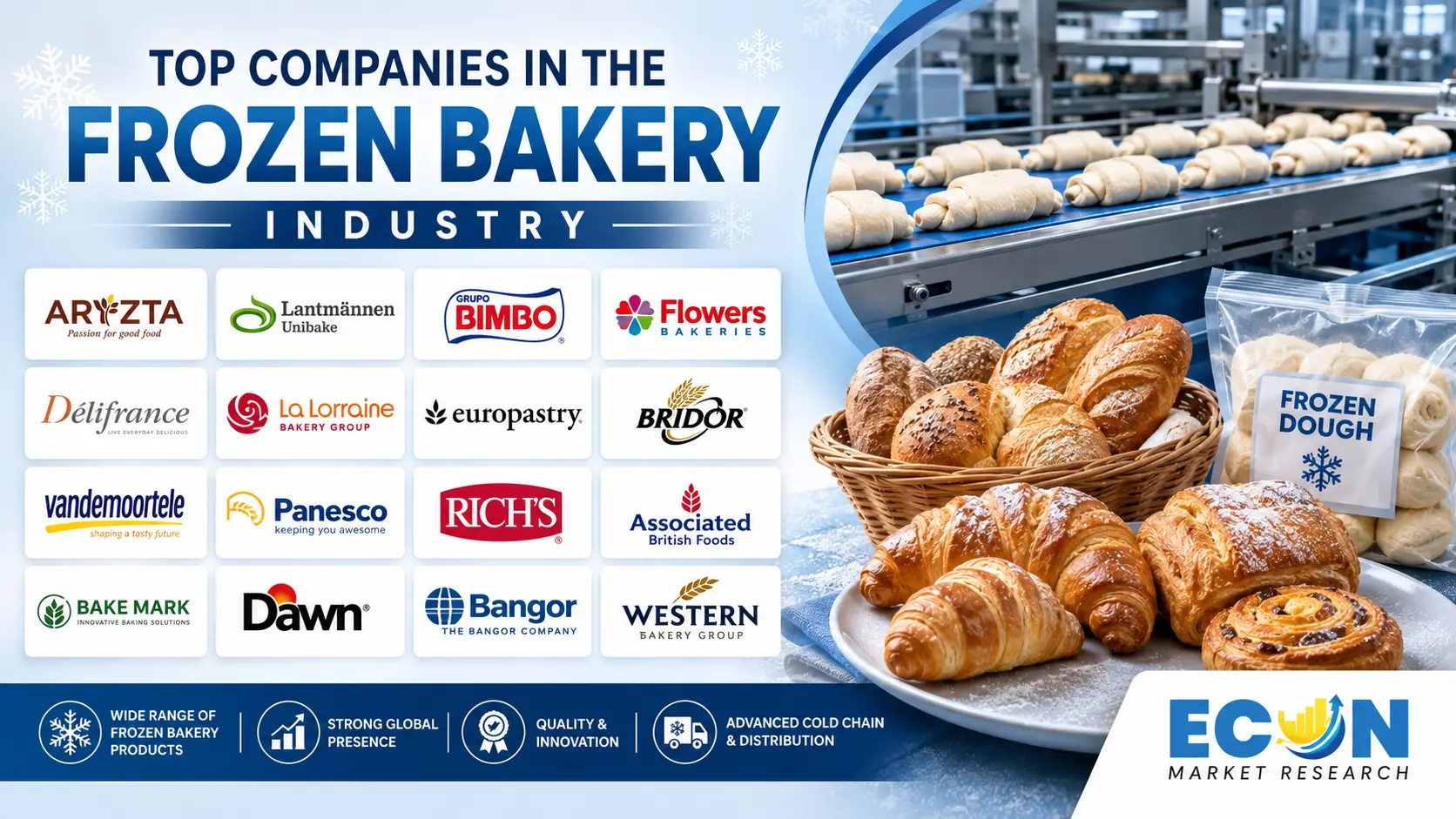
The following Top Companies in the Frozen Bakery Industry are presented as a non-ranked selection. The 10 businesses were chosen according to frozen-bakery relevance, manufacturing capabilities, product breadth, geographic coverage, bake-off expertise, technical development, and service scale rather than a single financial measurement.
1. Grupo Bimbo
Company Overview and Headquarters: Grupo Bimbo was founded in 1945 and is headquartered in Mexico City, Mexico. Its current international network reaches 96 countries, including direct operations in 39 countries and distribution through partners in another 57. The group operates approximately 251 bakeries and plants, more than 1,600 sales centres, and over 56,000 distribution routes, supported by more than 152,000 associates. This extensive infrastructure provides the company with access to retail, foodservice, convenience, and traditional trade channels while allowing recipes and product formats to be adapted to national eating habits.
Core Expertise and Major Products and Services: Grupo Bimbo’s frozen-bakery capabilities include frozen and pre-baked bread, baguettes, rolls, pastries, dough products, and foodservice-oriented bakery solutions. In 2018, the group added 4 frozen pre-baked baguette lines at its San Fernando facility in Argentina, demonstrating investment in products that can be finished closer to consumption. Its South American operations cover 6 countries and include almost 30 brands, creating a platform for regional frozen-product distribution. The company’s primary expertise lies in industrial-scale baking, route-to-market execution, product standardization, local brand management, and the integration of frozen formats with broader bread and snack portfolios.
2. Europastry
Company Overview and Headquarters: Europastry was founded in 1987 and is headquartered in Sant Cugat del Vallès, near Barcelona, Spain. The company operates 29 production plants and 29 sales offices, with commercial reach extending to more than 90 countries. Unlike diversified food groups that treat frozen bakery as 1 division among many, Europastry has developed around frozen dough, bread, pastries, and related bake-off products. Its international expansion has combined European bakery traditions with industrial freezing, automated production, and local sales organizations, giving the business a direct role in supermarket, foodservice, hospitality, and bakery-café supply chains.
Core Expertise and Major Products and Services: Europastry specializes in frozen bread, viennoiserie, doughnuts, pastries, savoury snacks, and ready-to-bake bakery formats designed for consistent preparation at customer sites. Its 29-plant network enables the company to manufacture products closer to major demand centres while maintaining standardized recipes and quality systems. The business combines fermentation, lamination, freezing, proofing, and baking expertise with product concepts influenced by Mediterranean, French, American, and local bakery styles. Its services extend beyond manufacturing to product development, category management, preparation guidance, and channel-specific formats, including individual portions, multipacks, foodservice cases, and products suitable for in-store finishing.
3. ARYZTA
Company Overview and Headquarters: ARYZTA was created in its current form in 2008 through the combination of businesses with bakery roots extending to 1897. Headquartered in Schlieren, Switzerland, it operates 26 production sites, employs approximately 7,700 people, and conducts business across 27 countries. The company has an established presence in Europe, Asia, Australia, and New Zealand, serving retailers, quick-service restaurants, convenience operators, and other foodservice customers. Its production network is structured around high-volume speciality bakery products rather than conventional daily fresh-bread distribution alone.
Core Expertise and Major Products and Services: ARYZTA’s core frozen-bakery capabilities include bread and rolls, morning goods, laminated pastries, savoury products, semi-finished bakery items, bake-off products, and thaw-and-serve formats. Its Eisleben manufacturing complex in Germany contains 5 plants and 23 lines capable of producing between 10 million and 15 million products per day. This scale requires advanced dough handling, automated forming, proofing, baking, freezing, packaging, and quality-control systems. The company supplies customer-specific products alongside established ranges, supporting foodservice operators that require standardized dimensions, baking instructions, holding performance, and supply continuity across large outlet networks.
4. Lantmännen Unibake
Company Overview and Headquarters: Lantmännen Unibake is headquartered in Copenhagen, Denmark, and has bakery roots dating to 1880. The company employs more than 6,000 people and operates bakeries in 13 countries. Its wider commercial network includes more than 30 bakeries, over 100 production lines, sales activity in 21 countries, and distribution to more than 60 markets. The business forms part of an agricultural cooperative-owned group, connecting grain knowledge with industrial bakery production and international foodservice distribution.
Core Expertise and Major Products and Services: Lantmännen Unibake focuses on frozen bread, baguettes, rolls, Danish pastries, croissants, fast-food breads, hamburger buns, hot-dog rolls, and products designed for bake-off or thaw-and-serve preparation. Its network of more than 100 lines supports high-volume production while allowing certain plants to specialize in particular product technologies. The company serves retail and foodservice customers, including restaurants, cafés, hotels, convenience outlets, and quick-service chains. Technical expertise covers flour functionality, fermentation, lamination, freezing, product customization, and preparation consistency, while its presence across more than 60 markets provides a broad base for adapting sizes, recipes, toppings, and packaging to regional requirements.
5. Vandemoortele
Company Overview and Headquarters: Vandemoortele was founded in 1899 and is headquartered in Ghent, Belgium. The company employs more than 4,000 associates and has developed a manufacturing footprint of approximately 35 sites in Europe and 1 site in the United States, with products reaching more than 90 countries. Its bakery operations are supported by more than 125 years of experience in food production, ingredient functionality, industrial processing, and European distribution. The company combines bakery products with plant-based food solutions, giving it expertise in both dough systems and fats used in laminated products.
Core Expertise and Major Products and Services: Vandemoortele supplies frozen bread, pastries, viennoiserie, doughnuts, patisserie, savoury products, and bake-off solutions for retail and foodservice customers. In 2025, the company expanded its bakery footprint by acquiring a business with 4 production facilities in northern Italy specializing in frozen sweet and savoury pastry, bread, pizza, focaccia, and patisserie. Its technical position is strengthened by knowledge of margarines and plant-based fats, which affect lamination, volume, flakiness, flavour release, and freeze-thaw stability. The group’s combination of finished bakery products, semi-finished formats, and ingredient expertise supports customers requiring consistent performance across different ovens, service environments, and national markets.
6. Bridor
Company Overview and Headquarters: Bridor was founded in 1984 and maintains its global headquarters in Paris, France. The company now distributes bakery products in more than 100 countries and operates through an international organization containing 27 sites and over 8,000 employees. Its Americas division includes approximately 2,000 employees across 5 countries and 5 operating sites, while its Europe, Middle East, and Africa network includes about 5,600 employees, 25 countries, and 19 sites. This structure supports a specialist position in premium frozen bread, viennoiserie, and pastry.
Core Expertise and Major Products and Services: Bridor’s catalogue includes approximately 218 viennoiserie products, 111 bread products, 24 pastries, and 20 savoury snacks. It offers around 200 ready-to-bake products, 104 part-baked items, more than 280 clean-label products, 78 fibre-source products, and 49 sourdough products. Its North American development includes a 142,700-square-foot plant opened in 2002, a 47,000-square-foot expansion in 2015, and a Canadian bakery expansion that increased bread capacity by approximately 80% in 2017. The company’s expertise covers lamination, long fermentation, sourdough, pre-proofing, freezing, and products that can be baked in 20 minutes or less.
7. La Lorraine Bakery Group
Company Overview and Headquarters: La Lorraine Bakery Group was founded in 1939 and is headquartered in Ninove, Belgium. After more than 85 years in bakery production, the company employs over 5,700 people, operates 18 production sites, sells in more than 40 markets, and maintains a portfolio containing over 1,500 products. Its development combines traditional fresh bakery operations with a large frozen bake-off business supplying international retailers and foodservice operators. The group also operates approximately 450 branded food outlets, while 7 fresh-production sites in Belgium serve about 2,300 customers each day.
Core Expertise and Major Products and Services: The company produces frozen bread, rolls, baguettes, viennoiserie, doughnuts, patisserie, savoury snacks, and other products intended for in-store or foodservice finishing. Its more than 1,500-product portfolio allows customers to source everyday bread, premium pastry, individual snacks, seasonal items, and channel-specific formats from the same supplier. La Lorraine’s frozen division has developed expertise in dough preparation, proofing, partial baking, rapid freezing, packaging, and preparation instructions for different oven systems. Distribution across more than 40 markets also requires multilingual labelling, allergen compliance, temperature monitoring, and adaptation to local flour preferences, portion sizes, sweetness levels, and consumption occasions.
8. Rich Products
Company Overview and Headquarters: Rich Products was founded in 1945 and is headquartered in Buffalo, New York, United States. The family-owned food company employs approximately 13,000 associates and serves customers in more than 100 countries. Its international product system contains over 4,000 product types, extending from bakery and desserts to foodservice products and culinary solutions. Rich has developed local operating platforms in markets including India, where it has worked for more than 15 years through 5 regional offices, 2 production plants, and more than 500 associates.
Core Expertise and Major Products and Services: Rich Products supplies frozen cakes, desserts, breads, rolls, pizza bases, flatbreads, cookie products, dough items, icings, toppings, creams, and gluten-free or plant-based bakery solutions. Its strength lies in combining frozen finished products with bakery components, enabling customers to assemble, decorate, customize, or portion products locally. The company serves supermarket bakeries, restaurants, hotels, cafés, convenience channels, and institutional customers. Its South African operation has more than 30 years of regional experience and supplies over 15 African countries, illustrating the company’s ability to support frozen and ambient bakery systems in markets with different logistics, equipment, climate, and workforce conditions.
9. Dawn Foods
Company Overview and Headquarters: Dawn Foods was founded in 1920 and is headquartered in Jackson, Michigan, United States. The company employs more than 3,500 people and serves over 50,000 customers in more than 100 countries. Its customers range from small independent bakeries to supermarket operators, foodservice businesses, and industrial producers. More than 100 years of operating history have given Dawn a broad understanding of bakery ingredients, production troubleshooting, product development, consumer trends, and finished-product requirements across different scales of operation.
Core Expertise and Major Products and Services: Dawn Foods provides bakery mixes, bases, fillings, icings, glazes, frozen dough, fully baked products, cakes, cupcakes, conchas, mantecadas, and technical services. Its position differs from a frozen-only manufacturer because it can support both production inputs and finished bakery formats. The company’s 2025 trend programme included research with more than 2,500 consumers and visits to hundreds of bakery and foodservice locations, giving product-development teams measurable insight into purchasing behaviour. This research supports customers working on nostalgic flavours, visual presentation, sustainability claims, social occasions, and convenient frozen formats while the company’s ingredient expertise helps manage texture, stability, decoration, and freeze-thaw performance.
10. Baker & Baker
Company Overview and Headquarters: Baker & Baker began operating as a standalone European bakery business in 2021 and is headquartered in Bromborough, Wirral, United Kingdom. It employs more than 2,500 people, operates 12 manufacturing sites across 6 European countries, and supplies more than 30 markets. More than 5 million of its products are consumed across Europe each day, demonstrating substantial production and distribution scale. The company’s portfolio combines internally developed bakery ranges with licensed and established brands for retail, foodservice, convenience, wholesale, and in-store bakery customers.
Core Expertise and Major Products and Services: Baker & Baker manufactures American-style bakery products, doughnuts, muffins, cookies, brownies, cakes, laminated pastries, sweet and savoury products, gluten-free cakes, and frozen bake-off items. Its operating portfolio includes brands and specialist ranges associated with 6 major bakery identities, while its United Kingdom network includes 4 production facilities. The company’s capabilities cover frozen dough handling, batter products, lamination, filling, decorating, freezing, and individual packaging. Its daily volume of more than 5 million products supports large retail promotions and foodservice programmes, while its multi-country manufacturing system allows regional product development and compliance with different allergen, labelling, packaging, and customer specifications.
Regional Outlook
North America
North America has a mature frozen bakery infrastructure supported by industrial bakeries, supermarket in-store ovens, convenience stores, restaurant chains, hotels, warehouse clubs, and institutional foodservice. United States industry classification separates bread and bakery manufacturing from frozen cakes, pies, and other pastries, demonstrating that frozen bakery is recognized as a distinct production activity. Commercial bakery and frozen cake, pie, and pastry operations together employed approximately 165,000 workers in November 2024. The region’s scale supports specialized suppliers of dough, fillings, toppings, finished cakes, pizza bases, breads, cookies, muffins, and laminated products, while widespread freezer capacity enables national and cross-border distribution.
The United States remains an important centre for product development, industrial production, quick-service bakery formats, and supermarket bakery programmes. Bridor’s American manufacturing development includes a 142,700-square-foot plant established in 2002 and a 47,000-square-foot expansion completed in 2015, while Rich Products and Dawn Foods each serve customers in more than 100 countries from North American headquarters. Canada has strong capabilities in premium French-style bread and pastry, illustrated by a 2017 Bridor expansion that increased bread capacity by approximately 80%. Mexico contributes a combination of industrial bakery expertise, regional distribution, foodservice demand, and access to Grupo Bimbo’s 56,000-route global system.
Regional opportunities include clean-label products, premium breakfast pastries, Hispanic bakery formats, gluten-free cakes, plant-based fillings, portion-controlled snacks, and automated in-store baking. The market also faces measurable operational pressures from labour availability, freezer energy consumption, ingredient-price volatility, food waste, and long-distance distribution. Manufacturers increasingly respond with pre-proofed products that bake in 20 minutes or less, simplified preparation instructions, and data-led demand planning. North American companies can also use established production and cold-chain systems to export products or manufacturing knowledge to faster-developing markets, although compliance with allergen labelling, nutrition rules, sanitation standards, and temperature control remains essential across every batch.
Europe
Europe is a major centre of frozen bakery manufacturing, with specialist groups operating networks of 18, 26, 29, or more than 30 production facilities. The region combines strong bread and pastry traditions with widespread supermarket bake-off, petrol-station foodservice, hotel breakfast programmes, cafés, and quick-service restaurant demand. Product diversity extends from baguettes and sourdough loaves to croissants, Danish pastries, doughnuts, focaccia, pizza, cakes, savoury snacks, and gluten-free products. Temperature regulation is highly developed: quick-frozen foods must generally remain at –18°C or lower, with only restricted deviations of up to 3°C during certain local distribution activities.
Sustainability regulation is reshaping product and packaging decisions. Europe generated about 58.2 million tonnes of food waste in 2023, or 130 kilograms per resident. Manufacturing represented 19% of that total, foodservice 11%, and retail 8%. Targets adopted in 2025 require food processing and manufacturing waste to fall by 10% by 2030, while per-capita waste from retail, restaurants, food services, and households must decrease by 30%. These targets favour frozen bake-off systems that allow smaller production batches, but manufacturers must also address factory losses, damaged packaging, obsolete inventory, and freezer energy use.
Packaging rules will become another competitive differentiator. The Packaging and Packaging Waste Regulation entered into force on 11 February 2025 and generally begins applying on 12 August 2026, with the objective of making packaging economically recyclable by 2030. Packaging accounts for approximately 40% of plastics used in the European Union, while packaging waste reached about 186.5 kilograms per person in 2022. Germany, France, Italy, Spain, the United Kingdom, Belgium, the Netherlands, and Nordic countries offer strong manufacturing or consumption bases, but suppliers must manage national recycling systems, language requirements, nutritional labelling, energy costs, and varying consumer preferences across more than 25 major national markets.
Asia-Pacific
Asia-Pacific combines large urban populations, expanding cold-storage capacity, international foodservice growth, convenience retail, and strong local bakery traditions. China’s urbanization rate reached 67.89% by the end of 2025, representing approximately 953.8 million urban residents. This concentration supports modern retail, café chains, hotel foodservice, home delivery, and centralized bakery production. Frozen suppliers can adapt croissants, cakes, buns, pizza products, and laminated pastries to regional flavours such as matcha, red bean, sesame, coconut, taro, curry, or local fruit. The opportunity is substantial, but product development must account for sweetness preferences, oven availability, freezer space, packaging sizes, and differences between premium urban outlets and lower-cost mass channels.
Japan offers a sophisticated convenience and foodservice environment where frozen or part-baked products can support frequent menu rotation and consistent store-level preparation. Convenience-store sales increased by approximately 3.4% in 2025, while the number of stores rose for the first time in 4 years. Australia and New Zealand have mature supermarket, café, and quick-service channels, with international suppliers maintaining established regional operations. South Korea, Singapore, and Taiwan combine high urban density with premium café culture and visually driven product innovation. Across these markets, small portions, hybrid flavours, seasonal decoration, and rapid in-store preparation can be as important as large production volume.
India illustrates the infrastructure expansion supporting future frozen bakery penetration. As of August 2024, the country had 8,698 cold-storage facilities with capacity of approximately 395.96 lakh metric tonnes, including 1,793 facilities added during the preceding 10 years. Since 2017, 643 captive cold, frozen, controlled-atmosphere, or modified-atmosphere storage projects with processing capacity of about 241.33 lakh metric tonnes per year have also received approval under a national food-processing programme. These facilities serve multiple food categories rather than bakery alone, but they improve the logistics base required for frozen dough, pastries, cakes, and foodservice products. Key constraints remain uneven freezer availability, electricity reliability, route density, product affordability, and workforce training.
Middle East & Africa
The Middle East is developing as an important frozen bakery market because of urban growth, tourism, international restaurant expansion, modern retail, airline catering, hotels, and large event programmes. The 6 Gulf Cooperation Council countries depend substantially on temperature-controlled distribution because of high ambient temperatures and imported food exposure. The United Arab Emirates’ Food Security Strategy 2051 identifies 18 key food categories, contains 38 initiatives, and establishes 5 strategic goals. It also promotes alternative supply arrangements involving between 3 and 5 sources for each essential category, a framework that encourages diversified procurement and resilient cold-chain planning.
Sustainability and food security are shaping procurement decisions. The United Arab Emirates has set a target to reduce food waste by 50% by 2030, while agricultural plans include annual objectives such as a 5% increase in self-sufficiency for selected crops, a 5% increase in the agricultural workforce, and a 15% reduction in irrigation water used per production unit. Saudi Arabia’s transformation programme includes raising annual Umrah capacity from 6.2 million visitors to 30 million, which can increase demand for standardized breakfast products, breads, pastries, snacks, and high-volume catering formats. Frozen bakery products can support these requirements through predictable portions and decentralized baking, provided freezer reliability and stock rotation are maintained.
African market conditions differ widely across more than 50 countries, with South Africa, Egypt, Kenya, Nigeria, Morocco, and selected urban centres offering the strongest organized retail and foodservice foundations. Rich Products has operated in South Africa for over 30 years and serves more than 15 African countries, demonstrating that regional bakery distribution can function across multiple regulatory and infrastructure environments. Expansion opportunities include hotel pastries, fast-food buns, frozen cakes, pizza bases, doughnuts, and products for supermarket finishing. Barriers include imported ingredient dependence, electricity interruptions, limited cold storage, long transport distances, currency instability, technical skill shortages, and high ambient temperatures, all of which increase the importance of robust packaging, route planning, backup power, and simple baking procedures.
Future Opportunities in the Frozen Bakery Industry
Future opportunities for the Top Companies in the Frozen Bakery Industry will increasingly depend on connecting product innovation with measurable operating improvements. Artificial intelligence can combine hourly sales, weather, holidays, local events, and inventory data to recommend bake quantities for each outlet. Machine vision can check dimensions, colour, filling placement, and packaging seals, while predictive maintenance can analyze motor temperature, vibration, and power consumption. At facilities producing between 10 million and 15 million items per day, even a 1% improvement in yield, giveaway, downtime, or rejected packs can affect substantial product volumes. Smaller bakeries can access similar capabilities through cloud-based production planning, connected ovens, and supplier-managed forecasting rather than purchasing complex enterprise systems.
Sustainability deadlines will create opportunities in packaging redesign, lower-energy freezing, renewable electricity, heat recovery, water reuse, reusable logistics materials, and food-waste analytics. European manufacturers must prepare for packaging rules applying broadly from 12 August 2026 and recyclability objectives for 2030. Food businesses also face 2030 waste-reduction targets of 10% in processing and manufacturing and 30% per person across retail, foodservice, and households. Suppliers that provide waste-measurement tools, optimized case quantities, resealable packs, smaller bake batches, and preparation guidance can compete on total operating performance rather than unit price alone. Verified targets should guide investment decisions, while unverified claims of zero waste or carbon neutrality should be avoided.
Geographic expansion will depend on localized products and localized supply chains. India’s 8,698 cold stores, China’s 953.8 million urban residents, the UAE’s 2051 food-security strategy, and Saudi Arabia’s target of 30 million annual Umrah visitors indicate distinct forms of demand rather than 1 uniform emerging-market opportunity. Manufacturers may establish regional finishing plants, partner with local flour mills, license recipes, create smaller case sizes, or supply frozen concentrates and dough components where full production is impractical. Workforce development will also matter: short training modules, multilingual instructions, automated proofing, and oven programmes can help small and medium-sized customers produce consistent results without employing a complete team of specialist bakers at every location.
Conclusion
The global frozen bakery industry is supported by industrial production, controlled storage near –18°C, international cold chains, and thousands of retail and foodservice baking points. Its current direction is defined by 5 connected trends: bake-off expansion, clean-label reformulation, automation and artificial intelligence, waste and packaging reduction, and premium product innovation. The 10 selected companies demonstrate different competitive strengths, ranging from networks of more than 250 plants to specialist catalogues containing over 200 viennoiserie products and manufacturing complexes producing up to 15 million items per day. Their relevance comes from measurable capabilities rather than a strict ranking based on financial size.
Regional priorities differ across the 4 analysed markets. North America combines mature industrial production with approximately 165,000 bakery-manufacturing workers; Europe is preparing for binding 2030 waste and packaging objectives; Asia-Pacific includes 953.8 million urban Chinese residents and India’s network of 8,698 cold stores; and the Middle East and Africa are developing around food security, tourism, retail modernization, and infrastructure expansion. The strongest opportunities for the Top Companies in the Frozen Bakery Industry will come from products that deliver consistent quality while reducing labour, waste, energy use, and preparation complexity. Companies that verify performance, localize recipes, strengthen cold chains, and meet approaching 2026 and 2030 regulatory milestones will be positioned more credibly than those relying on promotional claims alone.