


Top Companies in the AI-Powered Diagnostics Industry
The AI-powered diagnostics industry features 10 major companies advancing clinical imaging, pathology, workflow automation, and global healthcare adoption.
Introduction
Overview of the Global AI-Powered Diagnostics Industry
The global AI-powered diagnostics industry has progressed from limited clinical pilots to operational deployment across radiology, pathology, cardiology, oncology, neurology, ophthalmology, and infectious-disease screening. The United States authorization list included AI-enabled products across at least 10 medical specialties by March 2026, with radiology representing the largest concentration. Commercial deployment has also expanded beyond individual algorithms: Aidoc technology is used in 1,600 hospitals and analyzes 60 million patients annually, Viz.ai is embedded in 2,000 hospitals serving an estimated 230 million people, and Qure.ai reports an operational presence in 90 countries with 25 million lives affected. These figures indicate that diagnostic AI is becoming part of routine clinical infrastructure rather than remaining an experimental software category.
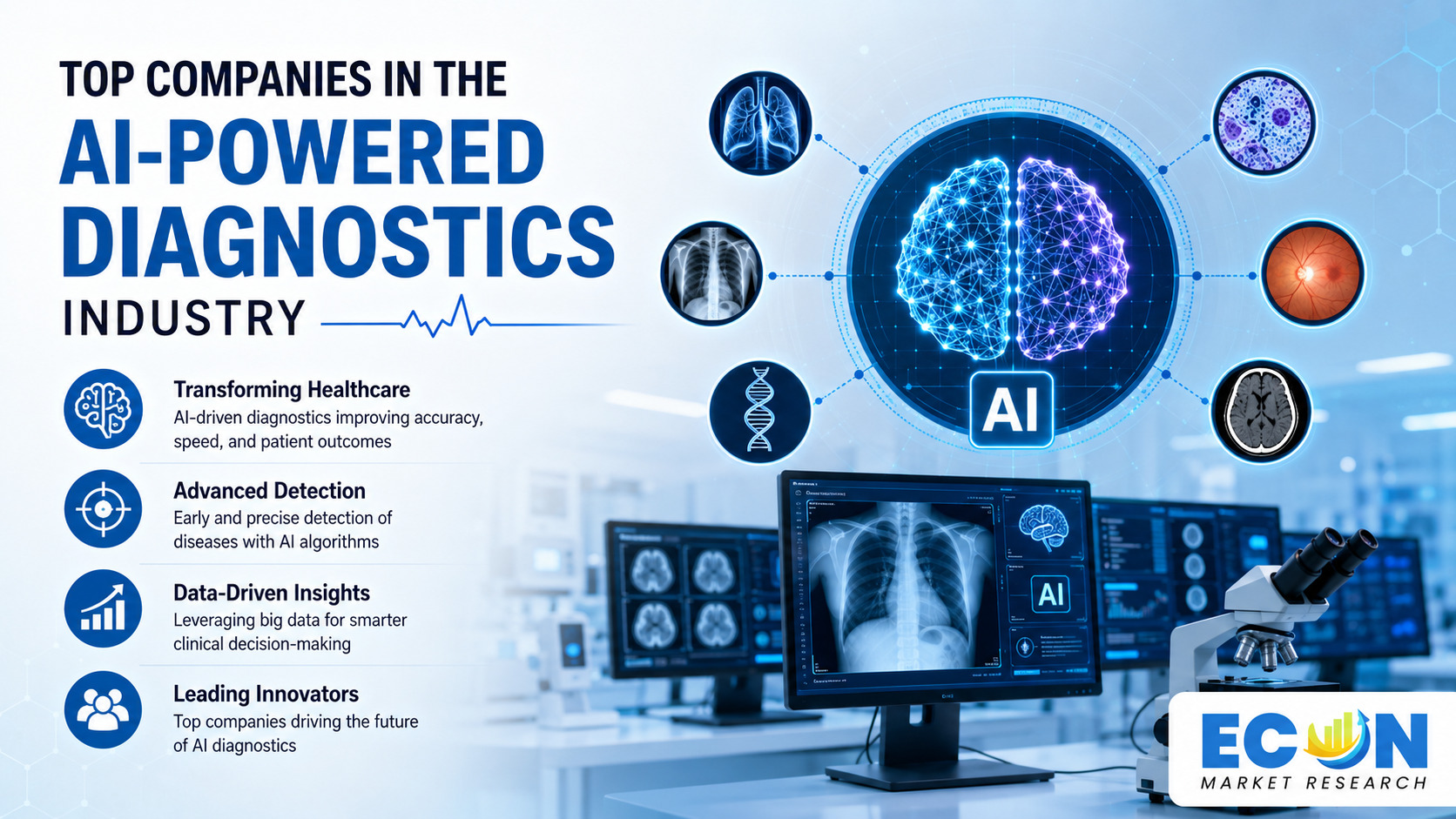
Technology penetration is strongest in medical imaging because X-ray, CT, MRI, mammography, and ultrasound generate standardized digital data that can be processed within existing hospital workflows. GE HealthCare supports 5 million installed devices, serves 1 billion patients annually, and offers over 200 imaging software applications, while Lunit’s cancer-screening technology is deployed at 10,000 healthcare sites in 65 countries. AI-powered diagnostic systems now assist with case prioritization, abnormality detection, image reconstruction, quantitative measurement, report preparation, disease-risk identification, and care-team activation. The industry therefore includes medical-device manufacturers, cloud-platform providers, algorithm developers, laboratory companies, digital-pathology specialists, and clinical workflow companies operating under different regulatory classifications.
Market Evolution and Growth Drivers
AI-powered diagnostics accelerated after 2018 as deep-learning models improved image classification, hospitals completed wider PACS and electronic health record integrations, and regulators established clearer software-as-a-medical-device pathways. By 2025, 32 of 50 surveyed countries in the WHO European Region were using AI-assisted diagnostics, while 98% identified better patient care as a primary adoption driver and 92% cited workforce-pressure reduction. Adoption is also being driven by the volume of diagnostic activity: 4.2 billion medical-imaging examinations are conducted globally each year, creating demand for automated reconstruction, triage, measurements, and reporting assistance. Clinical organizations increasingly evaluate AI according to workflow impact, subgroup performance, cybersecurity, interoperability, and post-deployment monitoring rather than algorithm accuracy alone.
Regulation has evolved alongside deployment. The FDA continued updating its AI-enabled medical-device list through March 2026, Health Canada issued detailed 2026 guidance for Class II, III, and IV machine-learning medical devices, and European AI legislation introduced phased obligations extending to high-risk AI embedded in regulated products by August 2028. WHO also published over 40 governance recommendations for large multimodal health models, reflecting concern about transparency, bias, accountability, privacy, and clinical validation. These developments are encouraging companies to build version control, risk management, representative datasets, human oversight, predetermined change plans, and real-world performance monitoring into product development from the first design stage.
Top 5 Latest Trends in the AI-Powered Diagnostics Industry
Enterprise-wide clinical AI orchestration
Multimodal and foundation-model diagnostics
Autonomous imaging and AI reconstruction
Digital pathology and computational biomarkers
Lifecycle regulation and continuous performance monitoring
Trend 1: Enterprise-Wide Clinical AI Orchestration
Healthcare providers are replacing isolated diagnostic algorithms with platforms capable of supporting multiple departments, data sources, and clinical pathways through 1 integration layer. Aidoc’s aiOS operates in 1,600 hospitals, supports partner applications at 100 sites, and processes 60 million patients annually, while Viz.ai offers over 50 care pathways across neurology, cardiology, oncology, pulmonology, and radiology. The commercial importance of this trend increased after 2022, when hospitals began moving from single-use stroke, hemorrhage, or pulmonary-embolism tools toward enterprise governance and centralized deployment. Platform models reduce repeated integration work, provide common audit controls, monitor algorithm usage, and connect diagnostic findings with specialist notifications, transfer decisions, and follow-up processes.
Trend 2: Multimodal and Foundation-Model Diagnostics
Foundation models are extending diagnostic AI beyond single images by combining radiology scans, pathology slides, electrocardiograms, clinical history, laboratory values, and report text. WHO’s health guidance contains over 40 recommendations covering governance, transparency, stakeholder engagement, and risk management for large multimodal models. In 2026, Aidoc received regulatory recognition for CARE, a clinical reasoning engine designed to operate across multiple acute conditions using multimodal information. The strategic value lies in identifying relationships that may be missed when each data source is reviewed independently. However, foundation models require broader validation because performance can vary across hospitals, scanners, patient groups, disease prevalence, and documentation practices. Successful commercialization therefore depends on evidence demonstrating consistent outputs across multiple clinical environments.
Trend 3: Autonomous Imaging and AI Reconstruction
AI is moving upstream from image interpretation into image acquisition, reconstruction, positioning, protocol selection, and quality control. GE HealthCare and NVIDIA began developing autonomous X-ray and ultrasound systems in 2025 against a backdrop of 4.2 billion annual imaging examinations and double-digit staffing shortages in some diagnostic departments. Deep-learning reconstruction is already delivering measurable operational gains: GE’s Sonic DL provides up to 12-times acceleration and an 80% reduction in scan time, while Philips SmartSpeed Precise can complete MRI scans 3 times faster and improve image sharpness by 80%. These technologies can increase scanner throughput, reduce repeat examinations, standardize acquisition, and extend advanced imaging to facilities with limited specialist availability.
Trend 4: Digital Pathology and Computational Biomarkers
Digital pathology is transforming glass-slide review into a software-supported diagnostic process involving whole-slide scanners, image-management systems, AI algorithms, and quantitative biomarker tools. Lunit supports 10,000 sites in 65 countries, while PathAI launched over 20 AI products by 2023 and gained FDA clearance for AISight Dx in 2025. Clinical validation is becoming larger and geographically broader; 1 prostate-cancer AI study evaluated over 100,000 biopsy cores from 7,342 patients across 15 sites in 11 countries. Beyond detecting cancer, computational pathology tools quantify tumor architecture, immune-cell distribution, receptor expression, and treatment-associated biomarkers, allowing laboratories to produce more reproducible measurements and support precision-oncology research.
Trend 5: Lifecycle Regulation and Continuous Performance Monitoring
Regulators increasingly treat diagnostic AI as a continuously managed medical product rather than a static software release. In 2021, regulators from the United States, Canada, and the United Kingdom established 10 good machine-learning-practice principles, followed by 5 principles for predetermined change-control plans. Health Canada’s 2026 framework addresses 9 lifecycle components, including data selection, training, testing, clinical validation, transparency, and post-market monitoring. European obligations will also phase in through 2028 for AI embedded in regulated medical products. Companies must consequently document model versions, subgroup performance, uncertainty, cybersecurity, data drift, intended users, clinical autonomy, and authorized modifications. Lifecycle compliance is becoming a competitive capability because hospitals require evidence that performance will remain controlled after deployment.
Top 10 Companies in the AI-Powered Diagnostics Industry
The following 10 companies are presented without a strict ranking. Selection is based on diagnostic relevance, product breadth, clinical evidence, regulatory progress, technical specialization, deployment scale, geographic presence, and integration with healthcare workflows.
1. GE HealthCare
Company Overview: GE HealthCare became an independent company in 2023 while retaining a medical-technology heritage extending for 130 years. It employs 54,000 people, operates in 160 countries, maintains 11,000 granted patents, and supports 5 million installed devices. Headquarters: Chicago, Illinois, United States. Core AI-Powered Diagnostics Expertise: The company integrates AI into CT, MRI, X-ray, ultrasound, mammography, molecular imaging, visualization, and radiology operations. Major Products and Services: Its portfolio includes AIR Recon DL, Sonic DL, Critical Care Suite, Pristina Recon DL, Imaging 360, LesionID Pro, and AI-enabled ultrasound applications. GE HealthCare reported over 110 AI-enabled device authorizations and is developing autonomous X-ray and ultrasound technology through simulation, edge computing, and robotic-acquisition research.
2. Siemens Healthineers
Company Overview: Siemens Healthineers builds on over 170 years of Siemens medical-engineering activity and employed 74,000 people at the end of fiscal 2025. It operates in over 70 countries and maintains direct or commercial activities across a substantially wider global network. Headquarters: Erlangen, Germany. Core AI-Powered Diagnostics Expertise: The company develops AI for radiology, cardiology, oncology, laboratory diagnostics, image reconstruction, organ segmentation, and clinical decision support. Major Products and Services: AI-Rad Companion automatically processes imaging datasets and supports chest CT, chest X-ray, brain MRI, prostate MRI, and radiation-therapy workflows. The chest CT platform received 3 initial FDA-cleared modules in 2019 and was validated using data from Siemens, GE, and Philips scanners, demonstrating a vendor-aware approach to clinical deployment.
3. Royal Philips
Company Overview: Philips was founded in 1891 and employed 64,800 people in 2025, with products and services distributed in over 100 countries. Headquarters: Amsterdam, the Netherlands. Core AI-Powered Diagnostics Expertise: Philips embeds AI into MRI, CT, ultrasound, mammography, cardiovascular imaging, advanced visualization, PACS, remote scanning, and image-guided procedures. Major Products and Services: SmartSpeed Precise enables MRI examinations up to 3 times faster with an 80% improvement in image sharpness, while Compact Ultrasound 5500CV can reduce cardiac-imaging time by 50%. The Verida spectral CT platform was introduced in 2025 after Philips’ spectral technology reached 800 installations and generated 800 peer-reviewed publications. Philips also integrates connected AI tools through Image Management 15 and Advanced Visualization Workspace.
4. Roche
Company Overview: Roche was founded in 1896 and employs over 100,000 people globally. Its high-medical-value diagnostic solutions affected 258 million lives during 2025, while its navify digital portfolio supports 6,500 customers. Headquarters: Basel, Switzerland. Core AI-Powered Diagnostics Expertise: Roche combines laboratory diagnostics, tissue pathology, molecular testing, digital health, sequencing, and pharmaceutical knowledge to develop connected diagnostic decision-support systems. Major Products and Services: navify Digital Pathology supports cloud and on-premise deployments, PACS and laboratory-system integration, remote consultation, multi-slide review, and third-party AI algorithms. Its digital-pathology portfolio works with VENTANA DP scanners and includes image-analysis applications for HER2, PD-L1, ER, PR, Ki-67, and dual in-situ hybridization workflows.
5. Aidoc
Company Overview: Aidoc was founded in 2016 and has grown to over 450 employees, 1,600 hospital deployments, and 60 million patient analyses annually. Headquarters: Tel Aviv, Israel, with major commercial operations in the United States. Core AI-Powered Diagnostics Expertise: Aidoc specializes in acute-condition detection, CT image analysis, clinical triage, workflow orchestration, specialist activation, enterprise integration, and multimodal reasoning. Major Products and Services: Its aiOS platform deploys Aidoc and third-party applications through a common infrastructure, while CARE is being developed as a foundation-model clinical reasoning engine. The company reported 18 FDA clearances in 2026 and supports cardiovascular, neurological, abdominal, pulmonary, and vascular workflows. Its technology is designed to operate continuously in the background and prioritize suspected urgent findings.
6. Viz.ai
Company Overview: Viz.ai was founded in 2016 and completed its first 10 years of operation in 2026. Its platform is deployed in 2,000 United States hospitals, supports an estimated 230 million people, and is backed by over 125 peer-reviewed publications. Headquarters: San Francisco, California, United States. Core AI-Powered Diagnostics Expertise: The company combines disease detection, care coordination, multimodal clinical data, mobile communication, and specialist activation. Major Products and Services: Viz.ai offers over 50 AI-enabled care pathways covering stroke, subdural hemorrhage, aortic disease, pulmonary embolism, cardiology, oncology, and other conditions. It holds 13 FDA clearances and received the first de novo authorization for AI computer-aided triage in 2018, establishing a regulatory pathway for time-sensitive diagnostic notification software.
7. Qure.ai
Company Overview: Qure.ai was founded in 2016 and has expanded its diagnostic AI footprint to over 90 countries, affected 25 million lives, and supported 7,750 healthcare workers through its wider digital-health ecosystem. Headquarters: Mumbai, India, with operational offices in New York and other international markets. Core AI-Powered Diagnostics Expertise: Qure.ai focuses on chest X-ray, CT, tuberculosis, lung cancer, stroke, traumatic brain injury, and public-health screening. Major Products and Services: qXR analyzes chest radiographs, qER processes emergency head CT scans, and QureOS helps governments evaluate and deploy AI technologies. The company reported 18 FDA clearances by 2025 and has participated in statewide Indian programs covering Maharashtra, Karnataka, Goa, Punjab, and other regions.
8. Lunit
Company Overview: Lunit was founded in 2013 and operates from Seoul with AI solutions deployed across 10,000 sites in over 65 countries. Headquarters: Seoul, South Korea. Core AI-Powered Diagnostics Expertise: Lunit develops cancer-screening algorithms, breast-density and risk tools, chest-image analysis, digital-pathology biomarkers, and precision-oncology research applications. Major Products and Services: Lunit INSIGHT includes FDA-cleared mammography and digital breast tomosynthesis applications, while Lunit SCOPE analyzes tissue images for immune phenotypes, PD-L1 expression, and other biomarkers. The company integrated Volpara’s breast-health capabilities and had produced 125 scientific journal papers by April 2024, including 100 studies involving its medical-imaging suite and 25 involving precision-oncology applications.
9. PathAI
Company Overview: PathAI was founded in 2016 to improve the accuracy and reproducibility of pathology through machine learning. Headquarters: Boston, Massachusetts, United States. Core AI-Powered Diagnostics Expertise: The company develops digital-pathology platforms, tissue-analysis algorithms, biomarker-quantification tools, clinical-trial endpoints, and AI-assisted drug-development solutions. Major Products and Services: PathAI launched over 20 AI products by 2023 and introduced the Precision Pathology Network in 2025 as a global network of digital anatomic-pathology laboratories. AISight Dx received FDA clearance in 2025 for primary diagnosis and included a predetermined change-control plan. AIM-MASH AI Assist also achieved regulatory qualification as an AI-powered pathology drug-development tool, while PathAssist Derm received Breakthrough Device Designation in 2026.
10. Ibex Medical Analytics
Company Overview: Ibex Medical Analytics was founded in 2016 and specializes exclusively in clinical-grade computational pathology. Headquarters: Tel Aviv, Israel. Core AI-Powered Diagnostics Expertise: Ibex develops algorithms for cancer detection, grading, case prioritization, quality control, biomarker analysis, and diagnostic workflow support in prostate, breast, gastric, and other tissue types. Major Products and Services: The Galen platform analyzes whole-slide images and provides decision-support information within laboratory workflows. Evidence supporting this technology includes a validation involving over 100,000 prostate biopsy cores from 7,342 patients at 15 sites across 11 countries. The company has expanded clinical and biopharma applications through 2025 and 2026 while presenting multi-institution studies at major pathology meetings.
Regional Outlook
North America
North America remains a primary commercialization region because the United States combines extensive digital imaging infrastructure, established reimbursement mechanisms, large integrated health systems, and an active medical-device authorization pathway. The FDA’s list, updated through March 30, 2026, includes products for radiology, cardiovascular care, neurology, pathology, gastroenterology, anesthesiology, hematology, and other specialties. Federal health agencies reported 271 active or planned AI implementations for fiscal 2024, with a projected 70% increase during 2025. Adoption is strongest in stroke coordination, acute CT triage, mammography, MRI reconstruction, echocardiography, pathology, and hospital workflow optimization. Large health systems increasingly purchase enterprise platforms instead of conducting isolated departmental pilots.
Canada introduced dedicated pre-market guidance in April 2026 covering Class II, III, and IV machine-learning medical devices. The framework requires representative Canadian data, clinical validation, risk management, transparency, subgroup evidence, post-market monitoring, and documentation of authorized model changes. Mexico has a smaller domestic AI-development base but participates through private imaging networks, international device manufacturers, and cancer-screening providers operating across the 3 North American markets. Regional challenges include interoperability between legacy systems, cybersecurity, patient consent, health-data fragmentation, liability, and differences in reimbursement. Opportunities remain strong for cloud radiology, rural imaging support, remote ultrasound, laboratory automation, and AI systems that can demonstrate improved turnaround time across multisite hospital networks.
Europe
Europe combines advanced diagnostic infrastructure with one of the world’s most structured emerging AI-governance environments. A 2025 survey covering 50 countries found that 32 countries were already using AI-assisted diagnostics and 26 had identified priority health-AI applications. Improving patient care motivated 98% of participating countries, workforce-pressure reduction influenced 92%, and operational efficiency influenced 90%. Adoption is concentrated in the United Kingdom, Germany, France, the Netherlands, Nordic countries, Italy, and Spain, where radiology networks, cancer-screening systems, research hospitals, and digital-pathology laboratories have established suitable clinical data environments. European institutions also support cross-border research in imaging biomarkers, federated learning, rare diseases, and precision oncology.
Regulatory complexity is the principal regional constraint: 86% of surveyed countries identified legal uncertainty as a leading barrier, while only 25% had allocated funding to identified AI priorities. The EU AI Act applies transparency and innovation-support requirements from August 2026, Annex III high-risk requirements from December 2027, and obligations for AI embedded in regulated medical products from August 2028. Diagnostic manufacturers must also coordinate these rules with medical-device and in-vitro diagnostic regulations, including extended transition periods reaching 2027, 2028, or 2029 for certain product classes. Europe therefore offers strong demand for explainable, energy-efficient, multilingual, interoperable, CE-marked systems supported by prospective clinical evidence and detailed technical documentation.
Asia-Pacific
Asia-Pacific combines high-volume healthcare systems, major medical-device manufacturing hubs, expanding digital infrastructure, and persistent specialist shortages. India has become a major deployment market for chest X-ray, tuberculosis, cancer, and emergency CT algorithms; 80% of surveyed Indian healthcare professionals stated that AI could save lives through earlier intervention. One 2025 multi-hospital study evaluated an AI chest X-ray system trained with over 5 million images, capable of identifying 75 pathologies, and deployed it across 17 healthcare systems. During the evaluation, the system processed 150,000 scans at an average rate of 2,000 examinations per day. Public programs in multiple Indian states are also integrating AI into routine screening and referral pathways.
South Korea contributes internationally deployed companies such as Lunit, whose products serve 10,000 sites in 65 countries, while Japan remains a major producer of CT, MRI, ultrasound, endoscopy, and laboratory systems. China is developing domestic imaging and clinical AI suppliers, Singapore supports regulated digital-health trials, and Australia is active in radiology and cancer-screening validation. Regional opportunities include tuberculosis screening, mobile imaging, breast-cancer detection, ophthalmology, remote islands, rural primary care, and multilingual clinical documentation. Risks include fragmented regulation, uneven hospital digitization, cross-border data restrictions, scanner variability, and limited local validation. Companies that combine low-bandwidth deployment, edge processing, portable equipment, and local clinical partnerships are positioned to address these differences.
Middle East & Africa
The Gulf Cooperation Council is adopting diagnostic AI through national digital-health programs, centralized imaging networks, smart hospitals, and government-supported research. The United Arab Emirates introduced an AI-supported radiology platform capable of 98% diagnostic accuracy for selected visa-screening examinations, directing only 2% of cases to radiologists and reducing image-processing time from 3 minutes to 0.1 seconds. In 2025, the country established an AI healthcare research center, launched the Biosigns smartphone-based vital-sign system, and developed a draft national ethical framework with health authorities and universities. Saudi Arabia, Qatar, and Israel are also supporting hospital AI, genomics, imaging, and digital-pathology projects through national transformation strategies.
African adoption is concentrated in tuberculosis screening, chest radiography, infectious-disease testing, maternal health, pathology, and portable diagnostics. South Africa’s National Health Laboratory Service operates 233 laboratories and serves 80% of the national population, creating a large potential environment for laboratory automation and AI quality control. A 2025 licensing agreement also enabled a Nigerian company to begin local development and manufacturing of rapid diagnostic tests through transferred technology. Regional barriers include limited broadband, shortages of radiologists and pathologists, inconsistent electricity, imported equipment, fragmented health records, and insufficient locally representative datasets. Edge processing, mobile radiography, regional cloud infrastructure, and African-led model development can reduce dependence on distant specialists and externally trained algorithms.
Future Opportunities in the AI-Powered Diagnostics Industry
Future opportunities will center on clinically validated multimodal models, autonomous acquisition, real-time edge inference, synthetic training data, and diagnostic systems designed for underserved settings. AI can support the complete pathway from patient positioning and image-quality control to disease detection, report preparation, referral, treatment selection, and follow-up. Synthetic imaging may help developers build representative datasets without transferring identifiable patient information, while edge computing can support rural facilities with limited connectivity. By 2028, European high-risk product rules will increase demand for traceable training data, documented human oversight, cybersecurity controls, and measurable post-market performance. Companies that design these elements into products from the beginning will face fewer deployment delays than developers treating compliance as a final-stage activity.
Geographic expansion offers another opportunity. A total of 130 WHO Member States had completed digital-health maturity assessments by 2025, while 40 countries participated in the Global Digital Health Partnership. These foundations can support interoperable diagnostic networks, public-health screening, and locally governed data platforms. Small and medium-sized healthcare providers will require subscription models, shared cloud infrastructure, managed validation, and vendor-neutral integration rather than large upfront IT projects. Workforce development will be equally important: only 1 in 5 countries in the WHO European Region provided AI education to health professionals before qualification. Partnerships among hospitals, regulators, universities, device manufacturers, cloud providers, and diagnostic laboratories can convert algorithms into clinically accountable services supported by trained users and defined escalation procedures.
Conclusion
The Top Companies in the AI-Powered Diagnostics Industry operate across a sector that now reaches thousands of hospitals, tens of millions of annual examinations, and healthcare systems in over 90 countries. The 5 defining trends—enterprise orchestration, multimodal models, autonomous imaging, computational pathology, and lifecycle regulation—show that competitive advantage increasingly depends on clinical integration rather than isolated algorithm performance. GE HealthCare, Siemens Healthineers, Philips, Roche, Aidoc, Viz.ai, Qure.ai, Lunit, PathAI, and Ibex Medical Analytics contribute different capabilities spanning imaging equipment, laboratory systems, pathology, cancer screening, acute-care coordination, and public-health deployment.
Regional development remains uneven: 32 of 50 surveyed European countries use AI-assisted diagnostics, North America maintains an expanding authorization ecosystem, Asia-Pacific supports high-volume deployment and manufacturing, and Middle Eastern and African systems are emphasizing national platforms, mobile diagnostics, and local capacity. The strongest future opportunities will involve measurable workflow improvements, representative clinical evidence, edge deployment, interoperability, responsible model updates, and workforce training. AI-powered diagnostics will create the greatest operational value when software remains transparent, clinicians retain meaningful oversight, and diagnostic performance is continuously evaluated across real patient populations rather than assumed from a single pre-market study.