

Top 10 Companies in the Lost Foam Casting Industry
The top companies in lost foam casting are advancing complex metal components, lightweight designs, automation, precision tooling, and global manufacturing.
Introduction
Overview of the Global Lost Foam Casting Industry
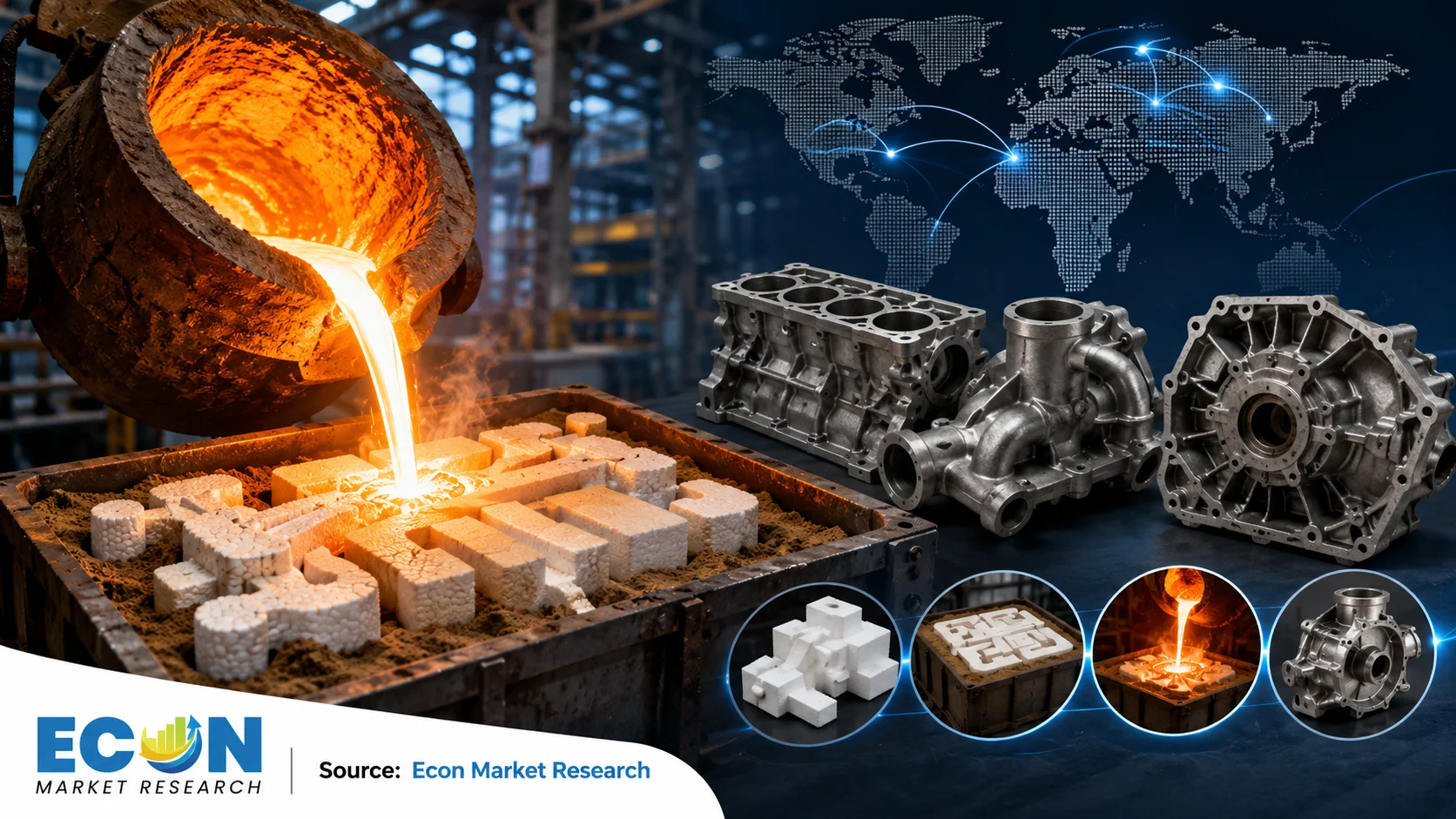
The global lost foam casting industry has developed into an important part of precision metal manufacturing, supporting automotive, marine, industrial machinery, energy, defense, and construction applications. The process uses an expanded polystyrene, or EPS, pattern that is coated with refractory material and placed in unbonded sand. When molten metal enters the mold, the foam pattern vaporizes and is replaced by metal in 1 continuous operation.
Global motor vehicle production increased from 92.7 million units in 2024 to 96.4 million units in 2025, strengthening demand for engine blocks, cylinder heads, housings, manifolds, transmission cases, and structural castings. Lost foam casting is particularly valuable because it can eliminate parting lines, reduce the use of conventional cores, consolidate multiple components, and produce complex internal passages.
Market Evolution and Growth Drivers
Lost foam casting technology originated from a patent application submitted by H. F. Shroyer in 1956, followed by patent approval in 1958 and the development of the dry-sand method in 1964. Industrial adoption expanded when automotive manufacturers began applying the process to aluminum cylinder heads and other mass-produced parts during the 1980s. In 2026, market development is being driven by vehicle lightweighting, electric mobility, near-net-shape manufacturing, digital simulation, automated foam-pattern production, and demand for fewer assembled components. A 10% reduction in vehicle weight can improve fuel economy by 6% to 8%, encouraging manufacturers to replace selected iron and steel parts with aluminum or magnesium castings. Lost foam casting supports this transition by enabling thin walls, integrated passages, lower machining requirements, and complex single-piece designs.
Top 5 Latest Trends in the Lost Foam Casting
1. Increasing Adoption of Lightweight Aluminum Castings
Lightweight aluminum casting is one of the most influential trends shaping the lost foam casting industry in 2026. Electric vehicles require lighter structural, powertrain, thermal-management, and battery-related components because battery packs can add 200 kg to 600 kg to vehicle weight, depending on capacity and platform design. Lost foam casting allows manufacturers to produce aluminum engine blocks, motor housings, transmission cases, cylinder heads, intake manifolds, and structural components with complicated internal channels.
European passenger vehicles contained 205 kg of aluminum per vehicle in 2022, compared with 174 kg in 2019, representing an 18% increase within 3 years. Aluminum content is expected to reach 237 kg per European vehicle in 2026 and 256 kg by 2030. These figures create a substantial opportunity for lost foam casting companies capable of controlling foam density, coating permeability, metal temperature, sand vibration, and solidification behavior.
Lost foam casting also supports component consolidation, enabling manufacturers to replace assemblies containing 3, 5, or 10 individual pieces with 1 integrated casting. Removing joints, welds, fasteners, and separate cores can reduce manufacturing stages while improving dimensional consistency. Pressurized lost foam processes using A356 aluminum can produce dense components with refined microstructures and reduced porosity.
Applications include cylinder heads, engine blocks, intake systems, electric motor housings, pump bodies, marine components, and defense-grade enclosures. As manufacturers target weight reductions of 5% to 15% across vehicles and industrial machines, aluminum lost foam casting is becoming a practical solution for balancing strength, complexity, tooling cost, and production volume.
2. Integration of 3D Printing and Digital Pattern Manufacturing
The integration of 3D printing, CAD, CAM, simulation software, and digitally machined foam patterns is changing how lost foam casting companies develop prototypes and production tooling. Traditional foam-pattern tooling can require several weeks of design, machining, testing, and modification. Digital manufacturing allows engineers to evaluate 3 or more design iterations before committing to hardened tooling. Large foundries can convert 3D data directly into foam patterns through CNC machining, additive manufacturing, or automated bead-molding systems. One leading full-mold specialist adopted CAD and CAM pattern manufacturing in 1987 and eliminated manually manufactured patterns by 2002, demonstrating how digital systems can transform casting repeatability and delivery speed.
Additive manufacturing is especially valuable for low-volume production, replacement parts, prototypes, and geometries requiring internal channels that are difficult to manufacture through conventional pattern tooling. Digital simulation tools can model metal flow, foam decomposition, gas evacuation, cooling behavior, shrinkage, and porosity before the first production pour. Engineers can examine 5 or 10 gating options virtually instead of producing physical trials for every configuration. Digital inspection systems using structured-light scanning and coordinate-measuring machines can compare finished castings with 3D models at hundreds of measurement points. This trend is reducing launch risk and supporting lost foam casting orders ranging from 1 prototype to thousands of serial-production parts.
3. Automation of Foam Molding, Coating, and Sand Compaction
Automation is becoming essential as lost foam casting manufacturers pursue higher output, consistent pattern quality, reduced scrap, and improved worker safety. A complete lost foam casting line can contain more than 10 coordinated stages, including bead pre-expansion, foam molding, pattern aging, assembly, refractory coating, drying, flask loading, sand filling, vibration, pouring, cooling, shakeout, sand recovery, cleaning, heat treatment, machining, and inspection. Variability at any 1 stage can cause folds, inclusions, porosity, dimensional distortion, carbon residue, or incomplete filling. Automated controls help maintain foam density, coating thickness, drying temperature, sand flow, vibration frequency, vacuum level, and pouring parameters within defined operating limits.
Robotic pattern handling and adhesive application allow manufacturers to assemble complex clusters with repeatable joint dimensions. Automated dipping and flow-coating systems can maintain coating layers measured in fractions of 1 mm, while controlled drying chambers regulate temperature and humidity. Three-dimensional compaction tables apply vibration along multiple axes to distribute unbonded sand around detailed pattern surfaces. Automated sand-recycling systems can screen, cool, clean, and return material to production, allowing the same sand to complete multiple cycles. Data collected from 100 or more process variables can be used to identify defect patterns, schedule preventive maintenance, and maintain consistent output across 2 or 3 production shifts.
4. Expansion of Lost Foam Casting Beyond Conventional Automotive Parts
Automotive applications remain central to lost foam casting, but the process is expanding into marine, agricultural, railway, mining, construction, machine-tool, renewable-energy, defense, and general industrial markets. Global vehicle production reached 96.4 million units in 2025, yet foundries are diversifying to reduce dependence on 1 end-use sector. Marine manufacturers use lost foam casting for engine components, propulsion-system parts, manifolds, housings, and water-management components. Agricultural and construction-equipment producers require pump housings, gearbox cases, hydraulic bodies, counterweights, brackets, and complex iron castings capable of operating for 5,000 to 20,000 hours.
Large-format full-mold casting has created another specialized opportunity. Advanced foundries can produce single castings measuring 8,200 mm in length and weighing 44 tons, supporting machine beds, press dies, turbine components, industrial frames, and energy equipment. One established producer reports full-mold production capacity of 78,000 tons per year. Lost foam casting is also used for customized artistic, architectural, and restoration components where production volumes may be limited to 1 or 2 units. The ability to manufacture cast iron, cast steel, stainless steel, and aluminum parts gives qualified suppliers access to multiple industries with different production cycles and technical requirements.
5. Greater Focus on Sustainability and Circular Manufacturing
Sustainability is influencing material selection, energy management, sand reuse, scrap control, and emissions monitoring across lost foam casting plants. Unlike conventional bonded-sand processes, lost foam casting generally uses dry, unbonded sand, which can be recovered and reused after screening, cooling, and dust removal. A closed-loop sand system can process several tons per hour while reducing purchases of fresh molding material. Component consolidation can also decrease the number of machining, welding, fastening, and transport operations required for 1 finished assembly. Reduced machining allowances can lower metal consumption and decrease the quantity of chips generated during finishing.
Environmental performance depends heavily on foam chemistry, pattern density, refractory coating permeability, filtration, and exhaust treatment. Modern foundries are installing thermal oxidation, dust collection, real-time temperature controls, energy-efficient melting systems, and waste-heat recovery equipment. Secondary aluminum is becoming increasingly important because it can be remelted repeatedly when alloy chemistry and contamination are properly controlled. Manufacturers are also measuring scrap at each of 10 or more production stages rather than evaluating only final casting rejection. This approach supports lower material loss, improved yield, fewer remelts, and stronger traceability for automotive and industrial customers seeking verified environmental performance.
Top 10 Companies in the Lost Foam Casting
1. Mercury Castings
Mercury Castings is headquartered in Fond du Lac, Wisconsin, United States, and operates as a vertically integrated aluminum-casting specialist serving marine, automotive, defense, recreation, and industrial customers. Its core lost foam casting expertise centers on pressurized lost foam technology using A356 aluminum. Pressure applied during solidification helps refine the microstructure, increase casting density, and reduce porosity.
The company produces engine blocks, cylinder heads, intake manifolds, transmission cases, structural components, and complex housings. Its broader capabilities include high-pressure die casting machines ranging from 900 tons to 4,500 tons, design-for-manufacturability reviews, simulation, tooling, prototyping, heat treatment, machining, and production sampling.
2. Kimura Foundry
Kimura Foundry is headquartered in Shizuoka Prefecture, Japan, and has operated as a specialist casting producer since its incorporation in 1948, following business origins dating to 1927. The company introduced full-mold casting in 1966 and adopted CAD and CAM pattern production in 1987. Its expertise includes evaporative pattern casting, full-mold casting, rapid prototype manufacturing, large industrial castings, machine-tool structures, automotive press dies, energy components, and reverse engineering.
Kimura can manufacture castings measuring 8,200 mm and weighing 44 tons, with reported production capacity of 78,000 tons per year. Its services cover foam-pattern production, casting, machining, inspection, prototype development, and low-volume complex components.
3. General Motors
General Motors is headquartered in Detroit, Michigan, United States, and is recognized as an early industrial adopter of lost foam casting for automotive production. The company applied full-mold technology to aluminum cylinder heads in 1980, helping establish the process for mass-produced automotive components. Its lost foam casting expertise has historically covered engine blocks, cylinder heads, manifolds, oil galleries, coolant passages, and other complex powertrain components.
General Motors operates across 4 principal automotive brands in the United States and maintains engineering, manufacturing, testing, and supplier-development capabilities across multiple countries. The company’s experience illustrates how lost foam casting can combine internal passages and external features within 1 near-net-shape component.
4. FATA Aluminum
FATA Aluminum is headquartered in Italy and provides complete aluminum-casting systems, engineering services, and foundry automation. With industrial experience spanning several decades, the company supports lost foam casting through process design, foam-pattern systems, sand handling, pouring equipment, heat treatment, finishing, and plant integration. Its engineering capabilities are relevant to automotive cylinder heads, engine blocks, suspension parts, electric motor housings, battery-related structures, and industrial aluminum components.
FATA Aluminum supplies greenfield and modernization projects involving dozens of connected machines, control systems, material-handling stations, and quality checkpoints. Its major services include feasibility analysis, plant layout, equipment installation, commissioning, training, production support, and lifecycle maintenance.
5. Vulcan Engineering
Vulcan Engineering is headquartered in Helena, Alabama, United States, and has provided foundry engineering and metalcasting equipment since 1970. Its lost foam casting expertise includes flask handling, sand filling, vibration, compaction, pouring, cooling, shakeout, casting cleaning, and automated material movement. The company designs equipment for iron, steel, aluminum, and other alloy foundries requiring repeatable processing across 2-shift or 3-shift operations.
Major products and services include robotic systems, manipulators, conveyors, pouring equipment, sand-processing systems, finishing machines, blast-cleaning equipment, engineering, installation, operator training, and aftermarket support. Its project-based approach enables manufacturers to integrate 5, 10, or more casting operations within a coordinated production cell.
6. Sinto Group
Sinto Group is headquartered in Nagoya, Japan, and traces its industrial history to 1934. The company supplies foundry equipment, surface-treatment systems, environmental controls, automation, inspection technology, and material-handling solutions. Its lost foam casting expertise relates to molding-line integration, sand preparation, flask systems, vibration equipment, shakeout, dust collection, and production monitoring.
Sinto serves automotive, machinery, infrastructure, aerospace, and general manufacturing customers through operations spanning multiple regions. Its major products include molding machines, sand systems, shot-blasting equipment, robotic cells, environmental systems, and digital foundry solutions capable of collecting data from hundreds of production signals.
7. Kurtz Ersa
Kurtz Ersa is headquartered in Germany and has manufacturing roots extending for more than 240 years. The company is a recognized producer of foam-processing, molding, automation, and foundry equipment. Its lost foam casting expertise is concentrated in EPS and expandable-polymer pattern production, including pre-expansion, molding, steam control, drying, handling, and automated pattern manufacturing.
Lost foam casting quality depends on pattern density and bead fusion, making controlled foam-processing technology essential for stable production. Kurtz Ersa’s major offerings include foam molding machines, pre-expanders, automation systems, foundry equipment, low-pressure casting systems, digital monitoring, maintenance, and technical support for production lines operating thousands of cycles.
8. Hebei Ruiou Lost Foam Science & Technology
Hebei Ruiou Lost Foam Science & Technology is headquartered in Hebei Province, China, and specializes in lost foam casting technology, production-line equipment, coatings, process engineering, and foundry implementation. China produced 30,269,903 passenger cars and 4,260,835 commercial vehicles in the referenced automotive production dataset, providing a substantial domestic base for casting suppliers.
The company’s expertise covers white-area and black-area plant systems, foam molding, cluster assembly, coating, drying, sand handling, vibration, vacuum molding, pouring, and sand recycling. Its principal offerings include complete lost foam casting lines, individual machines, technical consultation, plant commissioning, operator instruction, and process optimization.
9. RMC Casting Foundry
RMC Casting Foundry is based in Shandong Province, China, and supplies lost foam, sand, investment, and shell-mold castings to customers across more than 60 countries. Its lost foam casting portfolio includes gray iron gearbox housings, ductile iron parts, truck components, machinery castings, pump bodies, valve parts, and industrial enclosures. The company combines casting with CNC machining, heat treatment, surface treatment, testing, dimensional inspection, and export logistics. Its multi-process capability allows customers to compare 2 or more manufacturing routes for the same component according to alloy, annual volume, tolerance, surface finish, and tooling requirements.
10. Sunstar Castech
Sunstar Castech is headquartered in Rajkot, Gujarat, India, and produces precision-engineered castings and machined components through lost foam, no-bake, and green-sand processes. India manufactured 5,379,099 passenger cars and 1,111,711 commercial vehicles in the referenced production dataset, supporting demand for locally produced cast components. Sunstar Castech serves electric motors, pumps, pipe fittings, machine tools, industrial equipment, and engineering applications.
Its offerings include iron and steel castings, foam-pattern development, machining, inspection, and export-oriented component supply. The company’s use of 3 casting processes allows production planning to be matched with part geometry, weight, order quantity, finish, and mechanical-performance requirements.
Regional Outlook
North America
North America represents an established lost foam casting region supported by automotive, commercial vehicle, marine, defense, aerospace, energy, agricultural-equipment, and industrial-machinery production. The United States maintains a broad metalcasting network that supplies thousands of component designs for vehicles, pumps, compressors, engines, construction systems, valves, and power equipment. Lost foam casting is particularly relevant in the region because manufacturers require lightweight aluminum components, integrated engine passages, reduced machining, and reliable production traceability. North American suppliers have developed expertise in A356 aluminum, gray iron, ductile iron, pattern engineering, pressurized solidification, simulation, heat treatment, and precision machining.
Automotive lightweighting remains a major regional driver because reducing vehicle weight by 10% can improve fuel economy by 6% to 8%. Lost foam casting supports this objective by allowing 2, 3, or more previously separate components to be cast as 1 part. Marine manufacturing is another important application, particularly for engine blocks, cylinder heads, manifolds, propulsion housings, and fluid-management systems. Defense programs create additional demand for rugged housings and structural parts with complex geometry. Investment in automation, robotic handling, digital inspection, closed-loop sand recovery, and process-data analysis is helping regional foundries address skilled-labor constraints while maintaining repeatable output across multiple shifts.
Europe
Europe’s lost foam casting outlook is closely connected to automotive lightweighting, industrial machinery, renewable energy, railway equipment, premium vehicles, and environmental manufacturing standards. Germany produced 4,148,836 passenger vehicles in the referenced production period, while Italy, France, Spain, Poland, Czechia, Hungary, and other countries maintain extensive automotive-component supply chains. European manufacturers are increasing the use of aluminum in vehicles, with average content rising from 174 kg in 2019 to 205 kg in 2022. The average is forecast to reach 237 kg in 2026 and 256 kg by 2030, supporting demand for cast motor housings, battery structures, suspension components, heat-management parts, and integrated powertrain systems.
European lost foam casting companies must also address strict requirements related to emissions, energy use, material traceability, waste recovery, and workplace exposure. This environment encourages investment in electric melting, efficient furnaces, filtration, thermal treatment, sand reclamation, and automated process control. The region’s 27-country European Union manufacturing network provides access to vehicle, machinery, energy, and infrastructure customers, but high energy costs and competition from Asian suppliers remain challenges. Opportunities are strongest for companies delivering complex, low-machining, high-integrity castings rather than standardized commodity parts. Full-mold casting also supports European machine-tool, mold, die, and heavy-equipment producers requiring 1-unit or low-volume castings without conventional wooden patterns.
Asia-Pacific
Asia-Pacific is the largest manufacturing center for automotive vehicles, industrial machinery, pumps, agricultural equipment, construction systems, and metal castings. China produced 30,269,903 passenger cars and 4,260,835 commercial vehicles in the referenced production dataset, while India produced 5,379,099 passenger cars and 1,111,711 commercial vehicles. Japan, South Korea, Thailand, Indonesia, and Vietnam also maintain extensive manufacturing ecosystems. These production volumes create demand for millions of engine, transmission, motor, pump, compressor, valve, gearbox, and structural components that can be manufactured through lost foam casting.
China has developed a broad lost foam casting supply chain covering complete production lines, EPS materials, coatings, vibration tables, vacuum systems, sand-recycling units, foundry services, machining, and export logistics. Japan contributes high-precision full-mold expertise, including castings weighing up to 44 tons and measuring 8,200 mm. India is expanding its adoption of lost foam technology in automotive, pumps, electric motors, agricultural equipment, machine tools, and infrastructure. The top 10 casting nations account for 88% of global casting production, demonstrating the geographic concentration of manufacturing capability. Asia-Pacific suppliers are increasingly adopting robotic handling, 3D pattern development, digital simulation, automatic coating, and CNC machining to move from basic castings toward integrated, export-ready components.
Middle East & Africa
The Middle East and Africa's lost foam casting industry is developing through investments in construction, oil and gas, water infrastructure, mining, transportation, power generation, agriculture, and industrial localization. Demand is concentrated in pump bodies, valve housings, pipe fittings, crusher parts, wear components, engine parts, railway equipment, compressor housings, and heavy-machinery castings. Many regional projects require components capable of operating in temperatures above 40°C, abrasive mining conditions, corrosive fluids, or continuous industrial cycles exceeding 8,000 hours per year.
Regional governments are promoting domestic manufacturing to reduce dependence on imported industrial parts and shorten replacement lead times that can extend beyond 8 or 12 weeks. Lost foam casting provides an opportunity to manufacture complex spare parts from scanned components or digital models without investing in conventional wooden patterns. South Africa, Egypt, Türkiye, Saudi Arabia, and the United Arab Emirates have the strongest combinations of industrial demand, foundry infrastructure, engineering services, ports, and logistics. However, adoption remains constrained by limited process expertise, inconsistent EPS and coating supply, energy costs, and the need for automated sand-processing systems. Partnerships with Asian, European, or North American technology providers can help local foundries establish production cells containing 10 or more coordinated process stages.
Future Opportunities in the Lost Foam Casting
Future opportunities in lost foam casting will emerge from electric vehicles, component consolidation, digital manufacturing, large industrial castings, replacement parts, recycled alloys, and localized supply chains. Global motor vehicle production reached 96.4 million units in 2025, and each platform contains dozens of cast components across thermal management, motors, transmissions, suspension, braking, body structure, and auxiliary systems. Lost foam casting companies can pursue EV-specific components such as motor housings, inverter enclosures, cooling-system bodies, gearbox cases, structural brackets, and integrated fluid-management parts.
Digital foam-pattern production creates opportunities for orders ranging from 1 replacement component to thousands of serial castings. A worn pump housing, machine base, or industrial manifold can be scanned into a 3D model, modified, converted into a foam pattern, and cast without maintaining physical pattern inventory for 10 or 20 years. This capability is valuable for railways, power plants, mines, ships, and factories operating equipment whose original parts are no longer available.
Large-format full-mold casting offers another opportunity for machine tools, renewable-energy equipment, press dies, turbine systems, and industrial frames. Castings reaching 8,200 mm and 44 tons demonstrate the process’s ability to serve applications beyond standard automotive components. Future plants will increasingly combine simulation, robotic handling, sensor-based pouring, automated inspection, and sand recycling. Suppliers that control all 5 critical areas—pattern quality, coating performance, sand compaction, metal flow, and solidification—will be positioned to deliver lower rejection rates and stronger production consistency.
Conclusion
The lost foam casting industry has progressed from a patented concept introduced in 1956 into an advanced manufacturing process used for automotive, marine, machinery, energy, defense, agricultural, and infrastructure components. Its ability to eliminate parting lines, reduce conventional cores, create internal passages, and combine multiple pieces into 1 casting gives it a distinctive position among modern metalcasting processes. Companies such as Mercury Castings and Kimura Foundry demonstrate the process’s range, from pressurized A356 aluminum engine components to industrial castings weighing 44 tons.
The competitive landscape in 2026 includes specialized foundries, automotive manufacturers, foam-equipment producers, automation companies, coating suppliers, and complete plant integrators. Demand is supported by 96.4 million vehicles produced globally in 2025, increasing aluminum content, electric mobility, digital pattern manufacturing, and the need for localized industrial supply. The strongest future opportunities will belong to companies that combine casting knowledge with 3D engineering, simulation, robotics, machining, inspection, environmental control, and material traceability. Lost foam casting companies capable of controlling every major production parameter across 10 or more processing stages can deliver the dimensional accuracy, repeatability, complexity, and manufacturing efficiency required by next-generation industrial customers.