


Top Companies in Agentic AI Platforms Transforming Enterprise Automation
The top companies in Agentic AI Platforms are advancing autonomous workflows, multi-agent systems, enterprise automation, governance, and AI innovation.
Introduction
Overview of the Global Agentic AI Platforms Industry
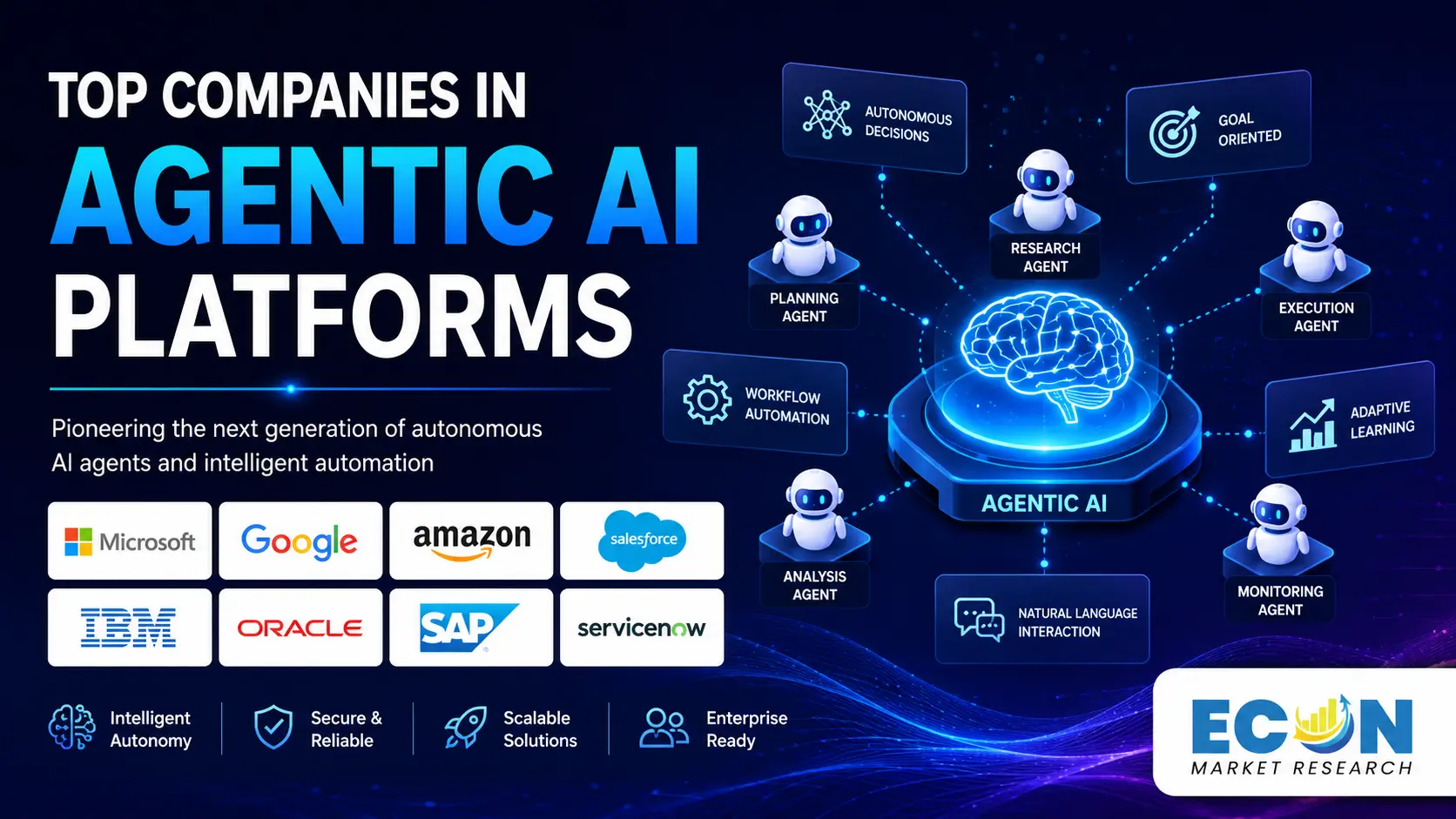
The global Agentic AI Platforms industry entered a decisive commercialization phase during 2025 and 2026 as enterprises moved beyond conversational assistants toward artificial intelligence systems capable of planning, reasoning, selecting tools, executing tasks, and evaluating outcomes. In 2024, 78% of surveyed organizations reported using AI in at least 1 business function, compared with 55% in 2023, demonstrating the expanding foundation for agent-based automation. Modern Agentic AI Platforms combine large language models, enterprise data, application programming interfaces, workflow engines, memory systems, security controls, and human approval checkpoints. These capabilities support autonomous operations across customer service, software engineering, finance, human resources, cybersecurity, supply chains, sales, and information technology.
Market Evolution and Growth Drivers
Agentic AI Platforms evolved rapidly between 2023 and 2026 because organizations required systems that could complete multi-step processes instead of generating isolated answers. The market transitioned through 3 broad stages: conversational copilots, task-specific agents, and coordinated multi-agent ecosystems. Adoption is being driven by cloud availability, stronger reasoning models, declining inference costs, enterprise application integration, and the introduction of open interoperability standards. Amazon Bedrock alone supports generative AI applications and agents for over 100,000 organizations, indicating the scale at which managed AI infrastructure is being deployed. Enterprise demand is also shifting toward centralized governance, because organizations may eventually operate 100s or 1,000s of specialized agents across multiple departments.
Top 5 Latest Trends in the Agentic AI Platforms
1. Multi-Agent Orchestration
Multi-agent orchestration is one of the most important Agentic AI Platforms trends in 2026 because complex enterprise processes rarely fit within the capabilities of 1 general-purpose agent. A coordinated architecture can assign separate responsibilities to planning agents, research agents, transaction agents, validation agents, and compliance agents. Each specialized agent performs a defined function while an orchestrator determines sequencing, tool access, shared context, and escalation rules. This structure improves modularity and makes failures easier to identify than in a single, unrestricted autonomous system. Enterprise platforms now support agent teams that collaborate across customer service, IT operations, finance, procurement, security, and employee support workflows involving 5, 10, or even 50 individual steps.
The commercial significance of multi-agent orchestration is reflected in the launch of dedicated control layers during 2025 and 2026. ServiceNow introduced its AI Agent Orchestrator and AI Agent Studio in March 2025, while IBM expanded watsonx Orchestrate with a centralized agentic control plane in May 2026. Google’s development framework supports sub-agents, session states, tools, evaluations, and multi-agent systems across 5 programming languages, including Python, TypeScript, Go, Java, and Kotlin. These developments show that orchestration is becoming a foundational platform requirement rather than an optional feature. Successful deployments increasingly use 1 supervisory agent to coordinate multiple domain agents while retaining human approval for sensitive transactions.
2. Enterprise Governance and AI Control Towers
Governance has become a central Agentic AI Platforms trend because autonomous systems can access databases, initiate transactions, send communications, modify records, and interact with 3rd-party applications. Traditional AI monitoring focused on model accuracy, but agentic governance must also examine permissions, identity, memory, tool usage, action history, data exposure, policy compliance, and business outcomes. Organizations are therefore establishing AI control towers that provide inventories of deployed agents, approved models, connected tools, assigned owners, operational risks, and performance indicators. A mature governance framework typically applies at least 4 layers of control: authentication, authorization, action validation, and post-execution auditing.
ServiceNow launched an AI Control Tower in May 2025 to govern native and 3rd-party agents, models, and workflows through 1 centralized environment. IBM introduced a comparable control plane in May 2026 for managing enterprise agent ecosystems. Regulatory deadlines are reinforcing this trend, particularly in Europe, where the Artificial Intelligence Act entered into force on August 1, 2024, general-purpose AI rules began applying on August 2, 2025, and additional transparency obligations become applicable on August 2, 2026. As a result, leading Agentic AI Platforms increasingly provide audit trails, policy enforcement, risk classification, evaluation dashboards, explainability features, and configurable human-in-the-loop controls.
3. Low-Code and No-Code Agent Development
Low-code and no-code development is expanding the Agentic AI Platforms market by enabling employees without advanced programming knowledge to build specialized agents using natural-language instructions and visual workflow components. In a conventional development model, creating an enterprise automation may require 3 separate teams covering software engineering, data integration, and business process design. Low-code agent builders reduce this dependency by allowing subject-matter experts to define goals, instructions, data sources, tools, guardrails, triggers, and escalation conditions within 1 interface. This approach is particularly valuable for organizations facing shortages of AI engineers and seeking to deploy 10s or 100s of departmental agents without creating an equivalent number of custom software projects.
Microsoft Copilot Studio, Salesforce Agent Builder, and ServiceNow AI Agent Studio are prominent examples of this trend. These tools allow organizations to create custom agents, connect business applications, apply predefined templates, and establish operational boundaries with limited code. Salesforce promotes preset templates and no-code agent creation, while ServiceNow provides a natural-language interface for building specialized agents and setting guardrails. Microsoft also offers a 10-minute organizational agent-readiness assessment connected to its Copilot Studio adoption program. Low-code capabilities will not eliminate professional development teams, but they can shift 30% to 60% of initial workflow configuration toward business users while technical specialists concentrate on security, integration, testing, and platform architecture.
4. Open Agent Interoperability and Tool Connectivity
Interoperability is becoming a defining feature of Agentic AI Platforms because enterprises rarely operate within 1 software ecosystem. A typical large organization may use 100s of cloud applications, internal databases, legacy systems, collaboration tools, and industry-specific platforms. Agents must therefore communicate with external tools and other agents through standardized interfaces instead of depending on a separate custom integration for every connection. Model Context Protocol and Agent-to-Agent communication approaches are helping developers create reusable connections among AI models, enterprise tools, data resources, and independently developed agents. This shift resembles the role that application programming interfaces played during the previous 20 years of cloud software expansion.
Modern platforms are increasingly designed to support 1 agent that can discover tools dynamically and collaborate with agents hosted in different environments. Google’s Agent Development Kit supports external tools, custom functions, session management, sub-agents, and built-in evaluations. Google’s enterprise platform also provides agent identity, gateway controls, private network connectivity, context management, and bidirectional streaming for real-time applications. Microsoft has integrated Model Context Protocol capabilities across parts of its agent ecosystem, while IBM and ServiceNow support coordination of native and external agents. Interoperability can reduce duplicated integration work, but organizations must still validate 4 critical elements: identity, authentication, data boundaries, and output compatibility.
5. Domain-Specific Agents with Measurable Outcomes
Agentic AI Platforms are moving from general demonstrations toward domain-specific systems designed to deliver measurable operational outcomes. During the first wave of generative AI adoption, many enterprises deployed broad assistants that summarized documents or answered questions. In 2026, buyers increasingly prioritize agents that can resolve service cases, investigate security incidents, qualify sales opportunities, reconcile invoices, onboard employees, update software, or optimize supply chain decisions. Domain specialization improves performance because the agent receives controlled access to relevant data, approved tools, role-specific instructions, industry terminology, and measurable success criteria. A customer-service agent, for example, may be evaluated using 5 indicators: resolution rate, response accuracy, escalation frequency, processing time, and customer satisfaction.
Production research illustrates the potential of tightly scoped agentic systems. A security investigation agent deployed across 10s of thousands of customer environments achieved 80.1% precision from user feedback during a 120-day evaluation and generated novel alerts for 15% of investigated incidents. Another production study involving compound AI systems reported a reduction of over 50% in 95th-percentile latency and an improvement of up to 3.9 times in throughput. These findings indicate that Agentic AI Platforms can deliver tangible value when organizations apply narrow objectives, validated tools, structured evaluation, and operational monitoring rather than giving 1 unrestricted agent responsibility for every business function.
Top 5 Companies in the Agentic AI Platforms
1. Microsoft
Company Overview
Microsoft is one of the leading companies in the Agentic AI Platforms landscape because it combines cloud infrastructure, productivity applications, developer tools, security products, enterprise data services, and AI development capabilities within 1 broad ecosystem. Founded in 1975, the company has spent over 50 years building enterprise software and now positions agents as a new interface for digital work. Its approach spans individual productivity agents, departmental agents, autonomous business-process agents, software development agents, and centrally governed enterprise agent ecosystems. The company’s established presence across Microsoft 365, Azure, Dynamics 365, GitHub, Teams, Power Platform, and security applications gives its agents access to multiple forms of organizational context.
Headquarters
Microsoft is headquartered in Redmond, Washington, United States, and operates across over 190 countries. Its North American location places the company within the world’s largest concentration of AI developers, cloud customers, research institutions, and newly funded AI enterprises. In 2024, the United States produced 1,073 newly funded AI companies, compared with 116 in the United Kingdom and 98 in China, supporting an extensive domestic innovation ecosystem for Microsoft’s agent technologies. The company also maintains engineering, research, sales, cloud infrastructure, and customer-support operations across Europe, Asia-Pacific, Latin America, the Middle East, and Africa.
Core Agentic AI Platforms Expertise
Microsoft’s core expertise includes low-code agent development, model hosting, enterprise grounding, identity management, workflow automation, tool integration, multi-agent coordination, application development, and centralized governance. Copilot Studio allows organizations to build and manage custom agents, while Microsoft Foundry supports developers creating more advanced AI applications and agentic systems. GitHub provides coding agents for software engineering workflows, and Microsoft 365 supplies organizational context through email, documents, chats, meetings, calendars, and collaboration records. During 2026, Microsoft also expanded its focus on always-active agents capable of working across cloud, desktop, web, browser, local resources, and protocol-connected systems.
Major Products and Services
Microsoft’s major Agentic AI Platforms products and services include Copilot Studio, Microsoft Foundry, Azure AI services, Microsoft 365 Copilot, Dynamics 365 agents, GitHub Copilot, Security Copilot, Power Automate, Fabric, and enterprise identity services. Copilot Studio supports the creation, deployment, and lifecycle management of custom agents, while Foundry provides model access, development tooling, evaluations, safety controls, and production deployment capabilities. Microsoft 365 connects agents with 4 major productivity data categories: communications, documents, meetings, and business knowledge. The company’s integrated portfolio makes it particularly suitable for organizations already using 3 or more Microsoft enterprise application families.
2. Salesforce
Company Overview
Salesforce is a prominent Agentic AI Platforms company focused on autonomous customer relationship management, sales, service, marketing, commerce, and employee workflows. Founded in 1999, the company built its market position around cloud-based business applications and later expanded into analytics, collaboration, integration, data management, and artificial intelligence. Agentforce represents Salesforce’s transition from predictive recommendations and conversational assistants to agents that can interpret requests, retrieve customer context, determine appropriate actions, use approved business tools, and complete multi-step workflows. The platform is designed for both customer-facing and employee-facing deployments operating 24 hours per day and 7 days per week.
Headquarters
Salesforce is headquartered in San Francisco, California, United States, placing it within 1 of the world’s most active enterprise software and AI development regions. The company operates globally through offices, data infrastructure, implementation partners, consulting organizations, developers, and application providers. Its platform serves businesses of multiple sizes across sectors including banking, retail, healthcare, manufacturing, telecommunications, government, consumer goods, travel, and professional services. Salesforce’s geographic reach enables multinational organizations to configure agents for multiple languages, business units, regulatory environments, and customer-service channels without developing a separate technology foundation for every country.
Core Agentic AI Platforms Expertise
Salesforce specializes in customer-data-grounded agents, customer service automation, sales development, marketing workflows, commerce assistance, employee productivity, low-code agent building, analytics, integration, and trust controls. Agentforce uses CRM records, enterprise data, business rules, actions, and conversational context to support autonomous decisions. Its strategic advantage is the ability to connect agents directly with customer profiles, service cases, sales opportunities, campaign records, orders, and collaboration channels. The platform can support both 1 specialized agent and coordinated agent deployments across multiple customer lifecycle functions. Salesforce also emphasizes deterministic guardrails, context engineering, testing, observability, and secure action execution as key requirements for production adoption.
Major Products and Services
Major Salesforce products supporting Agentic AI Platforms include Agentforce, Agent Builder, Data 360, Customer 360 applications, Service Cloud, Sales Cloud, Marketing Cloud, Commerce Cloud, MuleSoft, Tableau, and Slack. Agent Builder allows organizations to create agents using predefined templates or no-code configuration, while MuleSoft provides connections to external enterprise applications and application programming interfaces. Slack gives agents a collaborative interface for employee workflows, and Data 360 provides unified information for grounding agent decisions. These components create a platform capable of connecting at least 4 operational layers: data, reasoning, actions, and user interaction.
3. Google
Company Overview
Google is a major Agentic AI Platforms provider through its cloud infrastructure, Gemini model family, enterprise search technology, development frameworks, productivity applications, and data analytics services. Founded in 1998, the company has accumulated over 25 years of experience in search, machine learning, distributed computing, information retrieval, language processing, and digital advertising. Its agent platform strategy focuses on helping developers build, scale, govern, evaluate, and optimize agents capable of operating across enterprise data and external tools. Google supports both individual assistants and sophisticated multi-agent systems that divide complex objectives among specialized components.
Headquarters
Google is headquartered in Mountain View, California, United States, and maintains operations across North America, Europe, Asia-Pacific, Latin America, the Middle East, and Africa. The company operates cloud regions, engineering offices, research centers, data infrastructure, and customer-support networks across multiple countries. Its headquarters provides access to the United States AI ecosystem, which recorded 6,956 newly funded AI companies between 2013 and 2024. India recorded 434 companies during the same period, while Germany recorded 394, Japan recorded 270, and Singapore recorded 178, illustrating the international developer markets addressed by Google’s AI services.
Core Agentic AI Platforms Expertise
Google’s expertise includes agent development frameworks, model reasoning, multimodal AI, enterprise search, retrieval, tool integration, agent evaluation, scalable runtime infrastructure, identity, security, and multi-agent collaboration. The Agent Development Kit allows developers to build production agents in at least 5 supported programming languages. It also includes session-state management, sub-agent organization, custom tools, development interfaces, and an evaluation framework. Google’s enterprise agent platform supports runtime scaling, context management, agent identity, private connectivity, gateway controls, and real-time bidirectional communication, providing the infrastructure required to move from 1 prototype to large production deployments.
Major Products and Services
Google’s major products and services include Gemini Enterprise Agent Platform, Agent Development Kit, Gemini models, Agent Engine, Agent Garden, Vertex AI Search, BigQuery, Google Cloud infrastructure, Workspace integrations, and enterprise security services. The platform supports the complete agent lifecycle across 4 major stages: building, deploying, governing, and optimizing. Developers can ground agents in enterprise databases, documents, search indexes, cloud storage, and custom applications. Organizations can also combine Google-built models with selected 3rd-party technologies and internally developed tools. This flexibility makes the platform relevant to customer service, data analysis, software engineering, document processing, research, commerce, operations, and knowledge-management applications.
4. IBM
Company Overview
IBM is an established enterprise technology provider with significant expertise in hybrid cloud, artificial intelligence, consulting, automation, mainframe systems, data management, and regulated-industry deployments. Founded in 1911, IBM brings over 100 years of enterprise technology experience to the Agentic AI Platforms sector. Its strategy focuses on governed agent orchestration, enterprise workflow automation, model flexibility, secure deployment, and integration across existing business systems. IBM positions watsonx Orchestrate as a control layer through which organizations can coordinate agents, assistants, tools, applications, and human participants within multi-step operational processes.
Headquarters
IBM is headquartered in Armonk, New York, United States, and operates in over 170 countries. Its global presence supports Agentic AI Platforms adoption among multinational banks, insurers, manufacturers, telecommunications companies, healthcare organizations, retailers, public agencies, and infrastructure operators. IBM’s experience with regulated enterprises is particularly relevant because autonomous agents often require stronger governance than conventional software. A deployment in financial services, for example, may need at least 5 controls covering customer identity, data privacy, action authorization, model monitoring, and auditable recordkeeping before an agent can execute transactions independently.
Core Agentic AI Platforms Expertise
IBM specializes in multi-agent orchestration, hybrid-cloud deployment, enterprise automation, governance, model choice, data integration, responsible AI, and consulting-led implementation. Watsonx Orchestrate provides a unified environment for coordinating agents and assigning each interaction to an appropriate tool, assistant, specialized agent, or human employee. The platform also supports centralized visibility into an organization’s broader agent ecosystem. IBM’s orchestrator can manage multi-turn conversations and use reasoning models to select the correct capability at each stage. This architecture is valuable for workflows that cross 3 or more departments, applications, or approval layers.
Major Products and Services
IBM’s major offerings include watsonx Orchestrate, watsonx.ai, watsonx.data, watsonx.governance, IBM Granite models, automation software, integration services, hybrid-cloud infrastructure, and consulting. Watsonx Orchestrate functions as an agentic control plane for monitoring, managing, coordinating, and optimizing enterprise agents. Watsonx.governance adds lifecycle controls, while watsonx.data provides access to governed enterprise information. IBM Granite offers models designed for business applications, and the company’s consulting organization supports strategy, process redesign, implementation, security, and workforce transformation. Together, these capabilities address 5 recurring enterprise priorities: interoperability, governance, security, scalability, and measurable operational value.
5. Amazon Web Services
Company Overview
Amazon Web Services is one of the largest cloud infrastructure providers supporting the development and deployment of Agentic AI Platforms. Launched in 2006, the business has built a global portfolio covering computing, storage, databases, networking, security, analytics, machine learning, integration, and application development. Amazon Bedrock provides a managed environment for developing generative AI applications and agents using foundation models from Amazon and multiple external model providers. The service supports over 100,000 organizations, demonstrating broad adoption across startups, mid-sized companies, public institutions, and multinational enterprises.
Headquarters
Amazon Web Services operates from Amazon’s headquarters region in Seattle and Bellevue, Washington, United States, while maintaining cloud infrastructure across numerous global geographic areas. Its distributed infrastructure supports organizations that require local data processing, disaster recovery, low-latency applications, and jurisdiction-specific deployment. Agentic systems may execute 10s of model requests, retrieval operations, database queries, and tool calls during a single workflow, making infrastructure availability and elasticity important. Amazon’s global architecture enables customers to deploy agents closer to users, enterprise applications, and regulated datasets while applying region-specific identity and security controls.
Core Agentic AI Platforms Expertise
Amazon Web Services specializes in scalable AI infrastructure, managed model access, agent development, knowledge retrieval, action execution, multi-agent collaboration, security, observability, and serverless deployment. Amazon Bedrock offers enterprise-grade access to high-performing foundation models and supporting capabilities for building production applications. The platform allows organizations to connect agents with knowledge bases, enterprise systems, application programming interfaces, databases, and workflow tools. Multi-agent collaboration enables a supervisor agent to coordinate specialized sub-agents, while managed infrastructure reduces the operational burden of provisioning separate model servers for every use case.
Major Products and Services
Major Amazon Web Services offerings for Agentic AI Platforms include Amazon Bedrock, Agents for Amazon Bedrock, Bedrock Knowledge Bases, Bedrock Guardrails, model evaluation capabilities, Amazon Q, Lambda, Step Functions, API Gateway, databases, identity services, monitoring tools, and cloud security products. These services provide 6 essential layers for agent deployment: models, knowledge, actions, orchestration, governance, and infrastructure. Customers can use Bedrock to select among multiple model providers instead of relying on 1 model family. This flexibility is valuable when different agents require distinct combinations of reasoning quality, response speed, context capacity, multimodal support, and deployment economics.
Regional Outlook
North America
North America leads the Agentic AI Platforms industry because the region combines advanced cloud infrastructure, major platform providers, AI research institutions, enterprise software companies, venture-backed startups, and early technology adopters. The United States recorded 1,073 newly funded AI companies in 2024, compared with 116 in the United Kingdom and 98 in China. Between 2013 and 2024, the United States recorded 6,956 newly funded AI companies, giving the region a large pipeline of agent-development frameworks, models, evaluation systems, security tools, integration products, and industry-specific applications. Canada contributed another 481 companies during the same period, strengthening North America’s overall innovation capacity.
Enterprise adoption in North America is concentrated in customer service, software development, cybersecurity, finance, healthcare administration, retail, logistics, human resources, and information technology. Organizations are increasingly moving from 1 departmental pilot toward portfolios containing 10s of agents. The regional market benefits from extensive use of cloud-based customer relationship management, collaboration suites, data platforms, and application programming interfaces, which simplify agent integration. However, user confidence remains mixed: only 39% of respondents in the United States and 40% in Canada viewed AI products and services as offering greater benefits than harms, indicating that trust, transparency, and reliability remain important adoption barriers.
Governance requirements in North America are developing through industry rules, state-level legislation, federal guidance, contractual controls, and internal enterprise policies. Buyers increasingly demand permission management, audit logs, evaluation testing, data-loss prevention, human approval, and rollback procedures before granting agents access to high-impact operations. A production security agent evaluated over 120 days achieved 80.1% precision, but the same research also reported a 0.38% job-level failure rate, illustrating why even high-performing autonomous systems require monitoring. North American platform providers will continue competing on 5 dimensions: model quality, integration depth, governance, infrastructure scale, and verified business outcomes.
Europe
Europe represents a strategically important Agentic AI Platforms region because it combines strong industrial sectors, advanced digital infrastructure, established enterprise software demand, multilingual business environments, and the world’s most comprehensive horizontal AI regulatory framework. Between 2013 and 2024, France recorded 468 newly funded AI companies, Germany recorded 394, the Netherlands recorded 116, Spain recorded 117, and Switzerland recorded 239. The United Kingdom, considered separately from the European Union but central to the wider European AI ecosystem, recorded 885 newly funded AI companies during the same period. These figures demonstrate a broad innovation base extending beyond 1 national technology center.
The European Artificial Intelligence Act is shaping platform design and purchasing decisions. The legislation entered into force on August 1, 2024, initial provisions and prohibitions began applying on February 2, 2025, and general-purpose AI rules became applicable on August 2, 2025. Additional transparency obligations concerning certain AI-generated content become applicable on August 2, 2026. Companies deploying autonomous agents must therefore assess risk classification, transparency, human oversight, documentation, data governance, cybersecurity, and monitoring requirements. Agentic AI Platforms with built-in governance capabilities are likely to gain an advantage because enterprises may prefer 1 integrated compliance environment over numerous disconnected monitoring tools.
European adoption is expected to be strongest in manufacturing, automotive, financial services, telecommunications, pharmaceuticals, energy, logistics, public administration, and professional services. Industrial companies can use agents to analyze equipment data, coordinate maintenance, review technical documentation, and support supply planning across 10s of facilities. Banks and insurers can apply controlled agents to document processing, compliance reviews, customer support, and internal knowledge retrieval. Public agencies may deploy agents for multilingual citizen services while retaining human authority for legal or eligibility decisions. European buyers are likely to prioritize 4 capabilities: regional data control, auditable decision processes, multilingual performance, and configurable human oversight.
Asia-Pacific
Asia-Pacific is emerging as a major Agentic AI Platforms growth region because it combines large digital populations, expanding cloud infrastructure, manufacturing leadership, mobile-first services, government AI strategies, and a substantial developer workforce. Between 2013 and 2024, China recorded 1,605 newly funded AI companies, India recorded 434, Australia recorded 178, Japan recorded 270, South Korea recorded 388, and Singapore recorded 178. These 6 markets collectively provide a diverse base of AI research, software development, electronics manufacturing, financial technology, telecommunications, and digital commerce capabilities.
Public attitudes toward AI are comparatively positive in several Asia-Pacific markets. In a global survey, 83% of respondents in China, 80% in Indonesia, and 77% in Thailand considered AI products and services more beneficial than harmful. This confidence can support faster experimentation with AI agents in digital banking, e-commerce, customer service, education, travel, telecommunications, and government services. Nevertheless, adoption patterns vary substantially across the region’s 40-plus economies. Highly digitized markets may focus on multi-agent enterprise automation, while developing markets may prioritize mobile agents that provide customer assistance, language translation, document support, and access to public services.
Asia-Pacific also offers major opportunities for industrial and supply chain agents. Manufacturers can deploy agents to monitor production schedules, identify component shortages, analyze quality records, coordinate maintenance, and update procurement systems. Financial institutions can use agents for onboarding, service requests, fraud investigation, and compliance workflows involving 5 or more verification stages. India’s large software services sector can accelerate implementation for international enterprises, while Japan and South Korea can combine agentic software with robotics, electronics, mobility, and smart-factory systems. Regional platform competition will center on multilingual accuracy, local cloud availability, regulatory alignment, mobile integration, and the ability to handle high-volume workflows.
Middle East & Africa
The Middle East and Africa region is developing as an important Agentic AI Platforms market through national digital-transformation programs, public-sector modernization, cloud infrastructure investment, financial technology, telecommunications expansion, and smart-city initiatives. The region contains over 70 countries with substantially different levels of digital maturity, creating varied demand for enterprise agents. Gulf economies are investing in advanced government services, aviation, energy, healthcare, tourism, banking, and logistics, while African markets are applying AI to mobile financial services, agriculture, telecommunications, education, healthcare access, and customer support. Agentic platforms can help organizations address skills shortages by automating workflows that involve 3 to 10 repetitive administrative stages.
Middle Eastern adoption is expected to focus on bilingual and multilingual agents capable of supporting Arabic and English interactions across public and private services. Government agencies can use agents for permit guidance, document routing, service-request classification, and internal knowledge retrieval, while retaining human approval for legally significant decisions. Energy companies may deploy agents for maintenance planning, operational documentation, safety workflows, and supply-chain coordination. Banks can use governed agents for customer onboarding, compliance checks, service resolution, and employee assistance. Large organizations will require platforms that provide 24-hour availability, regional data controls, role-based permissions, and detailed audit records.
African adoption will be influenced by mobile access, cloud connectivity, language diversity, infrastructure availability, and implementation costs. The continent has over 2,000 living languages, making multilingual and speech-enabled agents strategically valuable. Telecommunications companies can deploy agents to resolve billing issues, manage service requests, and support network operations across millions of subscribers. Agricultural agents can provide crop guidance, weather-related recommendations, and supply information, while healthcare agents can assist with scheduling, administrative triage, and patient communication. Market development will depend on 5 factors: affordable inference, local-language performance, mobile integration, reliable connectivity, and trusted data-governance frameworks.
Future Opportunities in the Agentic AI Platforms
The future of Agentic AI Platforms will extend beyond employee copilots toward coordinated digital workforces that can execute entire business processes under defined controls. Organizations may operate 100s or 1,000s of agents covering sales, service, finance, procurement, human resources, security, legal operations, software development, and supply chains. This expansion will create demand for agent registries, identity services, evaluation systems, simulation environments, policy engines, cost controls, and centralized observability. The most valuable platforms will not simply generate intelligent responses; they will reliably coordinate data, reasoning, tools, actions, approvals, and performance measurement across 5 or more enterprise systems.
A major opportunity will emerge in vertical Agentic AI Platforms designed for regulated or technically complex industries. Healthcare platforms can support clinical administration, coding, scheduling, documentation, and supply management, while keeping licensed professionals responsible for treatment decisions. Financial platforms can automate document review, customer onboarding, fraud investigation, and compliance preparation through workflows containing 10s of validation rules. Manufacturing agents can coordinate equipment maintenance, quality management, production scheduling, and procurement. Industry-specific platforms can outperform generic systems by incorporating specialized terminology, approved data models, regulatory controls, operational tools, and domain-specific evaluation benchmarks.
Small and medium-sized businesses will represent another significant opportunity as low-code platforms reduce technical barriers. A company with 50 employees may not maintain a dedicated AI engineering department, but it can still deploy agents for lead qualification, customer support, invoice processing, inventory updates, appointment scheduling, and internal knowledge retrieval. Managed Agentic AI Platforms can provide templates, secure connectors, monitoring, and usage controls through 1 subscription environment. This accessibility may enable smaller organizations to automate 20% to 40% of repetitive administrative work while allowing employees to concentrate on judgment, customer relationships, product development, and business expansion.
Agent marketplaces and interoperability ecosystems will also expand. Organizations will be able to select specialized agents developed by platform providers, consulting firms, independent software companies, or internal teams. A procurement workflow may combine 1 supplier-research agent, 1 risk agent, 1 contract-review agent, and 1 approval agent. Standard communication protocols can make these components reusable across different platforms, but independent certification will become important. Buyers will expect agents to be tested for security, reliability, privacy, bias, interoperability, and task completion before receiving access to production systems.
Evaluation technology will become one of the largest supporting opportunities because agent performance cannot be measured through language quality alone. Enterprises will track completion rates, action accuracy, tool-selection quality, escalation frequency, latency, policy violations, operational cost, and business impact. A platform may need 100s or 1,000s of simulated scenarios before an agent is approved for live deployment. Continuous evaluation will then examine production behavior and identify performance changes caused by updated models, tools, instructions, data sources, or business rules. The companies that deliver verifiable reliability and transparent measurement will be better positioned than providers focused only on demonstration-level autonomy.
Conclusion
The Agentic AI Platforms industry is redefining enterprise automation by combining reasoning models, business data, software tools, workflow engines, memory, governance, and human supervision within unified environments. Between 2023 and 2026, the market progressed from conversational assistants toward autonomous and multi-agent systems capable of completing complex operational objectives. Microsoft, Salesforce, Google, IBM, and Amazon Web Services are among the leading companies shaping this transformation through cloud infrastructure, low-code development, enterprise integrations, orchestration tools, governance controls, and industry-focused services.
The next phase will be determined by execution quality rather than the number of agents announced. Enterprises will evaluate Agentic AI Platforms according to at least 6 criteria: reliability, security, integration, governance, scalability, and measurable business outcomes. North America will remain a major innovation center, Europe will influence responsible platform design, Asia-Pacific will support high-volume adoption, and the Middle East and Africa will create opportunities through public-sector modernization, mobile services, and multilingual applications.
By 2026, successful organizations are treating agents as governed digital workers rather than experimental chatbots. They are assigning clear roles, restricting tool access, testing 100s of scenarios, maintaining human approval for high-impact actions, and monitoring every production workflow. Agentic AI Platforms that balance autonomy with accountability will become an important layer of enterprise technology, supporting faster service, stronger operational coordination, improved employee productivity, and more responsive business processes across the next 5 to 10 years.