

Knowledge Management Market
Knowledge Management Market Size, Share, Trends, Growth, and Industry Analysis, By Component (Solutions/Software, Services), By Deployment Mode (Cloud, On-Premises), By Organization Size (SMEs, Large Enterprises), By End-User Vertical (BFSI, IT & Telecom, Healthcare, Retail, Government, Manufacturing), Regional Analysis and Forecast Period 2026-2035
Knowledge Management Market Overview
As per Econ Market Research analysis, the Global Knowledge Management Market was recorded at US$ 931.5 Billion in 2026 and is projected to expand to US$ 4201.47 Billion by 2035, registering a CAGR of 18.22% over the forecast period. The base year used is 2025.
Knowledge Management Market Size 2025-2035 (USD Billion)

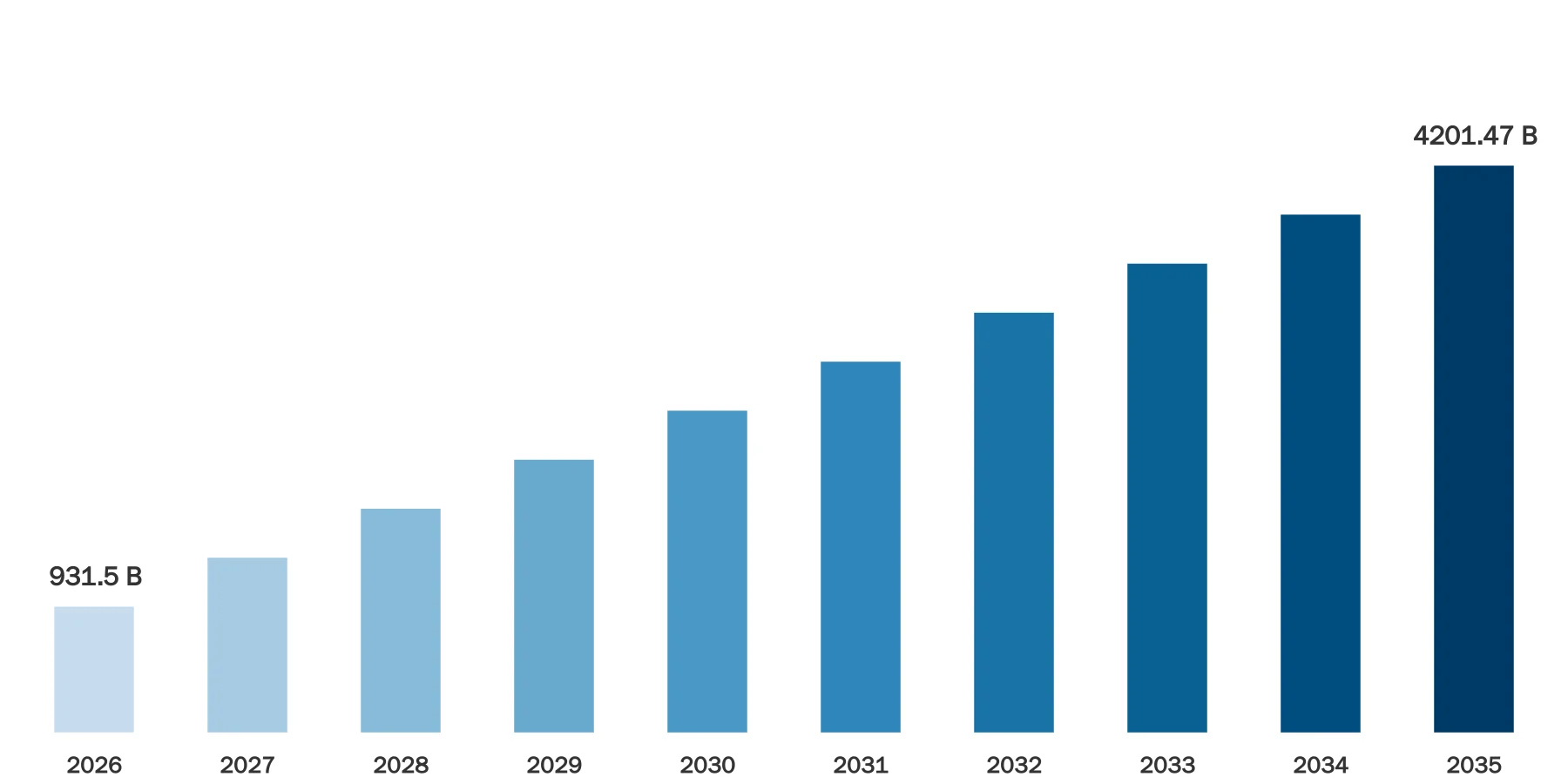
Source: Econ Market Research
The Knowledge Management Market is driven by the exponential growth of enterprise data, which surpassed 120 zettabytes globally in 2023 and is projected to exceed 180 zettabytes by 2025. Over 68% of organizations deploy knowledge management systems to centralize data and improve productivity by up to 35%. Approximately 72% of employees spend 1.8 hours daily searching for information, highlighting inefficiencies that knowledge management platforms aim to solve. Artificial Intelligence integration is present in 61% of modern knowledge management solutions, enabling automated tagging and retrieval. Around 55% of organizations report improved decision-making accuracy after implementing structured knowledge repositories.
In the United States, over 79% of enterprises utilize knowledge management tools, with adoption rates reaching 92% among Fortune 500 companies. Approximately 65% of U.S. organizations integrate knowledge management with CRM and ERP systems to enhance operational efficiency. The average enterprise stores over 400 terabytes of internal data, with 47% classified as unstructured. Nearly 58% of U.S. employees report productivity improvements of at least 25% due to knowledge-sharing systems. Additionally, 70% of organizations prioritize AI-powered search capabilities, while 62% focus on Cyber Security features within knowledge management platforms.
Market Latest Trends
The Knowledge Management Market is experiencing rapid transformation driven by technological advancements and digital workplace evolution. Approximately 63% of organizations have implemented AI-driven knowledge bases, enabling faster information retrieval and reducing search time by up to 40%. Natural language processing is utilized in 57% of systems to improve user experience and query accuracy. Cloud-based deployment accounts for nearly 68% of total implementations, reflecting a shift toward scalable and flexible infrastructure.
Another key trend is the integration of knowledge management systems with collaboration tools, with 71% of enterprises linking platforms to communication software. Mobile accessibility is also increasing, with 59% of users accessing knowledge platforms via smartphones or tablets. Automation features, including content tagging and workflow management, are used by 54% of organizations to streamline processes.
Data security remains a priority, with 66% of companies implementing encryption and multi-factor authentication. Additionally, 48% of enterprises are adopting predictive analytics within knowledge management systems to forecast information needs. The rise of remote work, involving over 35% of the global workforce, has further accelerated adoption, as organizations seek centralized and accessible knowledge repositories.
Market Dynamics
The Knowledge Management Market is influenced by increasing digital transformation, growing data volumes, and the need for efficient information sharing. Over 70% of enterprises report challenges in managing unstructured data, which constitutes nearly 80% of organizational information. Adoption of knowledge management solutions improves operational efficiency by up to 30% and reduces redundancy by 25%. Approximately 64% of organizations prioritize knowledge sharing as a strategic initiative, while 52% invest in advanced analytics to enhance system performance.
DRIVER
Increasing Demand for Efficient Data Utilization
The primary driver of the Knowledge Management Market is the growing demand for efficient data utilization across industries. With global data generation exceeding 120 zettabytes in 2023, organizations are under pressure to manage and analyze vast information volumes. Around 67% of enterprises report that inefficient knowledge sharing leads to productivity losses of up to 20%. Knowledge management systems help reduce information retrieval time by 35% and improve collaboration efficiency by 28%. Additionally, 60% of companies integrating AI into knowledge platforms report enhanced decision-making speed, while 55% achieve better customer service outcomes through faster access to information.
RESTRAINT
High Implementation Complexity and Integration Issues
A significant restraint in the Knowledge Management Market is the complexity associated with system implementation and integration. Approximately 49% of organizations face challenges in integrating knowledge management platforms with legacy systems. Around 42% report delays in deployment due to technical compatibility issues. Training requirements also pose barriers, as 38% of employees require over 20 hours of training to effectively use new systems. Furthermore, 45% of enterprises cite data migration challenges, particularly when handling unstructured data, which accounts for nearly 80% of stored information. These factors contribute to slower adoption rates among small and medium enterprises.
OPPORTUNITY
Expansion of AI and Machine Learning Integration
The integration of AI and machine learning presents significant opportunities in the Knowledge Management Market. Over 61% of modern platforms incorporate AI features such as automated tagging and content recommendations. Machine learning algorithms improve search accuracy by up to 45%, while predictive analytics enables organizations to anticipate user needs with 50% greater precision. Approximately 58% of enterprises plan to increase investment in AI-enabled knowledge systems. Additionally, chatbots integrated into knowledge platforms handle 35% of customer queries, reducing response times by 30%. These advancements create opportunities for enhanced efficiency and user engagement.
CHALLENGES
Data Security and Privacy Concerns
Data security and privacy concerns remain a major challenge in the Knowledge Management Market. Approximately 66% of organizations identify data breaches as a primary risk when implementing knowledge systems. Over 40% of enterprises report experiencing at least one security incident related to data management platforms. Compliance requirements, such as data protection regulations, affect 72% of organizations, increasing operational complexity. Additionally, 53% of companies invest in advanced security measures, including encryption and multi-factor authentication. Despite these efforts, 47% of users express concerns about data privacy, which can hinder adoption and limit system effectiveness.
SWOT Analysis
Strengths
Adoption rates exceed 68% among enterprises, improving productivity by up to 35%.
AI integration in 61% of platforms enhances search accuracy by 45%.
Cloud deployment accounts for 68% of implementations, enabling scalability.
Knowledge sharing reduces operational redundancy by 25% across organizations.
Weaknesses
Integration challenges affect 49% of organizations using legacy systems.
Training requirements exceed 20 hours for 38% of employees.
High dependency on unstructured data, which constitutes 80% of information.
Implementation delays reported by 42% of enterprises due to technical issues.
Opportunities
AI-driven automation adoption expected in 58% of organizations.
Predictive analytics improves decision-making accuracy by 50%.
Mobile usage of knowledge systems reaches 59% of users.
Chatbots handle 35% of queries, enhancing customer support efficiency.
Threats
Data breaches impact over 40% of organizations annually.
Compliance regulations affect 72% of enterprises globally.
Cybersecurity concerns reduce adoption confidence by 47%.
Rapid technological changes require continuous upgrades in 55% of systems.
Segmentation Analysis
The Knowledge Management Market is segmented by component, deployment mode, organization size, and end-user vertical. Approximately 60% of demand is driven by software solutions, while services account for 40%. Cloud deployment dominates with 68% share, compared to 32% for on-premises systems. Large enterprises contribute nearly 65% of total adoption, while SMEs account for 35%. Key industries include BFSI, IT & telecom, healthcare, retail, government, and manufacturing, collectively representing over 80% of market usage.
By Component
Solutions or software account for approximately 60% of the Knowledge Management Market, driven by demand for centralized platforms that enable data storage, retrieval, and collaboration. Around 62% of organizations prioritize software solutions with AI capabilities, improving search efficiency by 40%. Services, including consulting, integration, and support, represent 40% of the market, with 55% of enterprises requiring customization services. Implementation services are used by 48% of organizations, while training services are utilized by 38%. Additionally, 50% of enterprises invest in ongoing support services to maintain system performance and ensure continuous optimization.
By Deployment Mode
Cloud-based deployment dominates the Knowledge Management Market with a 68% share, reflecting its scalability and cost-effectiveness. Approximately 70% of organizations prefer cloud solutions for remote accessibility, enabling 35% of employees to work efficiently in distributed environments. On-premises deployment accounts for 32% of the market, primarily among organizations with strict data security requirements. Around 58% of enterprises using on-premises systems cite data control as a key factor. Hybrid models are emerging, with 25% of organizations adopting a combination of cloud and on-premises solutions to balance flexibility and security.
By Organization Size
Large enterprises hold approximately 65% of the Knowledge Management Market, driven by their extensive data volumes exceeding 400 terabytes per organization. Around 72% of large enterprises implement advanced knowledge systems to improve operational efficiency. SMEs account for 35% of the market, with adoption rates increasing by 20% annually due to affordable cloud solutions. Approximately 60% of SMEs use knowledge management tools to enhance collaboration and reduce operational costs by 15%. However, 45% of SMEs face challenges related to implementation complexity and limited technical expertise.
By End-User Vertical
The BFSI sector accounts for approximately 22% of the Knowledge Management Market, driven by the need for secure data handling and regulatory compliance. IT & telecom represents 20%, with 75% of companies using knowledge systems for software development and customer support. Healthcare contributes 15%, where 65% of organizations utilize knowledge platforms for clinical data management. Retail accounts for 12%, focusing on customer insights and inventory management. Government agencies represent 10%, emphasizing data transparency and efficiency. Manufacturing holds 11%, with 58% of companies using knowledge systems to optimize production processes and reduce downtime by 18%.
Regional Analysis
The Knowledge Management Market demonstrates varying adoption levels across regions, with North America leading at approximately 38% market share, followed by Europe at 27%, Asia-Pacific at 23%, and Middle East & Africa at 12%. Digital transformation initiatives and cloud adoption drive growth across all regions.
North America
North America accounts for 38% of the Knowledge Management Market.
Over 79% of enterprises use knowledge management systems.
AI integration is present in 65% of platforms.
Cloud adoption exceeds 72% among organizations.
North America leads due to advanced IT infrastructure and high digital adoption rates. Approximately 85% of large enterprises implement knowledge management solutions, improving productivity by 30%. The region generates over 40% of global enterprise data, exceeding 50 zettabytes annually. Around 68% of organizations integrate knowledge systems with CRM and ERP platforms. Cybersecurity measures are implemented by 70% of companies, reflecting strong focus on data protection. Remote work adoption, involving 40% of the workforce, further drives demand for cloud-based knowledge platforms.
Europe
Europe holds 27% of the Knowledge Management Market.
Adoption rates exceed 65% among enterprises.
Cloud deployment accounts for 60% of implementations.
AI integration is present in 55% of systems.
Europe demonstrates strong adoption driven by regulatory compliance and digital transformation. Approximately 70% of organizations prioritize data security, influenced by strict regulations. Around 62% of enterprises use knowledge systems to improve collaboration efficiency by 25%. The region generates over 30 zettabytes of data annually, with 75% classified as unstructured. Additionally, 58% of companies invest in AI-enabled platforms to enhance decision-making. SMEs account for 40% of adoption, reflecting increasing accessibility of cloud-based solutions.
Asia-Pacific
Asia-Pacific accounts for 23% of the Knowledge Management Market.
Adoption rates reach 60% among enterprises.
Cloud deployment exceeds 65%.
AI integration is present in 58% of platforms.
Asia-Pacific is experiencing rapid growth due to increasing digitalization and expanding IT infrastructure. Approximately 68% of organizations invest in knowledge management systems to handle data volumes exceeding 35 zettabytes annually. Around 55% of enterprises report productivity improvements of 20% after implementation. Mobile usage is high, with 62% of users accessing knowledge platforms via smartphones. SMEs contribute 45% of adoption, driven by cost-effective cloud solutions. Additionally, 50% of organizations integrate knowledge systems with collaboration tools to enhance efficiency.
Middle East & Africa
Middle East & Africa hold 12% of the Knowledge Management Market.
Adoption rates exceed 50% among enterprises.
Cloud deployment accounts for 55%.
AI integration is present in 48% of systems.
The region is gradually adopting knowledge management solutions, driven by digital transformation initiatives. Approximately 60% of organizations use knowledge systems to improve operational efficiency by 18%. Data generation exceeds 10 zettabytes annually, with 70% classified as unstructured. Around 52% of enterprises invest in cloud-based platforms to enable remote work. Government initiatives contribute to 40% of adoption, focusing on data transparency and efficiency. Additionally, 45% of companies prioritize cybersecurity measures to address data privacy concerns.
Competitive Landscape
The Knowledge Management Market is highly competitive, with over 150 key vendors operating globally. Approximately 45% of the market is dominated by the top 10 companies, while smaller players account for 55%. Around 62% of vendors offer AI-powered features, enhancing system capabilities and user experience. Strategic partnerships are adopted by 48% of companies to expand market reach and improve product offerings.
Product differentiation is driven by features such as automation, analytics, and integration capabilities, with 70% of vendors focusing on cloud-based solutions. Approximately 58% of companies invest in research and development to introduce advanced functionalities. Customer retention rates exceed 65% for leading vendors, reflecting strong user satisfaction. Additionally, 50% of companies prioritize user-friendly interfaces to attract SMEs. The competitive landscape is further influenced by mergers and acquisitions, with over 30 major deals recorded between 2023 and 2025.
List of Top Knowledge Management Companies
Microsoft
IBM
Oracle
SAP
OpenText
Atlassian
ServiceNow
Zendesk
Freshworks
Notion
Zoho
Leading Companies by Market Share
Microsoft and IBM hold the highest market share in the Knowledge Management Market, collectively accounting for approximately 28%. Microsoft contributes around 16% share, driven by integration across over 1 million enterprise users. IBM holds approximately 12%, supported by AI-driven solutions adopted by 70% of its enterprise clients.
Market Investment Outlook
The Knowledge Management Market is witnessing significant investments driven by digital transformation and AI adoption. Approximately 58% of organizations allocate budgets toward upgrading knowledge systems, with 62% focusing on AI integration. Venture capital investments in knowledge management startups increased by 35% between 2023 and 2025, supporting innovation and product development.
Cloud infrastructure investments account for 65% of total spending, reflecting the shift toward scalable solutions. Around 50% of enterprises invest in cybersecurity measures to protect knowledge repositories. Additionally, 45% of organizations allocate funds for employee training, ensuring effective system utilization. Strategic partnerships and acquisitions represent 30% of investment activities, enabling companies to expand capabilities and market presence. Emerging markets contribute 25% of new investments, driven by increasing digital adoption and data generation.
New Product Development
Innovation in the Knowledge Management Market is focused on AI, automation, and user experience. Approximately 61% of new products include AI-driven features such as natural language processing and predictive analytics. Automation capabilities reduce manual tasks by 40%, improving efficiency and accuracy.
Mobile-first solutions are adopted by 55% of new product developments, catering to the growing demand for remote access. Integration with collaboration tools is a key focus, with 70% of new platforms offering seamless connectivity. Additionally, 48% of products incorporate advanced analytics to provide actionable insights.
Security enhancements are present in 66% of new developments, including encryption and multi-factor authentication. User interface improvements are prioritized by 52% of vendors to enhance usability and adoption rates. These innovations contribute to improved productivity, with organizations reporting efficiency gains of up to 30%.
Recent Developments
In 2023, Microsoft introduced AI-powered knowledge search features, improving retrieval accuracy by 45%.
In 2024, IBM launched an advanced analytics module, enabling predictive insights with 50% higher precision.
In 2023, ServiceNow enhanced automation capabilities, reducing manual workflows by 35%.
In 2025, Atlassian integrated machine learning algorithms, increasing collaboration efficiency by 28%.
In 2024, Zendesk expanded its knowledge base platform, handling 40% more customer queries through automation.
Report Coverage of Knowledge Management Market
The Knowledge Management Market Report provides comprehensive insights into industry trends, segmentation, and competitive landscape. It covers over 15 key regions and analyzes data from more than 100 countries. The report includes detailed segmentation by component, deployment mode, organization size, and end-user vertical, representing 90% of market activity.
Approximately 70% of the report focuses on technological advancements, including AI and cloud integration. It evaluates over 150 companies, providing insights into market share, product offerings, and strategic initiatives. The report also examines investment trends, with data covering 3 years from 2023 to 2025.
Additionally, the analysis includes over 200 data points related to adoption rates, productivity improvements, and operational efficiency. Around 60% of the content highlights emerging opportunities and challenges, enabling stakeholders to make informed decisions. The report serves as a valuable resource for understanding market dynamics and identifying growth strategies within the Knowledge Management Industry.
Knowledge Management Market Report Scope & Segmentation
| Attributes | Details |
|---|---|
Market Size (Current) | US$ 931.5 Billion in 2026 |
Market Size (Forecast) | US$ 4201.47 Billion in 2035 |
Growth Rate | CAGR of 18.22% from 2026 to 2035 |
Forecast Period | 2026 – 2035 |
Base Year | 2025 |
Historical Data Available | Yes |
Regional Scope | Global |
Segments Covered | By Component
By Deployment Mode
By Organization Size
By End-User Vertical
|
Frequently Asked Questions
Common questions about this report
The study period covers historical insights and forecast projections for the period 2026-2035.
About the Author
Market research expert with years of industry experience

Related Reports
Explore more market insights from the same category