


Top Collaborative Robot Companies Advancing Flexible Automation in 2026
The top collaborative robot companies are advancing smart manufacturing with AI vision, safer automation, higher payloads, mobile cobots, and flexible deploymen
Introduction
Overview of the Global Collaborative Robot Industry
The global collaborative robot industry has developed into a distinct part of industrial automation by combining articulated robot performance with force limiting, torque sensing, simplified programming, and human-robot interaction capabilities. Collaborative robots represented 10.5% of the 541,302 industrial robots installed worldwide in 2023, demonstrating that cobots have moved beyond experimental deployments into routine manufacturing use. The broader automation environment expanded further in 2024, when 542,000 industrial robots were installed globally and the operational stock reached 4.664 million units. Cobots are now deployed for machine tending, welding, assembly, screwdriving, inspection, dispensing, packaging, palletizing, material handling, polishing, and laboratory automation, with 6-axis architectures remaining the dominant configuration among commercial articulated collaborative robots.
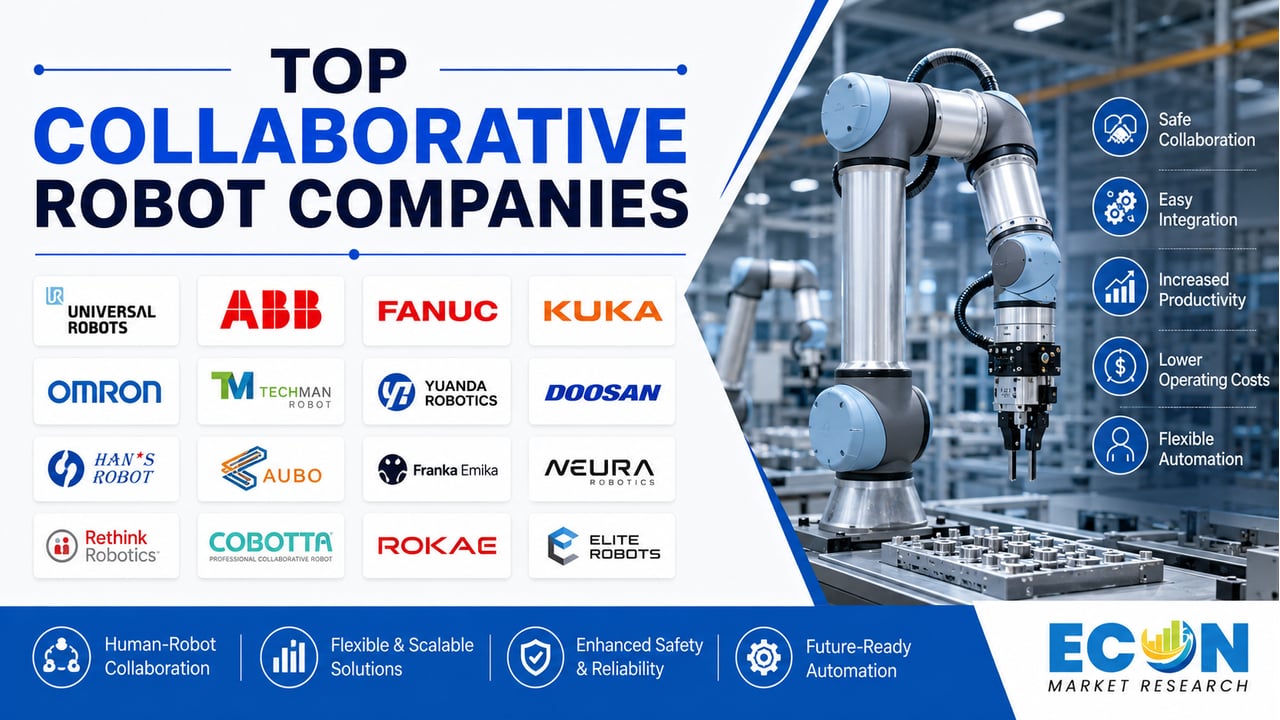
Current product portfolios show how substantially collaborative robot capabilities have expanded. Commercial cobots now range from compact 3 kg models designed for electronics and laboratory work to systems capable of handling 50 kg payloads. Universal Robots offers models reaching 35 kg payload capacity, FANUC provides a collaborative robot with a 50 kg payload, Doosan Robotics offers a 30 kg palletizing model with a 2,030 mm reach, and Yaskawa supplies a 30 kg collaborative palletizing robot with a 1,700 mm reach. The combination of higher payloads, longer reach, graphical programming, plug-and-play tooling, integrated machine vision, and application-specific packages is enabling adoption across automotive components, metalworking, electronics, food processing, logistics, pharmaceuticals, consumer goods, and smaller manufacturing operations.
Market Evolution and Growth Drivers
The modern collaborative robot industry can be traced to the commercial introduction of lightweight robots that could be reprogrammed without the engineering complexity associated with conventional industrial automation. Universal Robots was founded in 2005 and introduced its first commercial UR5 in 2008, while KUKA introduced its sensitive LBR iiwa into series production during the following phase of human-robot collaboration. By 2025, Universal Robots had reached the milestone of 100,000 cobots, illustrating how collaborative automation moved from low-volume experimentation into global industrial deployment within less than 2 decades. Product evolution has simultaneously increased payload, speed, repeatability, environmental protection, and integration options without abandoning the flexible deployment model that originally distinguished cobots from conventional industrial robots.
Labor shortages, shorter production runs, greater product variation, reshoring, and requirements for faster manufacturing changeovers continue to support adoption. Global industrial robot density reached 177 units per 10,000 manufacturing employees in 2024, compared with 163 previously, while South Korea operated at 1,220 units per 10,000 manufacturing employees and China reached 567. Cobots address a different automation need than high-speed fenced robots because they can be reassigned between applications and programmed through hand guiding or graphical interfaces. Safety technology is also evolving: ISO 10218-1:2025 and ISO 10218-2:2025 were published in February 2025, updating international safety requirements for industrial robots and integrated robot applications as manufacturers deploy increasingly sophisticated collaborative and hybrid production systems.
Top 5 Latest Trends in the Collaborative Robot Industry
The 5 important current trends affecting the Top Companies in the Collaborative Robot Industry are:
High-Payload and Longer-Reach Collaborative Robots
AI Vision and Intelligent Perception
Mobile Collaborative Manipulation
Low-Code Programming and Application-Ready Ecosystems
Advanced Safety and Specialized Industrial Cobots
Trend 1: High-Payload and Longer-Reach Collaborative Robots
High-payload cobots are expanding collaborative automation beyond lightweight assembly into palletizing, machine tending, logistics, and handling of substantial components. Universal Robots increased the UR30's supported payload to 35 kg in 2024 for specified operating conditions, while the robot maintains a 1,300 mm reach. FANUC's collaborative portfolio extends to the CR/50F-16B with a 50 kg wrist payload and 1,643 mm reach in its 50 kg configuration. Doosan Robotics' P3020 provides 30 kg payload capacity and a 2,030 mm working radius, while Yaskawa's HC30PL combines a 30 kg payload with 1,700 mm reach. These specifications allow cobots to automate cases, machine parts, multi-gripper tooling, and pallet loads that previously required conventional industrial robots or manual material handling.
Trend 2: AI Vision and Intelligent Perception
Collaborative robots are increasingly combining motion control with machine vision, AI classification, and adaptive decision-making. Techman Robot's TM AI Cobot platform integrates a native vision system with the robotic arm, while models such as the TM20 provide a 20 kg payload and 1,300 mm reach for applications that include machine tending, packaging, palletizing, and visually guided manipulation. JAKA Robotics is also moving beyond conventional programmed motion toward perception-enhanced and embodied intelligent systems; by 2026, the company reported tens of thousands of robots deployed across close to 100 countries. These capabilities allow cobots to recognize part orientation, conduct automated optical inspection, adapt pick positions, and work with variable products instead of relying exclusively on mechanically fixed fixtures and precisely presented components.
Trend 3: Mobile Collaborative Manipulation
Combining collaborative arms with autonomous mobile robots is creating mobile manipulators capable of performing tasks at multiple workstations. KUKA's KMR iisy integrates a collaborative arm with autonomous mobility for assembly and intralogistics, while Doosan Robotics states that its H-Series can be combined with AGVs and AMRs to create flexible automation configurations. Doosan's H2017 provides a 20 kg payload and 1,700 mm reach, enabling a mobile platform to transport components and subsequently manipulate them at a workstation. Mobile collaboration is strategically important in high-mix factories because 1 robotic system can potentially serve multiple machines instead of remaining fixed to 1 production cell, although navigation, functional safety, payload stability, and interaction with people require system-level risk assessment.
Trend 4: Low-Code Programming and Application-Ready Ecosystems
Programming complexity is falling as suppliers build graphical interfaces, hand-guided teaching, certified accessories, and reusable application templates around cobot hardware. Universal Robots introduced the UR+ ecosystem in 2016 and expanded its training infrastructure to 100 training centers across 23 countries by 2025. FANUC's CRX line supports direct teaching and tablet-based programming, while its product ecosystem added updated compatible plug-in peripherals in June 2026. AUBO states that basic programming methods for its collaborative robots can be learned in 30 minutes and simple programming completed within 1 hour, while modular components can be replaced within 15 minutes. These developments are reducing dependence on specialist robot programmers and making cobots more practical for SMEs and frequently changing production schedules.
Trend 5: Advanced Safety and Specialized Industrial Cobots
The collaborative robot industry is moving toward application-specific safety rather than treating every cobot deployment as an automatically fence-free installation. ISO 10218-1:2025 and ISO 10218-2:2025 established updated requirements for robot design and integrated applications, reinforcing the need for system-level risk analysis. Manufacturers are simultaneously designing specialized cobots for demanding environments. JAKA Pro16 combines a 16 kg payload, 1,713 mm reach, IP68 protection, and an operating range from -10°C to 50°C. Yaskawa's HC30PL offers IP66/67 protection and food-grade joint lubrication, while KUKA provides cleanroom versions of its 11 kg and 15 kg LBR iisy models. These designs extend collaborative automation into food production, wet processing, clean manufacturing, and contamination-controlled environments.
Top 10 Companies in the Collaborative Robot Industry
The following 10 companies are presented according to collaborative robot product depth, technical capability, deployment scale, geographic presence, safety technology, application coverage, and recent product development rather than as a strict numerical ranking.
1. Universal Robots
Company Overview: Universal Robots was founded in 2005 in Denmark and introduced its first commercial collaborative robot, the UR5, in 2008. By 2025, the company had reached 100,000 deployed cobots and operated 100 training centers across 23 countries. Headquarters: Odense, Denmark. Core Collaborative Robot Expertise: Universal Robots specializes exclusively in flexible collaborative automation, including hand-guided teaching, force-aware motion, graphical programming, application integration, and reusable robotic workcells. Major Products and Services: Its current UR Series includes the UR8 Long, UR15, UR18, UR20, and UR30. The UR30 supports payloads of up to 35 kg with a 1,300 mm reach, while the UR20 offers up to 25 kg in designated configurations and 1,750 mm reach. Applications include palletizing, welding, machine tending, assembly, dispensing, inspection, and finishing.
2. FANUC Corporation
Company Overview: FANUC was established in 1972 and employed 10,113 people on a consolidated basis as of March 2025. Its headquarters occupies a 1,780,000-square-meter site in Yamanashi Prefecture, Japan. Headquarters: Oshino-mura, Yamanashi, Japan. Core Collaborative Robot Expertise: FANUC combines collaborative safety with industrial servo technology, controller architecture, machine integration, direct teaching, tablet programming, and a large automation service ecosystem. Major Products and Services: The CRX family covers payloads from 3 kg to 30 kg, including the CRX-30iA with 1,756 mm reach. FANUC additionally offers the CR/50F-16B collaborative robot with a 50 kg payload and 1,643 mm reach. Food-grade and paint-compatible CRX variants extend deployment into specialized manufacturing environments.
3. ABB
Company Overview: ABB was formed in 1988 through the combination of ASEA and BBC and currently employs roughly 110,000 people globally. Headquarters: Zurich, Switzerland. Core Collaborative Robot Expertise: ABB integrates collaborative robotics with industrial motion control, RobotStudio simulation, safety engineering, machine automation, autonomous mobile robots, and digital manufacturing software. Major Products and Services: The GoFa collaborative robot family includes 5 kg, 10 kg, and 12 kg variants, with applicable configurations supporting payloads up to 14 kg. GoFa can achieve TCP speeds up to 2.2 m/s and repeatability of 0.02 mm. ABB also provides Ultra Accuracy functionality delivering path accuracy down to 0.03 mm, expanding cobot use in precision gluing, sealing, cutting, welding, machine tending, and assembly.
4. KUKA
Company Overview: KUKA was founded in Augsburg in 1898 and currently operates in more than 50 countries with roughly 14,500 employees. Headquarters: Augsburg, Germany. Core Collaborative Robot Expertise: KUKA has extensive experience in torque-sensing robotics, human-robot collaboration, mobile manipulation, integrated safety, robot operating systems, and industrial automation. Major Products and Services: The LBR iisy portfolio spans payload capacities from 3 kg to 15 kg and reaches from 760 mm to 1,300 mm. Torque sensors are integrated into every axis to support force-sensitive operations and hand guiding. KUKA also offers 11 kg and 15 kg cleanroom variants and the mobile KMR iisy platform, extending cobot deployment from fixed workstations into flexible intralogistics and mobile assembly environments.
5. Doosan Robotics
Company Overview: Doosan Robotics was launched in 2015 and released its first commercial products in 2018. The company reports operations in 45 countries and a dealer network extending across more than 100 countries. Headquarters: Suwon, Republic of Korea, with additional Korean innovation operations in Seongnam. Core Collaborative Robot Expertise: Doosan concentrates on torque-sensing collaborative arms, heavy-payload automation, force control, mobile integration, and intuitive Dart-Suite programming. Major Products and Services: Its lineup includes A-, M-, H-, E-, and P-Series robots. The H2515 handles 25 kg with a 1,500 mm reach and uses 6 torque sensors, while the P3020 handles 30 kg across a 2,030 mm operating radius. Applications range from machine tending and welding to food service, palletizing, and logistics.
6. Techman Robot
Company Overview: Techman Robot was founded in 2015 and maintains a distribution network with more than 100 partners across Asia, Europe, and other international markets. The company expanded its manufacturing facilities in 2019, while research, development, and production remain based in Taiwan. Headquarters: Taoyuan City, Taiwan. Core Collaborative Robot Expertise: Techman differentiates its cobots through integrated machine vision, AI functions, graphical programming, and robotic motion in a unified platform. Major Products and Services: The TM AI Cobot family includes models such as the TM12, TM16, and TM20. The TM20 carries 20 kg with a 1,300 mm reach, while the TM16 handles 16 kg over 917 mm. AI vision supports automated optical inspection, dynamic picking, positioning, machine tending, packaging, and quality-control applications.
7. JAKA Robotics
Company Overview: JAKA Robotics was founded in Shanghai in 2014 and reports tens of thousands of robots deployed across close to 100 countries. Its international organization includes 9 branch offices and more than 300 automation partners. Headquarters: Shanghai, China; its expanded global headquarters opened in 2025 in a facility covering over 20,000 square meters. Core Collaborative Robot Expertise: JAKA develops collaborative arms, vision systems, force-control solutions, perception technology, and increasingly embodied intelligent robotic platforms. Major Products and Services: The portfolio includes JAKA Zu, Pro, S, AL, A, and Mini families. The Pro16 provides a 16 kg payload, 1,713 mm reach, and IP68 protection for harsh industrial applications, while newer product development includes perception-enhanced and intelligent robotic systems.
8. AUBO Robotics
Company Overview: AUBO Robotics was formally established in Beijing in 2015 after collaborative robot development work began several years earlier. A production base in Changzhou entered operation in 2016, and the company participated in Chinese collaborative robot standardization activities by 2019. Headquarters: Beijing, China. Core Collaborative Robot Expertise: AUBO focuses on modular joint design, collision detection, open software interfaces, visual programming, hand-guided teaching, and flexible multi-robot integration. Major Products and Services: Its i-Series spans payload classes from 3 kg to 20 kg. The AUBO-i20 supports a 20 kg payload and 1,650 mm working radius, while the i16 carries 16 kg with repeatability of ±0.03 mm. The platform supports industrial communications, SDKs, APIs, Linux, Windows, and ROS integration.
9. Yaskawa Electric Corporation
Company Overview: Yaskawa Electric was founded in 1915 and employed 12,833 people as of February 2025. Its global network includes operations in 30 countries and 28 production sites across 12 countries. Headquarters: Kitakyushu, Fukuoka, Japan. Core Collaborative Robot Expertise: Yaskawa combines collaborative robots with servo drives, industrial motion control, machine automation, palletizing, welding, and production-system integration. Major Products and Services: The HC collaborative robot family includes the HC30PL, a 30 kg payload model with 1,700 mm reach designed for collaborative palletizing. The robot provides IP66/67 protection, food-grade grease in all joints, direct-teach controls, and compatibility with Yaskawa's Smart Pendant. These specifications support material handling, palletizing, food-related applications, and industrial work near human operators.
10. Comau
Company Overview: Comau was formed in 1973 from Turin-based automation companies and has accumulated more than 50 years of industrial automation experience. Together with its broader organization, it maintains 8 innovation centers and 14 production facilities in 12 countries and employs more than 4,000 people. Headquarters: Grugliasco, Turin, Italy. Core Collaborative Robot Expertise: Comau combines industrial robot mechanics with collaborative safety, hybrid operating modes, lightweight automation, and application integration. Major Products and Services: Comau introduced the MyCo family globally at Automatica in June 2025 with 6 models covering payloads from 3 kg to 15 kg. The MyCo-15-1.30 combines a 15 kg payload with 1,300 mm reach, while the Racer-5 COBOT can switch between collaborative operation up to 500 mm/s and industrial operation up to 6 m/s.
Regional Outlook
North America
North America provides a substantial installed automation base for collaborative robots, particularly across automotive manufacturing, metalworking, electronics, food processing, life sciences, warehousing, and machine shops. The United States operated 393,700 industrial robots in 2024 and installed 34,200 additional units during the year. Canada installed 3,800 robots, of which automotive applications accounted for 47%, while Mexico installed 5,600 robots and automotive manufacturing represented 63% of the national total. Cobots are particularly relevant to North American manufacturers running high-mix operations because smaller production cells can use 1 programmable arm for machine loading during one production period and reposition it for welding, inspection, packaging, or palletizing after a product change.
The region is also a major destination for global collaborative robot suppliers. Universal Robots maintains a North American headquarters in Michigan, Doosan Robotics operates an Americas organization in Pennsylvania, and Comau maintains its North American headquarters in Michigan. Safety expectations remain important because the publication of ISO 10218-1:2025 and ISO 10218-2:2025 reinforces the distinction between a robot designed with collaborative capabilities and a completed collaborative application. Tool geometry, operating speed, payload, workpiece characteristics, and human access must all be considered during risk assessment. North American opportunities are therefore strongest in standardized machine tending, palletizing, welding, laboratory handling, and ergonomic material-movement applications where repeatable safety architectures can be deployed across multiple production cells.
Europe
Europe installed 85,000 industrial robots in 2024, with 67,800 units deployed inside the European Union. Germany accounted for 26,982 installations and 32% of the European total, while Italy recorded 8,783 installations. Germany maintained an operational stock of 278,881 industrial robots and a manufacturing robot density of 449 units per 10,000 employees. This automation base supports collaborative robot adoption in automotive components, machinery, electronics, metal fabrication, pharmaceuticals, food processing, aerospace, logistics, and smaller industrial companies. Europe is also home to established collaborative robot developers including Universal Robots in Denmark, ABB in Switzerland, KUKA in Germany, and Comau in Italy, creating a strong combination of equipment manufacturing, integration expertise, research capabilities, and end-user demand.
European cobot development is increasingly influenced by safety, sustainability, labor availability, and flexible production requirements rather than automation volume alone. ISO 10218 Parts 1 and 2 were updated in 2025, while European suppliers continue expanding products for cleanrooms, food environments, precision manufacturing, and mixed human-robot workspaces. KUKA's LBR iisy family reaches payloads of 15 kg, ABB's GoFa offers TCP speeds up to 2.2 m/s, and Comau launched 6 MyCo models in 2025. These products illustrate Europe's shift toward cobots capable of combining traditional industrial performance with easier deployment. Regional constraints include aging production equipment, safety validation requirements, integration costs, and the need to demonstrate adequate productivity when collaborative speed limits are applied to specific human-accessible applications.
Asia-Pacific
Asia-Pacific is the dominant region for industrial robot deployment, accounting for 74% of new global installations in 2024. China installed 295,000 industrial robots during the year and increased its operational stock beyond 2 million units. Domestic Chinese suppliers captured 57% of robot installations in their home market, compared with 28% over the preceding decade. Japan installed 44,500 robots and operated 450,500 units, while South Korea recorded 30,600 new installations. These production ecosystems create extensive opportunities for collaborative automation in electronics, semiconductor production, batteries, automotive components, appliances, machinery, welding, inspection, packaging, and logistics. Asian companies including FANUC, Yaskawa, Doosan Robotics, Techman Robot, JAKA, and AUBO now offer cobots spanning lightweight assembly to 30 kg-class palletizing.
India added a record 9,100 industrial robots in 2024, representing a 7% annual increase, with automotive manufacturing responsible for 45% of installations. The region's competitive structure is therefore becoming broader than the highly automated economies of China, Japan, South Korea, Taiwan, and Singapore. New manufacturing locations across India and Southeast Asia create opportunities for cobots because flexible systems can be deployed without designing the large dedicated automation lines common in mature high-volume plants. The technical opportunity is also shifting toward domestic innovation: JAKA reported deployments across close to 100 countries by 2026, Doosan Robotics operates in 45 countries, and Techman Robot has developed more than 100 distribution partnerships. Supply-chain scale, electronics manufacturing expertise, and increasingly local robot production are strengthening Asia-Pacific's role in global collaborative robot development.
Middle East & Africa
Collaborative robot adoption in the Middle East and Africa remains less extensive than in Asia, Europe, or North America, but national industrial transformation programs are creating new automation opportunities. Saudi Arabia's Future Factories Program, launched in 2022, targets the transformation of 4,000 factories toward automation, smart operation, and advanced manufacturing. In the United Arab Emirates, Transform 4.0 was launched in 2024 to support 100 high-potential manufacturers and develop an Industry 4.0 lighthouse network over 3 to 5 years. These initiatives create potential applications for collaborative robots in machine tending, logistics, food processing, packaging, metalworking, inspection, and light assembly, particularly where factories are introducing connected automation for the first time.
Regional deployment conditions differ substantially across the Gulf states and Africa. Saudi Arabia and the UAE have explicit manufacturing digitalization strategies, while industrial opportunities elsewhere are concentrated in automotive plants, mines, food production, energy equipment, warehouses, and export-oriented manufacturing zones. High temperatures, dust, limited local integration capacity, and dependence on imported robotics can influence deployment decisions, making environmental protection and remote technical support important. JAKA's Pro16 operates between -10°C and 50°C with IP68 protection, while Yaskawa's HC30PL carries an IP66/67 rating. Products with these specifications are relevant to harsher industrial environments, although every installation still requires application-level engineering and safety assessment. Workforce development will also matter as thousands of factories transition toward increasingly automated production.
Future Opportunities in the Collaborative Robot Industry
Future opportunities for the Top Companies in the Collaborative Robot Industry will increasingly come from systems that combine greater physical capability with AI-based perception. The commercial ceiling for payload has already advanced from early cobots designed around 3 kg to 10 kg loads to current systems reaching 35 kg and 50 kg. The next technical step is not simply increasing payload but enabling robots to understand variable objects, choose grasp strategies, adapt trajectories, and safely respond to nearby workers. JAKA's 2026 focus on embodied intelligence and Techman's integrated AI vision demonstrate this direction. AI-enhanced cobots could expand flexible bin picking, mixed-product palletizing, inspection, kitting, assembly, and machine tending where conventional automation struggles with frequent variations.
Mobile manipulation represents another practical opportunity because a 6-axis cobot mounted on an autonomous platform can potentially service multiple workstations. KUKA already offers the KMR iisy concept, while Doosan's H-Series is designed for integration with AGVs and AMRs. Longer-reach arms such as Doosan's 1,700 mm H2017 and FANUC's 1,756 mm CRX-30iA can further increase the accessible work envelope. In warehouses, laboratories, electronics factories, and high-mix machine shops, mobile cobots could transport parts, load equipment, collect finished components, and perform inspections during the same production sequence. The principal development requirements will include navigation safety, stable manipulation from mobile bases, machine communication, automated tool changing, battery management, and coordination between human movement and robotic workspaces.
SMEs represent a major technology-access opportunity because programming and integration are becoming simpler. AUBO states that basic robot programming can be learned in 30 minutes, Universal Robots operated 100 training centers in 23 countries by 2025, and FANUC added further plug-in peripheral support for CRX systems in June 2026. Comau's 2025 MyCo launch introduced 6 lightweight models from 3 kg to 15 kg specifically designed for rapid installation and redeployment. These developments indicate that future competitive differentiation will depend increasingly on complete applications rather than robot arms alone. Suppliers that combine the robot, gripper, vision, safety hardware, application software, training, remote diagnostics, and deployment templates into repeatable packages can reduce the engineering barriers that still prevent smaller manufacturers from adopting automation.
Safety and environmental specialization will remain equally important through the second half of the 2020s. ISO 10218-1:2025 and ISO 10218-2:2025 provide updated international frameworks for robot and application safety, while manufacturers are already offering products rated from IP54 through IP68 and cleanroom-specific variants. Food-grade FANUC CRX models, Yaskawa's IP66/67 HC30PL, KUKA's cleanroom LBR iisy variants, and JAKA's IP68 Pro series illustrate the expansion into specialized environments. Future opportunities will therefore extend beyond conventional automotive and metalworking applications into pharmaceuticals, food production, laboratories, electronics cleanrooms, battery manufacturing, recycling, and other processes where human workers and flexible automation must operate in tightly controlled conditions.
Conclusion
The collaborative robot industry has progressed from lightweight experimental automation into a global industrial technology segment that represented 10.5% of worldwide industrial robot installations in 2023. The wider automation ecosystem reached 4.664 million operational industrial robots in 2024, with another 542,000 installations completed during the year. Within this environment, the 5 defining cobot trends are higher payloads, AI-enabled perception, mobile manipulation, low-code deployment, and advanced safety specialization. Commercial products now range from compact 3 kg systems to collaborative robots capable of handling 50 kg, while reaches beyond 2,000 mm are available for specialized palletizing applications. These developments are expanding cobot use from traditional assembly into welding, logistics, machine tending, palletizing, inspection, food processing, and precision manufacturing.
The 10 Top Companies in the Collaborative Robot Industry—Universal Robots, FANUC, ABB, KUKA, Doosan Robotics, Techman Robot, JAKA Robotics, AUBO Robotics, Yaskawa Electric, and Comau—represent different technical approaches to collaborative automation. Asia accounted for 74% of global industrial robot installations in 2024, Europe represented 16%, and the Americas accounted for 9%, while national programs in Saudi Arabia and the UAE are extending smart manufacturing into additional markets. Future competition will depend less on whether a supplier can manufacture a 6-axis collaborative arm and more on whether it can deliver reliable AI perception, intuitive programming, application-specific tooling, mobile integration, environmental protection, updated safety compliance, and scalable deployment across factories of different sizes.