

Welding Products Market
Welding Products Market Size, Share, Trends, Growth, and Industry Analysis, By Technology (Arc Welding, Resistance Welding, Oxy-Fuel Welding, Laser Beam Welding), By Product Type (Welding Equipment, Welding Consumables (Electrodes, Filler Metals, Fluxes)), By End-Use Industry (Automotive, Building andamp; Construction, Heavy Machinery, Shipbuilding, Oil andamp; Gas), Regional Analysis and Forecast Period 2026-2035
Welding Products Market Overview
As per Econ Market Research analysis, the Global Welding Products Market was valued at US$ 41.5 Billion in 2026 and is expected to reach US$ 58.52 Billion by 2035, registering a CAGR of 3.88% during the forecast period 2026–2035. The base year considered is 2025.
Welding Products Market Size 2025-2035 (USD Billion)

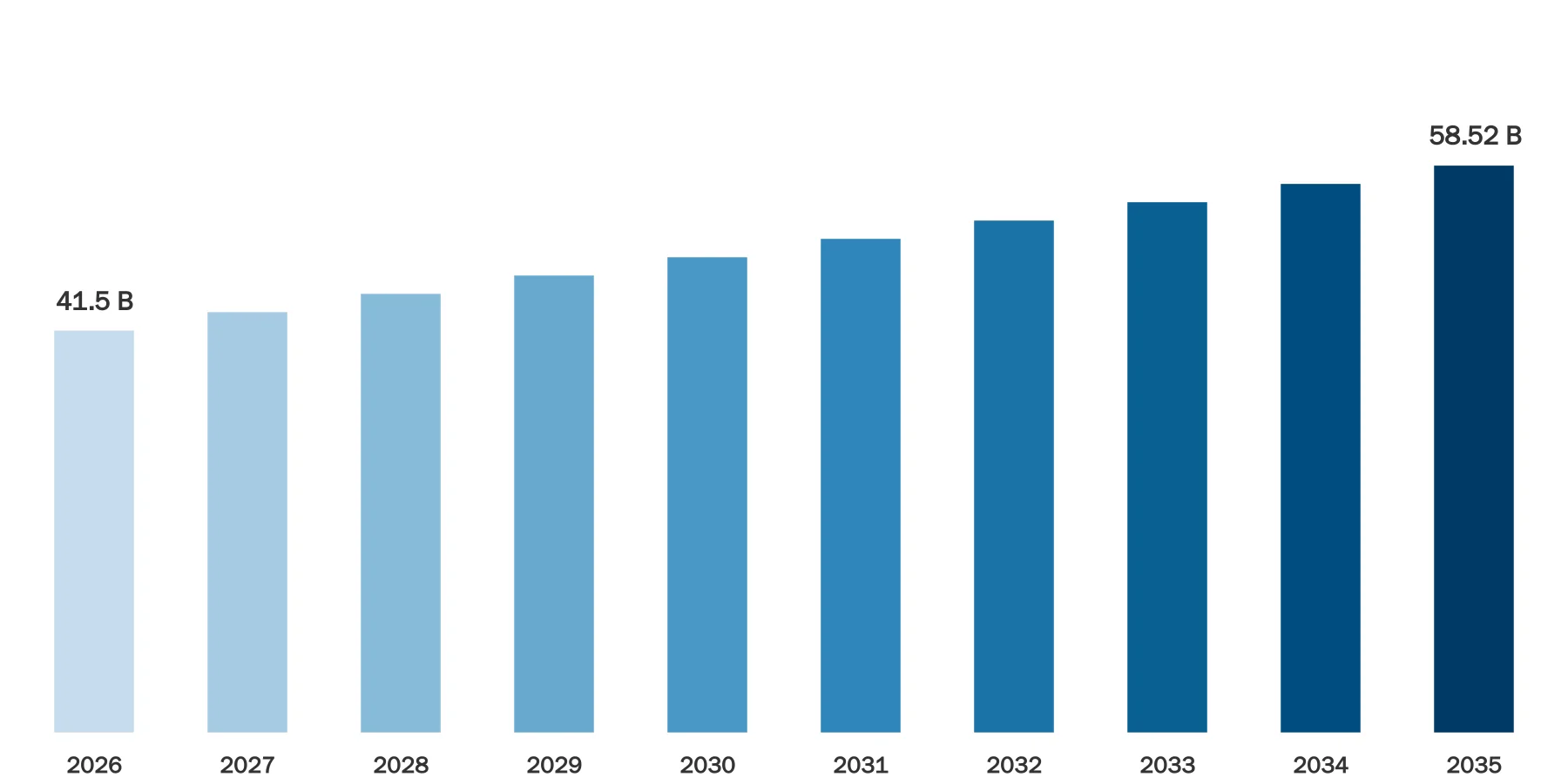
Source: Econ Market Research
Welding products include tools, which are the welding machines, consumables such as electrodes and wires, and safety equipment. All these are important to professional welders and to those doing the welding themselves. Welding is a very important activity in the construction industry, the automotive industry, the aerospace industry, and the manufacturing industry because of the need to produce durable structures and components.
Growth in this market is steady due to increasing global automotive production that will drive demand for infrastructure development and because of the technological innovations in welding such as automation and robotics used to enhance efficiency and precision in welding operations. The high productivity and cost-effectiveness are expected to drive higher adoption of advanced welding products. In addition, emphasis on renewable energy projects, such as wind power and solar power, is further adding to the expansion of the welding products market.
Dynamic Insights
Key growth drivers are the increasing demand for Industrial Automation in most developing countries and the increased utilization of welding in infrastructure development projects, which are currently key factors for economic growth. As industries become modernized, there is a significant push towards adopting advanced welding technologies, including laser and robotic welding, which allow for significant improvements in productivity and quality. Moreover, the growing automotive sector in these emerging markets has a positive impact and fuels the increasing demand for efficient welding solutions.
However, some weld products have restrictions. Highly developed welding machinery is relatively costly, and the whole operation of welding requires specialized workers. Fluctuations of raw materials can also affect costs and profit margins. Pollution and safety standards add pressure on producers to innovate and keep themselves aligned with environmental standards that requires a heavy investment more often than not. With the growth in the renewable energy sector comes a positive side, the demand for electric vehicles is also increasing, which requires premium welding technology.
Drivers Insights
Increasing Infrastructure Development
There are massive global strides for infrastructure development, primarily in welding products. Infrastructural investment by the government in the transportation and energy projects is still thriving with the goal of helping economies grow with better provision of public service delivery systems, thus enhancing their demand through heavy construction and other services requiring welding structures. A sector whose projects always expand is infrastructure. This, in turn, creates demand for reliable and efficient welding products. Therefore, advanced welding equipment and consumables can be sold to such companies as a way to supply the demands of expansion in infrastructure.
Technological Advancements in Welding
Changes in technology have been the major factors driving the welding products market. Automated welding systems, robotic welding, and laser and friction stir welding improve productivity, efficiency, and precision in welding operations. They reduce labor costs and enhance safety conditions by minimizing manual intervention. Furthermore, they allow complex weld designs and high-quality finishes. With increasing production and the desire to minimize operations costs through these technologies, the market is likely to see further growth as more-demanding welding equipment and tools are required.
Restraints Insights
High Initial Investment Costs
One of the major constraints in the welding products market is the high capital cost associated with advanced welding equipment and technologies. SMEs may not be able to afford the initial costs for modern welding machines, especially if they are equipped with automation features. This financial barrier will limit their ability to compete effectively in the market. The cost of maintaining and running high-tech welding systems also is quite high, and this can be a discouragement to potential users from upgrading their equipment or to adopt new technologies.
Skilled Labor Shortages
The welding industry is facing serious challenges due to the dearth of skilled labor. As welding technology is increasingly becoming a high-tech process, the need for more skilled technicians to operate and maintain the systems increases. However, in many places, this trend is changing, resulting in fewer skilled welding professionals, which also limits the growth of the market. This skill gap might make companies face more significant operating costs in one of two ways: by spending on training or through inability to find competent staff. In addition, since some of the old employees will retire, young people should be attracted into the sector to sustain its growth.
Opportunities Insights
Growth in Renewable Energy Sector
The renewable energy sector is a significant opportunity for the welding products market. As countries become more inclined towards sustainable energy sources such as solar, wind, and hydropower, the demand for welding applications in the manufacturing and installation of energy systems grows. For example, constructing wind turbines and Solar Panels needs robust welding solutions for their durability and efficiency. This new trend towards clean energy might give the welding products manufacturer an opportunity to develop products that would be suited particularly for the renewable energy sector and hence might serve to generate more revenue.
Segment Analysis
By Welding Equipment
Welding equipment primarily comprises a set of the tools and materials used in welding. This category includes stick electrodes, solid wires, flux-cored wires, and saw wires and fluxes. Stick electrodes are widely used for their flexibility and ease of use in a wide range of applications. Solid wires have resulted in very clean welds with good quality, therefore recommended in thin materials, the flux-cored wires show enhanced penetration and have usually been used outdoors since their shielding ability has rendered it suitable. The main application of saw wires in submerged arc welding in a flux, this is that process that is generally implemented in heavy industries.
By Welding Technology
There are a variety of welding technologies available, such as arc welding, resistance welding, and oxy-fuel welding. Arc welding is one of the most commonly used as it employs an electric arc for the purpose of creating heat to weld two or more materials together, allowing for its application to materials that are either thick or thin. Resistance welding requires the use of pressure and electric current and is mostly seen in the manufacture of automobiles as it can work within a very fast pace while remaining efficient. Oxy-fuel welding is a traditional process that uses a combination of oxygen and fuel gas to produce a flame for welding metals.
By End-User
The major industries for the end-user segment in welding products are manufacturing, construction, oil and gas, marine, and maintenance. For the manufacturing sector, welding is very important in assembling machinery and their components to secure structural integrity as well as performance. In construction, welding facilitates building frameworks, pipelines, and infrastructures, where strong and rigid joints are crucial. In the oil and gas industry, specialized welding solutions are required for pipelines and refineries to ensure safety and durability. In the marine industry, welding is also applied to shipbuilding and repairing to enable vessels to withstand harsh environments.
Regional Analysis
North America is the largest market share holder due to well-established manufacturing sectors and high-quality welding technologies in the region. The United States has leadership positions in automotive manufacturing, aerospace, and the energy sector-all of which require high-quality welding solutions. Investment in infrastructure projects and the push for automation further boost demand for welding products in this region. Europe is also an important region for the welding products market. Germany, France, and the UK are considered major drivers for the manufacturing and automotive industries. The sense of innovation and sustainability has been accelerated within Europe as countries focus on renewable energy and Electric Vehicle production.
Asia-Pacific is witnessing rapid industrialization and urbanization, thus leading to higher growth rates for welding products. Increased construction activity and output in the manufacturing sector in countries like China and India lead to higher demand for welding equipment and consumables. Scaling up of infrastructure projects in these countries will be high market potential for players. Latin America and the Middle East &, Africa are emerging markets where growth is being led by increased investments in infrastructure as well as energy projects. Growth in Latin America is seen mostly in Brazil and Mexico with growing demand for welding products in construction and oil and gas industries. In Middle East, market growth is driven by huge investments in infrastructure as well as the energy sectors.
Competitive Landscape
Major players in this market include Lincoln Electric Company, ESAB, and Miller Electric. These use comprehensive product portfolios and, through massive investments in the research and development area, deliver advanced welding technologies and equipment for the welding industry. They also carry a strong presence in several areas now being emphasized by the industry as crucial to sustainability and efficiency to enhance their advantage. Several other significant medium-sized and regional suppliers with specialized products and services are noted in every region.
ITW Welding, Panasonic Corporation, and Hobart Welding Products are also important in the marketplace because of their involvement with high-technology or automated and advanced welding applications. These have attracted new entrants into the market to provide innovative solutions to capture a share of the expanding market. Collaborations, partnerships, and mergers and acquisitions are the other strategies adopted by the companies to increase their presence in the market and expand their product portfolio. Firms are investing in R&,D wherever customer demands are changing, such as in renewable energy and electric vehicles.
List of Key Players:
Air Products and Chemicals, Inc.
Air Liquide SA
ESAB Holding Company
Fronius International GmbH
Hobart Brothers Company
Hyundai Welding Co., Ltd
Kobe Steel Ltd Welding Division
Linde plc
Lincoln Electric Holdings, Inc.
Messer Cutting &, Welding GmbH
Messer Group GmbH
Miller Electric Mfg. Co.
Nippon Sanso Holdings Corporation
The Lincoln Electric Company
voestalpine Bö,hler Welding GmbH
Recent Developments:
In April 2023, Kemppi unveiled its latest robotic welding solution, the AX MIG Welder. This advanced welder boasts an intuitive interface, seamless integration capabilities, and state-of-the-art welding technology designed to tackle complex tasks and meet stringent production requirements.
In March 2023, Kemppi launched a new range of portable welding machines, the Master M 205 and Master M 323, tailored for MIG/MAG welding applications. These machines are perfect for industrial welding in shipyards and repair facilities, as well as for enthusiastic hobby welders looking for reliable equipment.
Global Welding Products Report Segmentation
Welding Products Market Report Scope & Segmentation
| Attributes | Details |
|---|---|
Market Size (Current) | US$ 41.5 Billion in 2026 |
Market Size (Forecast) | US$ 58.52 Billion in 2035 |
Growth Rate | CAGR of 3.88% from 2026 to 2035 |
Forecast Period | 2026 – 2035 |
Base Year | 2025 |
Historical Data Available | Yes |
Regional Scope | Global |
Segments Covered | By Technology
By Product Type
By End-Use Industry
|
Frequently Asked Questions
Common questions about this report
The study period covers historical insights and forecast projections for the period 2026-2035.
About the Author
Market research expert with years of industry experience

Related Reports
Explore more market insights from the same category