

Waste Heat to Power Market
Waste Heat to Power Market Size, Share, Trends, Growth, and Industry Analysis, By Technology (Organic Rankine Cycle (ORC), Kalina Cycle, Steam Rankine Cycle), By Application (Combined Cycle Power Plants, Heavy Industrial Processes (Cement, Glass, Steel), Engine Waste Heat Recovery, Others), Regional Analysis and Forecast Period 2026-2035
Waste Heat to Power Market Overview
As per Econ Market Research analysis, the Global Waste Heat to Power Market was estimated at US$ 35.7 Billion in 2026 and is forecast to attain US$ 77.9 Billion by 2035, expanding at a CAGR of 9% between 2026 and 2035. The base year for the study is 2025.
Waste Heat to Power Market Size 2025-2035 (USD Billion)

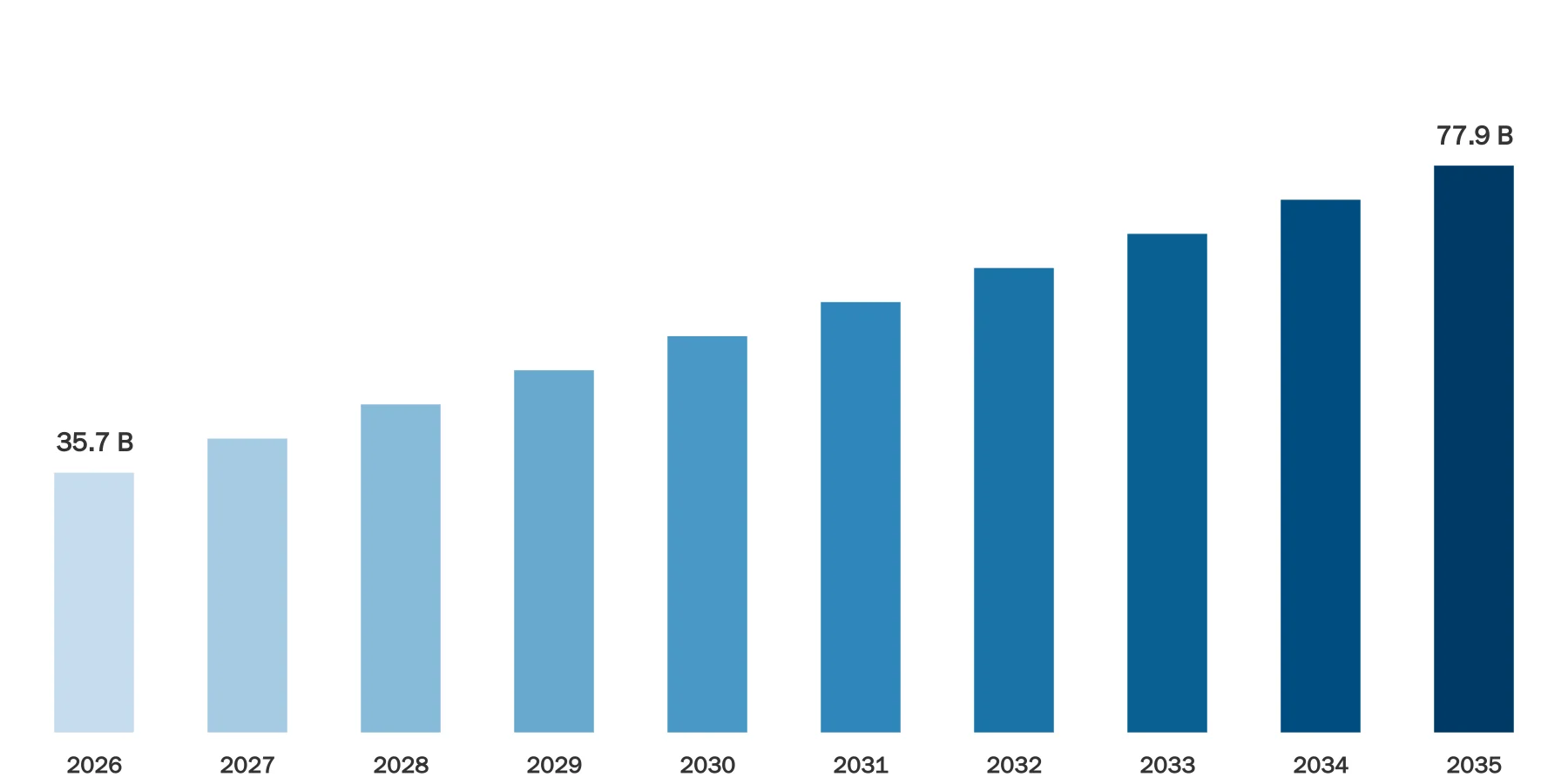
Source: Econ Market Research
Waste heat is one of the by-products often unused and is a result of the industrialized businesses, such as manufacturing, power generation, and transportation. With this technology, the businesses will save on energy efficiency, costs, and carbon emissions. WHP technology has Organic Rankine Cycle and steam Rankine cycle which efficiently capture and convert waste heat into power. With this shift in the global practice toward more sustainable practices, the WHP market is growing at a significant level.
The government and the organizations, as a matter of fact, are encouraging much more energy recovery solutions both for improvement in efficiency and compliance to environmental regulations in the country. What drives the market is, in reality, the necessity for energy-saving solutions, increasing energy charges, and a rising endeavor to curb greenhouse gas emission. In fact, waste heat recovery technologies are becoming increasingly common in both key oil and gas industries, manufacturing facilities, and other businesses that manage waste.
Dynamic Insights
The key driver is the rising need for energy efficiency in various industries. With companies striving to cut operational costs and increase sustainability, WHP technologies become more appealing. Additionally, stringent regulations meant to reduce carbon emissions are forcing businesses to invest in energy recovery solutions, which further boosts demand in the market.
However, some of the challenges in this market include high initial investment costs and complexity in the integration of WHP systems with existing infrastructure. Various industries may be hesitant to implement new technologies due to issues such as return on investment concerns and the possibility of interrupting operations during implementation. All these notwithstanding, the technology is making WHP systems more efficient and reliable, hence more attractive to the prospective users. Along with that, the growing awareness of environmental issues and other incentives in renewable energy increase new directions for the expansion of the WHP market.
Drivers Insights
Increasing Demand for Energy Efficiency
There has been increasing focus on the pursuit of energy efficiency within most industries, and that alone serves as a significant push to the Global Waste Heat to Power (WHP) market. Many manufacturing firms, the oil and gas industries, and transportation have many operational activities that leave huge wastes in terms of heat, and by using the latter for power generation, there can be significant reductions in costs in terms of energy as well as increasing general operation efficiencies. Coupling financial incentives in terms of reduction of energy costs along with the desire to achieve maximum optimization drives industries toward adopting WHP technologies, along with this, companies look toward sustainability and carbon reduction, therefore, energy recovery solutions fit many businesses pretty well.
Regulatory Support and Environmental Concerns
Stricter legislation targeted at preventing emission of carbon dioxide as a greenhouse gas and promotion toward sustainable applications is integral to the increasing usage of WHP. Governmental policy toward different countries tends to promote policies that include the recovery of energy as a part of a comprehensive climatic combating effort. Here, it is supplemented through tax credit, grant, and even subsidy through supporting energy-effective projects for market development. Growing demands from regulators and consumers in terms of the greening of industries result in pressure on industries for greener practice, thus requiring WHP solutions. Such regulatory landscapes become attractive not just to markets but to innovations as they spur developments that are both more efficient and reliable.
Restraints Insights
High Initial Investment Costs
The major constraint to the WHP market is the high capital that is required to install waste heat recovery systems. Most businesses, especially small and medium-sized enterprises, will find it hard to set aside funds for such investments. The long-term savings and reduced energy costs that may be realized by organizations using WHP technologies are outweighed by the initial financial burden. Further, the integration of these systems in ongoing operations would add further financial and logistical complexity, and some companies may delay or skip investments on waste heat recovery.
Operational Complexity and Integration Challenges
WHP system integration into existing processes can be cumbersome and requires huge reconstruction processes of existing infrastructures. The involvement of professional labor and supply chain for expertise to develop and maintain the systems may also deter companies from embracing this innovation. Interference of day-to-day activities by installation processes may also deter decision-makers. As a result, WHP technologies', perceived operational complexity can slow down the growth of the market and particularly within industries that have already been constrained with close margins and operational considerations.
Opportunities Insights
Technological Advancements
Continuous technological advancement provides massive opportunities for the WHP market. System design innovations, efficiency improvements, and new material developments enhance the effectiveness of waste heat recovery solutions. For instance, development in ORC technology enhances the ability to produce power from low-temperature waste heat sources, and thus the range of applications increases. These technologies enhance the viability of WHP systems and attract new players to the market, thus encouraging competition and, consequently, better solutions for end-users.
Segment Analysis
By Technology
From a technological standpoint, the WHP market can be categorized into a few conversion methods from waste heat to useful energy. The most widely used is the Organic Rankine Cycle, which converts low-temperature heat sources into electricity. It can be generally applied in many scenarios. High-temperature waste heat generates steam, which is then used for driving turbines in the Steam Rankine Cycle for electricity production.
The Kalina Cycle is more efficient in utilizing a mixture of ammonia and water, especially in processes with different temperature levels. Thermoelectric generators form a solid-state approach towards converting temperature differences into electrical energy, and other emergent technologies continue to further expand the possibilities for recovering waste heat. Each one of these technologies caters to different temperature ranges and operation needs, contributing to the flexibility of the market as a whole.
By Application
When considering applications, the WHP market encompasses a diverse range of uses for recovered waste heat. Industrial waste heat recovery is a major application, where excess heat from manufacturing processes is converted into electricity or used for heating, enhancing energy efficiency in industrial settings. Power generation applications utilize recovered heat to augment energy production in power plants, often resulting in significant improvements in overall plant efficiency. Additionally, WHP systems are applied in commercial and residential heating, providing a sustainable heating solution. District heating, where heat is distributed to multiple buildings from a central source, also leverages waste heat, showcasing the versatility of WHP technologies across various sectors.
By Source of Waste Heat
Source of waste heat is another critical segmentation of the WHP market. Flue gas, a product of combustion, accounts for most recoverable waste heat sources, particularly in the sectors of power generation and manufacturing. Another large source of waste heat is process heat, which is created through chemical reactions and other manufacturing processes.
Energy recovery opportunities abound in most industrial operations. Natural earth heat forms another source of geothermal heat, and solar heat involves the utilization of the energy from the sun to provide energy. Hence, another variation of sources of waste heat has arisen to serve WHP applications. These have diversified further the variations of sources adaptable to meet the energy recovery requirements in each industry.
By End-Use Industry
The WHP market can be further segmented by the end-use industry. This is essentially the industry in which the waste heat recovery technology will benefit. One of the biggest consumers of this is the manufacturing sector, the energy recovered from industrial processes can reduce operational costs by a tremendous margin and improve sustainability. The energy sector also employs WHP in power plants to enhance the efficiency of the facility.
Recovered heat in mining and metals can be utilized for several processes, whereas food and beverages use WHP technology to improve energy efficiency during production and processing. Construction and transport industries are increasingly using waste heat recovery to reduce energy usage and emissions, thus applying the principles of WHP in multiple industries.
By Capacity
WHP capacity market segmentation usually separates the systems in relation to power generation capabilities. Below 1 MW systems are smaller in capacity, usually installed on facilities and individual process that need relatively less amount of energy. 1 MW-5 MW can fit within a medium size, allowing them to produce optimal results both in terms of efficiency and output of electricity. Systems of 5 MW to 10 MW are used for large industrial applications. Capacity above 10 MW is intended for very large industrial applications. With such segmentation, solutions developed are able to cater specifically to the energy recovery need at different operational scales.
By Design
The WHP market can be segmented by design, which influences the functionality and adaptability of waste heat recovery systems. Modular systems are designed for flexibility and can be easily expanded or reconfigured based on changing energy demands, making them ideal for dynamic industrial environments. Conventional systems follow traditional designs and are well-established in various applications, providing reliability and proven performance. Hybrid systems combine features from both modular and conventional designs, allowing for optimized performance across diverse operational scenarios. This design diversity enables businesses to select WHP solutions that best fit their specific energy recovery requirements and operational contexts.
Regional Analysis
North America is currently in the lead, primarily because of the more advanced industrial base and strong emphasis on energy efficiency and sustainability. In the United States, significant investment has occurred in waste heat recovery technology, partly driven by regulatory incentives and increased environmental awareness. The oil and gas, manufacturing, and energy sectors are major in North America demand for WHP systems as most companies are aggressively searching for ways to cut their operation costs and enhance energy efficiency.
A stronger commitment to renewable energy sources and strict environmental regulations provide momentum for the WHP market in Europe. Countries at the forefront of industrialising waste heat recovery technologies include Germany and the United Kingdom. Meanwhile, the Asian-Pacific region is fast gaining growth in the WHP market and especially in China and India where industrialization and urbanization are resulting in increased energy consumption and waste heat generation. Energy efficiency improvements in manufacturing and power-generation processes are driving WHP system adoption in this region. It is also driven by increasing awareness of the existence of climate change throughout all regions, demanding more sustainable practices.
Competitive Landscape
Major players in this industry include majors such as Siemens, General Electric, and Mitsubishi Heavy Industries, holding immense expertise regarding energy system and waste heat recovery technology. These major companies engage their extensive capabilities in conducting research and development to create an efficient WHP systems solution that ensures sustainability through meeting the growth in demands for energy production. Additionally, there are companies like Ormat Technologies and Piller Group that specialize in waste heat recovery alone and offer customized solutions for specific industries.
The WHP market is becoming increasingly competitive as firms strive for differentiation through technological superiority and superior customer service. The use of modular or hybrid systems that provide flexibility and adaptability to any given application will also attract numerous industries, while strategic partnerships and collaborations have become the norm in combining strengths for more comprehensive solutions. With rising globalization of the focus on sustainability and energy efficiency, firms in the WHP market are looking to expand into new geographies and also build their service offerings. Other competitive factors include compliance with regulatory requirements and also the requirement for cost effectiveness with payback being as fast as possible.
List of Key Players:
AC Boiler SpA
Cochran Ltd.
Siemens Energy
Ormat Technologies
Thermax Ltd
Forbes Marshall
Aura GmbH &, CO. KG
IHI Corporation
Walchandnagar Industries Limited (WIL)
Mitsubishi Heavy Industries, Ltd.
Dü,rr Group
Rentech Boiler System
Exergy International Srl
General Electric
Climeon
Global Waste Heat to Power Report Segmentation
Waste Heat to Power Market Report Scope & Segmentation
| Attributes | Details |
|---|---|
Market Size (Current) | US$ 35.7 Billion in 2026 |
Market Size (Forecast) | US$ 77.9 Billion in 2035 |
Growth Rate | CAGR of 9% from 2026 to 2035 |
Forecast Period | 2026 – 2035 |
Base Year | 2025 |
Historical Data Available | Yes |
Regional Scope | Global |
Segments Covered | By Technology
By Application
|
Frequently Asked Questions
Common questions about this report
The study period covers historical insights and forecast projections for the period 2026-2035.
About the Author
Market research expert with years of industry experience

Dipali Bhingare serves as the Market Research Director at Econ Market Research. With a focus on translating complex global economic shifts into actionable business intelligence, she oversees the strategic direction of comprehensive market studies. Her work empowers organizations to navigate volatile industries through data-driven forecasting and deep-dive competitive analysis.
Related Reports
Explore more market insights from the same category