

Vehicle to Grid Technology Market
Vehicle to Grid Technology Market Size, Share, Trends, Growth, and Industry Analysis, By Vehicle Type (Battery Electric Vehicles (BEVs), Plug-in Hybrid Electric Vehicles (PHEVs), Fuel Cell Vehicles (FCVs)), By Component (Smart Meters, Electric Vehicle Supply Equipment (EVSE), Home Energy Management Systems, Software Solutions, Others), By Application (Residential, Commercial), Regional Analysis and Forecast Period 2026-2035
Vehicle to Grid Technology Market Overview
As per Econ Market Research analysis, the Global Vehicle to Grid Technology Market was valued at approximately US$ 7.01 Billion in 2026 and is predicted to reach US$ 58.76 Billion by 2035, expanding at a CAGR of 26.65% over the forecast duration. The base year is 2025.
Vehicle to Grid Technology Market Size 2025-2035 (USD Billion)

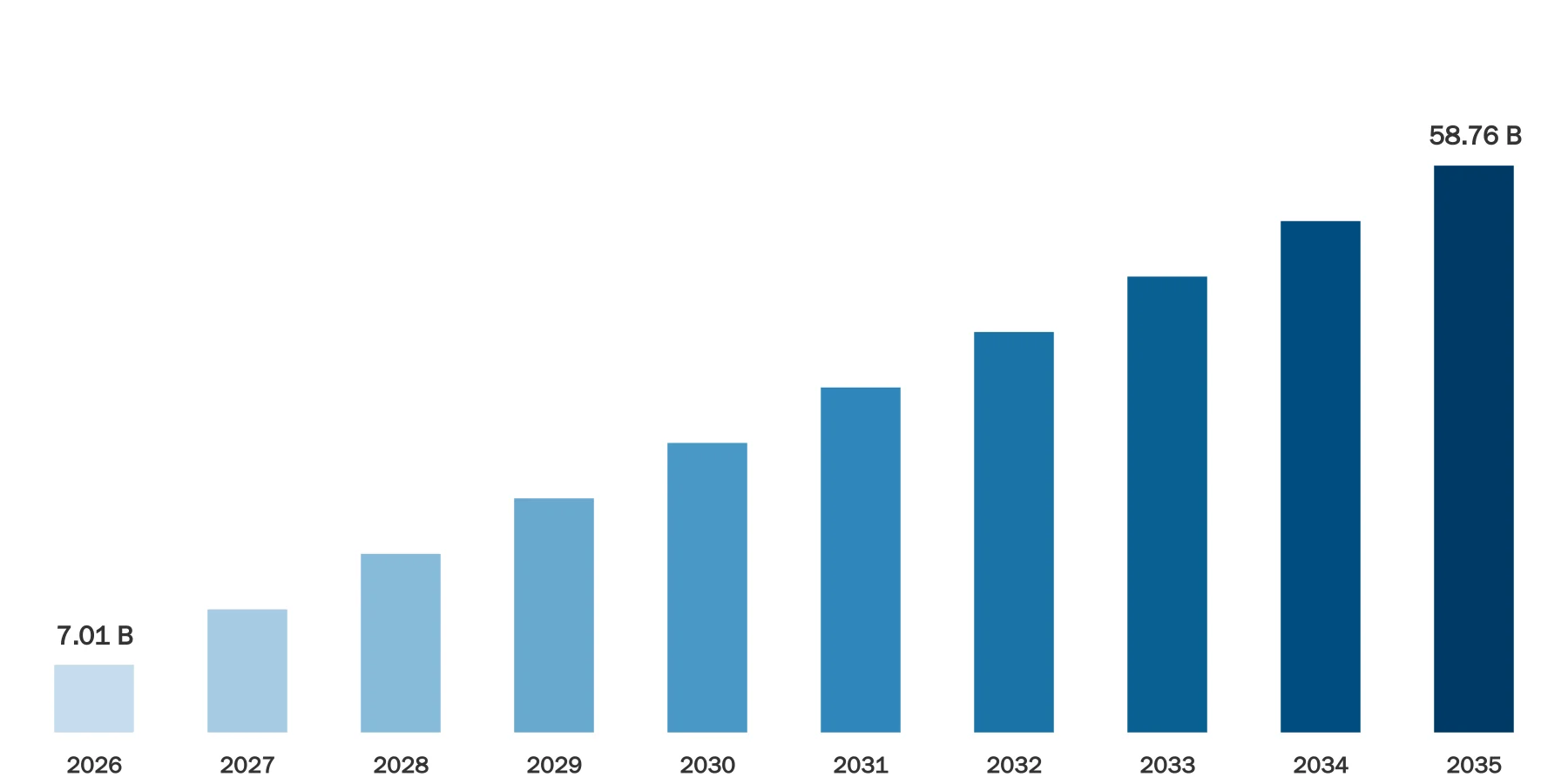
Source: Econ Market Research
The global Vehicle-to-grid Technology market is expanding rapidly due to rising electric vehicle deployment and increasing grid balancing requirements. More than 17 million electric cars were sold globally in 2024, representing over 20% of total new car sales, creating a significant installed battery base for bidirectional charging systems. Public charging infrastructure exceeded 5 million units worldwide in 2024, while fast chargers crossed 2 million installations. China accounted for nearly 65% of global charging infrastructure deployment, and Europe surpassed 1 million public charging points. Vehicle-to-grid Technology Market Analysis indicates that bidirectional charging capacity could provide over 10 GW of flexible grid support capacity in China alone by 2030.
The USA Vehicle-to-grid Technology Market Report shows strong infrastructure modernization and increasing adoption of bidirectional charging systems. More than 630,000 electric cars and trucks with bidirectional charging capability were already operating on U.S. roads by 2025. Nearly 30% of urban public charging points in the United States support fast charging above 22 kW, supporting grid-responsive charging services. The United States also recorded increasing deployment of vehicle-to-home and vehicle-to-building systems across California, Texas, and New York. More than 4% to 6% of highway charging points in the country now include high-capacity charging systems. Vehicle-to-grid Technology Market Growth in the USA is also supported by utility pilot programs integrating EV batteries into distributed energy management systems.
The European Vehicle-to-grid Technology Industry Analysis highlights extensive integration of smart charging infrastructure and renewable energy balancing. Europe crossed 1 million public charging points during 2024 after annual infrastructure growth exceeded 35%. The Netherlands alone operated over 180,000 charging points, followed by Germany with 160,000 and France with 155,000. Scandinavian cities such as Oslo recorded electric vehicle penetration above 55% within urban vehicle fleets, while Stockholm reached 35%. More than 15% of urban public chargers in Europe now support charging rates above 22 kW. The European Alternative Fuels Infrastructure Regulation mandates charging stations every 60 km across core transport corridors, accelerating Vehicle-to-grid Technology Market Opportunities for commercial fleets and residential energy systems.
Vehicle-to-grid Technology Market Latest Trends
The Vehicle-to-grid Technology Market Trends landscape is undergoing rapid transformation due to bidirectional charging advancements, battery innovations, and smart grid modernization. Ultra-fast charging installations in Europe more than doubled between 2022 and 2024, while China expanded fast charger deployment from 1.2 million units in 2023 to 1.6 million units in 2024. More than 50% of global fast charger growth originated from Asia-Pacific markets. Advanced charging protocols such as ISO 15118 are improving interoperability between electric vehicles, utility grids, and charging stations. Bidirectional charging systems are increasingly integrated with residential solar installations, allowing households to use EV batteries as backup energy storage systems.
Vehicle-to-grid Technology Market Insights also show increasing adoption in fleet operations. Commercial fleet operators in logistics, public transportation, and delivery services are deploying V2G-enabled vehicles to support peak demand management. Research studies involving 15 million electric cars in Germany demonstrated that even a 30% V2G participation rate can significantly reduce electricity system stress and improve energy balancing efficiency. Bidirectional charging projects are also expanding in Japan, South Korea, Australia, and the United Kingdom. Manufacturers are introducing EV platforms supporting home backup systems with battery capacities exceeding 80 kWh, enabling residential power supply during outages lasting between 24 and 72 hours. Vehicle-to-grid Technology Market Forecast assessments further indicate growing integration of Artificial Intelligence software for automated energy trading and dynamic load balancing.
Vehicle-to-grid Technology Market Dynamics
The Vehicle-to-grid Technology Market Dynamics are shaped by rapid EV deployment, renewable energy integration, smart charging infrastructure expansion, and grid decentralization. More than 150 million charging points are projected to be added globally between 2025 and 2030, with nearly two-thirds consisting of home charging systems. Governments across Asia-Pacific, Europe, and North America are implementing grid modernization policies supporting bidirectional energy exchange. Increased electrification of transport sectors is intensifying peak electricity demand, encouraging utilities to adopt V2G systems for load balancing. Vehicle-to-grid Technology Industry Report data also indicates that distributed battery storage systems can reduce pressure on aging transmission infrastructure and support renewable energy stability.
DRIVER
Increasing Deployment of Electric Vehicles and Smart Charging Infrastructure
The primary driver of the Vehicle-to-grid Technology Market Growth is the accelerating deployment of electric vehicles combined with smart charging infrastructure expansion. Global electric car sales exceeded 17 million units during 2024, while public charging infrastructure increased by more than 30% in a single year. China added approximately 850,000 public charging points in 2024 alone, while Europe exceeded 1 million charging stations. Home charging systems continue to dominate installations, accounting for nearly 66% of projected charging deployments through 2030. Governments are also supporting fast charger deployment with mandatory charging corridor regulations. Vehicle-to-grid Technology Market Size expansion is further supported by increasing renewable energy penetration, with utilities requiring flexible battery storage systems to manage intermittent solar and wind generation. Bidirectional charging enables EV batteries to stabilize grids during peak demand periods, reducing transformer overload risks and enhancing energy resilience.
RESTRAINT
Limited Standardization and High Infrastructure Complexity
A major restraint in the Vehicle-to-grid Technology Market is the absence of universal charging standards and the complexity of integrating bidirectional charging infrastructure into existing power systems. Less than 30% of public urban chargers in the United States currently support advanced fast charging and bidirectional compatibility. Many regional grids still operate using legacy distribution systems not designed for decentralized energy exchange. Compatibility differences between charging protocols, inverter technologies, and vehicle software create deployment barriers for utilities and charging operators. Vehicle-to-grid Technology Market Research Report findings indicate that grid connection approval processes can exceed 12 months in several European and North American regions. Installation costs for bidirectional charging systems remain significantly higher than standard Level 2 chargers due to additional inverter hardware and communication software requirements. Concerns regarding battery degradation and warranty limitations also continue to restrict consumer adoption rates.
OPPORTUNITY
Expansion of Renewable Energy Integration and Distributed Energy Storage
The Vehicle-to-grid Technology Market Opportunities segment is expanding due to increasing renewable energy generation and distributed storage requirements. More than 50% of newly installed charging capacity projected through 2030 is expected to consist of fast public chargers supporting flexible charging operations. Governments in China, Japan, and Europe are implementing smart grid policies encouraging EV participation in energy balancing systems. China plans to achieve 10 GW of flexible V2G capacity by 2030, while several European countries are integrating EV fleets into national grid balancing programs. Residential energy storage demand is also increasing, with EV battery capacities ranging from 60 kWh to 120 kWh now sufficient to support average household electricity consumption for 2 to 4 days. Commercial fleet operators can use V2G-enabled vehicles for peak shaving and demand response programs, creating additional operational value beyond transportation services.
CHALLENGES
Grid Stability Risks and Consumer Adoption Barriers
The Vehicle-to-grid Technology Market faces challenges associated with grid stability management, cybersecurity risks, and consumer participation limitations. Uncoordinated residential charging can create localized peak demand increases exceeding 40% during evening hours in dense urban regions. Bidirectional charging requires advanced software coordination, real-time communication systems, and dynamic electricity pricing mechanisms to prevent network instability. Vehicle-to-grid Technology Market Outlook studies also identify cybersecurity as a critical issue because charging networks process large volumes of real-time user and energy data. Battery degradation concerns remain significant among consumers despite improvements in lithium-ion chemistry and thermal management systems. Some regions also lack regulatory clarity regarding electricity resale and distributed energy participation rights. Market penetration is further slowed by limited awareness among residential consumers and small commercial operators regarding the long-term operational benefits of bidirectional charging technologies.
SWOT Analysis
Strengths
More than 17 million electric cars were sold globally in 2024, creating a large battery storage ecosystem for V2G integration.
Public charging infrastructure surpassed 5 million units worldwide, improving bidirectional charging accessibility.
China alone targets 10 GW of flexible V2G grid capacity by 2030.
Modern EV batteries provide storage capacities between 60 kWh and 120 kWh, supporting residential and commercial backup power systems.
Weaknesses
Less than 30% of U.S. urban charging stations support advanced fast charging compatibility.
Bidirectional chargers require higher installation complexity due to inverter integration and communication protocols.
Limited interoperability exists between charging standards across Europe, Asia-Pacific, and North America.
Consumer concerns regarding battery degradation continue to reduce adoption rates.
Opportunities
More than 150 million charging points are expected to be added globally by 2030.
Europe mandates charging stations every 60 km on core transport corridors.
Fleet electrification in logistics and public transportation sectors is increasing demand for smart energy systems.
AI-enabled energy management software can improve electricity optimization and demand response efficiency.
Threats
Grid overload risks increase with uncontrolled simultaneous charging behavior.
Cybersecurity vulnerabilities in connected charging networks may affect utility operations.
Regulatory uncertainty regarding distributed electricity resale remains significant in multiple countries.
Fluctuating raw material supply for lithium-ion batteries can impact charger and EV production timelines.
Segmentation Analysis
The Vehicle-to-grid Technology Market is segmented by vehicle type, component, and application. Passenger EVs represent the largest integration segment due to increasing residential charging adoption, while commercial fleet electrification is supporting rapid expansion in public charging infrastructure. Installation methods vary between residential wall-mounted systems and commercial high-capacity charging stations exceeding 150 kW. Smart software platforms, bidirectional inverters, and Home Energy Management systems are increasingly integrated into V2G ecosystems. Vehicle-to-grid Technology Market Share distribution is heavily influenced by charging accessibility, battery capacity, and utility participation programs across developed economies.
By Vehicle Type
Battery Electric Vehicles (BEVs) dominate the Vehicle-to-grid Technology Market Share due to their large battery capacities and full electrification compatibility. BEVs represented more than 70% of global EV sales during 2024, with many models offering battery capacities exceeding 75 kWh. These vehicles are highly compatible with bidirectional charging systems because they operate entirely on electric propulsion systems. Plug-in Hybrid Electric Vehicles (PHEVs) account for a smaller but growing segment, especially in Europe and North America, where hybrid adoption remains strong due to charging infrastructure limitations. PHEVs typically support battery capacities between 10 kWh and 25 kWh, limiting their V2G discharge duration compared with BEVs.
Fuel Cell Vehicles (FCVs) remain a niche category with limited V2G integration due to hydrogen infrastructure dependency. However, pilot projects in Japan and South Korea are testing FCV participation in distributed energy systems. Vehicle-to-grid Technology Market Forecast reports indicate BEVs will continue dominating due to increasing charging station deployment and falling battery costs. Commercial BEV fleets are also supporting grid balancing operations in logistics hubs and urban transportation systems. Bidirectional charging functionality is becoming standard in several new EV platforms introduced after 2024, accelerating BEV dominance in the V2G ecosystem.
By Component
Smart meters represent a critical component segment within the Vehicle-to-grid Technology Market because they enable two-way communication between vehicles, utilities, and charging infrastructure. Smart meter penetration in developed markets exceeded 60% of residential electricity connections by 2025. Electric Vehicle Supply Equipment (EVSE) also accounts for a major market share because bidirectional charging requires advanced inverter systems and communication interfaces. Ultra-fast EVSE systems above 150 kW are increasingly deployed along highways and urban commercial zones.
Home Energy Management Systems are expanding rapidly due to growing integration between solar panels, battery storage, and EV charging systems. Software solutions play a vital role in optimizing charging schedules, electricity pricing, and demand response participation. Artificial intelligence-enabled charging software can reduce peak load stress by more than 20% in dense urban grids. Other components include bidirectional inverters, communication controllers, and grid synchronization systems. Vehicle-to-grid Technology Market Insights indicate software-driven energy management platforms will become increasingly important as utilities expand dynamic pricing models and distributed energy programs across residential and commercial sectors.
By Application
Residential applications account for a significant portion of the Vehicle-to-grid Technology Market because home charging remains the dominant EV charging method globally. Nearly two-thirds of projected charging point additions through 2030 are expected to consist of home charging systems. Residential V2G systems allow homeowners to use EV batteries for backup power during outages and peak demand periods. Vehicle batteries with capacities between 60 kWh and 100 kWh can supply average household electricity demand for 48 to 96 hours.
Commercial applications are expanding rapidly due to fleet electrification and utility demand response programs. Commercial charging hubs support buses, logistics fleets, ride-sharing operators, and municipal transportation services. Public charging infrastructure exceeded 5 million units globally in 2024, supporting large-scale commercial adoption. Commercial V2G systems are increasingly integrated into office complexes, industrial parks, and retail centers with rooftop solar installations. Vehicle-to-grid Technology Industry Analysis shows commercial applications are particularly attractive for utilities because fleet operators provide predictable charging schedules and large battery aggregation capacities for grid stabilization services.
Regional Analysis
North America maintains strong V2G pilot deployments supported by advanced grid infrastructure and EV adoption growth.
Europe leads regulatory standardization and public charging density expansion.
Asia-Pacific dominates global charging infrastructure deployment and EV production.
Middle East & Africa show increasing smart city investments and renewable integration projects.

North America
North America accounts for a substantial share of the due to increasing electric vehicle penetration and advanced utility modernization programs. The United States leads regional deployment with more than 630,000 bidirectional-capable EVs already on roads by 2025. California, Texas, and New York are major V2G deployment centers because of high EV adoption and renewable energy integration targets. Nearly 30% of urban public charging stations in the United States now support fast charging systems above 22 kW. Utility companies across North America are also deploying dynamic pricing systems encouraging off-peak charging and energy discharge participation.
Canada is expanding public charging infrastructure along interprovincial transportation corridors, while commercial fleet electrification is increasing across logistics and public transit systems. North America also benefits from advanced software ecosystem development, with several charging network operators integrating AI-driven energy optimization platforms. Vehicle-to-grid Technology Market Outlook assessments indicate that residential solar adoption combined with EV charging systems is accelerating decentralized energy storage deployment across suburban markets. The region also maintains strong investments in cybersecurity frameworks and smart grid communication systems supporting bidirectional charging infrastructure.
Europe
Europe represents one of the most advanced Vehicle-to-grid Technology Market regions due to regulatory support and extensive charging infrastructure deployment. Public charging points in Europe surpassed 1 million units during 2024 following annual growth above 35%. The Netherlands operates more than 180,000 charging points, while Germany and France maintain networks exceeding 150,000 units each. Scandinavian countries continue leading EV penetration, with Oslo recording electric vehicle fleet shares above 55%.
The Alternative Fuels Infrastructure Regulation requires charging stations every 60 km along major transport corridors, significantly improving long-distance charging accessibility. Europe also leads bidirectional charging pilot programs involving utilities, fleet operators, and residential consumers. Commercial fleet electrification in Germany, the United Kingdom, and France is creating demand for advanced energy balancing systems. Vehicle-to-grid Technology Market Trends in Europe also highlight increasing deployment of smart meters and residential energy management systems. More than 15% of urban chargers support charging rates above 22 kW, enabling faster bidirectional energy transfer capabilities. Government incentives supporting renewable integration and carbon reduction targets continue strengthening V2G deployment across residential and commercial sectors.
Asia-Pacific
Asia-Pacific dominates the global Vehicle-to-grid Technology Market Share due to large-scale EV manufacturing, charging infrastructure deployment, and government policy support. China accounts for approximately 65% of global charging infrastructure and nearly 60% of global electric light-duty vehicle stock. The country expanded fast charger deployment from 1.2 million units in 2023 to 1.6 million units in 2024. China also plans to deploy more than 12 million public charging points by 2030 and target 10 GW of flexible V2G capacity.
Japan and South Korea are leading bidirectional charging research and vehicle integration initiatives. South Korea increased fast charger installations from 34,000 in 2023 to 47,000 in 2024 and plans to deploy 4,400 additional fast chargers. India is also emerging as a significant market, with public charging infrastructure projected to increase from 75,000 units in 2024 to around 375,000 by 2030. Vehicle-to-grid Technology Market Research Report findings indicate that Asia-Pacific benefits from strong EV battery manufacturing ecosystems, government incentives, and rapid urbanization. Smart city projects across China, Singapore, Japan, and South Korea are integrating EVs into distributed energy management systems and renewable energy balancing networks.
Middle East & Africa
The Middle East & Africa Vehicle-to-grid Technology Market is developing steadily due to renewable energy investments, urban electrification programs, and smart city infrastructure initiatives. Countries including the United Arab Emirates and Saudi Arabia are deploying EV Charging Infrastructure within large-scale sustainable city developments. Public charging infrastructure expansion is concentrated in urban transportation corridors and commercial districts. Renewable energy projects across the Gulf region are increasing interest in distributed battery storage solutions linked to EV charging systems.
South Africa leads electric mobility adoption in Africa, supported by urban charging deployments and renewable integration initiatives. Fleet electrification programs for buses and municipal vehicles are creating opportunities for commercial V2G deployment. Vehicle-to-grid Technology Market Opportunities in the region are also supported by increasing electricity reliability concerns and the need for backup energy systems. Residential solar adoption combined with EV charging is growing across high-income urban markets. The region still faces challenges related to charging accessibility and grid modernization; however, ongoing investments in smart infrastructure and renewable energy integration are expected to strengthen V2G deployment capacity over the coming decade.
Competitive Landscape
The Vehicle-to-grid Technology Market competitive landscape is characterized by strategic partnerships between automotive manufacturers, utilities, charging infrastructure providers, and software developers. Major companies are focusing on bidirectional charger deployment, smart energy management platforms, and interoperability standards. More than 20 global automotive manufacturers are currently testing or deploying V2G-compatible platforms. Competitive differentiation increasingly depends on charging speed, software integration capability, and grid communication performance.
Leading participants are investing in ultra-fast charging systems above 150 kW and advanced AI-enabled energy optimization platforms. Several companies are collaborating with utility operators to support frequency regulation and demand response services. Vehicle-to-grid Technology Industry Report assessments show that interoperability compliance with ISO 15118 standards is becoming a critical competitive factor. Companies are also expanding residential energy solutions integrating solar panels, battery storage, and EV charging systems into unified platforms.
Commercial fleet operators represent a key competitive target because fleet charging schedules provide predictable energy availability for grid balancing operations. Strategic partnerships between automakers and charging infrastructure providers are accelerating deployment across North America, Europe, and Asia-Pacific. Competition is also intensifying in software analytics, cybersecurity systems, and cloud-based charging management services supporting large-scale V2G operations.
List of Top Vehicle-to-grid Technology Companies
Hitachi Ltd.
Honda Motor Co.,Ltd.
Mitsubishi Motors Corporation
Nissan Motor Corporation
NRG Energy Inc.
ABB Ltd.
AC Propulsion Inc.
Denso Corporation
Edison International
Engie Group
Groupe Renault
NRG Energy Inc.
Nuvve Corporation
Leading Companies by Market Share
Nissan Motor Corporation and Nuvve Corporation are among the leading companies by market share in the Vehicle-to-grid Technology Market. Nissan has deployed bidirectional charging compatibility across several EV platforms and participated in multiple V2G pilot programs across Europe and Japan. Nuvve Corporation operates grid integration platforms supporting school bus fleets and commercial energy aggregation systems in North America and Europe. Both companies maintain strong partnerships with utilities, charging operators, and fleet management providers to expand commercial V2G deployment.
Market Investment Outlook
Vehicle-to-grid Technology Market Investment Outlook remains positive due to increasing EV adoption, charging infrastructure expansion, and renewable energy integration requirements. Governments globally are allocating billions in grid modernization and EV charging support programs. China plans to deploy more than 12 million charging points by 2030, while India targets approximately 375,000 public charging stations. Europe continues investing heavily in charging corridors and smart grid infrastructure under transportation decarbonization initiatives.
Private sector investments are increasingly directed toward software platforms, bidirectional inverter systems, and commercial fleet electrification projects. Utility operators are funding demand response systems capable of aggregating thousands of connected EV batteries into virtual power plants. More than 150 million charging points are expected to be added globally between 2025 and 2030, creating substantial infrastructure investment opportunities. Vehicle-to-grid Technology Market Opportunities also include AI-driven charging analytics, cybersecurity systems, and home energy management solutions integrating solar and storage systems.
Commercial fleet electrification represents one of the strongest investment segments due to predictable charging patterns and high battery capacities. Logistics companies, municipal transit systems, and delivery operators are deploying V2G-enabled fleets to reduce operational electricity costs and support grid balancing services. Investment activity is also accelerating in semiconductor development, power electronics, and high-efficiency charging hardware supporting next-generation bidirectional charging ecosystems.
New Product Development
New product development within the Vehicle-to-grid Technology Market is focused on bidirectional chargers, AI-enabled energy management software, and integrated home energy systems. Several manufacturers introduced chargers supporting both vehicle-to-home and vehicle-to-grid operations with charging capacities exceeding 19.2 kW. New DC bidirectional charging platforms are being designed to provide residential backup power during outages while also participating in utility demand response programs.
Automotive manufacturers are also launching EV models with native bidirectional charging functionality. Battery systems exceeding 80 kWh are increasingly common in premium EV segments, enabling extended household power supply capabilities. Software developers are introducing cloud-based platforms capable of optimizing electricity flow based on dynamic pricing, renewable generation availability, and household consumption patterns.
Charging equipment providers are focusing on interoperability improvements through ISO 15118 integration and advanced cybersecurity frameworks. Smart charging stations with embedded artificial intelligence can now automatically adjust charging schedules to reduce grid congestion and electricity costs. Vehicle-to-grid Technology Market Trends also show increasing integration of solar photovoltaic systems with EV charging infrastructure. Residential energy ecosystems combining rooftop solar, home batteries, and bidirectional EV charging are becoming key innovation areas across Europe, North America, and Asia-Pacific.
Recent Developments
China expanded public fast charger deployment from 1.2 million units in 2023 to 1.6 million units in 2024 while targeting 10 GW of V2G flexibility capacity by 2030.
Europe exceeded 1 million public charging points in 2024, with the Netherlands surpassing 180,000 installations and Germany reaching 160,000.
More than 630,000 bidirectional-capable EVs were operating in the United States by 2025, accelerating residential and commercial V2G adoption.
South Korea increased fast charger installations from 34,000 units in 2023 to 47,000 units in 2024 and announced deployment plans for 4,400 additional fast chargers.
India announced plans to expand public charging infrastructure from 75,000 charging points in 2024 to around 375,000 by 2030, supporting approximately 3 million electric light-duty vehicles.
Report Coverage of Vehicle-to-grid Technology Market
The Vehicle-to-grid Technology Market Report provides comprehensive analysis of charging infrastructure deployment, bidirectional charging technologies, EV penetration, smart grid integration, and distributed energy storage systems. The report covers major vehicle categories including Battery Electric Vehicles, Plug-in Hybrid Electric Vehicles, and Fuel Cell Vehicles. It also analyzes critical components such as smart meters, EVSE systems, software platforms, and home energy management solutions.
The Vehicle-to-grid Technology Market Research Report includes regional analysis covering North America, Europe, Asia-Pacific, and Middle East & Africa. Infrastructure deployment trends, utility modernization programs, charging standards, and renewable integration policies are examined in detail. The report also evaluates commercial fleet electrification trends, residential charging adoption, and public charging network expansion.
Competitive analysis includes leading automotive manufacturers, charging infrastructure providers, utility operators, and software developers. The report highlights recent product launches, strategic partnerships, and smart charging innovations between 2023 and 2025. Vehicle-to-grid Technology Market Forecast evaluations further assess the impact of artificial intelligence, cybersecurity frameworks, dynamic electricity pricing, and distributed energy management systems on future market expansion. Additionally, the report examines charging interoperability standards, regulatory developments, and investment opportunities associated with next-generation bidirectional charging ecosystems.
Vehicle to Grid Technology Market Report Scope & Segmentation
| Attributes | Details |
|---|---|
Market Size (Current) | US$ 7.01 Billion in 2026 |
Market Size (Forecast) | US$ 58.76 Billion in 2035 |
Growth Rate | CAGR of 26.65% from 2026 to 2035 |
Forecast Period | 2026 – 2035 |
Base Year | 2025 |
Historical Data Available | Yes |
Regional Scope | Global |
Segments Covered | By Vehicle Type
By Component
By Application
|
Frequently Asked Questions
Common questions about this report
The study period covers historical insights and forecast projections for the period 2026-2035.
About the Author
Market research expert with years of industry experience
As a Senior Research Associate at Econ Market Research, Akash Bhingare leads comprehensive market studies across dynamic and highly specialized sectors, ranging from advanced biotech fields to niche industrial markets. He excels at dissecting complex supply chains, analyzing market segmentation, and forecasting future industry trajectories. Akash’s commitment to high-fidelity data ensures that every report he authors delivers reliable, foundational knowledge for enterprise-level decision-making.
Related Reports
Explore more market insights from the same category