

Two Part Adhesive Market
Two Part Adhesive Market Size, Share, Trends, Growth, and Industry Analysis, By Resin Type (Epoxy, Polyurethane, Acrylic, Silicone), By Application (Construction, Automotive, Aerospace, Electronics), By End-User (Industrial, Residential), Regional Analysis and Forecast Period 2026-2035
Two Part Adhesive Market Overview
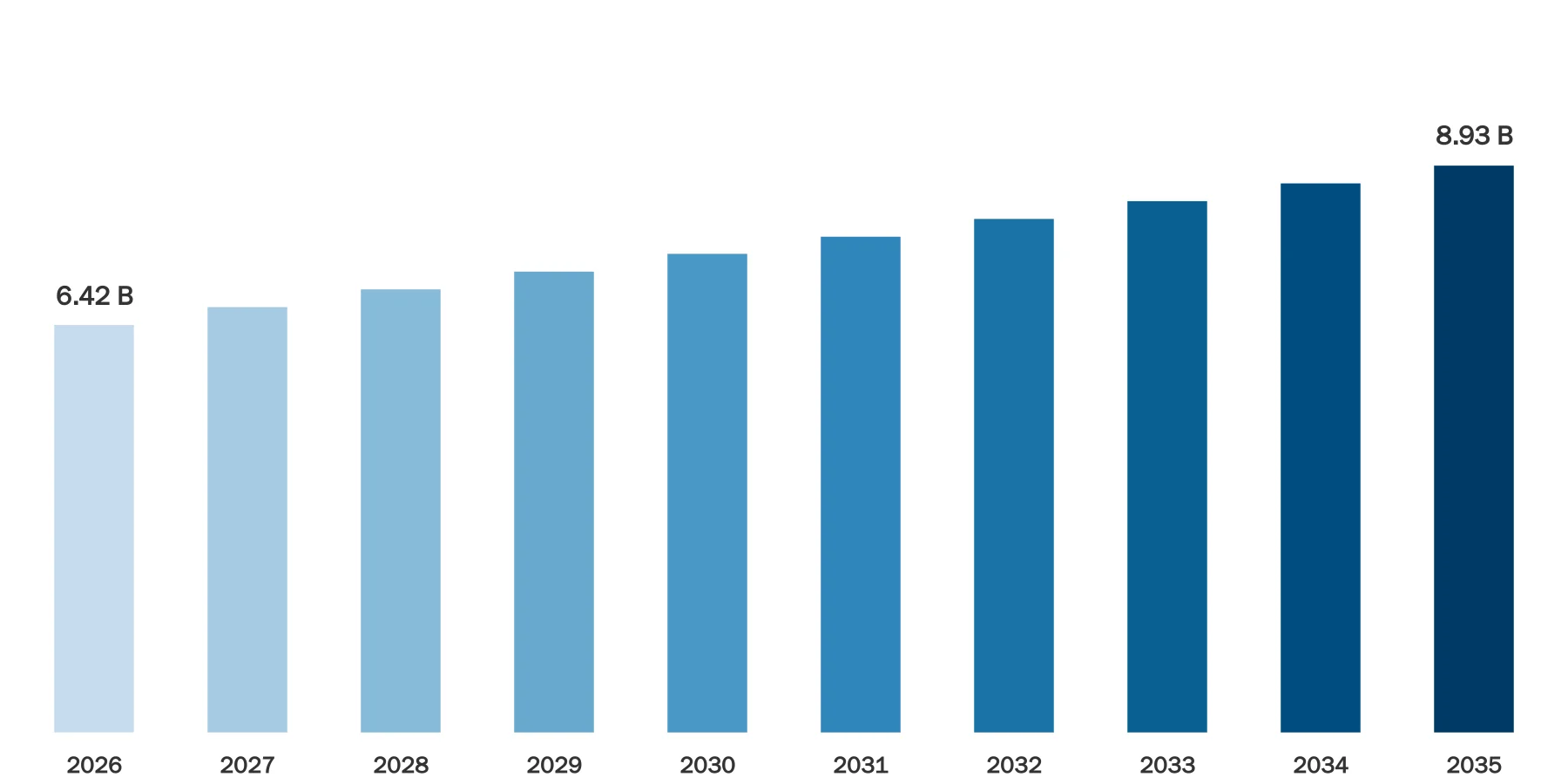
As per Econ Market Research analysis, the Global Two Part Adhesive Market accounted for US$ 6.42 Billion in 2026 and is expected to surpass US$ 8.93 Billion by 2035, witnessing a CAGR of 3.69% throughout 2026–2035. The analysis is based on 2025 as the base year.
Two Part Adhesive Market Size 2025-2035 (USD Billion)

Source: Econ Market Research
Two-part adhesives, also referred to as two-component adhesives, are adhesives that require a combination of two separate components for effective bonding. Usually, the two parts involve resin and hardener, but they may be in other forms. When combined, the two elements chemically react with each other and result in curing leading to a strong bonding. Two-part adhesives possess many such beneficial strengths- high strength, versatility, and resistance towards diverse environmental conditions. They can be used in most construction, automobile, electronic, and health industries where they can bond any form of metal, plastic, or ceramic.
Two-component adhesives market is progressing steadily in the marketplace due to the increased usage of two-component adhesives for durable and efficient bonding solutions in various applications. Growth is supported through advancements in technologies of adhesives, increased industrial activities, and eco-friendly products. Market expansion is further expected from new product developments introduced by manufacturers. In addition, this product-type has been widely sourced because of the demand boost created by increasing automation, and better manufacturing process in the automotive and electronics industries.
Dynamic Insights
The two key factors driving demand are the growing requirement for high-performance adhesives across a number of industries including automotive, construction, electronics, and healthcare. With evolving requirements of strong, and sustainable bonding solutions from the industry that can help improve product performance and dependability, two-part adhesives become indispensable for such demands because of their superior bonding properties, and resilience to withstanding extreme conditions of environment.
On the other hand, some of the other factors limiting the market growth include the exorbitant price of raw materials and cumbersome application procedures. Additionally, due to the right mixing and handling of the components of adhesive, technical manpower is needed, which can be a problem for some manufacturers. Opportunities include advanced technology whose main aspects are to improve the characteristics of adhesives, and easy usage. Another trend was that of sustainable and environmentally-friendly adhesives. It is also transforming the market dynamics as the manufacturers try to cater to the demands of greener products by consumers. Increased adoption of automation in manufacturing processes would boost efficiency and, subsequently, require two-part adhesives, another possible area of growth for the market.
Drivers Insights
Increasing Demand for High-Performance Adhesives
The global push toward stronger and more durable bonding solutions is one of the key drivers in the two-part adhesive market. Automotive and aerospace industries require adhesives with high strength as well as insulating capacities, high temperature stability, resistance to humidity, as well as mechanical stresses. This has made two-part adhesives satisfy the above requirements owing to the chemical reaction that takes place when the two components are mixed. Increased reliability and product life will enhance market growth, with high-performance adhesives. In addition, advancements in adhesive formulations make them applicable for use in areas like electronics, construction, etc., fuelling demand further.
Technological Advancements
Continuous advancements in adhesive technology play a significant role in driving the two-part adhesive market. Innovations such as faster curing times, improved adhesion properties, and enhanced resistance to chemicals and environmental factors make these adhesives more appealing to manufacturers. For example, the development of smart adhesives that can adapt to different conditions or repair themselves when damaged is gaining traction. These technological improvements not only enhance the performance of two-part adhesives but also expand their range of applications, thereby attracting more end-users. As manufacturers invest in research and development to create advanced adhesive solutions, the market is likely to experience substantial growth.
Restraints Insights
High Cost of Raw Materials
One of the major restraints in the two-part adhesive market is the rising cost of raw materials that go into the production. The resins and hardeners are often the most important component, and changes in these prices do have a bearing on the overall costs of production. The manufacturers may pass the extra costs to the consumers or absorb them, bringing down the profitability. Meanwhile, the small companies would fall in their hands because they cannot compete with the better cost management by the large companies. This economic stress can actually stifle innovation and lead to lower investment in new product development, further limiting market growth.
Complex Application Process
Another major hindrance is the need for proper mixing and application of two-part adhesives. The functioning of these adhesives largely depends on the accurate measurement and thorough mixing of the two components. The vagaries associated with this process may result in inconsistent outcomes if not properly controlled, making the manufacturers unwilling to introduce these solutions. Another factor is that there are skilled labor requirements in order to work with these adhesives, and this requires a good number of operational costs, thus, it can pose a difficult challenge for smaller firms to find their way into this market. The complexity and labor intensity of two-part adhesives may therefore bar its widespread application, especially in industries where easy use is valued most.
Opportunities Insights
Growing Demand for Sustainable Adhesives
The increasing focus on sustainability presents a significant opportunity for the two-part adhesive market. As consumers and industries become more environmentally conscious, there is a growing demand for eco-friendly adhesive solutions. Manufacturers are responding by developing two-part adhesives that are free from harmful chemicals, using renewable raw materials, and offering recyclable packaging. This trend aligns with global initiatives aimed at reducing carbon footprints and promoting sustainable manufacturing practices. By capitalizing on this demand for greener products, companies in the two-part adhesive market can differentiate themselves and capture a larger share of the market.
Segment Analysis
By Type
The two-part adhesives can be classified under several types which are silicone adhesives, polyurethane adhesives, UV curable adhesives, and cyanoacrylate adhesives. Silicone adhesives are highly valued for their flexibility as well as excellent resistance at high temperatures with resistance to weathering. Such adhesives are well found useful in construction applications and automotive. Polyurethane adhesives provide excellent bonding strength for both wood and plastics. Additionally, these have a wide range of applications and provide good resistance to moisture and chemicals.
UV curable adhesives are the most commonly used in applications that require fast curing times. They harden in a very short period when subjected to ultraviolet light and thus find application in electronic components and Medical Devices. Cyanoacrylate adhesives, commercially known as ",super glues,", bond rapidly to any range of materials and find widespread industrial and domestic use. Together these kinds of adhesives fulfil different bonding needs in different markets, and therefore it enhances the overall growth prospects of the market.
By Resin Type
The two-part adhesive market is further segmented based on resins, and further bifurcation is done into two resin types-polyurethane resins and epoxy resins. The polyurethane resins are in demand due to their flexibility, which provides durability, abrasion, and chemical resistance, and are appropriate for automotive, construction, or industrial applications. This type of resins exhibits high-performance bonding with a wide range of substrates like wood, metal, and plastics, making possible its widespread uses.
However, epoxy resins have excellent strength and bonding capabilities. These resins also exhibit good resistance to heat, chemicals, and moisture, hence their use in demanding applications such as aerospace and electronic components. Their capacity to cure at room temperature or with the application of heat has greatly expanded the range for the applicability of epoxy resins. These properties of such resins enable manufacturers to offer the most suitable adhesive for the problem being addressed and can thus sustain growth for two-part adhesives.
By Application
The applications of two-part adhesives span various industries, including automotive, construction, electronics, aerospace, and others. In the automotive sector, two-part adhesives are utilized for bonding components such as body panels, windshields, and interior fittings due to their strong adhesion and durability. In construction, these adhesives are essential for bonding structural elements, sealing joints, and enhancing the strength of materials. The electronics industry benefits from two-part adhesives for assembling circuit boards and encapsulating components, where precision and reliability are critical.
The aerospace sector also relies on these adhesives for their lightweight properties and strong bonds, which are crucial for aircraft assembly and repair. Other applications include medical devices, furniture manufacturing, and general industrial uses. The versatility of two-part adhesives across these diverse sectors significantly contributes to the market',s expansion and adaptability to changing industry needs.
Regional Analysis
North America is a prominent market due to strong key industries like automotive, aerospace, and electronics. The region is focused more on technological advancement and high-performance materials, which would encourage more adoption of two-part adhesives in the general environment. Increased investment in infrastructure development also increases the demand for construction applications of two-part adhesives.
The European market offers very stringent environmental sustainability regulations. As such, the manufacturers in the region are developing adhesive formulations which are more environmentally friendly. Automotive and aerospace represent significant parts of two-part adhesives, where both automotive and aerospace manufacturing opt for long-lasting bonding solutions that can withstand high-performance applications.
In such a scenario, the Asia-Pacific region is witnessing rapid growth, as significantly increased manufacturing industries across countries like China, India, and Japan have been seen. Automation adhesives market is trending toward higher adoption, and also increasing infrastructure development in this region explains the market growth for two-part adhesives. The Latin American region, along with the Middle East and Africa, are new markets for two-part adhesives, offering growth opportunities through higher industrial activities and demands for quality bonding solutions across different applications.
Competitive Landscape
Major companies such as 3M, Henkel AG, H.B. Fuller, and Sika AG lead the market by offering a diverse range of high-performance adhesive solutions tailored to various applications. These players invest heavily in research and development to enhance their product portfolios, focusing on improving adhesive properties such as curing times, flexibility, and resistance to environmental factors. Strategic mergers and acquisitions are also common in this market, enabling companies to expand their market reach and enhance their technological capabilities.
Additionally, emerging players and regional manufacturers are increasingly entering the two-part adhesive market, intensifying competition. These companies often focus on niche applications or eco-friendly adhesive solutions to differentiate themselves from established players. The emphasis on sustainability has prompted many manufacturers to develop environmentally friendly products, catering to the growing demand for green adhesives across industries. Furthermore, the increasing adoption of automation in manufacturing processes creates opportunities for adhesive suppliers to innovate and provide customized solutions that meet the specific needs of various sectors.
List of Key Players:
3M
BASF SE
Bostik
DAIKIN
Dow
DuPont
Franklin International
GAF
Henkel AG &, Co. KgaA
H.B. Fuller
Illinois Tool Works Inc.
Kingspan Group
Owens Corning
Paroc Group
Saint-Gobain
SOLVAY
Sika AG
The Chemours Company
DAP Global Inc.
Recent Developments:
March 2024, Bostik, a provider of adhesive solutions under Arkema, has enhanced its capabilities in UV acrylic hot melt pressure sensitive adhesives (UV acrylic HMPSA). Starting in April 2024, the company expanded the production of UV acrylic HMPSAs in its North American facilities, introducing a high-performance portfolio to the market.
Global Two Part Adhesive Report Segmentation:
Two Part Adhesive Market Report Scope & Segmentation
| Attributes | Details |
|---|---|
Market Size (Current) | US$ 6.42 Billion in 2026 |
Market Size (Forecast) | US$ 8.93 Billion in 2035 |
Growth Rate | CAGR of 3.69% from 2026 to 2035 |
Forecast Period | 2026 – 2035 |
Base Year | 2025 |
Historical Data Available | Yes |
Regional Scope | Global |
Segments Covered | By Resin Type
By Application
By End-User
|
Frequently Asked Questions
Common questions about this report
The study period covers historical insights and forecast projections for the period 2026-2035.
About the Author
Market research expert with years of industry experience

Dipali Bhingare serves as the Market Research Director at Econ Market Research. With a focus on translating complex global economic shifts into actionable business intelligence, she oversees the strategic direction of comprehensive market studies. Her work empowers organizations to navigate volatile industries through data-driven forecasting and deep-dive competitive analysis.
Related Reports
Explore more market insights from the same category