Turbocharger Market Overview
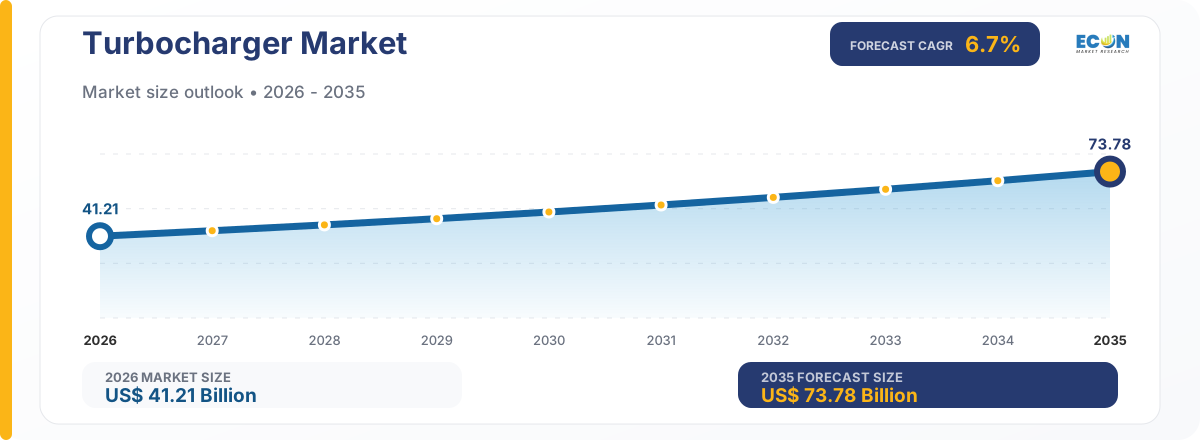
As per Econ Market Research analysis, the Global Turbocharger Market accounted for US$ 41.21 Billion in 2026 and is expected to surpass US$ 73.78 Billion by 2035, witnessing a CAGR of 6.7% throughout 2026–2035. The analysis is based on 2025 as the base year.
Turbochargers are commonly used in automotive engines to boost power output, improve fuel efficiency, and reduce emissions. In recent years, the market has witnessed steady growth due to the increasing demand for fuel-efficient vehicles, stringent emission regulations, and the rising popularity of turbocharged engines in both passenger and commercial vehicles.
The industry is marked by fierce competition between major firms that are constantly trying to innovate and create cutting-edge turbocharging technologies, like Honeywell International Inc., BorgWarner Inc., Mitsubishi Heavy Industries Ltd., and Cummins Inc. In the upcoming years, the introduction of hybrid and electric turbocharger systems is anticipated to further propel market expansion. But obstacles including expensive upfront prices, difficult installation and upkeep, and possible dependability problems continue to be major deterrents to wider use.
Turbocharger Dynamics
Automakers are forced to use turbocharging technology in order to increase fuel efficiency and reduce exhaust emissions due to strict government rules aimed at reducing vehicle emissions. Furthermore, the requirement for turbochargers has increased due to the growing trend of smaller engines in both passenger and commercial vehicles, which is motivated by the need for increased performance and better fuel economy.
The performance, economy, and dependability of turbochargers have also been improved by technological developments, such as variable geometry turbochargers (VGT) and electric turbochargers, which has further fuelled market expansion. Growing automobile production, rising disposable incomes, and the growing use of turbocharged engines in emerging markets are all factors driving market expansion.
However, the market for turbochargers confronts difficulties like expensive initial prices, difficult installation, and worries about longevity and dependability. Long-term demand for turbochargers will also be impacted by the move toward electric vehicles (EVs) and the advancement of alternative propulsion technologies, which present a challenge to conventional internal combustion engines. Despite these obstacles, it is anticipated that continuous R&,D spending and strategic partnerships between turbocharger producers and automakers will provide new business opportunities and maintain the pace of the global turbocharger market.
Turbocharger Drivers
Stringent Emission Regulations
Government laws designed to lower car emissions are a major factor propelling the market for turbochargers. Vehicle emissions must be reduced in accordance with these laws, which include the Euro 6 criteria in Europe and the CAFE standards in the US. Turbochargers increase engine efficiency and lower emissions, which helps automakers comply with these strict regulations.
Turbochargers improve fuel combustion by compressing air and raising the oxygen concentration in the combustion chamber. This lowers the amount of hazardous pollutants like carbon dioxide (CO2), nitrogen oxides (NOx), and particulate matter that are released into the atmosphere. The need for turbochargers is anticipated to rise as governments around the world continue to tighten emission standards in an effort to combat air pollution and reduce climate change, especially in areas with stringent regulatory frameworks.
Growing Trend of Engine Downsizing
Engine downsizing is becoming more and more popular in the automotive industry, mostly due to the requirement for higher fuel economy and lower CO2 emissions without sacrificing performance. This trend is made possible by turbochargers, which enable automakers to swap out larger displacement engines with smaller, turbocharged engines while retaining or even increasing power output.
Turbochargers improve power and torque characteristics by making up for the smaller engine size by increasing the volume of air fed to the engine. Automakers can also address consumer desires for more ecologically friendly automobiles and obtain improved fuel economy ratings by combining downsizing engines with turbocharging. As long as this trend keeps up, manufacturers of turbochargers will profit from the growing number of vehicles that are using turbocharged engines, which will spur market expansion.
Turbocharger Restraints:
High Initial Costs
One of the primary restraints for the turbocharger market is the high initial costs associated with turbocharging technology. The cost of producing vehicles can rise as a result of the substantial R&,D and manufacturing expenditures needed to integrate turbochargers into engines. To handle greater temperatures and pressures, turbocharged engines also frequently need stronger parts and materials, which raises the overall cost.
Price-conscious customers may be turned off by these higher expenses, which also present a problem for manufacturers trying to maintain regulatory compliance and competitive pricing. Moreover, the intricacy of turbocharger systems could call for specialist upkeep and repairs, raising the overall cost of ownership for buyers.
Reliability Concerns
Another restraint facing the turbocharger market is the potential reliability issues associated with turbocharged engines. Turbochargers operate under extreme conditions, including high temperatures and rotational speeds, which can lead to component wear and potential failures over time. Issues such as turbo lag, compressor surge, and premature bearing failure can affect engine performance and durability, leading to increased warranty claims and customer dissatisfaction.
Ensuring the reliability and longevity of turbocharger systems is essential for automakers to maintain customer trust and brand reputation. Addressing reliability concerns requires ongoing advancements in material science, manufacturing processes, and quality control measures to produce robust and durable turbocharger components.
Turbocharger Opportunities:
Shift Towards Electric Turbochargers and Hybridization
The trend toward hybrid and electric turbocharger systems offers encouraging chances for new product development and competitive advantage. Electric motor technology is used by electric turbochargers, or ",e-turbos,", to reduce turbo lag and enhance engine responsiveness. Comparing these systems to conventional turbochargers, significant performance increases and fuel efficiency improvements are possible.
In a similar vein, hybrid turbocharger systems combine fully or partially hybrid powertrains with electrically assisted turbochargers to maximize engine efficiency and further minimize emissions. Manufacturers of turbochargers can create innovative solutions that meet the changing demands of the automobile industry and obtain a competitive edge in the market by embracing the electrification and hybridization trends.
Segment Overview
By Technology
The turbocharger market encompasses various technological approaches to enhance engine performance and efficiency. Twin-turbo systems employ two turbochargers, typically arranged in a sequential or parallel configuration, to deliver increased airflow and power output, especially in high-performance vehicles. Wastegate turbochargers feature a bypass valve, known as the wastegate, which regulates exhaust gas flow to control boost pressure and prevent overboost conditions. Variable geometry turbochargers (VGT) utilize movable vanes in the turbine housing to optimize airflow and boost pressure across a wide range of engine speeds, improving responsiveness and fuel efficiency.
By Application
There are several different vehicle categories and industries that use turbochargers. Turbochargers are used in vans, pickup trucks, and small buses in the light commercial vehicle category to improve engine performance and satisfy fuel efficiency and emissions laws. Turbocharging helps heavy commercial vehicles&mdash,like trucks and buses&mdash,achieve greater torque and pulling force, which enhances their ability to transport loads and increases their overall efficiency.
Turbochargers are crucial components of construction and agricultural machinery because they provide the horsepower and torque required for tough jobs, such as powering tractors, loaders, and excavators. In maritime and aviation applications, where turbocharged engines provide the push and power needed for ships and aircraft to function effectively and dependably, turbocharging is also essential.
By Material
Turbocharger components are constructed from various materials to withstand the high temperatures and pressures encountered during operation. Cast iron is commonly used for turbine housings and exhaust manifolds due to its strength and heat resistance, making it suitable for heavy-duty applications. Aluminum alloys are preferred for compressor housings and impellers due to their lightweight properties and excellent thermal conductivity, improving turbocharger efficiency and responsiveness.
By Actuators
Turbocharger actuators control the operation of variable geometry systems and wastegates, influencing boost pressure and airflow characteristics. Hydraulic actuators utilize hydraulic fluid pressure to adjust vanes or actuate the wastegate, offering precise control and responsiveness. Pneumatic actuators rely on compressed air to regulate turbocharger operation, providing a balance between performance and cost-effectiveness.
Electric actuators represent the latest technological advancement, offering instantaneous response times and adaptive control strategies for optimal turbocharger performance across varying driving conditions. Each actuator type presents unique advantages and trade-offs in terms of efficiency, reliability, and complexity, catering to diverse application requirements in the turbocharger market.
Turbocharger Overview by Region
In North America, stringent emission regulations drive the adoption of turbocharging technology to meet fuel efficiency and emissions targets, particularly in light of the region',s heavy reliance on trucks and SUVs. Additionally, the growing preference for downsized engines and the popularity of performance vehicles contribute to market growth. Fuelled by regulatory pressure to cut CO2 emissions, turbochargers are becoming widely adopted throughout passenger car categories in Europe, a region noted for its strict emission requirements.
The region',s emphasis on diesel engines and technological developments in variable geometry turbochargers support market expansion even further. The Asia-Pacific region',s turbocharger market is driven by the automobile industry',s explosive expansion in nations like China and India. Urbanization, growing disposable incomes, and increasing vehicle manufacturing all contribute to the growing demand for turbocharged engines in passenger cars and commercial trucks.
In addition, government programs to reduce pollution and encourage the use of electric vehicles present prospects for hybrid turbocharger systems. Latin America and the Middle East &, Africa regions exhibit steady growth in turbocharger adoption, driven by infrastructure development, industrialization, and investments in transportation. However, economic volatility and political instability pose challenges to market growth in these regions.
Turbocharger Market Competitive Landscape
Companies such as Honeywell International Inc., BorgWarner Inc., Mitsubishi Heavy Industries Ltd., and Cummins Inc. are prominent players, leveraging their technological expertise and extensive product portfolios to gain competitive advantage. These industry leaders focus on research and development to introduce advanced turbocharging solutions that meet evolving customer demands for improved performance, fuel efficiency, and emissions compliance.
Moreover, strategic collaborations with automotive OEMs enable turbocharger manufacturers to develop customized solutions and enhance market penetration. Regional players also play a significant role, catering to specific market segments and niche applications. Additionally, mergers and acquisitions are prevalent in the market, facilitating consolidation and diversification strategies among companies to strengthen their competitive position and expand their global footprint.
Turbocharger Market Leading Companies:
MITSUBISHI ELECTRIC CORPORATION
BorgWarner Inc.
CONTINENTAL AG.
Turbo Dynamics Ltd.
IHI Corporation
Cummins Inc.
Honeywell International Inc.
Eaton
Precision Turbo &, Engine
Garrett Motion Inc.
Turbocharger Recent Developments
June 2023, Accelleron has introduced the ACCX300-L series, the latest advancement in turbochargers designed for two-stroke engines. This innovative platform, combined with an easy-service approach and Accelleron&rsquo,s Turbo Insights digital technology, establishes a ground-breaking standard in turbocharging. This advancement empowers ship operators with the adaptability needed to navigate uncertainties regarding fuel choices and operational strategies for their vessels in the years ahead.
April 2023, Garrett unveils its latest Turbocharger and e-Mobility innovations at Auto Shanghai 2023, showcasing cutting-edge E-Turbo and Fuel Cell Electric Compressor technologies to drive sustainable transportation. These advancements include state-of-the-art turbochargers designed for both hybrid and non-hybrid vehicles, promising improved performance and fuel efficiency.
Turbocharger Report Segmentation
Turbocharger Market Report Scope & Segmentation
| Attributes | Details |
|---|---|
| Market Size (Current)Current market valuation | US$ 41.21 Billion in 2026 |
| Market Size (Forecast)Projected market valuation | US$ 73.78 Billion in 2035 |
| Growth RateCompound Annual Growth Rate | CAGR of 6.7% from 2026 to 2035 |
| Forecast PeriodAnalysis timeline | 2026 – 2035 |
| Base YearReference year for analysis | 2025 |
| Historical Data AvailablePast market data availability | Yes |
| Regional ScopeGeographical coverage | Global |
| Segments CoveredMarket segments analyzed | By Technology
By Fuel Type
By Application
|
Frequently Asked Questions
Common questions about this report
The study period covers historical insights and forecast projections for the period 2026-2035.
About the Author
Market research expert with years of industry experience