

Train Brake Pads Market
Train Brake Pads Market Size, Share, Trends, Growth, and Industry Analysis, By Material (Organic, Sintered, Composite), By Train Type (High-Speed Train, Metro/Subway, Freight Train, Passenger Train), By Sales Channel (OEM, Aftermarket), Regional Analysis and Forecast Period 2026-2035
Market Overview
As per Econ Market Research analysis, the Global Train Brake Pads Market accounted for US$ 1.51 Billion in 2026 and is expected to surpass US$ 2.01 Billion by 2035, witnessing a CAGR of 3.1% throughout 2026–2035. The analysis is based on 2025 as the base year.
Train Brake Pads Market Size 2025-2035 (USD Billion)

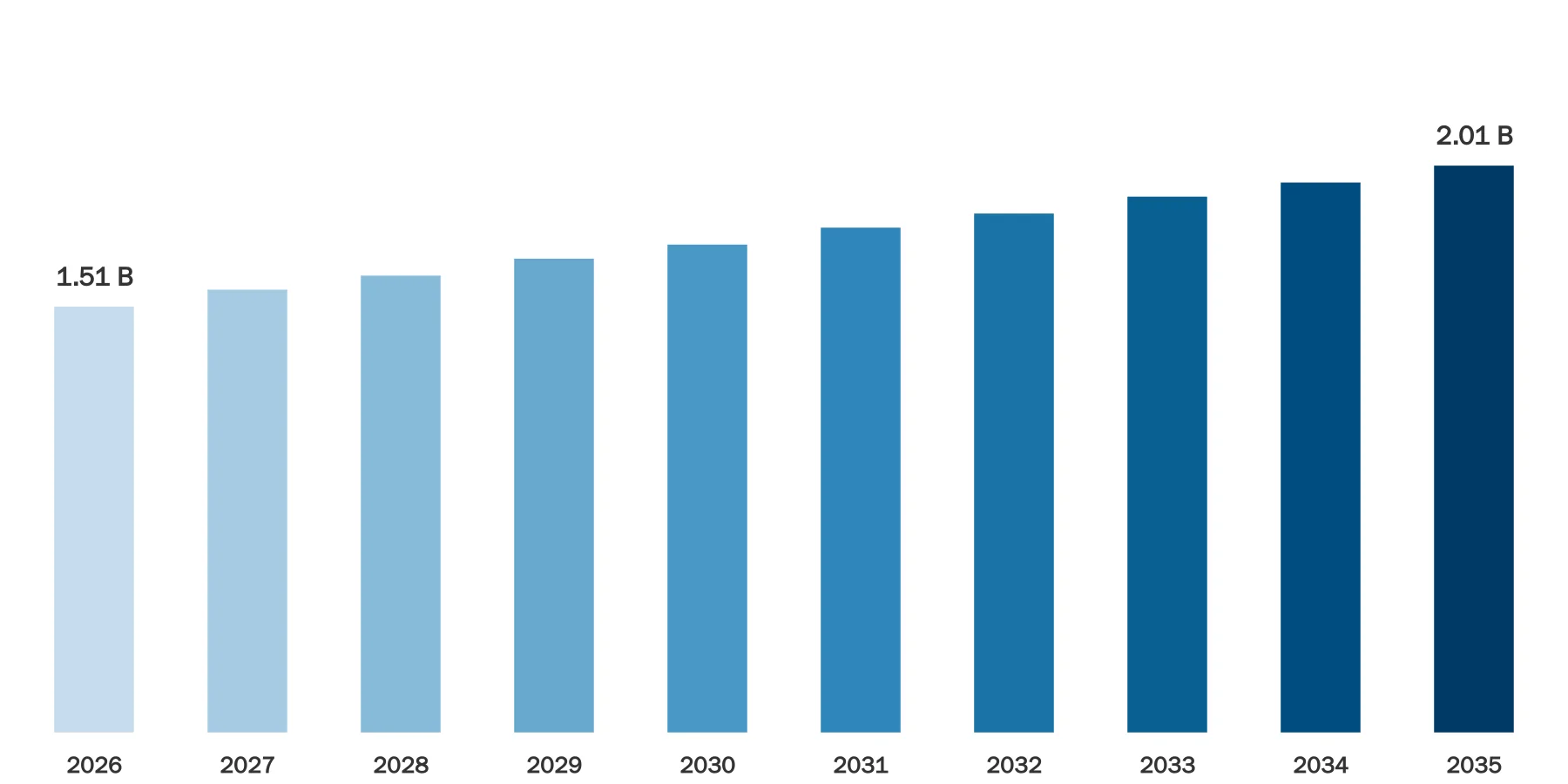
Source: Econ Market Research
Modern materials and technologies that improve efficiency and safety are introduced to the train brake pad market with great force. High-friction coatings, Composite Materials, and predictive maintenance systems are examples of innovations that have revolutionized the industry and ensured peak performance and minimal downtime. Strict industry standards are met by manufacturers who place a high priority on environmental sustainability, heat resistance, and durability. The development of rail infrastructure, growing urbanization, and an emphasis on freight and passenger safety are the main drivers of market growth. The competitive environment that encourages innovation makes the train brake pads market well-positioned to grow significantly and meet the changing demands of the world',s rail transportation industry.
Train Brake Pads Dynamics
Technological developments, changing regulatory requirements, and the increasing demand for efficiency and safety in rail transportation are the main factors driving the market for train brake pads. Market Growth is fueled by rising investments in high-speed rail networks and railway infrastructure. Manufacturers must contend with issues like strict quality standards, environmental considerations, and competition from other brake options. The market dynamics are also influenced by the increasing usage of electric and hybrid trains. The train brake pads market',s trajectory is further shaped by the rail industry',s shift towards predictive maintenance solutions and digitization, which encourage innovation and competition among major players.
Train Brake Pads Drivers
Growth in Rail Infrastructure Investments
Governmental programs and private sector involvement, with the goal of modernizing and expanding current railway networks, are the main drivers of the development in investments in rail infrastructure. Enhancing transportation capacity, boosting connectivity, and encouraging environmentally friendly forms of transportation are the goals of these efforts.
Railroads are essential to effective transportation systems that promote economic growth and ease traffic congestion as a result of urbanization and population increase. Furthermore, in order to address the growing demand for quick and dependable transportation options, programs like high-speed rail projects further stimulate significant investments in rail infrastructure.
Increasing Emphasis on Passenger and Freight Safety
A greater understanding of the significance of reducing the risks connected with rail transportation has led to an increased focus on freight and passenger safety. Strong safety precautions are required due to increased public and regulatory scrutiny following high-profile incidents and accidents. To guarantee their safety and safeguard priceless cargo, both freight operators and passengers require dependable systems and technologies. To foster trust and confidence in train travel, governments and industry stakeholders prioritize safety advancements through investments in state-of-the-art braking systems, collision avoidance technologies, and extensive safety standards.
Restraints:
Limited Availability of Advanced Materials
The market for train brake pads is severely constrained by the scarcity of modern materials. Innovative materials with better performance and durability are in demand, but the industry',s demands might not be met by the supply chain and production capacity for these materials. This limitation may result in higher expenses, longer lead times, and even postponements in the creation and introduction of new products. In order to get around this restriction and successfully satisfy consumer needs, manufacturers must manage sourcing difficulties and make investments in research and development.
Compatibility Issues with Existing Rail Systems
The global variation in railway networks', track gauges, signaling systems, and braking mechanisms presents a problem for brake pad manufacturers to ensure their goods are compliant with a range of infrastructure requirements. It can be difficult and expensive to retrofit new brake pads into an old train, and it involves lengthy testing and certification procedures. These compatibility issues restrict market penetration and impede the general implementation of new brake pad technology.
Opportunities:
Adoption of IoT and Data Analytics Solutions
Operators can execute proactive replacements and predictive maintenance by using real-time brake pad performance monitoring made possible by IoT sensors and data analytics. This proactive strategy reduces unplanned downtime, maximizes scheduled maintenance, and improves safety by seeing any problems before they become serious. Moreover, producers can better design products, increase productivity, and customize solutions to fit the changing needs of the rail sector thanks to data-driven insights.
Development of Next-Generation Brake Pad Materials
Improvements in material science can produce brake pads with better heat resistance, durability, and friction properties, which will increase both performance and safety. These cutting-edge materials may also lengthen the life of brake systems and lower the frequency and expense of maintenance. Additionally, eco-friendly materials can support sustainability objectives, attracting regulators and operators who share this concern and promoting market uptake.
Segment Overview
By Types
Based on types, the global train brake pads market is divided into composite brake pads, powder metallurgy brake pads, and cast-iron brake pads. Fibers, fillers, and resins are some of the materials used to make composite brake pads. These pads have great durability, heat resistance, and friction qualities. Because of their capacity to deliver reliable braking performance in a range of circumstances, they are frequently chosen for high-performance applications. Brake pads made with powder metallurgy are produced by compacting and sintering metal powders at elevated temperatures and pressures.
These pads are appropriate for heavy-duty applications because they have outstanding friction characteristics, stability, and fade resistance. Iron and carbon are combined to make cast-iron brake pads, the iron is usually in the form of gray iron. These pads are appropriate for heavy-duty braking applications because of their high friction coefficients and superior heat dissipation qualities.
By Application
Based on the application, the global train brake pads market is categorized into freight trains and passenger trains. The freight trains category leads the global train brake pads market with the largest revenue share in 2023. Long-distance freight and commodity transportation is the main purpose of freight trains. These trains usually consist of a line of freight cars carrying cargo being pulled by heavy-duty engines. For the purpose of safely reducing or halting these large weights, freight trains depend heavily on their braking systems. Whether for long-distance travel, regional travel, or urban commuting, passenger trains are made to carry people between locations. There are several different types of passenger trains, such as high-speed, intercity, and commuter trains.
Train Brake Pads Overview by Region
The global train brake pads market is categorized into North America, Europe, Asia-Pacific, and the Rest of the World. Asia-Pacific emerged as the leading region, capturing the largest market share in 2023. Train brake pads are in high demand as a result of the significant investments made in rail infrastructure by nations like China and India, which are rapidly becoming more urbanized and industrialized. The region',s shifting preference for mass transport systems as a result of growing urban congestion and population growth has further increased demand for trains and related braking components.
Furthermore, the expansion of high-speed rail networks and the promotion of sustainable transportation by the government have bolstered the train brake pads market in Asia-Pacific and cemented the company',s leadership position in the industry. Numerous causes, such as continued investments in modernizing the railway infrastructure, the rise in demand for freight transportation, and the emphasis on improving passenger comfort and safety, can be linked to this expansion. Additionally, the adoption of cutting-edge brake pad technology in the region is anticipated to be fueled by the implementation of strict rules addressing environmental sustainability and railway safety standards.
Train Brake Pads Competitive Landscape
In the global train brake pads market, a few major players exert significant market dominance and have established a strong regional presence. These leading companies remain committed to continuous research and development endeavors and actively engage in strategic growth initiatives, including product development, launches, joint ventures, and partnerships. By pursuing these strategies, these companies aim to strengthen their market position, expand their customer base, and capture a substantial share of the market.
Train Brake Pads Market Leading Companies:
CHINA RAILWAY
Nabtesco Corporation
Akebono Brake Industry Co., Ltd.
Beijing Railway Star Fortune High-Tech Co., Ltd. (RSF)
Zhejiang Lefen Rail Transit Technology Co., Ltd.
Hindustan Composites Ltd.
Shenyang Yuanyuan Friction Sealing Material Co., Ltd., and various others.
Train Brake Pads Recent Developments
In March 2023, New ZAP brake pads from Brakes India are exclusively made for electric vehicles. Brakes India, the producer of braking components for both automotive and non-automotive uses, has introduced ZAP brake pads for electric vehicles that include cutting-edge friction technology.
In January 2022, The railway friction business was bought by Wabtec Corporation from MASU, a prominent producer of friction components for the rail and automotive industries. The acquisition will increase Wabtec',s installed base and speed up growth across its braking product line. It has gained the required regulatory clearances and is subject to normal closing conditions.
Train Brake Pads Market Report Segmentation
Train Brake Pads Market Report Scope & Segmentation
| Attributes | Details |
|---|---|
Market Size (Current) | US$ 1.51 Billion in 2026 |
Market Size (Forecast) | US$ 2.01 Billion in 2035 |
Growth Rate | CAGR of 3.1% from 2026 to 2035 |
Forecast Period | 2026 – 2035 |
Base Year | 2025 |
Historical Data Available | Yes |
Regional Scope | Global |
Segments Covered | By Material
By Train Type
By Sales Channel
|
Frequently Asked Questions
Common questions about this report
The study period covers historical insights and forecast projections for the period 2026-2035.
About the Author
Market research expert with years of industry experience

Dipali Bhingare serves as the Market Research Director at Econ Market Research. With a focus on translating complex global economic shifts into actionable business intelligence, she oversees the strategic direction of comprehensive market studies. Her work empowers organizations to navigate volatile industries through data-driven forecasting and deep-dive competitive analysis.
Related Reports
Explore more market insights from the same category