

Trade Finance Software Market
Trade Finance Software Market Size, Share, Trends, Growth, and Industry Analysis, By Deployment (Cloud-based, On-Premise), By Organization Size (Large Enterprises, SMEs), By End-User (Retail andamp; Consumer Goods, IT andamp; Telecom, Automotive, Transportation andamp; Logistics, Others), Regional Analysis and Forecast Period 2026-2035
Trade Finance Software Market Overview
As per Econ Market Research analysis, the Global Trade Finance Software Market reached a valuation of US$ 56.83 Billion in 2026 and is anticipated to grow to US$ 93.46 Billion by 2035, at a CAGR of 5.1% during the forecast timeline 2026–2035. The base year considered is 2025.
Trade Finance Software Market Size 2025-2035 (USD Billion)

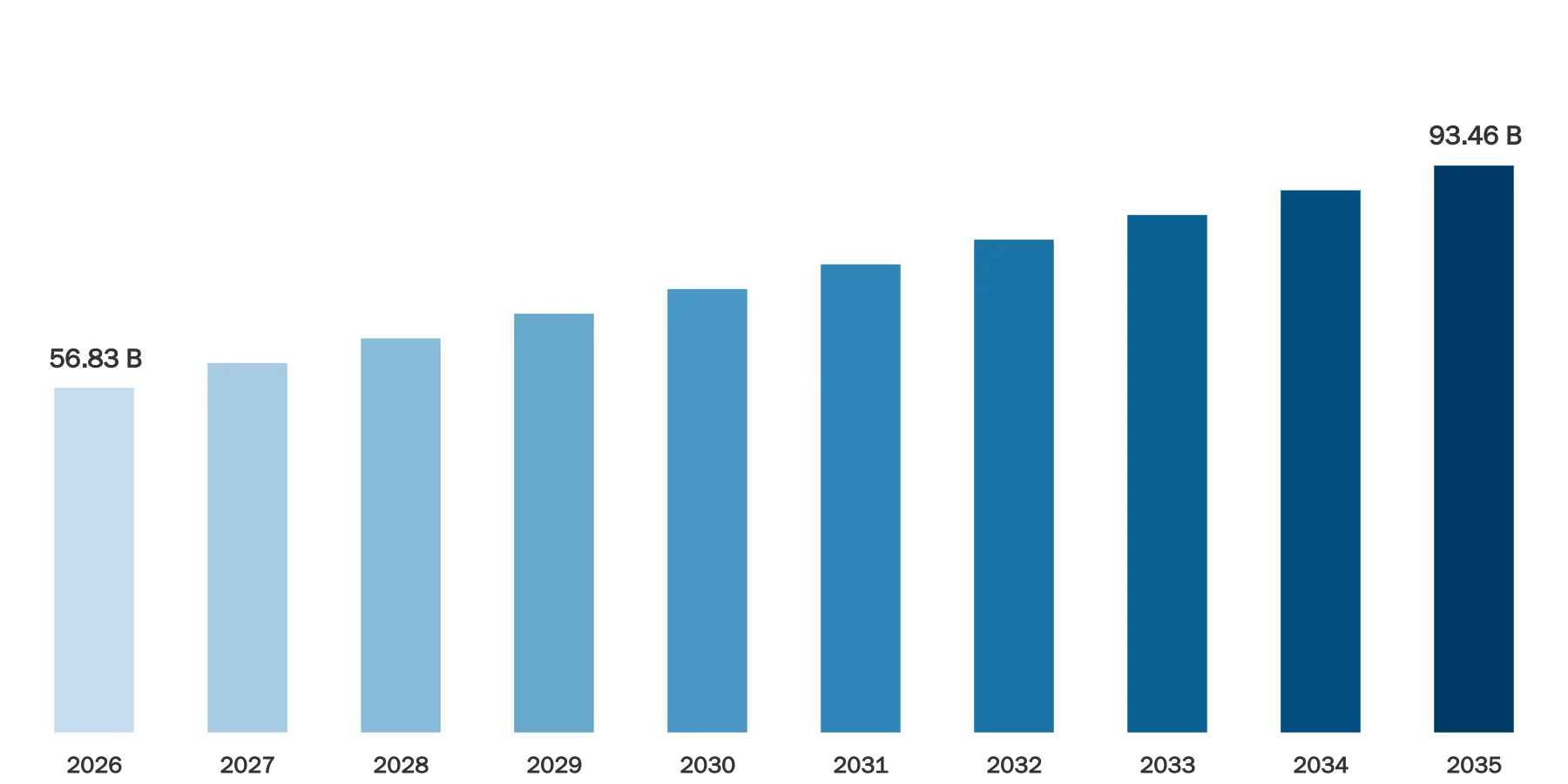
Source: Econ Market Research
Trade finance software refers to advanced software services help streamline tasks such as issuing letters of credit, organizing trade documents, and facilitating payments between businesses in different countries. The market is constantly buzzing with activity as companies turn to digital technology to handle financial transactions related to international trade. The trade finance software serves as a virtual helper, allowing companies to navigate the intricacies of global business smoothly and securely.
Recently, there has been a significant increase in the need for trade finance software, driven by businesses realizing the benefits of automated solutions to improve transparency, minimize errors, and speed up transactions in the global market. With the growth of online commerce and the intricate nature of supply chains, companies are increasingly relying on trade finance software to streamline their processes and remain competitive. As a result, there is now a flourishing market with a wide variety of vendors providing specialized software solutions to meet the specific requirements of different industries and trade partners. With globalization continuing to reshape the business world, trade finance software is becoming increasingly vital. It plays a crucial role in enabling smooth trade relationships and boosting economic growth globally.
Trade Finance Software Dynamics
The market dynamics of the Global Trade Finance Software sector are influenced by many factors that influence its growth and competitive landscape. One important factor is the rising trend towards digitalization of trade processes, driven by the desire for efficiency and transparency in global transactions. Businesses are looking to streamline their trade finance operations and meet changing regulatory standards, leading to a higher demand for advanced software solutions. Moreover, the increasing complexity of international trade, influenced by geopolitical issues and changing consumer preferences, highlights the need for strong trade finance software to manage risks and maintain compliance.
In addition, the market is influenced by technological advancements and innovations in the industry. Software vendors are constantly improving their products by incorporating Artificial Intelligence, blockchain integration, and predictive analytics. These enhancements allow businesses to have better visibility and control over their trade finance processes. This continuous innovation not only boosts market expansion but also encourages competition among vendors who are trying to stand out with advanced solutions. Furthermore, strategic partnerships and collaborations in the ecosystem are key factors in influencing market dynamics, as companies aim to utilize complementary technologies and broaden their market presence.
Trade Finance Software Drivers
Increasing Demand for Efficiency and Risk Mitigation
Global trade is becoming more complicated, and there are a lot of transactions happening. This means that customer need better and safer trade finance solutions to keep things running smoothly. Trade finance software, especially in things like guarantees and letters of credit, can help businesses make their processes more efficient, cut down on mistakes, and lower the risks that come with international transactions. As businesses try to improve their supply chains and keep up with changing laws, the need for software like this is only going to keep growing.
Technological Advancements and Innovation
Advances in technology, such as the use of artificial intelligence (AI), blockchain, and predictive analytics, are spurring innovation in trade finance software. These advancements allow for quicker processing, increased security, and greater transparency in trade finance operations. For example, platforms built on blockchain technology provide unchangeable transaction records, lowering the probabilities of fraud and building trust between parties involved in trade. As companies look to utilize these new solutions to remain competitive and keep up with market developments, the need for more sophisticated trade finance software is expected to rise.
Trade Finance Software Restraints:
Complex Implementation and Integration Challenges
Although trade finance software solutions provide numerous advantages, businesses can find it difficult and complicated to implement them. Challenges such as integrating with current systems, customizing to meet specific needs, and ensuring compatibility with partner networks can present major obstacles. Additionally, transitioning from traditional paper-based methods to digital platforms necessitate significant investments in training and change management. These obstacles in implementation and integration could impede the adoption of trade finance software, especially for smaller companies with restricted resources.
Security and Compliance Concerns
Security threats and compliance requirements are major concerns for businesses engaged in global trade. While trade finance software offers opportunities for automation and efficiency, it also introduces potential vulnerabilities that could be exploited by malicious actors. Additionally, stringent regulatory frameworks governing cross-border transactions impose compliance obligations on businesses, requiring them to adhere to anti-money laundering (AML) and know your customer (KYC) regulations. Ensuring robust Cyber Security measures and regulatory compliance presents a significant challenge for trade finance software providers and users alike.
Trade Finance Software Opportunities:
Expansion of Domestic Trade Finance
Even though global trade is still important, trade finance software companies are finding more potential in the domestic market. Domestic trade finance covers transactions within a country or a region, involving various industries and businesses. By providing customizable solutions for domestic trade finance, such as guarantees and letters of credit, companies can access new sources of revenue and meet the demand for efficient financing options among local businesses.
Segment Overview
By Product Type
By product type, the trade finance software market is segmented into guarantees, commercial letters of credit (LCs), and standby letters of credit (LCs) represent key product segments within this category. Assurances in the form of guarantees ensure payment to a recipient if contract conditions are not fulfilled. Meanwhile, Letters of Credit (LCs) act as payment tools in transactions between a purchaser and vendor, especially in trade deals. Standby LCs, conversely, act as backups for payments in instances of purchaser default.
By Provider
By provider, the market is segmented into banks, insurance companies, fixed POS terminals, and other financial service providers. Banks play a central role in trade finance, offering a wide range of services, including LC issuance, trade financing, and risk mitigation. Insurance companies provide additional risk management solutions, such as trade credit insurance, to protect businesses against non-payment and insolvency risks. Fixed POS terminals and other non-traditional providers offer specialized software solutions tailored to the unique needs of specific industries or trade participants.
By Application
By application, the market is segmented into international and domestic trade finance solutions. International trade finance software facilitates transactions between parties located in different countries, addressing complex regulatory requirements and currency exchange challenges. Domestic trade finance software, on the other hand, focuses on transactions within a single country or region, offering streamlined financing solutions for businesses operating in local markets.
By End-User
By end-user, the trade finance software market is segmented into Importers, exporters, and traders represent key end-user segments within this category. Importers depend on trade finance solutions to obtain funding for buying goods and services from foreign suppliers, while exporters use these solutions to reduce payment risks and get access to working capital. Traders, like brokers and trading companies, use trade finance software to streamline transactions and handle trade-related paperwork effectively.
Trade Finance Software Overview by Region
In North America, the market is driven by the presence of established financial institutions and tech-savvy businesses seeking to streamline their trade finance operations. Europe boasts a robust market identified by stringent regulatory frameworks and a strong emphasis on risk management and compliance. In the Asia-Pacific region, rapid digitization and the expansion of e-commerce platforms drive demand for trade finance software, particularly in emerging economies like China and India. Latin America and the Middle East &, Africa regions present opportunities for market growth, fuelled by increasing trade activities and efforts to modernize trade finance infrastructure.
Trade Finance Software Market Competitive Landscape
Key players include established financial institutions such as banks and insurance companies, as well as technology firms specializing in software development and fintech startups. Major players in the market leverage their extensive industry experience, robust technological infrastructure, and global networks to offer comprehensive trade finance solutions spanning guarantees, letters of credit, and other trade finance instruments.
Additionally, partnerships and collaborations between software providers, financial institutions, and regulatory bodies are becoming increasingly common, driving innovation and enhancing the competitiveness of the market. With the growing demand for efficient and secure trade finance solutions, competition among vendors is intensifying, leading to continuous advancements in technology and service offerings aimed at meeting the evolving needs of businesses operating in the global marketplace.
Trade Finance Software Market Leading Companies:
Infosys Ltd.
Finastra Inc.
IBM Corporation
CGI Inc.
Surecomp Ltd.
Misys Ltd.
China Systems Corporation Limited
Ariba Inc.
Experian Information Solutions Inc.
FIS Inc.
Trade Finance Software Recent Developments
Sep 2023, Standard Chartered Bank, a multinational financial institution, introduced a sustainable trade loan service tailored for financial entities. This initiative aims to support these institutions in addressing liquidity needs associated with sustainable development efforts in critical sectors.
Jan 2023, Newgen launched a comprehensive trade finance platform designed to automate the entire trade finance process, from application submission to document management and amendment processing. By streamlining origination workflows, it delivers a notable reduction in turnaround times, achieving nearly a 50% decrease. Powered by a low-code automation engine and cloud-native architecture, this platform ensures seamless processing of trade transactions and allows for easy customization to accommodate various structured trade finance products.
Apr 2022, the Asian Development Bank (ADB) finalized an agreement with Axis Bank Limited, valued at up to USD 150 million, to collaborate on expanding supply chain financing for small and medium-sized enterprises (SMEs). Under the terms of its Trade and Supply Chain Finance Programme (TSCFP), ADB will provide loan guarantees to support Axis Bank',s efforts in providing supply chain finance solutions to impact sectors.
Trade Finance Software Report Segmentation
Trade Finance Software Market Report Scope & Segmentation
| Attributes | Details |
|---|---|
Market Size (Current) | US$ 56.83 Billion in 2026 |
Market Size (Forecast) | US$ 93.46 Billion in 2035 |
Growth Rate | CAGR of 5.1% from 2026 to 2035 |
Forecast Period | 2026 – 2035 |
Base Year | 2025 |
Historical Data Available | Yes |
Regional Scope | Global |
Segments Covered | By Deployment
By Organization Size
By End-User
|
Frequently Asked Questions
Common questions about this report
The study period covers historical insights and forecast projections for the period 2026-2035.
About the Author
Market research expert with years of industry experience

Dipali Bhingare serves as the Market Research Director at Econ Market Research. With a focus on translating complex global economic shifts into actionable business intelligence, she oversees the strategic direction of comprehensive market studies. Her work empowers organizations to navigate volatile industries through data-driven forecasting and deep-dive competitive analysis.
Related Reports
Explore more market insights from the same category