

Solar Battery Chargers Market
Solar Battery Chargers Market Size, Share, Trends, Growth, and Industry Analysis, By Type (Solar Panel Chargers, Solar Power Banks, Solar Car-Battery Chargers, Foldable/Flexible Solar Chargers, Solar Backpack Chargers), By Application (Consumer Electronics, Automotive and Mobility, Military and Defense, Industrial), By End-User (Individual Consumers, Corporate Enterprises, Government), Regional Analysis and Forecast Period 2026-2035
Solar Battery Chargers Market Overview
As per Econ Market Research analysis, the Global Solar Battery Chargers Market valuation stood at US$ 0.74 Billion in 2026 and is expected to reach US$ 2.4 Billion by 2035, growing at a steady CAGR of 13.9% from 2026 to 2035. 2025 serves as the base year.
Solar Battery Chargers Market Size 2025-2035 (USD Billion)

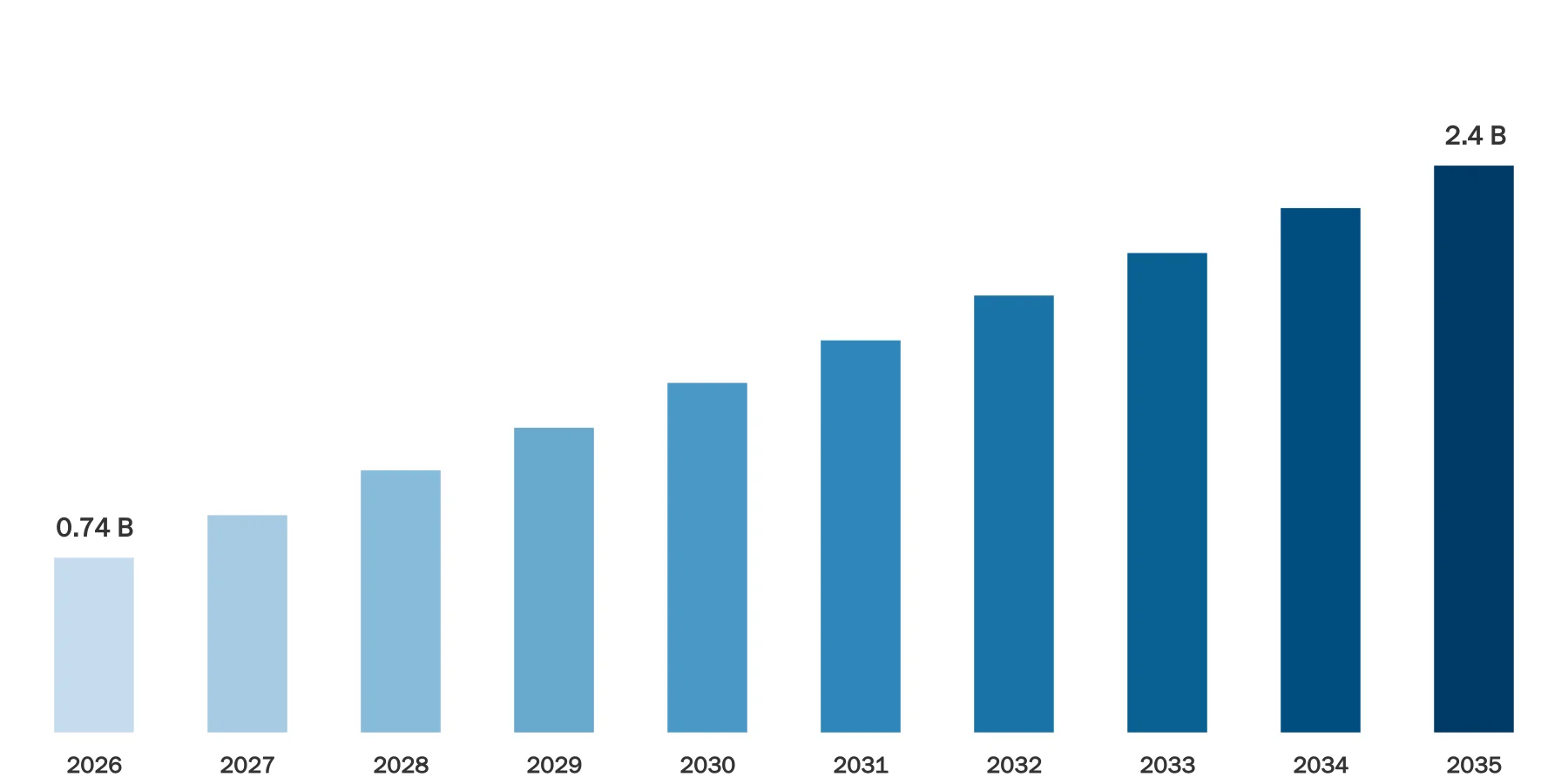
Source: Econ Market Research
The market for solar battery chargers has expanded significantly in recent years due to the growing need for environmentally friendly energy sources. These chargers effectively recharge batteries by using Solar Energy, offering a portable and environmentally responsible substitute for traditional charging techniques. With an emphasis on environmental awareness and the growing use of renewable energy technology, solar battery chargers are becoming more and more popular. These gadgets provide a flexible and easy-to-use charging option for a wide range of users, from regular people trying to cut back on their carbon footprint to outdoor enthusiasts seeking off-grid electricity.
Solar Battery Chargers Market Dynamics
Expanding environmental consciousness and solar technology',s quick progress drive market expansion. Renewable energy adoption is further encouraged by government subsidies, incentives, and regulatory support. Part of the market dynamics is also the growing customer base, which is being driven by an increasing need for sustainable and portable power solutions. Innovation is fueled by the incorporation of clever features, increased efficiency, and device compatibility. Obstacles are, nevertheless, obstacles like sun spottiness and expensive starting expenses. The solar battery charger industry is expected to grow further as economies of scale are reached and technology advances.
Solar Battery Chargers Market Drivers
Advancements in Solar Technology
The development of more effective and reasonably priced solar panels is facilitated by ongoing innovation and research in photovoltaic materials, energy conversion efficiency, and manufacturing techniques. Innovations include better energy harvesting and storage technology allow solar battery chargers to function more dependably and perform better. By solving important issues like inconsistent sunshine and high upfront costs, these technical advancements not only improve the overall efficacy of solar charging solutions but also help to promote the sustainable and widespread adoption of solar-powered gadgets in the market.
Consumer Demand for Portable Power
There is an increasing demand for on-the-go charging solutions due to the widespread usage of smartphones, tablets, and other portable electronic devices. With the ability to recharge mobile gadgets anywhere there is sunlight, solar battery chargers offer a practical and environmentally friendly solution to this need. In addition to outdoor activities and a general change in society toward more environmentally responsible choices, this trend is driven by an increasingly mobile lifestyle. The market for solar battery chargers is growing because of consumers', innate desire for sustainability and convenience and their need for dependable, portable power sources.
Restraints:
Although solar technology has long-term advantages, prospective customers are discouraged by the initial outlay. The initial costs cover the cost of the solar charger as well as its installation and integration with the current systems. This financial obstacle affects solar charging systems', accessibility and affordability, especially for users on a tight budget. To overcome this limitation, ongoing efforts are needed to lower production costs, boost productivity, and support policy incentives, making sure that the financial viability of solar battery chargers is balanced with their positive environmental effects.
Intermittent Sunlight and Weather Dependency
The reliability of the chargers is impacted by cloudy days, bad weather, and nocturnal solar power generation. The inability to provide consistent and uninterrupted charging impedes the efficiency of solar charging systems. This could lead to inconsistent charging performance for customers, raising questions about the dependability of solar-powered gadgets. To overcome these limitations and provide a more dependable and continuous power supply from solar battery chargers, innovations in energy storage technologies, enhanced efficiency in low light, and the creation of backup charging techniques are required.
Opportunities:
Expanding Off-Grid Applications
Solar chargers provide a sustainable way to meet electrical needs in isolated areas and developing nations with limited access to traditional power sources. As off-grid communities look for dependable and independent power sources, opportunities present themselves that encourage greater use of solar technology. Furthermore, solar battery chargers are perfect for disaster assistance and emergency circumstances because of their adaptability. In addition to addressing issues with energy accessibility, this growing market sector creates opportunities for partnerships, innovation, and projects aimed at providing off-grid and underprivileged communities with dependable, eco-friendly power sources.
Energy Storage Capacity Improvements
Improvements in battery technology can alleviate existing constraints by augmenting the storage capacity of solar chargers. This makes it possible for consumers to store extra solar energy for usage at night or during times when there is less sunlight, leading to more flexible and long-lasting applications. Opportunities to address a wider range of consumer needs arise as energy storage capacity increases. This supports higher adoption in a variety of situations, from daily use to off-grid scenarios, and contributes to the overall growth and feasibility of solar-powered solutions.
Segment Overview
By Product Type
Based on product type, the global solar battery charger market is divided into portable solar battery chargers and stationary solar battery chargers. The portable solar battery charger category dominates the market with the largest revenue share in 2023. Frequently used to charge portable power banks, smartphones, tablets, and other small electronic gadgets. For customers who require a dependable power supply in places without conventional electrical outlets, they are useful. Stationary solar battery chargers are widely used for both home and business applications. They can provide off-grid energy solutions, power larger devices or appliances, and act as backup power sources in the event of a grid outage. They are also frequently seen in commercial and residential solar power installations.
By Technology
Based on the technology, the global solar battery charger market is categorized into photovoltaic solar battery chargers, Concentrated Solar Power battery chargers, and thin-film solar battery chargers. The photovoltaic solar battery charger category leads the global solar battery charger market with the largest revenue share in 2023. Photovoltaic solar battery chargers are extensively utilized in a variety of stationary and portable applications, spanning from larger residential and commercial energy systems to tiny electronic devices.
In large-scale energy production for utilities, industries, and remote power generation where concentrated sunlight may be effectively harnessed, concentrated solar power systems are frequently used. Thin-film solar battery chargers are widely employed in flexible and portable applications, like rollable solar blankets, backpack solar panels, and architectural solar solutions incorporated into building materials.
By Application
Based on application, the global solar battery charger market is segmented into residential solar battery chargers, industrial solar battery chargers, and commercial solar battery chargers. The industrial solar battery chargers segment dominates the solar battery charger market. Industrial solar battery chargers are used in warehouses, manufacturing facilities, and other industrial settings in an effort to save operating costs, improve energy efficiency, and promote the use of sustainable energy in large-scale activities.
By capturing and storing solar energy for domestic use, home solar battery chargers promote sustainable living, energy independence, and backup power during blackouts. By assisting companies in lowering their dependency on traditional grid power, commercial solar battery chargers contribute to both financial savings and environmental sustainability.
Solar Battery Chargers Market Overview by Region
The global solar battery charger market is categorized into North America, Europe, Asia-Pacific, and the Rest of the World. North America emerged as the leading region, capturing the largest market share in 2023. Solar battery chargers have become widely used due to strong technological infrastructure, rising environmental consciousness, and supportive government regulations supporting renewable energy. The region has become increasingly dominant due to its large investments in R&,D and the growing demand for portable and sustainable power solutions.
In terms of the integration and acceptance of solar battery chargers across a range of consumer and industrial applications, North America continues to dominate due to its well-established market, cutting-edge technologies, and increased emphasis on lowering carbon footprints. Throughout the forecast period, Asia-Pacific is anticipated to post a significant CAGR. The region',s rapidly expanding population, swift economic progress, and growing consciousness of environmental sustainability are some of the elements driving this strong growth. The industry is expanding due to government initiatives encouraging the use of renewable energy and the growing need for off-grid power solutions.
Solar Battery Chargers Market Competitive Landscape
In the global solar battery charger market, a few major players exert significant market dominance and have established a strong regional presence. These leading companies remain committed to continuous research and development endeavors and actively engage in strategic growth initiatives, including product development, launches, joint ventures, and partnerships. By pursuing these strategies, these companies aim to strengthen their market position, expand their customer base, and capture a substantial share of the market.
Solar Battery Chargers Market Leading Companies:
Anker
Goal Zero
RavPower
EcoFlow
Jackery
Voltaic Systems
YOLK
Solar Technology International (STI)
Letsolar
Suntrica
Hanergy, and various others.
Solar Battery Chargers Market Recent Developments
In June 2023, a Bidirectional EV charger was unveiled by SolarEdge. With its ability to easily integrate with its home energy systems, SolarEdge',s new bidirectional DC-coupled Electric Vehicle (EV) charger allows for both vehicle-to-home and vehicle-to-grid applications. The second part of 2024 is when it is supposed to be released.
In September 2022, A 5 kW solar canopy with integrated EV charging capability has been unveiled by California-based Paired Power. PairTree, one of its products, can be utilized both on and off the grid and paired with lithium-ion battery packs that have a 40 kWh storage capacity.
Solar Battery Chargers Market Report Segmentation
Solar Battery Chargers Market Report Scope & Segmentation
| Attributes | Details |
|---|---|
Market Size (Current) | US$ 0.74 Billion in 2026 |
Market Size (Forecast) | US$ 2.4 Billion in 2035 |
Growth Rate | CAGR of 13.9% from 2026 to 2035 |
Forecast Period | 2026 – 2035 |
Base Year | 2025 |
Historical Data Available | Yes |
Regional Scope | Global |
Segments Covered | By Type
By Application
By End-User
|
Frequently Asked Questions
Common questions about this report
The study period covers historical insights and forecast projections for the period 2026-2035.
About the Author
Market research expert with years of industry experience

Related Reports
Explore more market insights from the same category