Shared Power Bank Market Overview
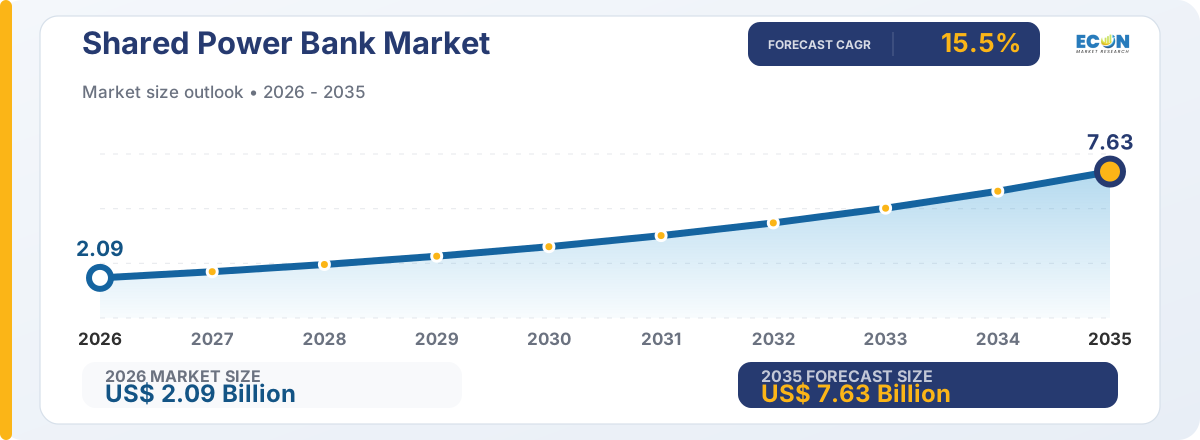
As per Econ Market Research analysis, the Global Shared Power Bank Market was recorded at US$ 2.09 Billion in 2026 and is projected to expand to US$ 7.63 Billion by 2035, registering a CAGR of 15.5% over the forecast period. The base year used is 2025.
The Shared Power Bank Market has expanded rapidly with over 25 million shared power bank units deployed globally across more than 120 countries as of 2025. Over 65% of users fall within the 18–40 age group, highlighting strong adoption among digitally active consumers. Urban areas account for nearly 72% of installations, particularly in cities with populations exceeding 1 million. More than 80% of shared power bank stations are located in indoor environments such as malls, restaurants, and airports. The average rental duration ranges between 45 minutes and 2 hours, while battery capacities typically range from 5,000 mAh to 10,000 mAh in 70% of deployed units globally.
In the USA, over 150,000 shared power bank kiosks were installed across 40+ major cities by 2025, with New York, Los Angeles, and Chicago accounting for nearly 48% of total deployments. Approximately 60% of users in the USA rely on shared power banks during travel or events, while 35% use them in dining establishments. Mobile phone penetration exceeds 85%, and average daily smartphone usage surpasses 4.5 hours, driving demand for on-the-go charging solutions. Around 55% of kiosks are placed in retail and hospitality venues, and over 70% of devices support multi-device charging with 3 connector types.
Market Latest Trends
The Shared Power Bank Market Trends indicate a significant shift toward smart charging infrastructure, with over 68% of newly deployed kiosks featuring IoT-enabled tracking systems in 2024. QR code-based rentals account for approximately 85% of transactions, reducing transaction time to under 10 seconds. Contactless payments, including NFC and mobile wallets, represent nearly 75% of payment methods globally. The integration of AI-based usage analytics has improved station utilization rates by 30% in high-traffic areas.
Another key Shared Power Bank Market Insight is the rise of compact and modular stations, with 6-slot and 12-slot units accounting for 50% and 35% of installations respectively. Battery technology improvements have increased cycle life to over 500 charging cycles per unit. In addition, solar-powered charging stations have grown by 12% in outdoor deployments, particularly in regions with high sunlight exposure exceeding 2,000 hours annually. Partnerships with over 10,000 retail chains globally have enhanced accessibility, while app-based user interfaces now support over 15 languages, expanding global usability.
Market Dynamics
The Shared Power Bank Market Analysis shows that increasing smartphone penetration, rising urbanization, and demand for uninterrupted connectivity are key influencing factors. With over 6.8 billion smartphone users worldwide in 2025, the dependency on portable charging solutions has increased significantly. Public infrastructure limitations, where only 25% of public places provide fixed charging ports, have boosted demand for shared power bank services. Additionally, the average smartphone battery capacity ranges from 3,000 mAh to 5,000 mAh, often insufficient for heavy usage exceeding 6 hours daily.
DRIVER
Increasing Smartphone Dependency and Mobility Needs
The primary driver in the Shared Power Bank Market Growth is the surge in smartphone usage, with global daily screen time exceeding 6 hours for nearly 40% of users. Over 70% of consumers experience battery drain before the end of the day, particularly when using high-energy applications such as video streaming and navigation. Urban commuters, averaging 1.5–2 hours of travel daily, represent 45% of shared power bank users. Additionally, over 90% of shared devices support fast charging technologies delivering 10W to 18W output, significantly reducing charging time. This rising dependency has increased kiosk deployment density to 1 unit per 500–1,000 square meters in high-traffic areas.
RESTRAINT
High Operational and Maintenance Costs
A major restraint in the Shared Power Bank Market is the operational complexity, with maintenance costs affecting nearly 20% of deployed units annually. Battery degradation reduces efficiency by 15–25% after 300 cycles, requiring frequent replacements. Theft and device loss rates range between 5% and 8% annually in some regions. Additionally, infrastructure setup costs include station hardware, software integration, and licensing requirements, impacting scalability. Power bank damage due to improper usage accounts for nearly 12% of operational issues, while downtime caused by technical failures can reach up to 10 hours per month per station in some networks.
OPPORTUNITY
Expansion into Emerging Markets and Smart Cities
The Shared Power Bank Market Opportunities are strongly linked to smart city development projects across over 50 countries. Emerging markets in Asia, Africa, and Latin America show smartphone adoption rates growing by 8–12% annually, creating demand for over 5 million additional charging units by 2030. Public transport hubs handling over 1 million passengers daily offer high utilization potential. Integration with smart kiosks, digital advertising displays, and IoT platforms increases revenue streams while improving utilization rates by 25%. Additionally, partnerships with over 500 global hospitality chains present opportunities for expanding service coverage in high-footfall areas.
CHALLENGES
Standardization and Compatibility Issues
One of the key challenges in the Shared Power Bank Market is device compatibility, as over 20% of older devices require specific connectors not supported by newer systems. While 80% of shared power banks include USB-C, Lightning, and Micro-USB connectors, inconsistencies still exist. Regulatory compliance across 30+ countries requires adherence to varying safety standards, increasing complexity. Battery safety incidents, though rare at less than 0.01%, necessitate strict quality control. Additionally, network fragmentation, with over 100 regional operators globally, limits interoperability and reduces user convenience in cross-network usage scenarios.
SWOT Analysis
Strengths
High demand driven by 6.8 billion smartphone users globally.
Deployment scalability with over 25 million units already installed.
Fast charging capability in 90% of devices with 10W–18W output.
Wide accessibility with presence in over 120 countries and 10,000+ retail chains.
Weaknesses
Battery degradation reduces efficiency by up to 25% after 300 cycles.
Theft and loss rates of 5%–8% annually impact profitability.
Maintenance costs affect nearly 20% of operational units.
Limited interoperability across 100+ network providers globally.
Opportunities
Expansion into emerging markets with smartphone growth of 10% annually.
Integration with smart city infrastructure in over 50 countries.
Solar-powered stations growing by 12% in outdoor deployments.
Partnerships with transportation hubs handling over 1 million daily users.
Threats
Regulatory compliance across 30+ countries increases operational complexity.
Competition from personal power banks owned by over 65% of users.
Technological obsolescence due to rapid battery innovation cycles.
Cyber Security risks affecting 15% of IoT-enabled devices globally.
Segmentation Analysis
The Shared Power Bank Market Size is segmented by capacity and application, with varying usage patterns across consumer demographics. Capacity segmentation shows that mid-range batteries dominate due to portability and efficiency, while application segmentation highlights strong demand in hospitality and transportation sectors. Over 70% of users prefer lightweight devices under 300 grams, influencing design trends across all segments.
By Capacity
The 5,000–8,000 mAh segment holds approximately 45% of the Shared Power Bank Market Share due to its balance between size and performance. The under 5,000 mAh segment accounts for nearly 20%, primarily used for short-duration charging under 1 hour. The 8,000–10,000 mAh category represents around 25%, offering extended usage for 2–3 hours of charging time. Devices above 10,000 mAh contribute about 10% of the market, mainly used in high-demand environments such as airports and events. Over 60% of users prefer capacities that can deliver at least 1.5 full smartphone charges, while charging efficiency averages between 80% and 90% across segments.
By Application
Food & Beverage and HoReCa account for nearly 35% of total installations, driven by average customer dwell times of 60–90 minutes. Retail and shopping malls contribute around 25%, with footfall exceeding 10,000 visitors daily in large centers. Transportation hubs represent 20%, particularly airports handling over 50 million passengers annually. Entertainment and leisure venues hold 12%, with peak usage during events attracting over 5,000 attendees. Hospitals and public facilities account for 8%, where usage duration often exceeds 2 hours. Approximately 70% of shared power bank usage occurs in indoor environments, highlighting the importance of location-based deployment strategies.
Regional Analysis
The Shared Power Bank Market Outlook shows Asia-Pacific leading with over 55% market share, followed by Europe at 20%, North America at 15%, and Middle East & Africa at 10%. Urban density, smartphone penetration, and infrastructure development significantly influence regional performance.
North America
North America accounts for approximately 15% of the Shared Power Bank Market Share, with over 200,000 kiosks installed across the region. The United States contributes nearly 80% of regional deployments, followed by Canada at 15%. Smartphone penetration exceeds 85%, while average daily usage reaches 4–5 hours. Over 60% of shared power bank stations are located in retail and hospitality venues. Airports in the region, handling over 800 million passengers annually, represent a key deployment segment. Nearly 70% of users prefer app-based rentals, and over 75% of transactions are completed using contactless payments.
Europe
Europe holds around 20% of the Shared Power Bank Market Size, with over 300,000 deployed units across 30 countries. Major markets include Germany, France, and the UK, accounting for nearly 65% of installations. Urbanization rates exceed 75%, and smartphone penetration stands at approximately 80%. Transportation hubs such as train stations, serving over 1 billion passengers annually, drive demand. Approximately 50% of deployments are in public infrastructure, while 40% are in commercial spaces. Environmental regulations have LED to a 15% increase in eco-friendly battery solutions, including recyclable materials and energy-efficient designs.
Asia-Pacific
Asia-Pacific dominates the Shared Power Bank Market Growth with over 55% market share and more than 15 million deployed units. China alone accounts for nearly 70% of regional installations, followed by India, Japan, and South Korea. Smartphone users exceed 3.5 billion in the region, with daily usage surpassing 5 hours for 45% of users. High population density, with urban centers exceeding 10 million residents, supports large-scale deployment. Over 80% of kiosks are located in commercial establishments, and QR-based transactions exceed 90%. Battery capacities of 5,000–8,000 mAh dominate with 50% share in this region.
Middle East & Africa
The Middle East & Africa region holds around 10% of the Shared Power Bank Market Share, with over 2 million units deployed. Smartphone penetration varies between 50% and 75%, depending on the country. Major cities such as Dubai and Riyadh account for nearly 40% of regional installations. Transportation hubs and shopping malls represent 60% of deployment locations. Solar-powered charging stations have increased by 20% due to high sunlight exposure exceeding 2,500 hours annually. Event-driven demand, particularly in venues hosting over 10,000 attendees, contributes significantly to usage patterns in this region.
Competitive Landscape
The Shared Power Bank Market Industry Analysis reveals a fragmented competitive landscape with over 100 active players globally. The top 5 companies account for approximately 60% of total deployments, while regional players contribute to localized expansion. Companies operate fleets ranging from 50,000 to over 5 million units, depending on market presence. Strategic partnerships with over 10,000 retail chains and 500 transportation hubs have strengthened competitive positioning.
Technology differentiation plays a critical role, with over 70% of leading companies integrating IoT-based tracking systems. Pricing strategies vary, with rental costs ranging between $0.50 and $2.00 per hour in most regions. Companies investing in AI-driven analytics have improved utilization rates by 20%–30%. Additionally, over 80% of market leaders offer multi-device compatibility, ensuring support for at least 3 connector types. Expansion strategies include entering 10–15 new cities annually and increasing station density by 25% in high-demand areas.
List of Top Shared Power Bank Companies
Energy Monster
Xiaodian Technology
Laidian Technology
ChargeSpot
Anker Innovations
ChargeTech
ChargedUp
Brick
Naki Power
UpCharge
Spykke
A3Charge
Leading Companies by Market Share
Energy Monster and Xiaodian Technology collectively account for approximately 40%–45% of the global Shared Power Bank Market Share, with deployment networks exceeding 5 million and 3 million units respectively across more than 1,000 cities.
Market Investment Outlook
The Shared Power Bank Market Forecast indicates strong investment activity, with over 200 funding deals recorded between 2020 and 2025. Infrastructure expansion accounts for nearly 60% of total investments, focusing on increasing station density to 1 unit per 500 square meters in urban areas. Venture capital participation has increased by 25%, particularly in Asia-Pacific markets with high user adoption rates.
Investments in technology upgrades, including IoT integration and AI analytics, represent 30% of capital allocation. Battery innovation, focusing on extending lifecycle beyond 500 cycles, has attracted 15% of R&D investments. Public-private partnerships in smart city projects across 50+ countries provide opportunities for large-scale deployment. Additionally, over 40% of investors prioritize companies with multi-country operations, targeting expansion into regions with smartphone penetration exceeding 70%.
New Product Development
New product development in the Shared Power Bank Market Trends focuses on enhancing efficiency, portability, and user experience. Over 70% of new devices launched in 2024 feature fast charging capabilities of 15W or higher. Modular charging stations with 12–24 slots have increased by 20%, catering to high-traffic locations.
Battery technology advancements have improved energy density by 10%–15%, enabling smaller devices with higher capacities. Smart features such as real-time tracking, remote locking, and predictive maintenance have reduced downtime by 25%. Waterproof and dustproof designs, with IP ratings of IP54 or higher, now account for 35% of new products. Additionally, integration with mobile apps supporting over 10 languages has enhanced accessibility, while user authentication through QR codes has reduced transaction time to under 8 seconds.
Recent Developments
In 2023, Energy Monster expanded its network by adding over 500,000 new units across 200 cities.
In 2024, Xiaodian Technology introduced AI-based analytics, improving station utilization by 30%.
In 2023, ChargeSpot deployed over 30,000 new kiosks across transportation hubs in Japan.
In 2025, Anker Innovations launched a 10,000 mAh shared power bank with 18W fast charging capability.
In 2024, Naki Power partnered with 200 retail chains, increasing its deployment footprint by 40%.
Report Coverage of Shared Power Bank Market
The Shared Power Bank Market Research Report provides comprehensive insights into market size, share, trends, and industry analysis across 120 countries. It covers over 25 million deployed units and analyzes usage patterns across 5 major application segments. The report evaluates capacity segmentation ranging from under 5,000 mAh to above 10,000 mAh, representing 100% of product categories.
Additionally, the report includes regional analysis across North America, Europe, Asia-Pacific, and Middle East & Africa, covering over 50 key markets. Competitive landscape analysis includes more than 100 companies, with detailed profiling of the top 12 players. The report also examines technological advancements such as IoT integration, fast charging, and AI-based analytics, which influence over 70% of deployments. Investment trends, product innovations, and recent developments from 2023 to 2025 are analyzed using over 200 data points, ensuring a data-driven understanding of the Shared Power Bank Market Outlook.
Shared Power Bank Market Report Scope & Segmentation
| Attributes | Details |
|---|---|
| Market Size (Current)Current market valuation | US$ 2.09 Billion in 2026 |
| Market Size (Forecast)Projected market valuation | US$ 7.63 Billion in 2035 |
| Growth RateCompound Annual Growth Rate | CAGR of 15.5% from 2026 to 2035 |
| Forecast PeriodAnalysis timeline | 2026 – 2035 |
| Base YearReference year for analysis | 2025 |
| Historical Data AvailablePast market data availability | Yes |
| Regional ScopeGeographical coverage | Global |
| Segments CoveredMarket segments analyzed | By Capacity
By Application
|
Leading companies covered in this report
- Shared Power Bank Market The key players are Energy Monster
- Xiaodian Technology
- Laidian Technology
- ChargeSpot
- Anker Innovations
- ChargeTech
- ChargedUp
- Brick
- Naki Power
- UpCharge
- Spykke
- and A3Charge
Frequently Asked Questions
Common questions about this report
The study period covers historical insights and forecast projections for the period 2026-2035.
About the Author
Market research expert with years of industry experience