

Rolling Stock Market
Rolling Stock Market Size, Share, Trends, Growth, and Industry Analysis, By Product Type (Locomotives, Rapid Transit Vehicles, Wagons), By Application (Passenger Transportation, Freight Transportation), By Technology (Conventional, Turbocharged, Maglev), Regional Analysis and Forecast Period 2026-2035
Rolling Stock Market Overview
As per Econ Market Research analysis, the Global Rolling Stock Market valuation stood at US$ 65.32 Billion in 2026 and is expected to reach US$ 102.7 Billion by 2035, growing at a steady CAGR of 5.1% from 2026 to 2035. 2025 serves as the base year.
Rolling Stock Market Size 2025-2035 (USD Billion)

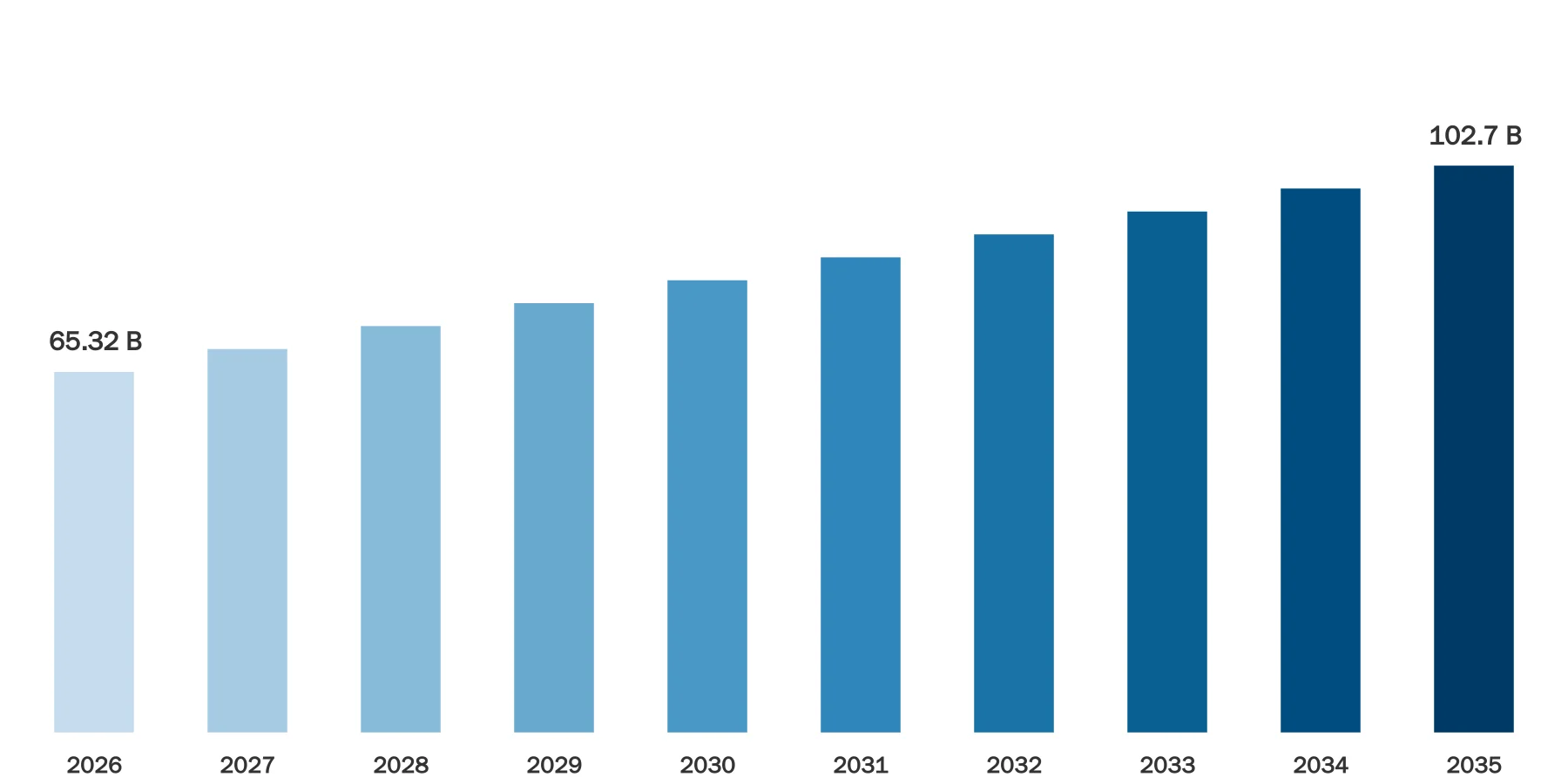
Source: Econ Market Research
Locomotives, railcars, and related components are among the items sold and purchased in the rolling stock market. Investors exchange shares or contracts that represent ownership in these assets, and it functions similarly to other financial markets. Railroad corporations, financiers, landlords, and producers are among the participants. Businesses can obtain essential equipment through the market without incurring significant upfront costs by leasing or buying shares. It provides investors with an opportunity to broaden their investment portfolios and experience the transportation industry. Economic situations, technology developments, and legislative changes that affect the rail sector are some of the factors that affect the market.
Rolling Stock Dynamics
Demand for transportation services is driven by economic growth, which influences market fluctuations. Innovations in energy efficiency and automation, for example, have an effect on rolling stock',s competitiveness and worth. Environmental concerns are also addressed by market dynamics, which impact the uptake of greener and more sustainable transportation options. Market conditions can be greatly impacted by changes in legislation, such as those pertaining to safety requirements and emissions. Global market trends are also shaped by trade agreements and geopolitical considerations, which have an effect on pricing, growth, and output.
Rolling Stock Drivers
Technological Advancements and Innovation
Artificial Intelligence and automation enhance train control and management, while Predictive Maintenance solutions cut maintenance costs and downtime. Additionally, improvements in design and materials result in lighter, more fuel-efficient trains, which lower operating costs and have a smaller environmental effect. The rolling stock market is encouraged to expand and evolve as a result of these innovations, which also boost competitiveness, draw in investment, and support the industry',s modernization and sustainability objectives.
Economic Growth and Demand for Transportation Services
While commuters look for dependable public transit choices, industries need efficient freight transportation to convey goods as economies grow. Demand for rolling stock is driven by increased economic activity, which encourages investment in rail networks and infrastructure projects. The market is further stimulated by growing disposable incomes, which also increase passenger volume and desire for upscale travel options. Therefore, the demand for rolling stock and transportation services is directly correlated with economic growth.
Restraints:
Safety Concerns and Liability Risks
Events like derailments and accidents cause property damage, casualties, and legal ramifications in addition to harming stakeholders', reputations and generating compensation claims. Modern safety technologies, extensive infrastructure renovations, and strict training initiatives are all necessary to address safety concerns. Moreover, operations become more difficult and expensive due to regulatory compliance. These elements limit market expansion and profitability by raising operational risks and insurance costs.
Infrastructure Bottlenecks and Capacity Constraints
The rolling stock market is hampered by capacity limitations and infrastructure impediments that prevent efficient transportation operations. As freight and passenger demands increase, antiquated or overburdened train networks find it difficult to keep up, which causes delays, traffic jams, and decreased service dependability. Significant investments in infrastructure modifications, including as track extensions, signaling upgrades, and terminal improvements, are necessary to address these limitations. But funding constraints and red tape frequently obstruct development. These bottlenecks impede productivity, restrict market expansion, and reduce the transportation system',s overall effectiveness.
Opportunities:
Growing Demand for Rail Transportation
Rail provides an effective and sustainable means of transporting people and cargo as urbanization and population growth pick up speed. Concerns about energy efficiency, environmental pollution, and transportation congestion are other factors driving this trend. To meet this demand, money must be spent on rolling stock upgrades, rail network expansion, and passenger amenity improvements. Businesses can take advantage of this by offering creative solutions to address changing transportation requirements.
Adoption of Digitalization and IoT in Rail Operations
In the rolling stock market, digitalization and the Internet of Things (IoT) usage in rail operations present a game-changing possibility. Railways may improve their operating efficiency, safety monitoring, and predictive maintenance by utilizing digital technologies and IoT sensors. Proactive decision-making, which minimizes downtime and maximizes resource allocation, is made possible by real-time Data Analytics. In addition, the development of smart trains and infrastructure is made possible by IoT-driven technologies, which enhances service dependability and passenger experience. Embracing digitalization gives railroads a competitive edge, spurring new ideas and opening more sources of income.
Segment Overview
By Product
Based on product, the global rolling stock market is divided into locomotive, rapid transport, and wagon. The wagon category dominates the market with the largest revenue share in 2023. Wagons are essential for freight transportation because they can move heavy loads over great distances, carrying everything from raw materials to completed items. Their varied designs cater to various sorts of freight, guaranteeing the seamless movement of products along rail networks.
The locomotive, which pulls passenger or freight trains along tracks, is the engine of rail transportation. They are available in a variety of forms, including hybrid, electric, and diesel-electric variants, each designed to meet specific operational and environmental requirements. Rapid transit vehicles, like high-speed trains or light rail systems, give commuters a suitable substitute for clogged roadways by providing quick and efficient passenger transit in urban or intercity environments.
By Train Type
Based on the train type, the global rolling stock market is categorized into rail freight and rail passenger. The rail freight category leads the global rolling stock market with the largest revenue share in 2023. Rail freight is the movement of goods and commodities over different distances, from raw materials to completed products. Freight trains, which are made up of locomotives and wagons, are an integral component of supply chains since they provide bulk freight with an economical and sustainable means of transportation. On the other hand, rail passenger services provide both commuter and intercity services to meet the transportation needs of travelers.
By Type
Based on type, the global rolling stock market is segmented into diesel and electric. The diesel segment dominates the rolling stock market. Diesel-fueled internal combustion engines are used in rolling stock that powers passenger and freight services by producing electricity. Diesel locomotives are adaptable and commonly utilized, particularly in regions with little or no electrified train infrastructure.
On the other hand, electric rolling stock provides effective and eco-friendly transportation options since its electric motors are powered by onboard batteries, overhead cables, or third rails. Electric trains are common along electrified rail tracks and in densely populated urban areas. They offer cleaner, quieter, and frequently faster modes of transportation for both freight and people.
Rolling Stock Overview by Region
The global rolling stock market is categorized into North America, Europe, Asia-Pacific, and the Rest of the World. Asia-Pacific emerged as the leading region, capturing the largest market share in 2023. The need for effective transportation solutions has increased throughout the region due to factors such as population growth, industrialization, and rapid urbanization.
Governments are spending a lot of money on developing infrastructure, which includes modernizing and growing railroad networks. Furthermore, a trend toward greener and more energy-efficient forms of transportation has been brought about by the emphasis on sustainability and environmental issues, which has favored the deployment of electric rolling stock. Throughout the forecast period, North America is anticipated to post a significant CAGR. Numerous factors, such as continuous infrastructure investments, modernization programs, and rising demand for rail transit options throughout the region, are blamed for this increase.
Additionally, technological developments are generating benefits in efficiency and drawing investments in rolling stock, as evidenced by the introduction of digitization and IoT in rail operations. Additionally, the shift to greener and more energy-efficient forms of transportation is being driven by growing concerns about sustainability and environmental impact, which is driving demand for contemporary rolling stock solutions in North America.
Rolling Stock Competitive Landscape
In the global rolling stock market, a few major players exert significant market dominance and have established a strong regional presence. These leading companies remain committed to continuous research and development endeavors and actively engage in strategic growth initiatives, including product development, launches, joint ventures, and partnerships. By pursuing these strategies, these companies aim to strengthen their market position, expand their customer base, and capture a substantial share of the market.
Rolling Stock Market Leading Companies:
CRRC Corporation
Trinity Rail
Alstom Transport
GE Transportation
Siemens Mobility
Stadler Rail AG
Hitachi Rail System
The Greenbrier Co
Hyundai Rotem
Kawasaki Heavy Industries, Ltd., and various others.
Rolling Stock Recent Developments
In February 2023, the railroad company BBR Verkehrstechnik GmbH and its group businesses were acquired by Stadler Rail AG in order to expand its internal knowledge in the domains of digitalization and signaling technology. Together, the businesses will be able to provide cutting-edge signaling solutions that will improve and influence the rail industry',s digitization.
In January 2023, through a partnership with Indian Railways, Siemens Mobility was able to secure the largest locomotive order in the history of both Siemens India and Siemens Mobility: 1,200 locomotives with 9,000 horsepower. Siemens Mobility will be in charge of the trains', development, construction, testing, and assembly.
In November 2022, In Aurangabad, India, Siemens Mobility announced plans to build a train bogies manufacturing. A single export order can be filled by the new plant with around 200 bogies. Siemens used the global design principle for the SF30 Combino Plus to build these rail bogies.
Rolling Stock Market Report Segmentation
Rolling Stock Market Report Scope & Segmentation
| Attributes | Details |
|---|---|
Market Size (Current) | US$ 65.32 Billion in 2026 |
Market Size (Forecast) | US$ 102.7 Billion in 2035 |
Growth Rate | CAGR of 5.1% from 2026 to 2035 |
Forecast Period | 2026 – 2035 |
Base Year | 2025 |
Historical Data Available | Yes |
Regional Scope | Global |
Segments Covered | By Product Type
By Application
By Technology
|
Frequently Asked Questions
Common questions about this report
The study period covers historical insights and forecast projections for the period 2026-2035.
About the Author
Market research expert with years of industry experience

Dipali Bhingare serves as the Market Research Director at Econ Market Research. With a focus on translating complex global economic shifts into actionable business intelligence, she oversees the strategic direction of comprehensive market studies. Her work empowers organizations to navigate volatile industries through data-driven forecasting and deep-dive competitive analysis.
Related Reports
Explore more market insights from the same category