

Revenue Assurance Market
Revenue Assurance Market Size, Share, Trends, Growth, and Industry Analysis, By Component (Software, Services), By Deployment (Cloud, On-Premise), By End-User (Telecom, Utilities, BFSI, Healthcare, Retail), Regional Analysis and Forecast Period 2026-2035
Revenue Assurance Market Overview
As per Econ Market Research analysis, the Global Revenue Assurance Market reached a valuation of US$ 0.8 Billion in 2026 and is anticipated to grow to US$ 1.64 Billion by 2035, at a CAGR of 8.2% during the forecast timeline 2026–2035. The base year considered is 2025.
Revenue Assurance Market Size 2025-2035 (USD Billion)

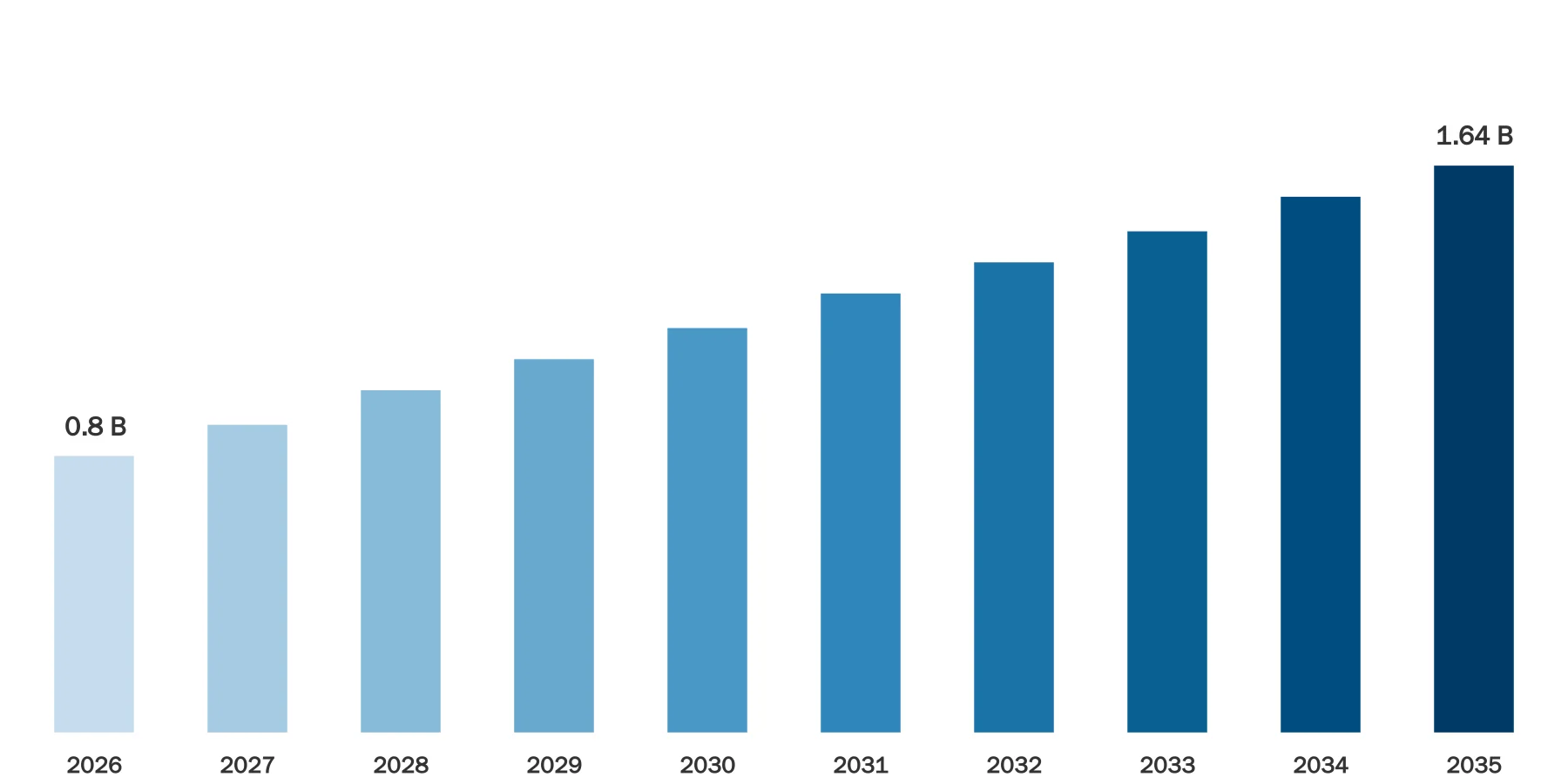
Source: Econ Market Research
The market for revenue assurance detects and corrects revenue leaks and disparities to guarantee businesses operate profitably. By using sophisticated analytics, auditing, and monitoring tools, it protects against fraud, inaccuracies in billing, and inefficiencies in operations. Revenue assurance solutions, an essential part of financial management, support businesses in maintaining accurate accounting, increasing profitability, and building consumer trust. The market for revenue assurance is essential to fostering financial sustainability and integrity for businesses at a time of complicated revenue sources and changing business models.
Revenue Assurance Market Dynamics
Growing company operations complexity, digital transformation, and changing regulatory environments are all driving forces in the revenue assurance market. The market is expanding due to a growing reliance on a variety of income streams, the emergence of subscription-based models, and cutting-edge technology like AI and analytics. Demand for reliable revenue assurance solutions is fueled by issues that businesses confront, such as fraud threats, billing problems, and operational inefficiencies. Innovations, partnerships, and flexible tactics are the market',s response to companies', efforts to maximize profits and guarantee correct revenue recognition.
Revenue Assurance Drivers
Digital Transformation
The increasing need for improved flexibility, productivity, and client interactions drives companies to adopt cutting-edge tools and procedures. Using technology like Artificial Intelligence (AI), Cloud Computing, and Data Analytics to improve operations, expedite communication, and open up new revenue streams is the driving force. To satisfy changing customer expectations, maintain competitiveness, and successfully navigate the complexity of today',s business environment, it is imperative to embrace digital transformation. To ensure long-term sustainability and growth, it represents a strategy move towards an organizational ecosystem that is tech-savvy, networked, and responsive.
Subscription-Based Models
The driving force is the consumer',s need for individualized experiences, cost predictability, and convenience. Due to their capacity to cultivate enduring relationships and consumer loyalty, subscription models are attractive to businesses seeking consistent revenue streams. The driver is the flexibility and scalability that subscription models which offer both scalability and flexibility offer across a range of businesses, from software to entertainment. Adopting this strategy enables businesses to stay competitive in today',s dynamic marketplace, improve customer engagement, and match with changing market trends. It also helps businesses build a robust and sustainable business model.
Restraints:
Solutions requiring large upfront costs may make organizations hesitant to invest, which could affect budgetary allocations and the viability of the project financially. This restraint is especially noticeable in sectors where budgetary constraints are critical, which causes the implementation of potentially advantageous projects to be postponed or severely constrained. High upfront costs have the potential to stifle innovation, delay the adoption of new technologies, and restrict firms', capacity to seize game-changing opportunities. In the end, this can affect decision-making procedures and obstruct the path to increased productivity and competitiveness.
Complex Implementation
Companies may have trouble incorporating complex solutions into their current systems, which could cause delays, disruptions, and even operational inefficiencies. Hesitancy to embrace sophisticated implementations might arise from a combination of the requirement for specialized expertise and the fear of disrupting workflow. This constraint may make it more difficult for the company to quickly adopt creative ideas, which would reduce its capacity to remain flexible and competitive in a market that is changing quickly. Reaping the full advantages of transformative efforts and ensuring their successful implementation depends on overcoming these challenges.
Opportunities:
IoT Monetization
Businesses can create creative ways to commercialize data, services, and connectivity as the Internet of Things (IoT) grows. Organizations can use the potential for long-term revenue development by providing value-added services, subscription-based models, or predictive analytics. Furthermore, developing specialized IoT solutions for diverse businesses makes room for specialized services. Adopting IoT monetization helps organizations become more profitable while also putting them at the forefront of technological innovation, which promotes long-term sustainability and competitiveness in a world where connectivity is growing.
AI and Machine Learning
AI and machine learning (ML) present enormous opportunities for enterprises, enabling them to transform workflows, decision-making, and creative thinking. Businesses can now leverage enormous volumes of data by using AI and ML to automate operations, improve operational efficiency, and gain insightful insights. The applications range widely, from tailored customer experiences to predictive analytics. Businesses are able to identify trends, allocate resources optimally, and develop cutting-edge products. Adopting AI and ML offers a chance to stay ahead in a data-driven environment by boosting agility, competitiveness, and opening up new business opportunities. In the end, this will alter industries and provide transformative value in a number of areas.
Segment Overview
By Component
Based on components, the global revenue assurance market is divided into software, planning and consulting, and services. The software category dominates the market with the largest revenue share in 2023. Advanced analytics, data processing, and reporting tools are frequently included in revenue assurance software in order to track financial transactions, spot irregularities, and guarantee correct revenue recognition.
In order to mitigate risks in real time, it might also have automated capabilities. Consulting services concentrate on comprehending the particular difficulties and objectives of an organization, creating customized plans for revenue assurance, and making suggestions for streamlining procedures. Planning entails establishing goals, developing roadmaps, and coordinating revenue assurance programs with overarching business plans.
By Application
Based on the application, the global revenue assurance market is categorized into government, BFSI, telecom, retail, energy and utilities, and others. The telecom category leads the global revenue assurance market with the largest revenue share in 2023. To improve financial performance, telecom revenue assurance entails real-time call data record monitoring, billing verification, and fraud detection. In the banking and financial services industry, revenue assurance solutions may concentrate on fraud detection, adherence to financial regulations, and precise financial transaction reconciliation. In the public sector, revenue assurance solutions could include streamlining revenue collection techniques, guaranteeing regulatory compliance, and inspecting financial procedures.
By Deployment Type
Based on deployment type, the global revenue assurance market is segmented into cloud and on-premise. The cloud segment dominates the revenue assurance market. Revenue assurance solutions that are cloud-based are accessed via the internet and are hosted on external servers. Cloud solutions are easily scalable to meet expanding company requirements and data volumes. Installed and operated on the company',s internal servers and computer infrastructure, on-premise revenue assurance systems are situated there.
Revenue Assurance Market Overview by Region
The global revenue assurance market is categorized into North America, Europe, Asia-Pacific, and the Rest of the World. North America emerged as the leading region, capturing the largest market share in 2023. Because of its advanced infrastructure, early adoption of digital transformation, and strong regulatory frameworks, North America has emerged as the market leader for revenue assurance.
The area has driven the rise of revenue assurance with its proactive attitude to deploying innovative solutions, especially in the technology, banking, and telecommunications sectors. North America is at the forefront of developing and implementing state-of-the-art revenue assurance technologies to guarantee financial integrity, operational efficiency, and sustained growth across a variety of industries. This is due to the region',s developed market ecosystem, strong focus on compliance, and innovative technological culture. Throughout the forecast period, Asia-Pacific is anticipated to post a significant CAGR.
Asia-Pacific offers enormous prospects for revenue assurance solutions in industries like finance, e-commerce, and telecoms due to its sizable and diverse market. The region is positioned for significant growth as a result of growing investments in technology and growing understanding of the significance of revenue optimization. Over the course of the projection period, the demand for strong revenue assurance solutions is likely to drive continuous and significant growth as organizations in Asia-Pacific continue to embrace digital transformation.
Revenue Assurance Competitive Landscape
In the global revenue assurance market, a few major players exert significant market dominance and have established a strong regional presence. These leading companies remain committed to continuous research and development endeavors and actively engage in strategic growth initiatives, including product development, launches, joint ventures, and partnerships. By pursuing these strategies, these companies aim to strengthen their market position, expand their customer base, and capture a substantial share of the market.
Revenue Assurance Market Leading Companies:
Accenture
Amdocs
Araxxe
Hewlett Packard Enterprise Development LP
IBM Corporation
SUBEX
TATA Consultancy Services Limited
Tech Mahindra Limited
TEOCO
Mobileum
Revenue Assurance Recent Developments
In July 2023, using End-to-End Revenue Leakage Mitigation to Expand the Revenue Assurance Imperative. Service providers run their businesses profitably but closely. To maximize conversion to income, it is now more crucial than ever to keep a careful eye on incoming chances given the volatility of the epidemic and the ensuing market slump.
In June 2023, the service assurance division of TEOCO was acquired by Amdocs. Amdocs sought to give service providers a unique end-to-end service orchestration solution that guarantees service quality and enables the monetization of next-generation dynamic customer experiences with this purchase.
Revenue Assurance Market Report Segmentation
Revenue Assurance Market Report Scope & Segmentation
| Attributes | Details |
|---|---|
Market Size (Current) | US$ 0.8 Billion in 2026 |
Market Size (Forecast) | US$ 1.64 Billion in 2035 |
Growth Rate | CAGR of 8.2% from 2026 to 2035 |
Forecast Period | 2026 – 2035 |
Base Year | 2025 |
Historical Data Available | Yes |
Regional Scope | Global |
Segments Covered | By Component
By Deployment
By End-User
|
Frequently Asked Questions
Common questions about this report
The study period covers historical insights and forecast projections for the period 2026-2035.
About the Author
Market research expert with years of industry experience

Dipali Bhingare serves as the Market Research Director at Econ Market Research. With a focus on translating complex global economic shifts into actionable business intelligence, she oversees the strategic direction of comprehensive market studies. Her work empowers organizations to navigate volatile industries through data-driven forecasting and deep-dive competitive analysis.
Related Reports
Explore more market insights from the same category