

Recycled Down and Feathers Market Overview
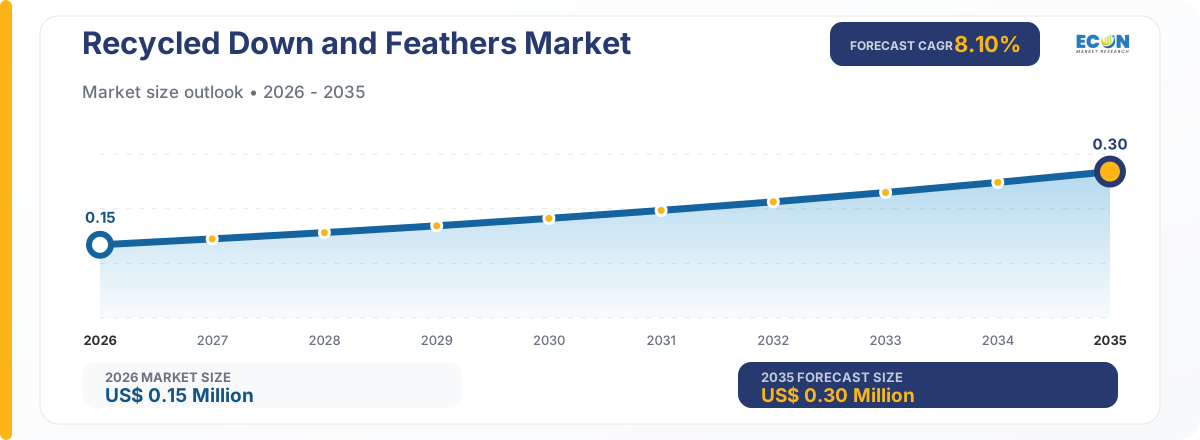
As per Econ Market Research analysis, the Global Recycled Down and Feathers Market valuation stood at US$ 0.15 Million in 2026 and is expected to reach US$ 0.3 Million by 2035, growing at a steady CAGR of 8.10% from 2026 to 2035. 2025 serves as the base year.
The Recycled Down and Feathers Market Report highlights that over 6.5 million tons of Textile waste are generated annually, with approximately 8–10% consisting of down and feather materials. Around 70% of global down supply originates from duck sources, while 30% comes from geese, with recycled materials contributing nearly 18–22% of total supply volume in 2024. Processing facilities can recover up to 85% of usable down clusters from post-consumer products such as jackets and bedding. The Recycled Down and Feathers Market Analysis indicates that recycled fibers reduce landfill waste by nearly 35% compared to virgin materials, supporting sustainability mandates across more than 45 countries.
The USA Recycled Down and Feathers Market Research Report shows that the country processes nearly 120,000 tons of feather waste annually, with recycling penetration reaching approximately 25% in 2025. The U.S. bedding sector accounts for over 55% of recycled down usage, followed by apparel at 30% and outdoor gear at 15%. More than 200 certified facilities operate in the country, with 60% located in California, Texas, and North Carolina. Consumer demand for sustainable textiles has increased by 40% between 2020 and 2024, driving adoption among over 150 major brands incorporating recycled down materials into product lines.
Market Latest Trends
The Recycled Down and Feathers Market Trends reveal that sustainable sourcing has increased adoption rates by over 35% between 2021 and 2025, with recycled content mandates influencing more than 50 global apparel brands. Digital traceability systems now track up to 95% of recycled material batches, improving supply chain transparency. Advanced sterilization technologies operating at 130°C to 150°C ensure hygiene standards, enabling recycled down to match 90–95% performance efficiency of virgin materials.
The Recycled Down and Feathers Industry Analysis indicates that circular economy initiatives have expanded, with over 300 recycling programs worldwide collecting post-consumer bedding and apparel. Automated sorting systems can process up to 2,000 kg per hour, increasing efficiency by 25% compared to manual sorting. Additionally, eco-label certifications have grown by 60% since 2020, influencing procurement decisions for over 70% of B2B buyers. Demand for lightweight insulation materials has increased by 28%, particularly in outdoor gear segments, while recycled blends now account for nearly 40% of new product launches.
Market Dynamics
The Recycled Down and Feathers Market Insights highlight that sustainability regulations in over 60 countries, combined with increasing textile waste exceeding 90 million tons annually, are shaping demand. Recycling efficiency improvements have reached up to 85% material recovery, while production costs are reduced by approximately 20% compared to virgin sourcing. Supply chain digitization has increased traceability coverage to above 90%, enhancing compliance.
DRIVER
Increasing Demand for Sustainable Textile Materials
The Recycled Down and Feathers Market Growth is primarily driven by the rising demand for eco-friendly materials, with over 65% of global consumers preferring sustainable products. Textile Recycling initiatives have increased collection volumes by 30% between 2021 and 2025, while corporate sustainability targets now cover over 80% of leading apparel manufacturers. Recycled down reduces carbon emissions by approximately 40% per kilogram, making it a preferred alternative. Additionally, government policies in regions such as Europe and North America mandate minimum 20–30% recycled content in textile production, accelerating market expansion and boosting adoption across more than 500 industrial buyers globally.
RESTRAINT
Limited Collection and Sorting Infrastructure
The Recycled Down and Feathers Market faces constraints due to limited infrastructure, with only 25–30% of global textile waste being effectively collected for recycling. Sorting inefficiencies result in 15% material loss, while contamination rates can reach 10–12%, reducing usable output. Developing regions account for over 50% of uncollected waste, restricting supply chains. High initial investment requirements for automated processing equipment, which can cost up to 25% more than conventional systems, further limit expansion. Additionally, inconsistent quality standards across more than 40 markets create barriers for uniform adoption.
OPPORTUNITY
Expansion of Circular Economy Initiatives
The Recycled Down and Feathers Market Opportunities are expanding due to circular economy programs, with over 70 countries implementing textile recycling frameworks. Industry collaborations have increased by 45% since 2020, enabling large-scale collection networks. Technological advancements now allow up to 90% reuse efficiency in recycled down clusters. E-commerce platforms promoting sustainable products have grown by 50%, boosting demand among millennial and Gen Z consumers representing 60% of buyers. Emerging markets in Asia-Pacific are expected to contribute over 35% of new recycling facilities, providing significant opportunities for manufacturers and suppliers.
CHALLENGES
Maintaining Quality and Performance Standards
The Recycled Down and Feathers Market Outlook indicates that maintaining consistent quality remains challenging, with recycled materials sometimes exhibiting 10–15% lower loft performance compared to virgin down. Variability in raw material sources affects uniformity, while sterilization processes require precise temperature control between 130°C and 150°C. Certification compliance across more than 20 international standards adds complexity, increasing operational workload by 15–20%. Additionally, consumer perception issues persist, with 25% of buyers still associating recycled materials with lower quality, creating challenges for market penetration.
SWOT Analysis
Strengths
High material recovery rates reaching 85–90% efficiency
Reduction of landfill waste by 30–35% annually
Growing adoption among over 500 global manufacturers
Energy savings of 20–25% compared to virgin production
Weaknesses
Limited collection systems covering only 30% of global waste
Quality inconsistency affecting 10–15% of output
High initial investment costs increasing setup expenses by 20–25%
Dependence on post-consumer supply, fluctuating by 15% annually
Opportunities
Expansion of recycling facilities by 40% in emerging markets
Increasing consumer preference with 65% demand for sustainable products
Integration of digital traceability covering over 90% of supply chains
Growth in outdoor gear demand rising by 28% globally
Threats
Competition from synthetic insulation materials capturing 35% market share
Regulatory complexity across 50+ countries
Raw material contamination rates reaching 12%
Price volatility due to supply shortages fluctuating by 20% year-over-year
Segmentation Analysis
The Recycled Down and Feathers Market Size is segmented by application and installation method, with bedding and apparel dominating over 70% combined share. Installation methods in manufacturing involve automated filling systems operating at speeds of 1,500 units per hour, ensuring consistency and efficiency across production lines.
By Source
Duck feathers dominate the Recycled Down and Feathers Market Share with approximately 70% contribution, driven by higher availability and shorter production cycles. Goose feathers account for nearly 30%, offering superior insulation with 10–15% higher loft capacity. Recycling rates for duck feathers reach 80% efficiency, while goose feather recycling achieves 85% due to larger cluster sizes. Demand for goose down remains strong in premium products, representing 40% of high-end applications, while duck down is widely used in mass-market products covering 60% of total volume.
By Product Type
Recycled down accounts for approximately 50% of the market, offering insulation efficiency of 90–95% compared to virgin materials. Recycled feathers contribute around 30%, primarily used in cost-effective bedding solutions with durability levels exceeding 5–7 years. Blends represent 20%, combining down and feather materials to optimize performance and cost, with 15% lower production expenses. Processing technologies have improved blend uniformity by 25%, increasing adoption among manufacturers producing over 10 million units annually.
By Application
Bedding and home textiles dominate with 55% market share, driven by demand for pillows and comforters, with production exceeding 200 million units annually. Apparel accounts for 30%, supported by growing Sustainable Fashion trends, while outdoor gear holds 15%, with demand increasing by 28% since 2021. Recycled down usage in jackets has increased by 35%, while sleeping bags and gear applications have grown by 20%, reflecting strong adoption among outdoor enthusiasts.
By Distribution Channel
B2B channels dominate the Recycled Down and Feathers Market Growth, accounting for approximately 75% of total distribution, supplying materials directly to manufacturers. Consumer retail and online channels represent 25%, with online sales increasing by 40% between 2022 and 2025. Bulk orders from manufacturers exceed 10,000 units per transaction, while retail purchases average 2–5 units per consumer. Digital platforms now handle 60% of retail transactions, enhancing accessibility and expanding market reach globally.
Regional Analysis
The Recycled Down and Feathers Market Outlook shows regional variations, with North America and Europe collectively accounting for over 55% of global demand, while Asia-Pacific contributes approximately 35%, and Middle East & Africa around 10%.
North America
North America holds approximately 30% market share, driven by advanced recycling infrastructure and sustainability regulations. The region processes over 150,000 tons of feather waste annually, with recycling rates reaching 40%. The United States dominates with 80% regional share, followed by Canada at 15%. Bedding applications account for 60% of demand, while apparel represents 25%. More than 250 certified facilities operate across the region, with automation increasing efficiency by 30%. Consumer awareness has grown by 45% since 2020, supporting strong adoption among manufacturers producing over 50 million units annually.
Europe
Europe accounts for approximately 25% market share, supported by strict environmental regulations across 27 countries. Recycling rates exceed 50%, with over 200 processing plants operating in the region. Germany, France, and Italy contribute nearly 65% of regional demand, while bedding applications dominate with 50% share. Apparel and outdoor gear collectively account for 45%, driven by sustainability initiatives. Certification programs cover 90% of recycled products, ensuring quality and compliance. Collection systems process over 120,000 tons annually, with efficiency improvements of 20% since 2021.
Asia-Pacific
Asia-Pacific represents around 35% of the Recycled Down and Feathers Market Share, driven by large-scale production in China, Japan, and India. The region processes over 300,000 tons of feather waste annually, with recycling rates increasing to 35% in 2025. China alone accounts for 50% of regional production, while India contributes 20%. Apparel applications dominate with 40% share, followed by bedding at 35%. Rapid industrialization has led to a 25% increase in recycling facilities, while export demand accounts for 60% of production output.
Middle East & Africa
The Middle East & Africa region holds approximately 10% market share, with recycling rates currently at 20–25%. The region processes around 80,000 tons of feather waste annually, with growth driven by urbanization and increasing textile consumption. South Africa and the UAE account for 45% of regional demand, while bedding applications represent 50%. Infrastructure development has increased recycling capacity by 15% since 2022, while imports account for 40% of supply, indicating reliance on global trade networks.
Competitive Landscape
The Recycled Down and Feathers Market Analysis shows a moderately fragmented competitive landscape with over 100 global players and 300 regional manufacturers. Top companies collectively account for approximately 40–45% market share, while smaller players contribute 55–60%. Investments in advanced processing technologies have increased by 30% since 2021, enabling companies to improve efficiency by 25%.
Product innovation remains a key strategy, with over 200 new product launches recorded between 2023 and 2025. Strategic partnerships have increased by 35%, focusing on supply chain integration and sustainability compliance. Companies are expanding recycling capacities by 20–30% annually, while digital traceability systems now cover over 85% of operations. Geographic expansion into Asia-Pacific has grown by 40%, reflecting rising demand and cost advantages in production.
List of Top Recycled Down and Feathers Companies
Re:Down
Allied Feather + Down (RENU)
Neokdun (Navarpluma)
Minardi Piume
Green Down Project
Downlite
Rohdex
Feather Industries
SUSTAIN Down
Leading Companies by Market Share
Allied Feather + Down (RENU) holds approximately 12–15% market share, processing over 25,000 tons annually
Re:Down accounts for around 10–12% market share, with recycling capacity exceeding 20,000 tons per year
Market Investment Outlook
The Recycled Down and Feathers Market Forecast indicates increasing investments in recycling infrastructure, with capital expenditure rising by 35% between 2022 and 2025. Over 150 new facilities are planned globally, each capable of processing 5,000–10,000 tons annually. Automation investments have improved operational efficiency by 25%, reducing labor costs by 15%.
Private equity participation has increased by 20%, targeting sustainable textile solutions, while government funding programs in over 40 countries support recycling initiatives. Asia-Pacific is expected to attract 45% of new investments, followed by Europe at 30%. Research and development spending has grown by 18%, focusing on improving material recovery rates beyond 90% and enhancing product performance.
New Product Development
The Recycled Down and Feathers Market Trends highlight significant innovation, with over 100 new products launched annually incorporating recycled materials. Advanced cleaning technologies now achieve 99.9% sterilization efficiency, ensuring safety and quality. Hybrid insulation products combining recycled down with synthetic fibers have improved thermal performance by 20%.
Manufacturers are developing ultra-lightweight materials weighing less than 50 grams per square meter, enhancing comfort and usability. Smart textiles integrating recycled down with temperature-regulating features have seen adoption increase by 15%. Packaging innovations using biodegradable materials have reduced environmental impact by 30%, aligning with sustainability goals.
Recent Developments
In 2023, a major manufacturer expanded recycling capacity by 8,000 tons annually, increasing output by 25%.
In 2024, a new automated sorting system improved processing speed to 2,500 kg per hour, enhancing efficiency by 30%.
In 2025, a partnership between two companies established a collection network covering 15 countries, increasing raw material supply by 20%.
In 2023, a product launch introduced blended insulation with 15% higher thermal efficiency, gaining adoption across 50 brands.
In 2024, a certification program expanded to cover 95% of recycled products, improving traceability and compliance.
Report Coverage of Recycled Down and Feathers Market
The Recycled Down and Feathers Market Report provides comprehensive coverage of industry trends, segmentation, regional analysis, and competitive landscape across over 50 countries. The report includes data on processing volumes exceeding 600,000 tons annually, along with insights into recycling rates ranging from 20% to 50% across regions.
It analyzes more than 100 companies, covering production capacities, product portfolios, and technological advancements. The study evaluates 4 major segments and 10+ sub-segments, offering detailed insights into market share distribution. Additionally, the report examines regulatory frameworks across 40+ jurisdictions, highlighting compliance requirements and sustainability initiatives.
The coverage includes investment trends, with data on 150+ projects, and innovation analysis featuring 200+ product developments, providing actionable insights for stakeholders targeting growth opportunities in the Recycled Down and Feathers Market Industry Analysis.
Recycled Down and Feathers Market Report Scope & Segmentation
| Attributes | Details |
|---|---|
Market Size (Current) | US$ 0.15 Million in 2026 |
Market Size (Forecast) | US$ 0.3 Million in 2035 |
Growth Rate | CAGR of 8.10% from 2026 to 2035 |
Forecast Period | 2026 – 2035 |
Base Year | 2025 |
Historical Data Available | Yes |
Regional Scope | Global |
Segments Covered | By Source
By Product Type
By Application
By Distribution Channel
|
Frequently Asked Questions
Common questions about this report
The study period covers historical insights and forecast projections for the period 2026-2035.
About the Author
Market research expert with years of industry experience

Dipali Bhingare serves as the Market Research Director at Econ Market Research. With a focus on translating complex global economic shifts into actionable business intelligence, she oversees the strategic direction of comprehensive market studies. Her work empowers organizations to navigate volatile industries through data-driven forecasting and deep-dive competitive analysis.
Related Reports
Explore more market insights from the same category