

Printing Ink Additives Market
Printing Ink Additives Market Size, Share, Trends, Growth, and Industry Analysis, By Type (Rheology Modifiers, Dispersing andamp; Wetting Agents, Foam Control Additives, Slip/Rub Materials), By Technology (Solvent-based, Water-based, UV-Cured), By Application (Packaging, Publishing, Commercial Printing), Regional Analysis and Forecast Period 2026-2035
Market Overview
As per Econ Market Research analysis, the Global Printing Ink Additives Market was valued at approximately US$ 2.34 Billion in 2026 and is predicted to reach US$ 3.07 Billion by 2035, expanding at a CAGR of 3.1% over the forecast duration. The base year is 2025.
Printing Ink Additives Market Size 2025-2035 (USD Billion)

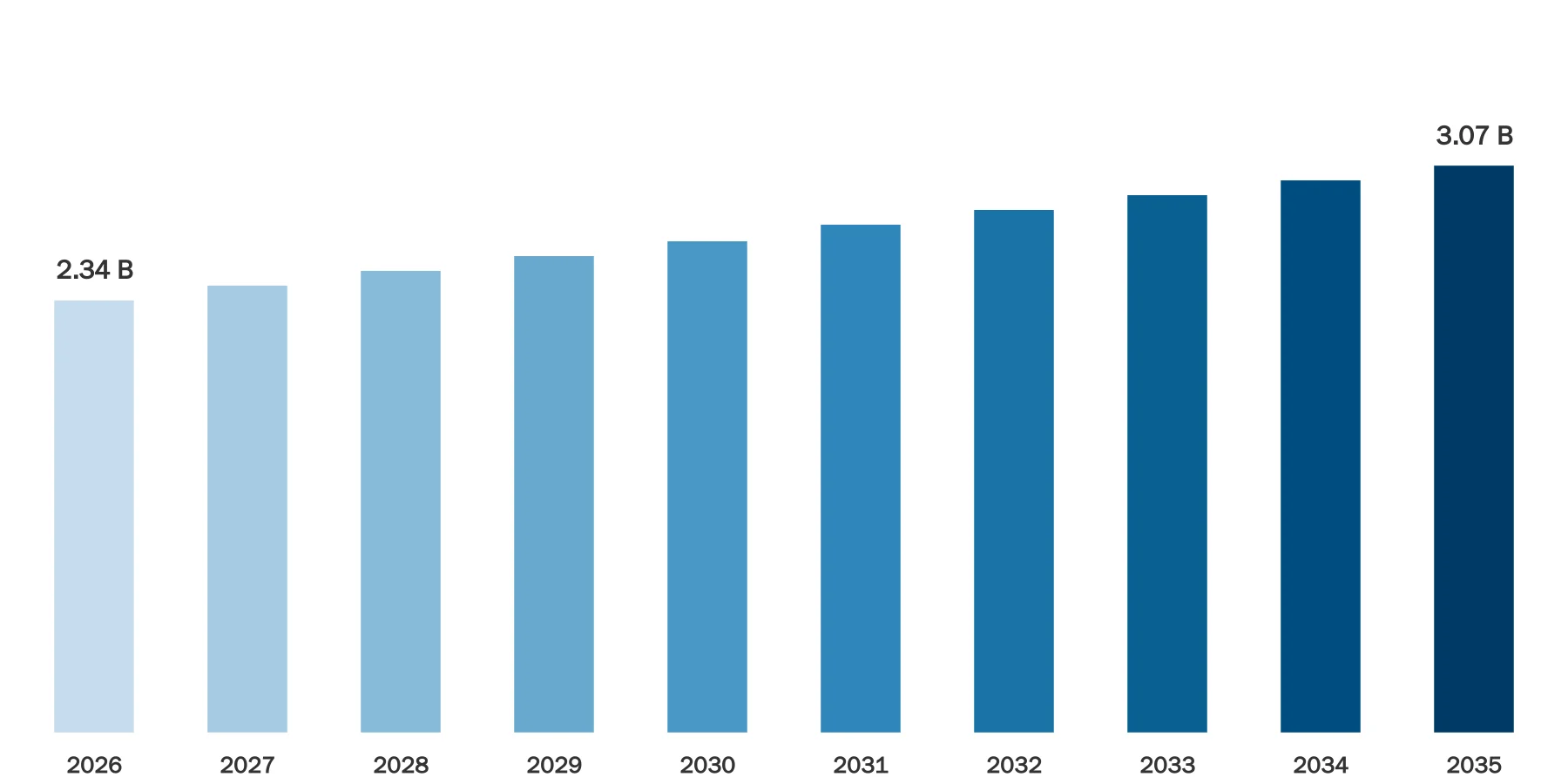
Source: Econ Market Research
Printing Ink Additives are typically blended into the ink formulation to achieve specific characteristics such as improved adhesion, color stability, drying time, and print quality. Key additives include dispersants, rheology modifiers, defoamers, and surface tension modifiers. The market is driven by the growing demand for high-quality printed materials across various industries including packaging, publishing, and advertising. Additionally, advancements in printing technologies and the increasing adoption of digital printing methods are further fuelling the demand for printing ink additives. However, factors such as stringent environmental regulations regarding the use of certain additives and fluctuations in raw material prices pose challenges to market growth.
Printing Ink Additives Dynamics
The growing need for high-quality, bespoke printing solutions across a range of industries, including publishing, textiles, and packaging, is one of the main drivers. Printing ink additive demand is also being driven by consumers', growing preference for digital printing techniques, which call for specific ink formulations. Furthermore, new developments in additive formulations are being sparked by technology breakthroughs in printing materials and methods, which will enhance functionality and performance. The market is confronted with obstacles, nevertheless, including strict environmental laws that limit the use of specific chemicals, especially those that include volatile organic compounds (VOCs).
Manufacturers may have to pay extra to produce environmentally friendly additive solutions in order to comply with these rules. Furthermore, industry participants find it difficult to maintain profit margins and pricing competitiveness due to variable raw material prices. Furthermore, market dynamics are influenced by competitive factors such as mergers and acquisitions, partnerships, and strategic collaborations among key players. These activities aim to expand market presence, enhance product portfolios, and capitalize on emerging opportunities in niche segments.
Printing Ink Additives Drivers
Increasing Demand for High-Quality Printing Solutions
The printing business is seeing an increase in demand from a variety of industries, including publishing, advertising, and packaging, for high-quality, bespoke printed goods. The need for sophisticated printing ink additives that can improve print quality, color stability, and overall performance is being driven by this expanding need. The need for specialty additives like colorants and dispersants is predicted to increase dramatically as companies work to produce printed goods that are both aesthetically pleasing and long-lasting in order to draw in customers.
Rapid Adoption of Digital Printing Technologies
The market for printing ink additives is being driven by the increased adoption of digital printing techniques, which is being fuelled by technological improvements and shifting consumer tastes. Shorter turnaround times, cost-effectiveness for small print runs, and effective customization of prints are just a few benefits of digital printing. Additives that can maximize ink performance for digital printing processes are becoming more and more necessary as the use of digital printing spreads throughout sectors including textiles, labels, and packaging. This will guarantee better print quality, adhesion, and durability.
Restraints:
Stringent Environmental Regulations
Stricter environmental rules that aim to reduce the usage of hazardous chemicals and volatile organic compounds (VOCs) are posing difficulties to the printing ink additives business. Manufacturers must make research and development investments in order to create environmentally friendly additives that satisfy regulatory requirements without sacrificing functionality in order to comply with these regulations. Furthermore, switching to greener additives might result in increased production costs, which might have an effect on market participants', profit margins and pricing policies.
Fluctuating Raw Material Prices
The market for additives for printing ink is prone to variations in the cost of raw materials, especially those derived from petrochemicals, like pigments, Solvents, and resins. Price volatility for raw materials can have a significant impact on manufacturers', profit margins and production costs, making it difficult for them to maintain competitive pricing. Furthermore, abrupt price changes may cause supply chains to break down and cause problems with inventory management for end users as well as manufacturers.
Opportunities:
Innovative Product Developments
The evolving needs of the printing industry present opportunities for manufacturers to innovate and develop new printing ink additives with enhanced performance and functionality. By investing in research and development, companies can create additives that offer superior properties such as improved adhesion, faster drying times, and enhanced color vibrancy, catering to the diverse requirements of end-users across different printing applications.
Segment Overview
By Type
The market offers a range of printing ink additives, including foam control additives and rheology modifiers. Foam control additives help in preventing or minimizing foam formation during the ink manufacturing process and printing operations, ensuring smooth and consistent ink application. Rheology modifiers play a crucial role in adjusting the viscosity and flow behaviour of printing inks, enabling precise control over ink consistency and performance. These additives are essential for achieving desired print quality, adhesion, and durability across different printing applications.
By Process
Printers employ different printing processes such as digital and flexography, each with distinct characteristics and requirements. Digital printing, characterized by its high-speed, variable data capabilities, and minimal setup requirements, is increasingly preferred for short print runs and personalized printing applications. Flexography, on the other hand, is a versatile and cost-effective printing process commonly used for packaging materials, labels, and corrugated board. Both processes demand tailored printing ink formulations optimized for their specific requirements, driving the demand for process-specific additives that can enhance ink performance and compatibility.
By Application
The printing ink additives find extensive application in commercial printing and packaging sectors. Commercial printing encompasses a wide range of printed materials such as brochures, catalogs, magazines, and promotional materials, where print quality, color accuracy, and consistency are paramount. Packaging, including food packaging, cosmetics, pharmaceuticals, and consumer goods packaging, requires specialized inks with properties such as adhesion, flexibility, and resistance to abrasion and chemicals. Additives tailored for commercial printing and packaging applications address specific challenges and requirements, ensuring optimal ink performance and end-product quality.
Printing Ink Additives Overview by Region
North America holds a significant share in the market, driven by the presence of major printing ink manufacturers, technological advancements, and a thriving packaging industry. The region',s stringent regulatory standards regarding environmental sustainability also contribute to the demand for eco-friendly printing ink additives. In Europe, the market is influenced by similar factors, with a strong emphasis on sustainability and innovation driving the adoption of advanced printing ink additives. Additionally, the region',s robust packaging industry, particularly in countries like Germany and the UK, fuels demand for additives catering to diverse packaging applications.
Asia-Pacific emerges as a lucrative market, fuelled by rapid industrialization, urbanization, and expanding commercial printing and packaging sectors. Countries like China, India, and Japan are witnessing substantial investments in printing infrastructure and technologies, driving the demand for printing ink additives. Moreover, the region',s burgeoning e-commerce industry and increasing consumer demand for packaged goods further bolster market growth. Latin America and the Middle East &, Africa regions also present growth opportunities, albeit to a lesser extent, driven by improving economic conditions, increasing disposable incomes, and rising investments in printing and packaging industries. However, challenges such as volatile raw material prices, regulatory complexities, and geopolitical uncertainties may hinder market growth in these regions.
Printing Ink Additives Market Competitive Landscape
Leading companies such as BASF SE, Evonik Industries AG, and Dow Chemical Company dominate the market with their extensive product portfolios and strong distribution networks. These companies focus on developing advanced printing ink additives that cater to diverse customer requirements, including improved print quality, durability, and sustainability. Moreover, strategic collaborations and partnerships with raw material suppliers, technology providers, and end-users enable these companies to enhance their product offerings and expand their market presence globally.
Additionally, mergers and acquisitions play a significant role in shaping the competitive landscape, with companies seeking to strengthen their market positions, access new markets, and leverage synergies to drive growth. Emerging players such as Clariant AG, DIC Corporation, and Elementis PLC are also making significant investments in research and development to introduce innovative additives and gain a competitive edge in the market. Furthermore, increasing focus on sustainable solutions and environmental regulations is prompting companies to develop eco-friendly printing ink additives, thereby enhancing their competitiveness and meeting evolving customer demand.
Printing Ink Additives Market Leading Companies:
Evonik Industries
BYK-Chemie GmbH
Arkema
BASF SE
Solvay
Dow
Eastman Chemical Company
DIC Corporation
ALTANA AG
Elementis PLC
Clariant
The Lubrizol Corporation
Toyo Printing Inks Inc.
Printing Ink Additives Recent Developments
Dec 2023, INX International Ink Co. has finalized an investment in DetraPel, an innovative materials company specializing in eco-friendly coatings. This marks the fourth successful transaction under the $50 million INX Venture Capital investment initiative launched in 2022. DetraPel operates through two main divisions: ProofPlus, serving consumers, and Impermea Materials, its industrial segment which has recently been rebranded. Impermea Materials is dedicated to pioneering solutions aimed at advancing PFAS-free and plastic-free innovations.
Oct 2023, At the Printing United Expo in Atlanta, Georgia, from October 18-20, DuPont, renowned for its innovative Artistri ink products in digital inkjet printing, will showcase the future of color in digital printing.
Printing Ink Additives Report Segmentation
Printing Ink Additives Market Report Scope & Segmentation
| Attributes | Details |
|---|---|
Market Size (Current) | US$ 2.34 Billion in 2026 |
Market Size (Forecast) | US$ 3.07 Billion in 2035 |
Growth Rate | CAGR of 3.1% from 2026 to 2035 |
Forecast Period | 2026 – 2035 |
Base Year | 2025 |
Historical Data Available | Yes |
Regional Scope | Global |
Segments Covered | By Type
By Technology
By Application
|
Frequently Asked Questions
Common questions about this report
The study period covers historical insights and forecast projections for the period 2026-2035.
About the Author
Market research expert with years of industry experience

Dipali Bhingare serves as the Market Research Director at Econ Market Research. With a focus on translating complex global economic shifts into actionable business intelligence, she oversees the strategic direction of comprehensive market studies. Her work empowers organizations to navigate volatile industries through data-driven forecasting and deep-dive competitive analysis.
Related Reports
Explore more market insights from the same category