

Pneumatic Tire Market
Pneumatic Tire Market Size, Share, Trends, Growth, and Industry Analysis, By Product Type (Radial Tires, Cross-Ply Tires), By Vehicle Type (Passenger Cars, Commercial Vehicles, Two-Wheelers, Off-Road Vehicles, Aircraft), By Sales Channel (OEM, Aftermarket), Regional Analysis and Forecast Period 2026-2035
Pneumatic Tire Market Overview
As per Econ Market Research analysis, the Global Pneumatic Tire Market valuation stood at US$ 56.71 Billion in 2026 and is expected to reach US$ 77.84 Billion by 2035, growing at a steady CAGR of 3.58% from 2026 to 2035. 2025 serves as the base year.
Pneumatic Tire Market Size 2025-2035 (USD Billion)

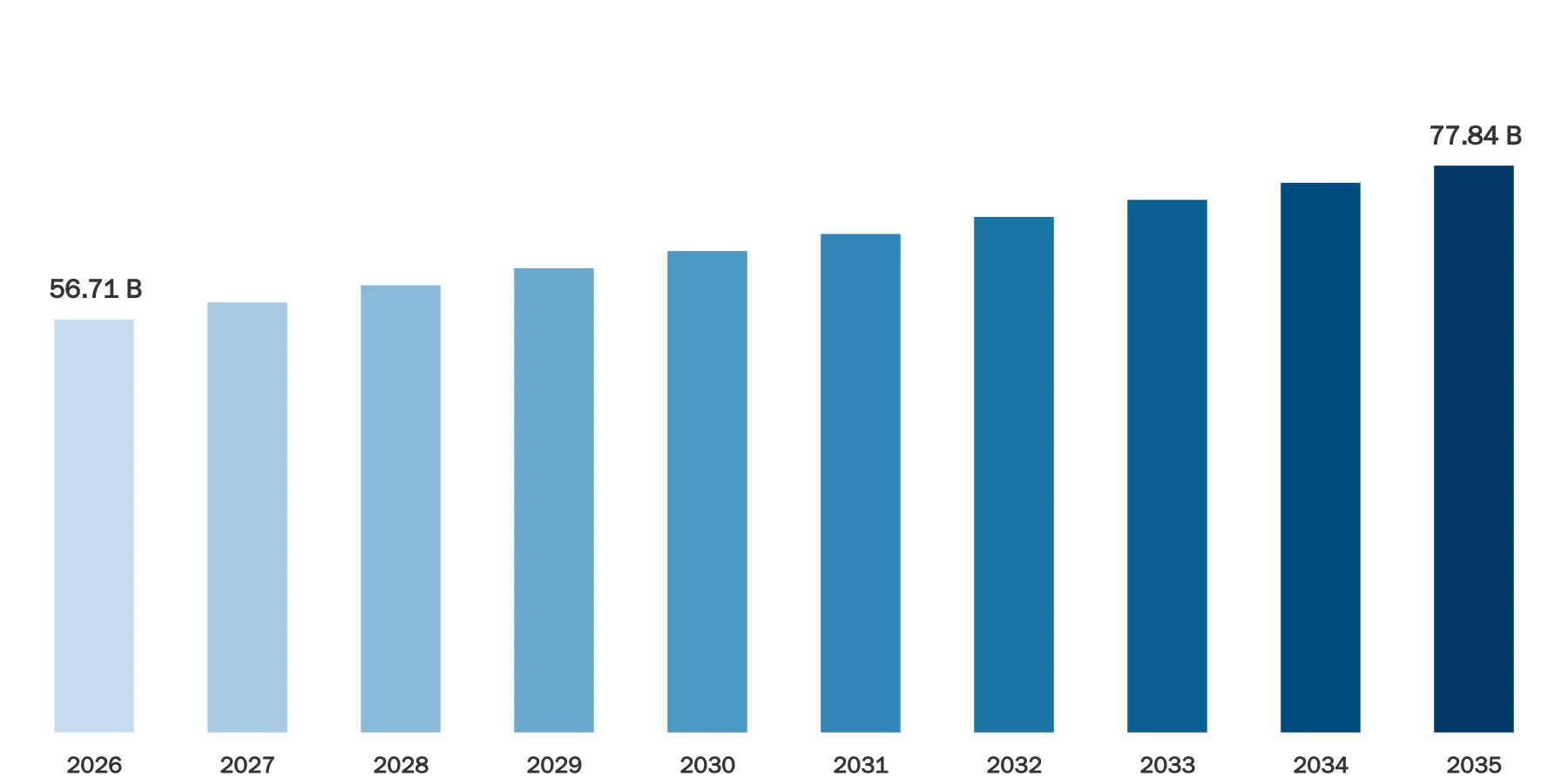
Source: Econ Market Research
The global Pneumatic Tire Market continues to expand due to rising vehicle production, increasing replacement demand, and expanding logistics networks. More than 2.5 billion tires are produced globally every year, with passenger vehicles accounting for nearly 65% of total pneumatic tire consumption. Radial tires represent over 75% of worldwide tire installations because of improved rolling resistance and fuel efficiency. Electric vehicle tire demand increased by over 18% during 2024 due to rising EV registrations exceeding 17 million units globally. Asia-Pacific contributes nearly 55% of global tire manufacturing capacity, while replacement tire demand contributes over 70% of annual tire sales. Commercial vehicle tire replacement cycles range between 80,000 and 140,000 kilometers globally.
The USA pneumatic tire market remains one of the largest globally, supported by strong automotive production and replacement demand. According to industry shipment data, total U.S. tire shipments reached approximately 338.9 million units during 2024, compared with 331.9 million units in 2023. Passenger tire shipments exceeded 220 million units, while light truck tire shipments crossed 37 million units. The United States operates more than 280 tire-related manufacturing and distribution facilities. Replacement tires account for nearly 80% of total market demand in the country. Electric pickup and SUV sales increased by more than 20% in 2024, accelerating demand for low-noise pneumatic tires with rolling resistance below 7.5 kg/t standards.
The European pneumatic tire market is characterized by strong regulations, advanced mobility infrastructure, and increasing EV penetration. Europe recorded more than 223 million replacement consumer tire sales during 2024, reflecting a 5% increase from 2023 levels. Germany, France, Italy, and the United Kingdom collectively represent over 58% of regional tire consumption. Winter tires account for nearly 32% of annual tire demand across Northern and Central Europe. Radial tires dominate over 85% of the regional market because EU fuel-efficiency labeling standards continue to tighten. Commercial fleet operators in Europe reduced average tire replacement intervals by nearly 8% during 2024 to improve fuel optimization and fleet safety compliance.
Pneumatic Tire Market Latest Trends
The pneumatic tire market is witnessing rapid technological transformation supported by electrification, sustainability initiatives, and smart tire integration. Tire manufacturers are increasing silica compound usage by over 22% to improve rolling efficiency and reduce tread wear. Connected tire systems equipped with embedded sensors increased by approximately 28% during 2024, especially in Fleet Management applications. Tire pressure monitoring systems are now installed in more than 90% of new passenger vehicles sold across North America and Europe.
Electric vehicles are significantly reshaping pneumatic tire market trends. EV tires require 15% to 20% higher load-bearing capacity due to battery weight, while torque resistance requirements are nearly 30% higher than Internal Combustion Engine vehicles. More than 17 million electric vehicles were sold globally in 2024, boosting demand for low-noise and low-rolling-resistance tire technologies. Sustainable tire manufacturing is also accelerating, with some manufacturers targeting over 40% renewable material utilization by 2030.
Another major trend in the pneumatic tire industry report involves airless and self-sealing technologies. Self-sealing tire installations increased by 12% among premium passenger vehicles during 2024. Smart manufacturing adoption expanded significantly, with automated tire plants reducing operational downtime by nearly 18%. Online tire retailing also expanded rapidly, accounting for approximately 16% of aftermarket tire purchases globally. Commercial fleet operators increasingly prefer predictive tire maintenance systems capable of improving tire lifespan by 10% to 15%.
Pneumatic Tire Market Dynamics
The pneumatic tire market analysis indicates strong industrial momentum driven by automotive manufacturing growth, replacement demand, logistics expansion, and EV adoption. Global vehicle production exceeded 93 million units during 2024, while replacement tire demand crossed 1.8 billion units worldwide. Increasing freight movement, urbanization, and infrastructure investments continue supporting commercial tire installations. Raw material prices, including natural rubber and synthetic polymers, remain highly volatile, with price fluctuations exceeding 14% during 2024. Advanced tire technologies such as RFID-enabled tires and intelligent monitoring systems are increasing adoption among commercial fleets operating more than 50 vehicles.
DRIVER
Increasing Global Vehicle Production and Fleet Expansion
The primary driver in the pneumatic tire market growth is rising vehicle manufacturing and expanding transportation fleets. Global automobile production surpassed 93 million units in 2024, with passenger cars contributing approximately 70 million units. Commercial truck registrations increased by nearly 9% in developing economies, particularly in India, Indonesia, and Brazil. Urban delivery fleets expanded by over 18% due to e-commerce logistics growth. Tire replacement frequency in ride-sharing fleets is nearly 25% higher than privately owned vehicles because average annual mileage exceeds 45,000 kilometers. Additionally, infrastructure projects across Asia-Pacific and the Middle East increased off-the-road tire demand by over 11% during 2024. Rising two-wheeler penetration in Asia generated demand exceeding 600 million pneumatic tires annually.
RESTRAINT
Volatility in Raw Material Prices
Raw material volatility remains a major restraint in the pneumatic tire market outlook. Natural rubber prices fluctuated between 12% and 18% during 2024 because of climatic disruptions and supply chain bottlenecks. Synthetic rubber costs increased due to crude oil price instability, while carbon black prices rose by nearly 9%. Tire manufacturers allocate approximately 45% to 55% of production costs toward raw materials. Logistics disruptions increased shipping costs by nearly 14% in several export markets. Environmental compliance costs are also rising, particularly in Europe where tire recycling regulations require recovery rates above 95%. These factors are pressuring manufacturers with smaller production capacities below 5 million units annually, limiting profit margins and slowing expansion projects.
OPPORTUNITY
Rising Electric Vehicle Tire Demand
Electric vehicle expansion presents major opportunities in the pneumatic tire market forecast. Global EV registrations crossed 17 million units during 2024, while EV-specific tire demand increased by approximately 20%. EV tires require advanced compounds capable of handling torque levels 30% higher than gasoline vehicles. Low rolling resistance tires can improve EV driving range by nearly 7%. Several manufacturers introduced tires with noise reduction technologies capable of lowering cabin noise by 3 to 5 decibels. Battery electric SUVs require larger tire dimensions ranging between 18 inches and 22 inches, increasing premium tire demand. Asia-Pacific EV tire manufacturing investments exceeded 40 large-scale facility expansions between 2023 and 2025.
CHALLENGES
Increasing Environmental and Recycling Regulations
Environmental regulations are becoming increasingly challenging for the pneumatic tire industry analysis. More than 1 billion waste tires are generated globally every year, creating major disposal and recycling concerns. Europe requires tire recovery rates above 95%, while several countries introduced extended producer responsibility programs during 2024. Tire manufacturing contributes approximately 1.5% of total industrial particulate emissions globally. Carbon emission reduction targets are forcing manufacturers to redesign supply chains and reduce fossil-based materials. Additionally, stricter wet grip and rolling resistance labeling regulations are increasing R&D costs by nearly 12%. Manufacturers operating older plants with utilization rates below 70% face significant modernization expenses to comply with sustainability standards.
SWOT Analysis
Strengths
Global tire production exceeds 2.5 billion units annually, ensuring strong industrial scale.
Radial tires account for more than 75% of global installations because of durability and fuel efficiency.
Replacement tire demand contributes nearly 70% of total pneumatic tire market share.
Commercial logistics activity increased over 10% globally during 2024, strengthening truck tire demand.
Weaknesses
Raw materials contribute up to 55% of manufacturing costs.
Natural rubber supply disruptions affected more than 20 tire-producing countries during 2024.
Tire disposal remains problematic, with over 1 billion scrap tires generated annually.
Production energy consumption for a single passenger tire can exceed 25 kWh.
Opportunities
EV tire demand increased by nearly 20% during 2024.
Smart tire technology installations expanded by approximately 28%.
Online tire sales account for over 16% of global aftermarket purchases.
Sustainable tire compounds using recycled materials increased by 14% in production adoption.
Threats
Counterfeit tire circulation exceeds 5% of global aftermarket sales in some regions.
Trade restrictions increased cross-border tire logistics costs by over 12%.
Environmental regulations require recycling compliance above 90% in many developed markets.
Volatile petroleum prices significantly impact synthetic rubber production costs.
Segmentation Analysis
The pneumatic tire market research report segments the industry by tire type, vehicle type, sales channel, application, and end use. Radial tires dominate due to superior durability and fuel efficiency, while bias tires maintain demand in agriculture and heavy industrial applications. Passenger vehicles account for the largest share because annual global car production exceeds 70 million units. OEM sales remain strong with increasing automotive manufacturing, while aftermarket sales dominate replacement demand. On-road applications contribute most installations, though off-road demand is increasing in mining, construction, and agriculture sectors where heavy-duty pneumatic tires operate under high-load conditions exceeding 100 tons.
By Tire Type
Radial tires dominate the pneumatic tire market size with more than 75% market share globally. Their superior fuel efficiency, tread life, and heat dissipation characteristics support widespread use in passenger vehicles and commercial trucks. Radial tires improve fuel efficiency by approximately 8% compared with traditional bias tires. Commercial truck fleets using radial tires often achieve mileage exceeding 160,000 kilometers before replacement. Passenger radial tire demand exceeded 1.4 billion units globally during 2024.
Bias tires maintain relevance in industrial, agricultural, and construction applications. Bias tire installations account for nearly 25% of global tire consumption. Agricultural machinery operating in rugged terrain prefers bias tires because sidewall strength is approximately 20% higher under low-speed heavy-load operations. Mining vehicles using bias pneumatic tires can carry loads exceeding 300 tons. Several developing markets continue using bias tires because manufacturing costs are lower by nearly 18% compared with radial tire production.
By Vehicle Type
Passenger vehicles represent the largest pneumatic tire market share, accounting for approximately 58% of global tire demand. Global passenger car production crossed 70 million units during 2024, while replacement demand exceeded 1 billion passenger tires. SUV tire demand increased by nearly 14% because SUVs represent over 48% of new vehicle sales in several developed economies.
Commercial vehicles contribute nearly 22% of market demand. Heavy trucks require replacement every 80,000 to 140,000 kilometers depending on road conditions. Two-wheelers account for nearly 15% of total pneumatic tire consumption, with Asia-Pacific contributing more than 80% of global motorcycle tire demand. Off-the-road vehicles account for approximately 5% of the market but generate strong industrial demand due to mining and construction activity. Construction vehicle tire diameters often exceed 49 inches for heavy-load applications.
By Sales Channel
The aftermarket segment dominates the pneumatic tire market outlook with nearly 70% share because replacement cycles remain frequent across passenger and commercial vehicles. Global replacement tire shipments exceeded 1.8 billion units during 2024. Commercial fleets replace tires every 2 to 4 years depending on operating conditions and mileage. Online aftermarket tire sales increased by approximately 16% during 2024 because digital retail platforms offer wider inventory selection.
OEM sales account for nearly 30% of the market. Automotive manufacturers increasingly demand low rolling resistance tires to comply with emission standards. OEM passenger tire installations exceeded 350 million units globally during 2024. EV manufacturers are partnering directly with tire producers to develop noise-optimized pneumatic tires. Tire dimensions between 18 inches and 21 inches represented over 45% of premium OEM installations during 2024.
By Application and End Use
On-road applications account for nearly 82% of the pneumatic tire market due to passenger cars, buses, and commercial trucks. Urban logistics expansion increased delivery van tire demand by approximately 19% during 2024. Off-road applications contribute nearly 18% of demand, particularly in mining, construction, and agriculture sectors. Mining haul trucks require tires capable of carrying over 100 tons under extreme temperatures exceeding 50°C.
By end use, automotive applications dominate with over 72% market share. Industrial applications account for approximately 11%, agriculture contributes nearly 9%, and construction contributes around 8%. Agricultural tire demand increased because global tractor registrations exceeded 2.3 million units during 2024. Construction Equipment tire demand expanded by approximately 10% due to infrastructure investments across Asia-Pacific and the Middle East.
Regional Analysis
North America maintains strong replacement tire demand and advanced tire technology adoption.
Europe emphasizes sustainable tire manufacturing and fuel-efficiency regulations.
Asia-Pacific dominates production capacity and vehicle manufacturing volume.
Middle East & Africa show increasing off-road and commercial vehicle tire demand.
North America
North America accounts for approximately 24% of the global pneumatic tire market share. The United States represents the dominant regional market, with total tire shipments reaching nearly 338.9 million units during 2024. Passenger replacement tires contributed more than 220 million units, while commercial truck tire demand increased by over 8%. The region operates more than 60 major tire production plants with combined annual output exceeding 350 million tires.
Electric pickup truck sales increased by approximately 22% during 2024, supporting demand for reinforced pneumatic tires with enhanced torque resistance. Canada and Mexico continue strengthening regional manufacturing networks, particularly under automotive trade agreements. Fleet management systems using smart tire monitoring increased by nearly 25% among logistics operators. Winter tire adoption exceeds 70% in several Canadian provinces. Commercial trucking activity across the United States moved more than 11 billion tons of freight annually, supporting consistent replacement tire demand.
Europe
Europe represents approximately 22% of the global pneumatic tire market size. The region recorded more than 223 million replacement consumer tire sales during 2024. Germany, France, Italy, and the United Kingdom collectively account for over 58% of regional demand. Winter tire regulations in Northern Europe significantly support seasonal tire replacement cycles. EV registrations increased by more than 15% during 2024, accelerating demand for energy-efficient tires.
European tire labeling regulations require detailed efficiency grading related to wet grip, rolling resistance, and external noise levels. Sustainable tire material adoption increased by approximately 13% during 2024. Michelin reported that Europe accounted for 36% of its total sales volume in 2024. Commercial truck tire demand weakened slightly because industrial freight movement slowed in Germany and France. However, replacement demand remains stable due to aging vehicle fleets averaging over 12 years across multiple European countries.
Asia-Pacific
Asia-Pacific dominates the pneumatic tire market growth with nearly 55% of global manufacturing capacity. China, India, Japan, South Korea, and Thailand collectively produce more than 1.3 billion tires annually. China alone contributes over 35% of worldwide tire manufacturing output. India’s two-wheeler market exceeded 18 million vehicle sales during 2024, driving massive demand for motorcycle pneumatic tires.
Passenger vehicle production in Asia-Pacific crossed 45 million units during 2024. Commercial freight expansion and e-commerce logistics increased truck tire demand by approximately 12%. Several countries expanded tire manufacturing investments between 2023 and 2025, including over 40 EV-specific tire projects. Japan and South Korea remain leaders in smart tire sensor technologies and silica-based tire compounds. Radial tire penetration exceeded 80% across passenger vehicles in urban markets throughout China, Japan, and South Korea.
Middle East & Africa
The Middle East & Africa pneumatic tire market is expanding due to infrastructure development, mining activity, and increasing vehicle ownership. The region accounts for nearly 8% of global tire consumption. GCC countries recorded passenger vehicle fleet growth of approximately 7% during 2024. Saudi Arabia and the UAE continue investing heavily in logistics infrastructure and construction projects, increasing heavy-duty tire demand.
Mining operations across South Africa require large off-the-road pneumatic tires for haul trucks operating with payload capacities exceeding 200 tons. Agricultural mechanization increased tractor tire demand by nearly 9% across several African economies. Tire imports dominate regional supply, accounting for over 65% of market volume. High ambient temperatures exceeding 45°C in desert environments create demand for heat-resistant tire compounds. Fleet operators in the Middle East increasingly adopt tire pressure monitoring systems to improve fuel efficiency and reduce tire failures by approximately 15%.

Competitive Landscape
The pneumatic tire market competitive landscape remains highly consolidated, with the top 10 manufacturers controlling more than 65% of global market share. Major manufacturers operate integrated production networks spanning over 45 countries. Leading companies collectively manufacture more than 1.5 billion tires annually across passenger, commercial, industrial, and off-road categories.
Competition focuses heavily on EV tire technology, rolling resistance reduction, tread durability, and smart tire integration. Tire manufacturers increased R&D spending by approximately 10% during 2024 to develop sustainable compounds and intelligent monitoring systems. Production automation adoption increased across more than 120 global facilities, reducing manufacturing defects by nearly 18%.
Manufacturers are expanding localized production to minimize trade-related disruptions and logistics costs. North America and Asia-Pacific remain priority investment regions because combined vehicle production exceeds 60 million units annually. Several tire companies introduced bio-based materials and recycled rubber technologies capable of reducing fossil-derived content by 20% to 30%. Competitive differentiation increasingly depends on fuel efficiency ratings, EV compatibility, and fleet management partnerships. Digital tire monitoring systems integrated with cloud analytics platforms expanded by nearly 25% among commercial transportation companies during 2024.
List of Top Pneumatic Tire Companies
Michelin
Bridgestone Corporation
Goodyear Tire & Rubber Company
Continental AG
Pirelli & C. S.p.A.
Hankook Tire
Yokohama Rubber Company
Sumitomo Rubber Industries
Apollo Tyres
JK Tyre & Industries
Leading Companies by Market Share
Michelin and Bridgestone Corporation remain the leading companies by global pneumatic tire market share. Michelin operates more than 120 manufacturing sites worldwide and maintains strong penetration across Europe and North America. Bridgestone produces over 180 million tires annually and maintains significant leadership in passenger and commercial vehicle tire segments. Combined, both companies account for approximately 28% of the global premium tire segment. Their investments in EV-compatible tires, smart tire systems, and sustainable materials continue strengthening competitive positioning.
Market Investment Outlook
The pneumatic tire market outlook remains investment-intensive due to expanding EV production, smart manufacturing adoption, and sustainable material initiatives. Tire manufacturers announced more than 50 plant modernization projects globally between 2023 and 2025. Asia-Pacific attracted the highest number of investments because vehicle production in the region exceeds 45 million units annually.
North America continues receiving manufacturing investments to localize supply chains and reduce import dependence. Michelin indicated that more than 70% of U.S. demand is supplied through local production facilities. Smart tire technology investment increased by approximately 30% during 2024 as fleet operators prioritize predictive maintenance. Automated production systems reduced operational downtime by nearly 18% across modern tire plants.
Sustainable tire production remains a key investment area. Manufacturers are targeting recycled and renewable material utilization levels between 40% and 60% by 2030. Several companies are investing in recovered carbon black processing and bio-based synthetic rubber technologies. EV tire development facilities expanded significantly, especially for larger tire dimensions above 20 inches. Mining and agricultural tire investments are also increasing because heavy-duty vehicle demand continues rising across infrastructure and commodity sectors.
New Product Development
New product development within the pneumatic tire market focuses heavily on EV compatibility, smart sensors, sustainability, and puncture resistance. Several manufacturers introduced EV-specific tires during 2024 featuring rolling resistance reductions between 10% and 15%. Noise reduction technologies capable of lowering cabin sound levels by 3 to 5 decibels gained popularity in premium electric vehicles.
Smart tires with embedded sensors capable of monitoring temperature, pressure, tread wear, and road conditions increased by approximately 28% during 2024. Commercial fleet operators are deploying intelligent tire systems capable of reducing breakdown incidents by nearly 20%. Self-sealing tire technologies also expanded among premium passenger vehicles and luxury SUVs.
Manufacturers introduced silica-rich tread compounds capable of increasing tire lifespan by approximately 12%. Sustainable material integration remains a major innovation trend, with some new tire models containing over 30% recycled or renewable content. Air retention technologies improved significantly, reducing pressure loss rates by nearly 50% compared with conventional designs. Advanced off-road tires introduced during 2025 support payload capacities exceeding 100 tons while maintaining improved heat resistance for mining operations in extreme climates.
Recent Developments
Michelin expanded EV tire production capacity in North America during 2024 to support increasing electric SUV demand and targeted supplying over 70% of regional demand locally.
Bridgestone Corporation introduced advanced ENLITEN tire technology during 2024, reducing rolling resistance by approximately 15% while improving tread wear performance.
Goodyear Tire & Rubber Company launched connected fleet tire monitoring systems capable of reducing tire-related roadside incidents by nearly 20% across logistics fleets during 2025.
Continental AG increased automation deployment across manufacturing plants during 2024, lowering production defects by approximately 18% and improving operational efficiency.
Pirelli & C. S.p.A. expanded Cyber Tire sensor integration into premium EV platforms during 2025, enabling real-time road condition and tire performance analysis.
Report Coverage of Pneumatic Tire Market
The pneumatic tire market report provides detailed analysis of production trends, tire technologies, replacement demand, manufacturing developments, and competitive positioning across global regions. The report covers segmentation by tire type, vehicle category, sales channel, application, and end use. Analysis includes radial tire penetration exceeding 75%, passenger vehicle demand representing nearly 58% of market share, and aftermarket dominance above 70% of total sales volume.
The report evaluates regional manufacturing trends across North America, Europe, Asia-Pacific, and Middle East & Africa. Asia-Pacific coverage highlights manufacturing capacity exceeding 55% of global output, while North America analysis focuses on tire shipments approaching 339 million units during 2024. Europe coverage examines replacement tire demand surpassing 223 million units and sustainability regulations impacting production strategies.
The pneumatic tire industry report further assesses technological developments such as smart tires, self-sealing technologies, low rolling resistance compounds, and EV-specific tire innovations. Competitive benchmarking covers leading manufacturers operating across more than 45 countries. Investment analysis includes plant automation, sustainable materials, and intelligent tire monitoring systems. The report also evaluates supply chain risks, raw material volatility, environmental regulations, and replacement demand trends shaping the future pneumatic tire market outlook.
Pneumatic Tire Market Report Scope & Segmentation
| Attributes | Details |
|---|---|
Market Size (Current) | US$ 56.71 Billion in 2026 |
Market Size (Forecast) | US$ 77.84 Billion in 2035 |
Growth Rate | CAGR of 3.58% from 2026 to 2035 |
Forecast Period | 2026 – 2035 |
Base Year | 2025 |
Historical Data Available | Yes |
Regional Scope | Global |
Segments Covered | By Product Type
By Vehicle Type
By Sales Channel
|
Frequently Asked Questions
Common questions about this report
The study period covers historical insights and forecast projections for the period 2026-2035.
About the Author
Market research expert with years of industry experience

Dipali Bhingare serves as the Market Research Director at Econ Market Research. With a focus on translating complex global economic shifts into actionable business intelligence, she oversees the strategic direction of comprehensive market studies. Her work empowers organizations to navigate volatile industries through data-driven forecasting and deep-dive competitive analysis.
Related Reports
Explore more market insights from the same category