

Personal Financial Management Tools Market
Personal Financial Management Tools Market Size, Share, Trends, Growth, and Industry Analysis, By Application (Budgeting, Investment Management, Debt Reduction, Credit Monitoring, Taxation, Other), By Types (Browser-based, Mobile Apps), Regional Analysis and Forecast Period 2026-2035
Market Overview
As per Econ Market Research analysis, the Global Personal Financial Management Tools Market was valued at approximately US$ 2.72 Billion in 2026 and is predicted to reach US$ 7.97 Billion by 2035, expanding at a CAGR of 12.7% over the forecast duration. The base year is 2025.
Personal Financial Management Tools Market Size 2025-2035 (USD Billion)

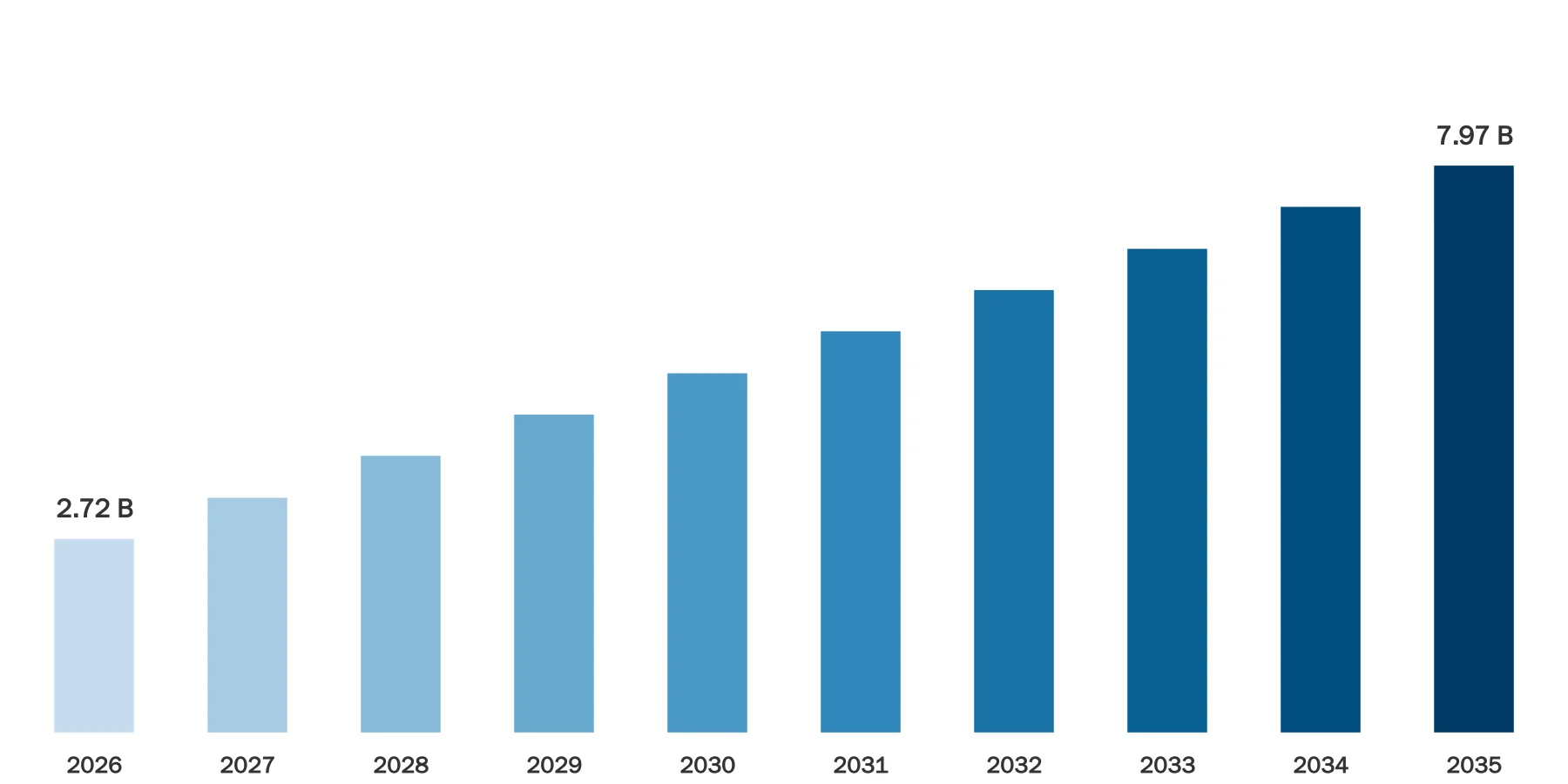
Source: Econ Market Research
The Personal Financial Management Tools Market is expanding on the back of rising digital banking usage, app-based budgeting behavior, and automated money management features. In 2024, more than 4.2 billion people used smartphones globally, creating a large addressable base for personal financial management tools. Over 76% of adults in developed economies used some form of online or mobile banking, while more than 58% of digitally active consumers tracked expenses through at least 1 financial app or software platform. Open banking frameworks were active in over 60 jurisdictions by 2024, supporting account aggregation, transaction analysis, and spending categorization. Cloud deployment represented over 70% of software delivery models in digital finance ecosystems, while AI-enabled budgeting, alerts, and predictive cash-flow features appeared in more than 45% of leading personal financial management tools.
The USA market for personal financial management tools is one of the most mature globally, supported by high banking penetration, widespread smartphone ownership, and strong fintech adoption. In 2024, the United States had more than 310 million smartphone users, and internet penetration remained above 92%. Roughly 78% of adults used digital banking channels, while over 43% used mobile apps to monitor balances, spending, or savings goals at least once per week. Credit card ownership exceeded 70% among adults, increasing demand for debt tracking and credit monitoring tools. More than 130 million US consumers had access to some form of free credit score visibility by 2024, and over 60% of tax filers used software-assisted preparation, reinforcing cross-category demand for integrated personal financial management tools.
Key Insights
Emerging Trends: More than 62% of users preferred mobile-first financial tracking, 48% used automated savings rules, 37% engaged with AI-driven spending insights, and 29% connected at least 3 financial accounts, showing a clear shift toward integrated, predictive, and multi-account personal financial management tools.
Key Market Driver: Around 78% of banking customers used digital channels, 64% preferred self-service financial monitoring, 52% wanted real-time alerts, and 46% actively tracked monthly budgets, making digital financial visibility and automated money control the strongest demand driver in this market.
Major Market Challenges: Nearly 41% of users expressed data-sharing concerns, 33% abandoned apps after 90 days, 27% reported account-linking errors, and 22% faced duplicate transaction issues, indicating persistent trust, retention, and interoperability problems across the personal financial management tools market.
Regional Outlook: North America accounted for about 34% of adoption intensity, Europe 28%, Asia-Pacific 24%, and Middle East & Africa 14%, with the fastest user onboarding visible in mobile-centric economies where digital wallet penetration exceeded 45% and app-led financial behavior continued rising.
Competitive Landscape: The top 5 platforms represented nearly 57% of active user concentration, mobile-native tools held 61% of engagement, bank-linked aggregators captured 49% of usage cases, and subscription-based software accounted for 31% of monetization models in the personal financial management tools market.
Market Segmentation: Mobile apps represented approximately 68% of user preference, browser-based tools held 32%, budgeting applications led with 29%, investment management captured 18%, debt reduction 16%, credit monitoring 15%, taxation 12%, and other functions accounted for 10% of use cases.
Recent Development: Between 2023 and 2025, over 44% of leading vendors added AI assistants, 39% improved open-banking connectivity, 33% launched enhanced credit score dashboards, and 26% expanded tax and retirement planning modules within personal financial management tools market offerings.
Market Latest Trends
The Personal Financial Management Tools Market is being shaped by mobile engagement, embedded analytics, AI personalization, and open-finance integration. In 2024, around 68% of users preferred mobile apps over desktop or browser-first systems, reflecting the dominance of always-on money management. More than 52% of active users expected real-time transaction notifications, while 47% favored automated categorization of spending across groceries, utilities, subscriptions, and transport. Subscription-tracking modules appeared in over 35% of leading tools as recurring payment fatigue intensified across households managing 8 to 15 monthly digital services.
AI-supported insights became a major trend, with over 37% of platforms offering predictive cash-flow alerts, overspending warnings, or bill reminders. Retirement and wealth-planning functions also expanded, as nearly 31% of users under age 45 sought integrated views of savings, debt, and long-term investing. Account aggregation remained central; users linking 2 or more accounts represented over 54% of active customers. Open banking and API-based connectivity improved the speed of syncing, though 27% of users still reported occasional categorization or balance mismatches.
Another visible trend is the convergence of personal finance, credit health, and tax support. Around 33% of users wanted a single dashboard combining budgeting, credit score monitoring, and tax document readiness. Security features grew in importance, with biometric authentication present in over 49% of mobile-first tools and multi-factor authentication enabled across more than 70% of mainstream offerings.
Market Dynamics
DRIVER
Rising Adoption of Digital Banking and Mobile Financial Behavior
The primary growth driver in the Personal Financial Management Tools Market is the rapid normalization of digital banking and app-based money management. In 2024, over 76% of adults in advanced economies used online banking, while more than 60% of consumers checked financial balances through smartphones at least once per week. This high-frequency behavior increases demand for budgeting dashboards, spending analysis, bill reminders, and savings automation. More than 52% of users preferred platforms that offered instant alerts for low balances, due dates, or unusual spending. Account aggregation is another major accelerator, with over 54% of active users connecting at least 2 accounts and nearly 29% connecting 3 or more. As households manage multiple cards, loans, subscriptions, and savings accounts, the need for one-screen visibility keeps rising. Younger demographics are especially important; more than 65% of consumers aged 18 to 34 reported comfort using fintech-style interfaces for daily financial decisions, supporting continued user expansion for personal financial management tools market participants.
RESTRAINT
Data Privacy Concerns and User Retention Weakness
A major restraint in the Personal Financial Management Tools Market is user hesitation around data privacy, bank connectivity, and sustained engagement. About 41% of consumers have concerns about sharing transaction-level financial data with third-party tools, even when encrypted access is used. Around 27% of users reported account-linking failures or delayed syncs, and these friction points directly affect trust. Retention is another structural barrier: nearly 33% of users stop engaging with personal finance apps within 90 days, often because onboarding is too complex or dashboards provide limited perceived value after initial setup. Duplicate transactions, misclassified expenses, and delayed balance refreshes affect approximately 22% to 27% of users depending on platform design. For subscription-based tools, churn pressure is stronger when users compare a paid app against free bank-provided money management features. In addition, over 30% of consumers remain uncomfortable granting continuous read-access to checking, savings, investment, and credit accounts, limiting total adoption despite favorable smartphone and online banking penetration.
OPPORTUNITY
AI-Led Personalization and Integrated Financial Wellness
The biggest opportunity in the Personal Financial Management Tools Market lies in AI-driven personalization and integrated financial wellness ecosystems. By 2025, over 44% of leading vendors had embedded AI or rules-based engines for forecasting bills, detecting spending anomalies, or recommending savings actions. More than 48% of users showed interest in automated savings transfers, while 34% wanted debt payoff simulations and scenario planning. This creates a significant opportunity for tools that combine budgeting, debt reduction, credit monitoring, tax preparation, and investment tracking in one platform. Financial wellness demand is also increasing among employers and financial institutions; more than 50% of large organizations globally were investing in digital employee finance benefits by the mid-2020s, opening B2B distribution channels for software vendors. Embedded personal finance modules inside banking apps also represent a high-potential route, especially as over 70% of retail banking customers already use digital channels. Vendors that improve predictive guidance, life-event planning, and multilingual user experiences can capture broader adoption across both bank-led and direct-to-consumer deployment models.
CHALLENGE
Interoperability Complexity and Regulatory Fragmentation
A critical challenge in the Personal Financial Management Tools Market is the complexity of integrating data across banks, brokers, lenders, tax systems, and credit bureaus while complying with varying regulations. More than 60 jurisdictions have some form of open banking or open finance initiative, but API standards, authentication methods, and consent rules differ substantially. Around 27% of users still experience inconsistent synchronization, particularly when linking investment accounts, small credit unions, or loan servicers. Credit reporting frameworks, tax documentation cycles, and consumer consent requirements also vary by country, increasing engineering workload for multinational providers. Security pressure is growing as well; more than 70% of major tools have implemented multi-factor authentication, yet cyber-risk expectations continue to rise. Platform operators must manage large data volumes, frequent software updates, and model accuracy for transaction categorization across thousands of merchants. The challenge becomes more intense when users expect near real-time updates, which over 52% already do. Maintaining stable connectivity, compliant data flows, and intuitive user experiences at scale remains one of the hardest operating issues in this market.
Segmentation Analysis
Segmentation in the Personal Financial Management Tools Market is shaped by delivery format and functional use case. By type, mobile apps account for around 68% of user preference, while browser-based tools represent about 32%, reflecting the stronger engagement generated by smartphones and real-time notifications. By application, budgeting leads with approximately 29% share, followed by investment management at 18%, debt reduction at 16%, credit monitoring at 15%, taxation at 12%, and other functions at 10%. B2B buyers often evaluate these segments based on user retention, API connectivity, account aggregation depth, security features, and cross-sell potential. The most competitive solutions combine 3 to 5 functions to increase daily or weekly usage frequency.
By Type
Browser-based
Browser-based personal financial management tools continue to serve users who prefer detailed dashboards, spreadsheet-like controls, and larger-screen financial planning. This segment holds about 32% share of the Personal Financial Management Tools Market by user preference. Browser-based platforms are particularly relevant for investment tracking, tax preparation workflows, and long-range financial planning where users review 12 to 24 months of account history in one interface. Around 46% of desktop-oriented users favor browser tools for exporting CSV files, printing reports, or comparing multiple accounts side by side. Adoption remains strong among users aged 35 and above, especially in households managing mortgages, retirement assets, and education savings simultaneously. Browser-based tools also appeal to B2B partners such as advisory firms and financial institutions because they enable deeper analytics, rule customization, and document-level interactions that are harder to manage on small screens.
Mobile apps
Mobile apps dominate the Personal Financial Management Tools Market with approximately 68% share, driven by daily balance checks, instant notifications, and easier habit formation. In 2024, more than 60% of users accessed financial management features through smartphones at least weekly, and over 35% did so daily. Push notifications, biometric login, and simplified account linking significantly raise engagement. More than 52% of users prefer mobile apps for low-balance alerts, bill reminders, and spending insights delivered in real time. Younger segments are especially mobile-centric, with over 70% of adults aged 18 to 34 expressing preference for app-first finance management. Mobile apps also support stronger user retention through gamified savings goals, recurring payment detection, and spending trend visuals. For providers targeting scalable adoption, mobile apps remain the core channel for distribution, onboarding, and continuous interaction in the personal financial management tools market.
By Application
Budgeting
Budgeting is the largest application segment in the Personal Financial Management Tools Market, representing about 29% share. More than 46% of users actively track monthly spending categories such as food, housing, transport, and subscriptions, making budgeting the foundation of most product experiences. Automated categorization is central to this segment, with over 47% of users expecting transactions to be sorted instantly. Budgeting tools also benefit from high repeat usage because households monitor weekly cash flow and compare planned versus actual spending across 4 to 10 categories. Nearly 52% of users want alerts for overspending thresholds, while 48% are interested in automated savings rules linked to budgeting outcomes. B2B demand is strong among banks and employers seeking financial wellness features that encourage healthier money habits and lower stress related to daily expense control.
Investment Management
Investment management accounts for roughly 18% of the Personal Financial Management Tools Market by application. This segment includes portfolio tracking, asset allocation views, retirement planning, and performance dashboards tied to brokerage or retirement accounts. Around 31% of users under age 45 want a combined view of investments and cash-flow management, and over 25% of digitally engaged savers monitor long-term goals through online dashboards. Multi-account aggregation matters significantly here because users often hold 2 to 4 investment vehicles, including retirement plans, taxable brokerage accounts, and education funds. Browser-based interfaces remain relevant in this segment due to charting depth and time-series analysis across 12 to 60 months. Providers competing in investment management are increasingly adding risk scoring, rebalancing alerts, and retirement gap projections, especially for households balancing debt, emergency savings, and retirement contributions at the same time.
Debt Reduction
Debt reduction represents about 16% of application demand in the Personal Financial Management Tools Market. This segment is highly relevant in economies where credit card balances, student loans, auto loans, and mortgages shape monthly household budgets. More than 39% of users seek payment calculators, payoff timelines, and debt-priority recommendations, especially when managing 2 or more liabilities simultaneously. Automated debt reduction tools frequently include snowball and avalanche repayment methods, projected interest savings, and reminder alerts for due dates. Around 44% of users with revolving credit prefer tools that connect balances directly for progress tracking. This segment also benefits from credit health integration, since debt reduction plans are often tied to score improvement strategies. For B2B buyers, debt reduction functionality supports financial wellness programs aimed at reducing employee stress and improving long-term financial stability across user populations.
Credit Monitoring
Credit monitoring holds approximately 15% share in the Personal Financial Management Tools Market. Demand is supported by widespread consumer interest in score visibility, fraud detection, utilization tracking, and identity-related alerts. In the United States alone, more than 130 million consumers had access to some form of free credit score visibility by 2024, demonstrating the scale of this use case. Around 42% of users value monthly score updates, while 36% want notification of new inquiries, balance spikes, or missed payment risks. Integration with debt reduction and budgeting tools increases stickiness because users can connect behavior changes to score movement over 30 to 90 days. This segment is especially attractive for financial institutions and fintech partners because it drives repeat engagement through alerts, educational prompts, and product recommendations related to cards, loans, and refinancing opportunities.
Taxation
Taxation represents close to 12% of the Personal Financial Management Tools Market and remains an important seasonal and annual-use application. More than 60% of tax filers in digitally advanced markets use software-assisted processes, creating a strong base for integrated tax estimation, deduction tracking, and document organization. Personal financial management tools with tax modules help users classify deductible expenses, estimate quarterly payments, and prepare year-end summaries across 12 months of transactions. Around 28% of self-employed or Gig Economy users want automated separation of personal and business spending, while 24% seek estimated tax alerts based on income inflows. Taxation tools become especially valuable when linked to budgeting and investment features, allowing users to assess withholding, capital gains, and savings goals in one place. B2B demand includes payroll providers, digital banks, and platforms serving freelancers or independent workers.
Other
The “Other” application segment accounts for roughly 10% of the Personal Financial Management Tools Market and includes bill management, subscription tracking, financial goal setting, family finance coordination, insurance reminders, and educational coaching. Subscription monitoring has become more prominent, with households often managing 8 to 15 recurring digital services. Around 35% of leading tools now provide recurring payment detection and cancellation awareness features. Family finance tools are also gaining traction, particularly among households coordinating shared expenses across 2 or more adults. Goal-based savings modules are popular with younger users, with over 40% expressing interest in visual progress bars and milestone tracking. For B2B providers, these “other” capabilities are important differentiators because they raise user engagement beyond basic budgeting. Vendors that combine niche features with core tracking functions are better positioned to improve retention and broaden addressable use cases.
Regional Analysis
The Personal Financial Management Tools Market shows strong regional variation based on smartphone penetration, digital banking maturity, open banking rules, and consumer trust in data-sharing. North America leads with about 34% share of overall adoption intensity, followed by Europe at 28%, Asia-Pacific at 24%, and Middle East & Africa at 14%. Regions with internet penetration above 80% and digital banking usage above 70% generally exhibit stronger personal financial management tools market activity. Mobile-first usage is highest in markets with younger populations and wallet-led payment habits, while browser-based usage remains stronger where tax complexity, investment participation, and multi-account financial planning are common. B2B expansion is rising in all regions through banks, fintech apps, employers, and advisory ecosystems.
North America:
North America accounts for approximately 34% share of the Personal Financial Management Tools Market, supported by high digital banking penetration, widespread credit usage, and strong consumer familiarity with app-based finance. In the United States and Canada, internet penetration is above 90% in most urban populations, while smartphone ownership exceeds 80% among adults. Around 78% of consumers in the region use digital banking services, and more than 43% engage with mobile financial tracking tools at least weekly. The region also benefits from high account complexity: many households manage checking accounts, savings accounts, credit cards, mortgages, retirement plans, and brokerage assets at the same time. This increases demand for account aggregation and unified dashboards.
Credit monitoring and debt reduction are particularly important in North America because revolving credit and loan-based financial behavior are widespread. More than 70% of US adults hold at least 1 credit card, and free score-visibility services reach over 130 million consumers. Budgeting remains the largest application, but investment management has a stronger share here than in many other regions because retirement account participation and retail investing are more established. Browser-based tools maintain relevance among users reviewing long-term plans, tax documents, and investment reports over 12-month to 60-month periods. B2B search intent such as Personal Financial Management Tools Market Report and Personal Financial Management Tools Industry Analysis is especially strong in North America due to active bank-fintech partnerships and employer-led financial wellness programs. Security standards are also high, with multi-factor authentication and biometric login widely expected by users.
Europe:
Europe represents around 28% share of the Personal Financial Management Tools Market and benefits from advanced digital banking behavior, robust consumer protection frameworks, and broad adoption of open banking standards. In many European countries, internet penetration exceeds 85%, while cashless payment usage in urban areas is above 70%. Open banking regulation has played a major role in supporting account aggregation, secure consent-based data access, and standardized interfaces for third-party finance apps. As a result, budgeting, spending analytics, and multi-bank account monitoring are highly developed across the region. Around 50% of digitally active users in mature European markets use some form of expense tracking or financial dashboard.
Europe also shows balanced demand across budgeting, debt management, and savings planning. Credit monitoring is comparatively less dominant than in North America in some countries, but account orchestration across multiple banks is more advanced because cross-bank usage is common. Mobile apps hold a majority share, though browser-based tools remain important for tax, pension, and household financial planning. Consumers in Europe place high emphasis on privacy and consent controls; this shapes product design and onboarding expectations. More than 40% of users consider transparency in data usage a deciding factor when choosing a personal financial management solution. B2B decision-makers searching for Personal Financial Management Tools Market Analysis and Personal Financial Management Tools Market Outlook often focus on PSD-style compliance readiness, API quality, multilingual capability, and localization across currencies, tax rules, and banking institutions.
Asia-Pacific:
Asia-Pacific holds approximately 24% share of the Personal Financial Management Tools Market and is one of the fastest-expanding regions in terms of user volume due to large populations, rising smartphone penetration, and rapid Mobile Wallet adoption. In several major markets across Asia-Pacific, smartphone penetration has crossed 75%, and mobile payments are used by more than 50% of urban digital consumers. This mobile-first behavior strongly favors app-based personal financial management tools, especially for budgeting, bill reminders, savings goals, and payment-linked spending analysis. Younger populations drive adoption, with consumers under age 35 forming a substantial portion of active finance app users in many countries.
The region shows strong demand for lightweight, intuitive tools rather than desktop-heavy systems. Mobile apps can account for more than 70% of personal finance tool engagement in several Asia-Pacific markets. Investment management is also growing as retail participation in digital brokerage and mutual fund apps rises, although budgeting remains the largest use case. In markets with fragmented banking systems, interoperability can still be inconsistent, and users may connect digital wallets, bank accounts, and credit products separately. This creates opportunities for vendors focused on aggregation and transaction normalization. B2B searches related to Personal Financial Management Tools Market Forecast and Personal Financial Management Tools Market Opportunities are increasing as banks, super apps, and digital lenders seek embedded personal finance modules to improve retention and cross-sell efficiency. Language localization and low-friction onboarding remain critical to success in this region.
Middle East & Africa
Middle East & Africa accounts for around 14% share of the Personal Financial Management Tools Market, with adoption shaped by rising smartphone use, expanding digital banking infrastructure, and accelerating financial inclusion programs. In several Gulf countries, smartphone penetration exceeds 85%, while digital banking adoption is growing steadily among younger, urban populations. In parts of Africa, mobile money usage is a major gateway to formal financial behavior, and that creates demand for simple financial tracking tools even where traditional bank account penetration is lower. Budgeting, bill management, and savings tracking are the most important use cases across the region.
The market is still developing compared with North America and Europe, but growth in digital wallets, real-time payments, and app-based banking is improving the base for personal financial management tools. In regions where unbanked and underbanked populations remain significant, basic financial planning tools with low data usage and multilingual design are especially relevant. Browser-based usage is more limited, while mobile apps dominate engagement because smartphones are the main digital access point for many consumers. B2B buyers in the region often look for modular solutions that can be embedded into mobile banking or telecom-finance ecosystems. Search intent around Personal Financial Management Tools Market Research Report and Personal Financial Management Tools Industry Report often centers on financial inclusion, wallet integration, credit-building tools, and localized user education. Security, trust, and regional compliance remain important adoption factors.
List of Top Personal Financial Management Tools Companies
Mint
Mvelopes
BankTree Software
You Need a Budget (YNAB)
FutureAdvisor
Personal Capital
Quicken
Tiller Money
Yodlee
TurboTax
Top two companies with the highest market share
Mint – Mint has historically held one of the largest user bases in the personal financial management tools market, with market share estimated in the low double digits among mainstream consumer-facing platforms in North America. Its strength came from free budgeting, account aggregation across multiple institutions, bill tracking, and automated categorization used by millions of consumers.
Quicken – Quicken remains among the top companies by market share, particularly in browser/desktop-oriented and long-term financial planning use cases. It has strong penetration among users managing 12-month to 60-month financial histories, investments, property-related spending, and tax preparation support, giving it a high single-digit to low double-digit share in several mature user segments.
Market Investment Outlook
The Personal Financial Management Tools Market presents strong investment potential across embedded finance, AI personalization, and financial wellness distribution models. Investors and strategic buyers are focusing on platforms that can integrate budgeting, credit monitoring, debt reduction, and investment visibility within 1 user interface. Over 70% of retail banking customers now use digital channels, making bank partnerships a major route for scale. More than 50% of large employers have expanded financial wellness initiatives, creating a B2B opportunity for vendors offering white-label or co-branded personal finance tools.
Investment activity is also being influenced by open banking expansion across more than 60 jurisdictions, which supports account aggregation, transaction enrichment, and real-time insights. Platforms with high retention metrics are especially attractive because nearly 33% of users abandon finance apps within 90 days, meaning vendors that reduce churn can gain a strong competitive edge. Mobile-first solutions command particular interest, as approximately 68% of users prefer app-based finance management. AI capabilities are another investment theme; over 44% of leading vendors have added predictive alerts, savings recommendations, or anomaly detection.
There are also opportunities in underserved segments such as freelancers, gig workers, younger first-time investors, and underbanked users. Tools that support multilingual interfaces, low-friction onboarding, and localized compliance stand to benefit in Asia-Pacific and Middle East & Africa. For B2B buyers seeking Personal Financial Management Tools Market Insights, the most investable categories are API-ready, secure, multi-function platforms with strong user engagement data.
New Product Development
New product development in the Personal Financial Management Tools Market is centered on automation, personalization, and broader financial visibility. Between 2023 and 2025, over 44% of major vendors introduced AI-based features such as cash-flow forecasting, spending anomaly alerts, and smart budgeting recommendations. These tools increasingly analyze 30-day, 90-day, and 12-month transaction histories to identify patterns in housing, transport, food, debt payments, and subscription usage. More than 35% of leading products added recurring payment detection to help users manage 8 to 15 monthly subscriptions.
Another development area is modular integration. Around 39% of vendors improved open-banking or API connectivity so users could link checking accounts, credit cards, loans, brokerage accounts, and digital wallets in one place. Credit health features also expanded, with 33% of updated tools adding score dashboards, utilization tracking, or inquiry alerts. On the security side, biometric login is now present in nearly 49% of mobile-first offerings, while multi-factor authentication is standard in more than 70% of mainstream platforms.
Product innovation is also targeting specific user groups. Tools for freelancers increasingly include tax estimation and deductible expense tagging, while family-oriented products offer shared budgets for 2 or more users. Retirement-focused dashboards now model savings targets over 10-year to 30-year horizons. For businesses evaluating Personal Financial Management Tools Market Trends, innovation is moving toward all-in-one digital financial wellness environments rather than single-purpose budgeting utilities.
Recent Developments
Intuit completed the shutdown of Mint in 2024 and shifted users toward a broader consumer finance ecosystem, affecting millions of legacy budgeting users and accelerating migration demand for alternative personal financial management tools with account aggregation, budgeting, and net-worth tracking features.
YNAB expanded real-time money management and educational onboarding enhancements during 2023–2025, reinforcing its budgeting-led model with stronger habit-based planning workflows, while continuing to support users managing monthly allocations across dozens of spending categories.
Quicken advanced its cross-device experience between 2023 and 2025, emphasizing synchronized financial dashboards, longer historical data views, and expanded planning tools for investments, property spending, and tax-related organization over 12-month and multi-year periods.
Personal Capital, operating within a digital wealth framework, continued enhancing integrated retirement and investment planning tools in 2023–2025, with features supporting portfolio visibility, savings forecasting, and holistic net-worth monitoring for users linking multiple financial accounts.
Yodlee strengthened data connectivity and financial data aggregation capabilities during 2023–2025, supporting broader API-based access, transaction enrichment, and account-linking infrastructure used by financial institutions and fintech providers delivering personal financial management tools at scale.
Personal Financial Management Tools Market Report Scope & Segmentation
| Attributes | Details |
|---|---|
Market Size (Current) | US$ 2.72 Billion in 2026 |
Market Size (Forecast) | US$ 7.97 Billion in 2035 |
Growth Rate | CAGR of 12.7% from 2026 to 2035 |
Forecast Period | 2026 – 2035 |
Base Year | 2025 |
Historical Data Available | Yes |
Regional Scope | Global |
Segments Covered | By Application
By Types
|
Frequently Asked Questions
Common questions about this report
The study period covers historical insights and forecast projections for the period 2026-2035.
About the Author
Market research expert with years of industry experience

Dipali Bhingare serves as the Market Research Director at Econ Market Research. With a focus on translating complex global economic shifts into actionable business intelligence, she oversees the strategic direction of comprehensive market studies. Her work empowers organizations to navigate volatile industries through data-driven forecasting and deep-dive competitive analysis.
Related Reports
Explore more market insights from the same category