

Personal AI Assistant Market
Personal AI Assistant Market Size, Share, Trends, Growth, and Industry Analysis, By Product Type (Chatbots, Smart Speakers, Others), By Technology (Natural Language Processing (NLP), Machine Learning (ML), Text-Based AI), By Deployment Model (Cloud-Based, On-Premises), By Application (Productivity, Customer Service, Virtual Assistance, Content Generation, Others), Regional Analysis and Forecast Period 2026-2035
Personal AI Assistant Market Overview
As per Econ Market Research analysis, the Global Personal AI Assistant Market was valued at approximately US$ 4.26 Billion in 2026 and is predicted to reach US$ 78.01 Billion by 2035, expanding at a CAGR of 38.15% over the forecast duration. The base year is 2025.
Personal AI Assistant Market Size 2025-2035 (USD Billion)

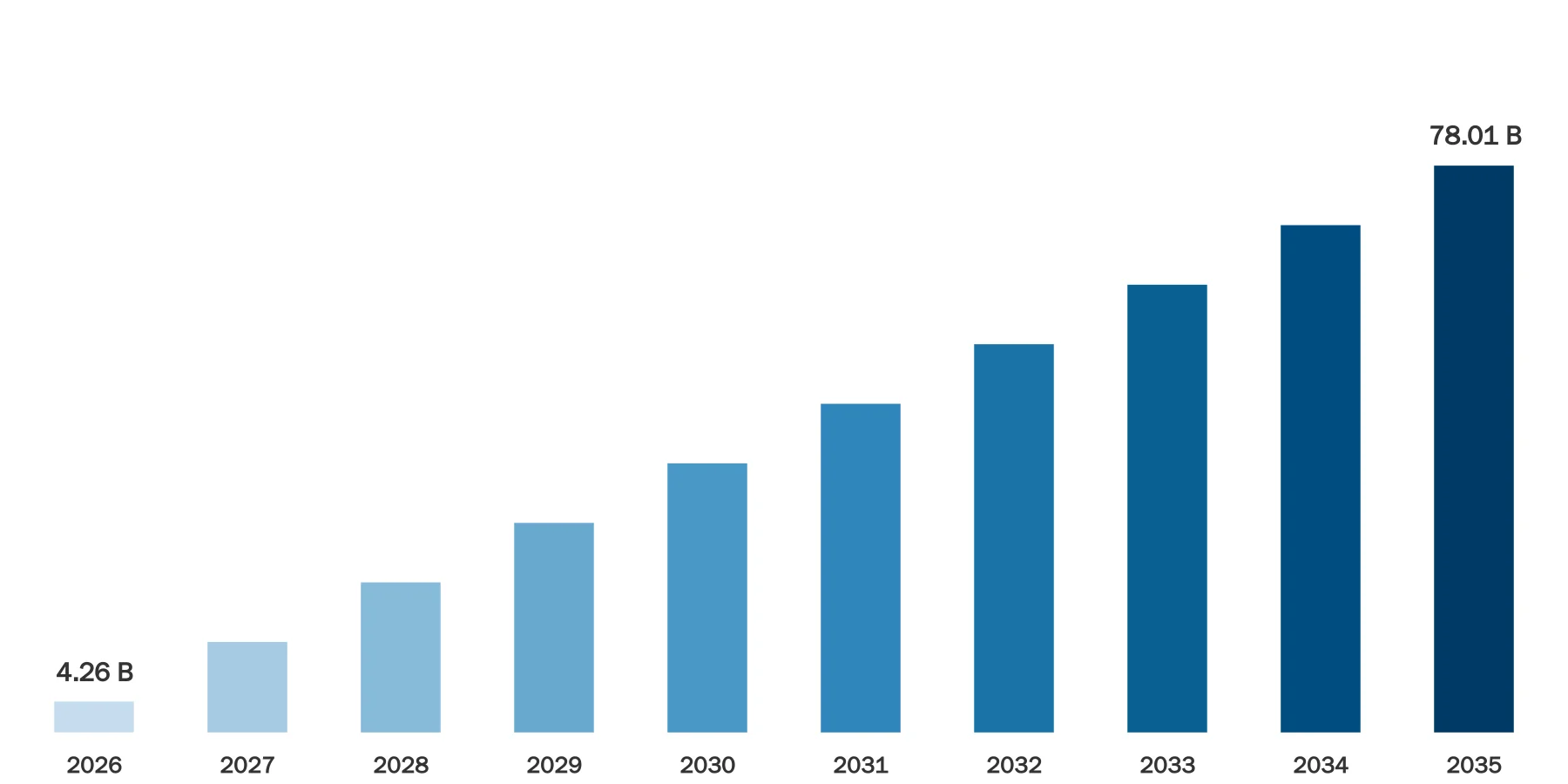
Source: Econ Market Research
The Artificial Intelligence powered Personal AI Assistant Market expanded rapidly during 2024 and 2025 due to increasing integration across smartphones, laptops, smart speakers, enterprise collaboration tools, and connected home ecosystems. More than 1.8 billion users globally interacted with AI-powered assistants in 2025, while over 500 million users engaged with AI assistants daily for scheduling, voice search, customer support, and workflow automation. Around 73% of generative AI users preferred conversational assistants for information retrieval, while 61% of adults in developed digital economies reported regular AI assistant usage. More than 117 AI assistant tools were actively tracked across desktop and mobile ecosystems during 2025, demonstrating strong product diversification and cross-platform adoption.
The USA Personal AI Assistant Market demonstrated strong enterprise and consumer adoption during 2025. Nearly 46% of internet adults in the United States used generative AI tools, compared with 24% during early 2024. Approximately 73% of AI users preferred chatbot-based assistants for productivity tasks, while 26% used integrated AI copilots for workplace automation. More than 69.7 million mobile users accessed AI assistant applications during the first half of 2025, increasing to 73.4 million within 3 months. Around 34% of surveyed consumers were willing to allow AI assistants to make purchasing decisions automatically. Enterprise deployment accelerated as 78% of organizations integrated AI assistants into at least 1 operational function.
The European Personal AI Assistant Market experienced expansion due to multilingual AI adoption, data privacy regulations, and smart home integration. More than 52% of UK consumers accepted AI shopping recommendations during 2025, while 28% expressed willingness to authorize AI-driven purchases under predefined spending limits. Germany, France, Italy, and the UK collectively represented over 60% of regional smart assistant device installations. Approximately 45% of European consumers still preferred human interaction for high-value purchases, highlighting balanced adoption patterns. Voice-enabled smart home device penetration surpassed 35% in Western Europe, while enterprise AI assistant deployment increased across banking, telecommunications, and automotive sectors. GDPR compliance influenced over 70% of AI assistant procurement decisions among European enterprises.
Personal AI Assistant Market Latest Trends
The Personal AI Assistant Market Trends indicate rapid transformation from simple command-response systems toward multimodal and agentic AI platforms. During 2025, mobile AI assistant usage increased by 82% between November 2024 and June 2025, while desktop adoption declined by 11.1%. More than 40% of enterprise applications are expected to include task-specific AI agents by 2026, compared with less than 5% during 2025. AI assistants increasingly support text, voice, image recognition, and contextual memory functions. Advanced assistants now execute multi-step tasks including presentation generation, calendar scheduling, workflow automation, and research summarization.
Smart speaker innovation accelerated with integration of conversational large language models. More than 73% of generative AI users interacted with chatbot-style assistants weekly, while over 33 million users utilized productivity copilots integrated into operating systems and enterprise software. Cross-device synchronization became a critical trend as AI assistants migrated across smartphones, laptops, wearables, automobiles, and smart home ecosystems.
Privacy-focused AI assistants gained traction across Europe and North America. Around 66% of consumers still preferred maintaining manual purchasing control despite increasing trust in AI recommendation systems. AI assistant personalization also became a central trend, with memory-enabled assistants capable of storing long-term user preferences and contextual behavior data. Enterprises increasingly prioritized AI assistants supporting multilingual capabilities, cybersecurity compliance, and workflow integration APIs for scalable deployment across customer service, productivity management, and knowledge automation functions.
Personal AI Assistant Market Dynamics
The Personal AI Assistant Market Analysis demonstrates strong momentum due to rising adoption of conversational AI, increasing smartphone penetration, smart home device expansion, and enterprise automation demand. More than 61% of adults in technologically advanced economies actively use AI tools, while 500 million users engage with AI assistants daily. Cloud computing infrastructure, multimodal AI models, and machine learning advancements improved response accuracy, contextual understanding, and language support. However, cybersecurity risks, hallucination issues, data privacy concerns, and interoperability challenges continue to impact adoption across regulated industries. AI assistants are increasingly used in productivity, virtual assistance, customer support, healthcare triage, financial management, and enterprise collaboration environments.
DRIVER
Increasing Adoption of Conversational AI Across Consumer Devices
The primary growth driver in the Personal AI Assistant Industry Analysis is increasing adoption of conversational AI technologies across smartphones, smart speakers, wearables, and enterprise software platforms. More than 1.8 billion users globally interacted with AI systems during 2025, while approximately 73% of users preferred chatbot-based AI assistants for information retrieval and productivity tasks. Smart speaker installations exceeded hundreds of millions of active devices globally, with voice-enabled assistants becoming integrated into home automation ecosystems, automotive dashboards, and connected appliances.
Mobile AI assistant usage increased by 82% within less than 12 months, highlighting consumer preference for always-accessible AI productivity tools. Around 78% of organizations integrated AI assistants into at least 1 business function, including customer support, scheduling, software development, and content generation. AI assistants improved operational efficiency through automation of repetitive tasks, reducing manual administrative workload by 20% to 40% across several enterprise functions. Multilingual NLP capabilities expanded significantly, supporting more than 100 languages across leading AI assistant platforms.
RESTRAINT
Data Privacy and AI Reliability Concerns
Data privacy concerns remain a major restraint in the Personal AI Assistant Market Outlook. More than 50% of surveyed consumers expressed concern regarding improper handling of personal information by AI assistant platforms. Approximately 28% of users indicated distrust toward enterprise data practices associated with AI systems. Privacy regulations such as GDPR significantly impacted AI assistant deployment strategies in Europe, where more than 70% of procurement decisions included data protection evaluation criteria.
Reliability issues also affected user retention and satisfaction. Generative AI assistants occasionally produced inaccurate recommendations, hallucinated outputs, and inconsistent automation results. Around 45% of consumers still preferred human interaction for complex purchasing decisions and customer service tasks. Smart home AI assistants experienced criticism for inconsistent command execution and interoperability limitations. Several enterprise users reported concerns regarding contextual memory retention, unauthorized access to sensitive business data, and dependency on cloud infrastructure. These limitations slowed adoption in healthcare, banking, and government sectors where regulatory compliance requirements remain strict.
OPPORTUNITY
Expansion of AI Agents in Enterprise Productivity Applications
The strongest opportunity in the Personal AI Assistant Market Forecast involves enterprise productivity automation and intelligent workflow management. More than 40% of enterprise software applications are projected to integrate task-specific AI agents by 2026. AI assistants increasingly support scheduling, coding support, document drafting, meeting summarization, workflow orchestration, and business analytics functions.
Developer-focused AI assistants demonstrated particularly strong adoption. Around 84% of software developers reported using or planning to use AI coding assistants, while 85% regularly utilized AI tools for development tasks. AI copilots improved software development productivity by 88% to 126% in several enterprise environments. Enterprises adopting AI assistants achieved measurable reductions in response times, operational bottlenecks, and repetitive administrative workload.
Personalized AI assistants capable of maintaining contextual memory and cross-platform synchronization are expected to create major opportunities in healthcare monitoring, education technology, enterprise collaboration, legal research, and financial advisory services. AI-enabled voice interfaces also present opportunities for accessibility-focused applications supporting elderly populations and differently abled users.
CHALLENGES
Interoperability and Infrastructure Complexity
The major challenge in the Personal AI Assistant Market Research Report is interoperability across devices, software ecosystems, and enterprise platforms. Many AI assistants operate in closed ecosystems with limited compatibility across competing hardware and software environments. This fragmentation creates integration difficulties for organizations using multiple productivity platforms and connected devices.
Infrastructure complexity also increased due to rising computational requirements associated with multimodal large language models. Advanced AI assistants require high-performance GPUs, cloud computing infrastructure, and low-latency networking environments. Enterprises deploying AI assistants at scale face challenges involving cybersecurity management, API standardization, and data governance.
Consumer trust remains inconsistent because many AI assistants still fail to provide predictable outcomes during complex interactions. Several early adopters reported frustration regarding incomplete automation workflows, contextual misunderstandings, and memory inconsistencies. Smart home ecosystems also faced reliability issues associated with command interpretation variability and device synchronization failures. Regulatory uncertainty related to AI governance, algorithmic transparency, and ethical compliance additionally creates deployment challenges for multinational enterprises operating across different legal jurisdictions.
SWOT Analysis
Strengths
More than 1.8 billion global users interacted with AI assistants during 2025.
Around 61% of adults in developed digital markets actively use AI systems.
Mobile AI assistant adoption increased by 82% between late 2024 and mid-2025.
Over 78% of enterprises integrated AI into at least 1 business operation.
AI copilots improved coding productivity by 88% to 126% in enterprise development environments.
More than 100 languages are supported across major NLP-based assistant platforms.
Weaknesses
Approximately 50% of consumers expressed concerns regarding AI data privacy.
Around 28% of users distrusted enterprise AI data handling practices.
Nearly 45% of consumers still preferred human interaction for complex purchases.
AI hallucination rates and inaccurate recommendations reduced enterprise trust.
Cloud dependency creates latency and uptime risks for real-time AI assistants.
Interoperability limitations exist across smart home and enterprise ecosystems.
Opportunities
More than 40% of enterprise applications are expected to include AI agents by 2026.
Smart home device penetration surpassed 35% in several developed economies.
AI assistants are increasingly integrated into Automotive Infotainment systems.
Multimodal AI enables image, text, and voice interaction within unified platforms.
Enterprise automation demand increased across healthcare, banking, and retail sectors.
Wearable AI assistant integration is expanding across fitness and productivity applications.
Threats
Regulatory frameworks regarding AI transparency are tightening globally.
Cybersecurity attacks targeting AI assistants increased significantly during 2024–2025.
High GPU infrastructure requirements increase operational complexity.
Competition among global AI vendors intensified across consumer and enterprise markets.
Consumer backlash regarding AI surveillance and contextual memory remains significant.
Open-source AI alternatives are intensifying pricing and differentiation pressures.
Segmentation Analysis
The Personal AI Assistant Market Size is segmented by product type, technology, deployment model, and application. Chatbots and smart speakers represent dominant product categories due to strong adoption in customer engagement and smart home environments. NLP technology leads technological deployment because more than 70% of AI assistant interactions involve conversational interfaces. Cloud deployment dominates due to scalability and remote accessibility advantages. Productivity and virtual assistance applications account for a substantial share because enterprises increasingly automate administrative and operational workflows. AI assistant adoption is expanding across healthcare, education, banking, telecommunications, automotive, and e-commerce industries through voice recognition, contextual understanding, and intelligent workflow automation capabilities.
By Type
Chatbots accounted for a leading share of the Personal AI Assistant Market Share during 2025 because of rapid deployment across enterprise customer support, productivity management, and online search interfaces. More than 73% of AI users interacted with chatbot-based assistants regularly. Chatbots became dominant across banking, retail, education, and healthcare sectors due to 24/7 availability and multilingual communication capabilities.
Smart speakers represented another major segment with hundreds of millions of installed units globally. Voice-enabled assistants integrated into smart speakers supported music streaming, home automation, e-commerce, and information retrieval functions. Smart home penetration exceeded 35% in multiple developed economies, boosting smart speaker demand.
The “Others” segment includes wearable assistants, automotive AI copilots, and AI-enabled productivity applications integrated into laptops and smartphones. Mobile AI assistant users surpassed 73 million active users in monitored ecosystems during 2025. Automotive manufacturers increasingly embedded conversational AI into infotainment systems, navigation interfaces, and driver assistance environments. Wearable AI assistants also gained popularity in fitness monitoring and health management applications.
By Technology
Natural Language Processing dominated the Personal AI Assistant Market Insights because conversational interfaces account for most user interactions. More than 70% of AI assistant applications utilize NLP for speech recognition, contextual interpretation, multilingual support, and intent detection. NLP adoption accelerated due to improvements in transformer-based language models capable of processing billions of parameters.
Machine Learning represented another substantial segment due to predictive analytics, personalization, and recommendation capabilities. AI assistants leverage ML algorithms for behavioral analysis, contextual memory, and workflow optimization. Enterprise AI systems increasingly utilize ML to automate repetitive processes and personalize customer experiences. Approximately 78% of enterprises adopted AI-enabled systems within at least 1 operational process.
Text-Based AI maintained significant adoption across enterprise productivity applications, document generation, customer service automation, and coding assistance. More than 84% of developers reported using or planning to use AI coding assistants. Text-based AI tools support email drafting, report generation, research summarization, and workflow automation. Enterprises deploying text-based AI assistants reported productivity improvements ranging between 20% and 40% across administrative operations.
By Deployment Model
Cloud-based deployment represented the dominant segment in the Personal AI Assistant Industry Report because cloud infrastructure enables scalability, continuous updates, and cross-device accessibility. More than 80% of AI assistant deployments rely on cloud-based architectures for large language model processing, contextual synchronization, and multimodal interaction capabilities. Cloud deployment also supports integration across smartphones, smart speakers, laptops, enterprise collaboration tools, and IoT ecosystems.
On-premises deployment maintained relevance in industries requiring strict regulatory compliance and data security controls. Banking, healthcare, government, and defense organizations increasingly adopted on-premises AI assistants to minimize risks associated with cloud data transfer and third-party infrastructure dependency. More than 70% of European enterprises considered privacy regulations a key procurement factor for AI deployments.
Hybrid deployment models are also emerging as enterprises seek a balance between cloud scalability and local data governance. AI assistants supporting edge computing capabilities gained traction for latency-sensitive applications including automotive systems, Industrial Automation, and healthcare monitoring. Localized AI inference also reduced bandwidth dependency and improved response speed in real-time operational environments.
By Application
Productivity applications accounted for a substantial share of the Personal AI Assistant Market Growth because enterprises increasingly automate scheduling, meeting management, document drafting, coding, and analytics tasks. AI copilots are used by millions of professionals for workflow optimization and operational efficiency enhancement.
Customer service represented another major segment as AI assistants manage inquiries, ticket routing, multilingual communication, and chatbot-based customer engagement. AI-driven customer support systems reduced response times significantly while enabling 24/7 availability.
Virtual assistance applications expanded rapidly across smartphones, smart speakers, wearable devices, and connected vehicles. More than 500 million users interacted with AI assistants daily during 2025. Content generation also emerged as a rapidly expanding application area, with AI systems producing reports, presentations, marketing materials, and research summaries.
The “Others” category includes healthcare assistance, educational tutoring, financial advisory automation, and smart home management. AI assistants increasingly support medication reminders, adaptive learning systems, and personalized financial recommendations. Voice-enabled interfaces also improve accessibility for elderly and differently abled populations across healthcare and consumer environments.
Regional Analysis
The Personal AI Assistant Market Outlook varies significantly across regions due to digital infrastructure maturity, smartphone penetration, AI regulation, and enterprise technology adoption. North America leads in enterprise AI deployment and smart assistant integration. Europe emphasizes privacy-compliant AI systems and multilingual support. Asia-Pacific demonstrates rapid adoption driven by smartphone ecosystems and digital commerce growth. Middle East & Africa experiences increasing AI integration across smart cities, telecommunications, and banking applications.
North America
North America accounted for more than 40% of global Personal AI Assistant Market Share during 2025 due to advanced digital infrastructure, high smart device penetration, and strong enterprise AI adoption. The United States remained the largest regional market, with approximately 46% of internet adults using generative AI tools. More than 73% of AI users interacted with chatbot-style assistants, while 26% utilized AI copilots integrated into productivity software.
The region demonstrated strong smart speaker adoption with millions of connected voice-enabled devices installed across households and enterprises. AI assistant integration expanded across banking, healthcare, retail, automotive, and software development sectors. More than 78% of enterprises implemented AI technologies within at least 1 business operation.
Mobile AI assistant usage surpassed 73 million monitored users during 2025, while AI-powered workplace tools became standard across collaboration platforms. North America also led in AI infrastructure investment, GPU deployment, and enterprise cloud integration. The region benefits from high consumer awareness, advanced NLP research capabilities, and extensive integration of AI assistants into operating systems, browsers, and productivity ecosystems.
Europe
Europe represented a major Personal AI Assistant Market Analysis region due to strong demand for privacy-focused AI systems and multilingual assistant deployment. Germany, the UK, France, and Italy collectively accounted for more than 60% of European AI assistant adoption. GDPR regulations significantly shaped market structure, with over 70% of enterprises prioritizing data governance and privacy compliance during AI procurement.
The UK market demonstrated increasing acceptance of AI-powered shopping assistants. More than 52% of surveyed consumers were open to AI-generated recommendations, while 28% allowed AI assistants to make purchases within predefined limits. Smart home adoption also expanded, with voice-enabled device penetration exceeding 35% across several Western European countries.
European enterprises increasingly integrated AI assistants into automotive infotainment systems, banking applications, and customer support platforms. Manufacturing and industrial automation sectors also utilized AI copilots for operational monitoring and workflow optimization. AI adoption in healthcare and education increased steadily, particularly across telemedicine and adaptive learning platforms. Regional demand for localized language support accelerated development of multilingual NLP systems capable of supporting diverse linguistic markets across the continent.
Asia-Pacific
Asia-Pacific emerged as the fastest-expanding region in the Personal AI Assistant Market Research Report due to smartphone penetration, digital commerce growth, and rapid urbanization. China, India, Japan, and South Korea accounted for the majority of regional AI assistant deployments. The region benefited from large mobile-first populations and extensive adoption of AI-integrated messaging, e-commerce, and payment applications.
Chinese technology companies accelerated development of AI chatbots, smart speakers, and multimodal virtual assistants supporting local languages and digital ecosystems. AI-powered assistants increasingly support automated presentation generation, business analytics, and workflow management functions across enterprise environments. Smart device manufacturing capabilities across China, South Korea, and Taiwan strengthened regional supply chains.
India demonstrated strong growth in mobile AI assistant adoption due to increasing internet penetration and smartphone affordability. Educational technology, digital banking, and e-commerce sectors increasingly utilized conversational AI assistants for multilingual customer engagement. Japan and South Korea expanded AI assistant deployment across robotics, automotive systems, and connected home technologies. Asia-Pacific also experienced rising adoption of AI voice assistants integrated into appliances, wearable devices, and smart city infrastructure.
Middle East & Africa
The Middle East & Africa Personal AI Assistant Market experienced steady growth driven by smart city initiatives, telecommunications modernization, and digital banking expansion. Gulf countries accelerated AI adoption through national digital transformation strategies supporting AI-powered government services, smart mobility systems, and enterprise automation.
Smartphone penetration exceeded 70% in several Gulf Cooperation Council economies, supporting increased usage of AI-enabled mobile assistants. Financial institutions increasingly integrated conversational AI into digital banking platforms for customer service automation and fraud monitoring. Telecommunications providers also expanded deployment of AI assistants for multilingual customer engagement across Arabic, English, and regional languages.
South Africa, the UAE, and Saudi Arabia emerged as major regional AI adoption centers due to enterprise cloud investment and smart infrastructure projects. Healthcare organizations utilized AI assistants for appointment scheduling, telemedicine support, and patient engagement. Educational institutions integrated AI tutoring assistants into digital learning environments. Although infrastructure disparities continue across parts of Africa, rising internet penetration and smartphone affordability are expected to support broader AI assistant adoption throughout the region.

Competitive Landscape
The Personal AI Assistant Competitive Landscape is characterized by intense competition among global technology companies, AI startups, cloud providers, and smart device manufacturers. Leading vendors compete through ecosystem integration, multimodal AI capabilities, language support, contextual memory, and enterprise productivity enhancement. More than 117 AI assistant tools were monitored across mobile and desktop ecosystems during 2025, reflecting rapid product diversification.
Major players increasingly focus on integrating AI assistants across smartphones, laptops, enterprise collaboration software, search engines, and smart home ecosystems. Companies are investing heavily in multimodal large language models capable of handling voice, text, image, and workflow automation tasks simultaneously. Personalized contextual memory functions and autonomous task execution emerged as critical differentiation strategies.
Strategic partnerships between AI developers, semiconductor manufacturers, cloud infrastructure providers, and enterprise software vendors intensified during 2024–2025. Several companies launched AI copilots supporting document drafting, coding assistance, workflow automation, and customer engagement functions. Competition also increased in smart speaker ecosystems, where AI assistants increasingly support shopping automation, home control, and conversational search capabilities.
Open-source AI models intensified market competition by lowering entry barriers for startups and enterprise developers. Privacy-focused AI assistants and edge AI deployment also became important competitive differentiators, particularly across Europe and regulated industries.
List of Top Personal AI Assistant Companies
Amazon.com, Inc.
Apple Inc.
Microsoft Corporation
Google
Samsung Electronics
Alibaba Group
Yandex
Naver Corporation
Baidu
Huawei Technologies
Perplexity AI
Uniphore
Leading Companies by Market Share
Amazon.com, Inc. maintained one of the highest market shares in smart speaker and voice assistant ecosystems with hundreds of millions of connected Alexa-enabled devices globally. The company expanded AI assistant integration across shopping, home automation, and enterprise productivity functions during 2025.
Google remained a dominant market participant due to extensive Android ecosystem integration, conversational AI deployment, and smart home expansion. Gemini-based AI assistants gained strong adoption across mobile devices, productivity software, and connected home platforms.
Market Investment Outlook
The Personal AI Assistant Market Opportunities continue expanding as enterprises increase investment in AI infrastructure, multimodal language models, and intelligent automation systems. Organizations are prioritizing AI copilots for productivity enhancement, workflow automation, software development, and customer engagement. More than 78% of enterprises integrated AI technologies into at least 1 operational function during 2025, highlighting strong institutional investment momentum.
Cloud infrastructure providers expanded GPU deployment capacity to support large-scale AI inference and conversational processing. Venture capital investment increased across startups developing agentic AI systems, contextual memory architectures, and industry-specific AI assistants. Smart home ecosystems also attracted substantial investment as companies integrated AI assistants into connected appliances, entertainment systems, and energy management platforms.
Enterprise demand for personalized AI assistants capable of executing multi-step workflows created investment opportunities in cybersecurity, API orchestration, edge computing, and multilingual NLP systems. Healthcare, banking, legal services, and education emerged as high-potential verticals due to increasing demand for digital automation and intelligent customer interaction platforms.
Asia-Pacific attracted growing AI investment because of large mobile-first populations and expanding digital commerce ecosystems. Europe focused investments on privacy-compliant AI assistants, while North America remained dominant in cloud AI infrastructure, AI chips, and enterprise software integration.
New Product Development
The Personal AI Assistant Market Trends increasingly emphasize multimodal functionality, contextual awareness, and autonomous task execution. During 2025, multiple companies launched next-generation AI assistants capable of processing text, voice, image, and workflow interactions simultaneously. AI assistants evolved beyond simple Q&A functions toward proactive digital agents supporting scheduling, purchasing, coding, analytics, and smart home automation.
Memory-enabled AI assistants became a major innovation area. Advanced systems now maintain long-term contextual understanding of user preferences, communication patterns, and workflow behavior. Cross-device synchronization also improved significantly, enabling seamless transitions between smartphones, laptops, smart speakers, wearables, and automobiles.
Voice assistant innovation accelerated through integration of large language models into smart home ecosystems. New AI assistants support complex conversational interactions and multi-command task execution. AI-powered shopping assistants capable of price monitoring, recommendation personalization, and transaction support gained popularity in retail ecosystems.
Enterprise-focused AI copilots expanded capabilities in document drafting, software development, meeting summarization, and workflow orchestration. Coding assistants demonstrated significant productivity improvements for developers, while industry-specific AI assistants emerged across healthcare, legal services, education, and financial advisory sectors. Companies also increased development of privacy-preserving AI assistants supporting localized processing and edge inference to reduce cloud dependency and improve regulatory compliance.
Recent Developments
In 2025, Amazon launched enhanced conversational shopping capabilities for Alexa+, enabling persistent cross-device shopping interactions and AI-powered recommendation workflows.
In 2025, Google introduced Gemini for Home, replacing previous smart home assistant systems with multimodal AI integration supporting advanced conversational interaction and device automation.
In 2025, Alibaba launched a major upgrade to its Qwen chatbot platform with capabilities including automated report generation and PowerPoint presentation creation.
During 2025, mobile AI assistant usage increased by 82% between November 2024 and June 2025, while monitored AI assistant platforms expanded to 117 tools across desktop and mobile ecosystems.
In 2025, enterprise AI adoption reached 78% across at least 1 business function, while more than 500 million global users engaged with AI assistants daily for productivity and workflow automation.
Report Coverage of Personal AI Assistant Market
This Personal AI Assistant Market Report provides detailed analysis of market trends, segmentation, competitive landscape, technological advancements, regional adoption, and enterprise deployment patterns across global markets. The report evaluates adoption across smartphones, smart speakers, enterprise collaboration platforms, wearables, automobiles, and smart home ecosystems. It includes analysis of chatbot deployment, NLP integration, machine learning capabilities, cloud infrastructure adoption, and contextual AI memory systems.
The report examines market performance across North America, Europe, Asia-Pacific, and Middle East & Africa with quantitative insights related to user adoption, enterprise integration, smart device penetration, and AI infrastructure expansion. More than 1.8 billion global users interacted with AI technologies during 2025, while over 61% of adults in developed digital economies actively utilized AI tools.
The report also analyzes deployment models including cloud-based, on-premises, and hybrid architectures. Industry applications assessed include productivity management, customer service automation, content generation, healthcare assistance, educational support, and financial advisory systems. Competitive benchmarking evaluates innovation strategies, ecosystem integration, multilingual support, smart speaker deployment, and enterprise AI assistant capabilities across major global technology vendors.
The scope additionally includes recent developments between 2023 and 2025, investment patterns, regulatory influences, interoperability challenges, cybersecurity considerations, and future opportunities associated with multimodal AI assistants and autonomous digital agents.
Personal AI Assistant Market Report Scope & Segmentation
| Attributes | Details |
|---|---|
Market Size (Current) | US$ 4.26 Billion in 2026 |
Market Size (Forecast) | US$ 78.01 Billion in 2035 |
Growth Rate | CAGR of 38.15% from 2026 to 2035 |
Forecast Period | 2026 – 2035 |
Base Year | 2025 |
Historical Data Available | Yes |
Regional Scope | Global |
Segments Covered | By Product Type
By Technology
By Deployment Model
By Application
|
Frequently Asked Questions
Common questions about this report
The study period covers historical insights and forecast projections for the period 2026-2035.
About the Author
Market research expert with years of industry experience

Related Reports
Explore more market insights from the same category