

Organic Fertilizers Market
Organic Fertilizers Market Size, Share, Trends, Growth, and Industry Analysis, By Source (Plant-based, Animal-based, Mineral-based), By Form (Dry, Liquid), By Crop Type (Cereals andamp; Grains, Fruits andamp; Vegetables, Oilseeds andamp; Pulses), Regional Analysis and Forecast Period 2026-2035
Organic Fertilizers Market Overview
As per Econ Market Research analysis, the Global Organic Fertilizers Market was valued at approximately US$ 15 Billion in 2026 and is predicted to reach US$ 26.1 Billion by 2035, expanding at a CAGR of 7.19% over the forecast duration. The base year is 2025.
Organic Fertilizers Market Size 2025-2035 (USD Billion)

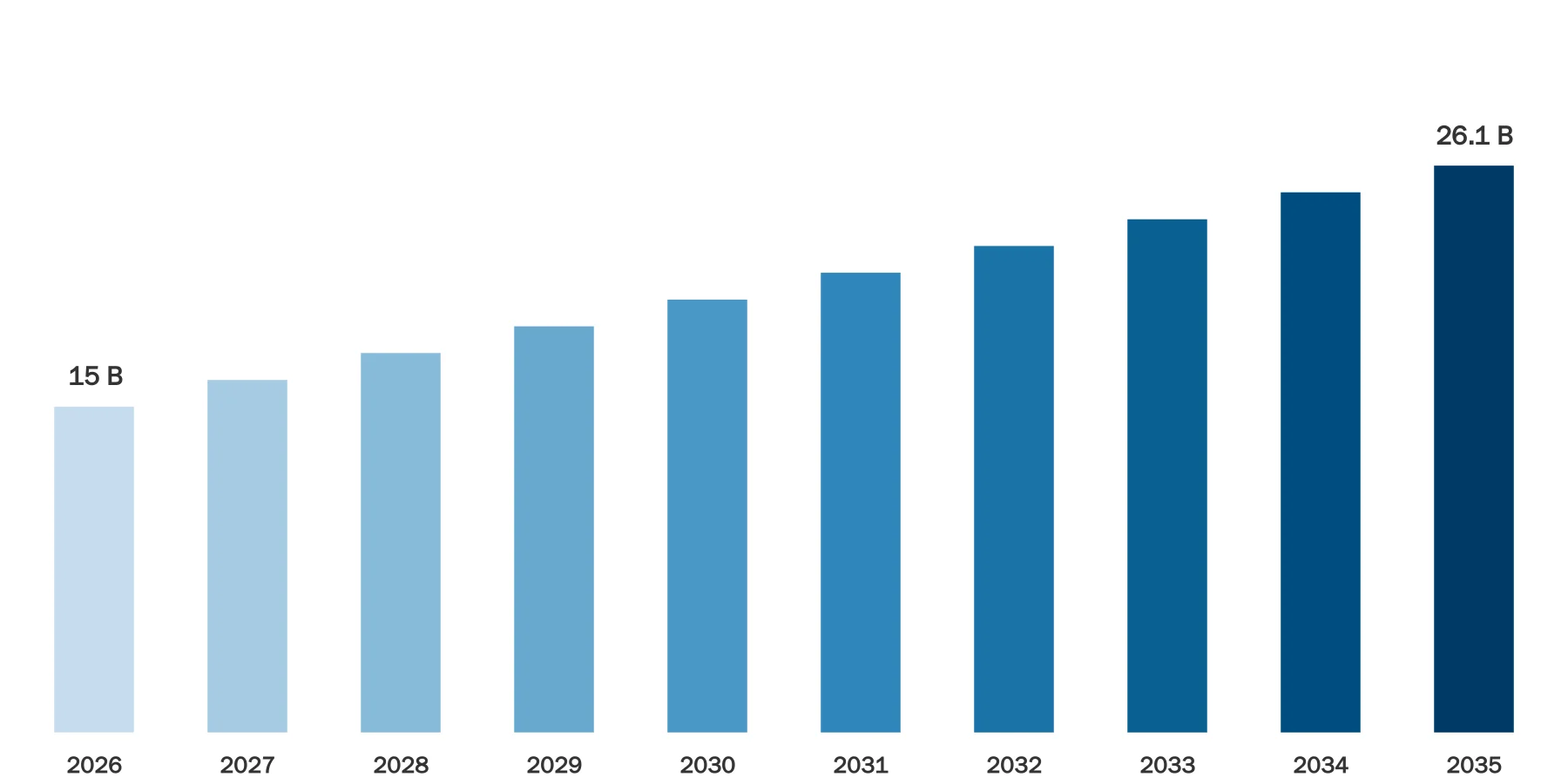
Source: Econ Market Research
Organic fertilizers are derived from natural substances such as animal manure, Compost, bone meal, and plant residues, among others. The market is driven by a growing emphasis on sustainable agricultural practices, increasing awareness about the harmful effects of chemical fertilizers on soil health and the environment, and a rising demand for organic food products worldwide.
In recent years, the organic fertilizers market has witnessed significant growth due to the shift towards organic farming methods, driven by consumer preferences for healthier and environmentally-friendly food options. Governments and regulatory bodies across the globe have also implemented policies and initiatives to promote organic farming practices, further fuelling market growth. Moreover, the increasing adoption of organic fertilizers by conventional farmers as a means to improve soil fertility, enhance crop yields, and reduce dependency on chemical inputs has bolstered market expansion.
Key players in the global organic fertilizers market are investing heavily in research and development activities to develop innovative and technologically advanced organic fertilizers that offer improved nutrient content, enhanced efficacy, and reduced environmental impact. Additionally, strategic collaborations, partnerships, and mergers and acquisitions are prevalent strategies adopted by market players to strengthen their market presence and expand their product portfolios. However, challenges such as high production costs, limited availability of raw materials, and inconsistent quality standards pose significant hurdles to market growth.
Organic Fertilizers Dynamics
One of the primary drivers of market growth is the increasing consumer awareness regarding the health and environmental benefits of organic food products. This heightened consciousness has spurred a shift towards organic farming practices, consequently driving the demand for organic fertilizers. Additionally, stringent regulations imposed by governments and regulatory bodies to minimize the use of synthetic chemicals in agriculture further propel the market expansion, creating a conducive environment for organic fertilizers adoption. Moreover, the market dynamics are influenced by the rising need for sustainable agricultural practices to mitigate environmental degradation and preserve soil health.
Organic fertilizers, derived from natural sources, offer a sustainable alternative to conventional chemical fertilizers, promoting soil fertility, biodiversity, and long-term agricultural sustainability. Technological advancements play a pivotal role in enhancing the efficacy and production efficiency of organic fertilizers, driving innovation and product development in the market. Furthermore, strategic collaborations and partnerships among key industry players facilitate market expansion, fostering research and development initiatives and enhancing distribution networks. High production costs associated with organic fertilizers, limited availability of raw materials, and inconsistent quality standards pose significant hurdles to market growth. Additionally, the lack of standardized regulations and certification processes across regions may hinder market penetration and consumer trust.
Organic Fertilizers Drivers
Growing Consumer Awareness
Increasing consumer awareness regarding the health and environmental benefits of organic food products is a significant driver for the organic fertilizers market. Consumers are becoming more conscious of the potential harmful effects of chemical fertilizers on human health and the environment. This awareness has led to a surge in demand for organic food produced using organic fertilizers. As consumers seek healthier and more sustainable food options, the demand for organic fertilizers continues to rise, driving market growth.
Stringent Regulatory Frameworks
Stringent regulations imposed by governments and regulatory bodies worldwide to reduce the use of synthetic chemicals in agriculture act as a key driver for the organic fertilizers market. Regulations often mandate limits on chemical fertilizers and promote the adoption of organic farming practices. These regulations create a favourable environment for the organic fertilizers market by encouraging farmers to switch to organic fertilizers to comply with standards and regulations. Moreover, government subsidies and incentives for organic farming further stimulate market growth by reducing the financial barriers associated with transitioning to organic fertilizers.
Restraints:
One of the major restraints facing the organic fertilizers market is the high production costs associated with organic fertilizers. Organic fertilizers typically require more resources and labor-intensive processes compared to chemical fertilizers. The production of organic fertilizers often involves sourcing natural materials, composting, and processing, all of which contribute to higher production costs. These elevated costs can limit the affordability and accessibility of organic fertilizers for farmers, hindering market growth.
Limited Raw Material Availability
Another significant restraint for the organic fertilizers market is the limited availability of raw materials used in organic fertilizer production. Organic fertilizers are primarily derived from natural sources such as animal manure, compost, and plant residues. However, the availability of these raw materials can be inconsistent and subject to seasonal variations. Competition for raw materials from other industries, such as Bioenergy and Animal Feed, further exacerbates the challenge of securing a stable supply of raw materials for organic fertilizer production. Limited raw material availability can constrain production capacity and hinder market expansion.
Opportunities:
Technological Advancements:
Technological advancements present significant opportunities for the organic fertilizers market. Innovations in fertilizer manufacturing processes, such as microbial fermentation and enzymatic hydrolysis, hold the potential to improve the efficiency, efficacy, and nutrient content of organic fertilizers. Advanced technologies also enable the development of novel organic fertilizer formulations tailored to specific crop requirements and soil conditions, enhancing their overall performance and efficacy. Investing in research and development to harness technological advancements can drive product innovation and differentiation, enabling organic fertilizer manufacturers to gain a competitive edge and capitalize on emerging market opportunities.
Segment Overview
By Source
In the organic fertilizers market, the segmentation by source includes plant-based, animal-based, and synthetic-based fertilizers. Plant-based organic fertilizers are derived from natural plant materials such as compost and crop residues, providing essential nutrients and enhancing soil fertility sustainably. Animal-based fertilizers, sourced from animal manure and by-products, offer rich nutrient content and contribute to soil health and crop productivity. Synthetic-based organic fertilizers are formulated from organic compounds to mimic natural fertilizers, offering precise nutrient ratios and convenient application methods, catering to the diverse needs of modern agriculture.
By Form
Segmentation by form encompasses dry and liquid organic fertilizers. Dry formulations, available as granules or powders, are convenient for storage, handling, and application, promoting gradual nutrient release and long-term soil fertility. Liquid organic fertilizers, offered as concentrated solutions or suspensions, enable rapid nutrient uptake by plants and versatile application methods such as fertigation and foliar spraying, ensuring efficient nutrient delivery and enhanced crop performance.
By Crop Type
The segmentation by crop type includes cereals &, grains, oilseeds &, pulses, fruits &, vegetables, and other crops. Cereals &, grains benefit from organic fertilizers to improve soil fertility and grain quality sustainably. Oilseeds &, pulses rely on organic fertilizers for root development, nitrogen fixation, and yield enhancement. Fruits &, vegetables require tailored nutrient management for optimal growth, fruiting, and quality, supported by organic fertilizers. Other crops, including specialty herbs, spices, and ornamentals, benefit from organic fertilizers to meet unique nutritional needs and ensure sustainable production practices across diverse cropping systems.
Organic Fertilizers Overview by Region
The organic fertilizers market exhibits a diverse regional landscape shaped by varying agricultural practices, regulatory frameworks, consumer preferences, and economic factors. In North America, the market is driven by a strong emphasis on sustainable agriculture, increasing consumer demand for organic products, and supportive government initiatives promoting organic farming practices.
Europe remains a prominent market for organic fertilizers, buoyed by stringent regulations governing chemical inputs in agriculture, growing organic farming acreage, and rising consumer awareness about environmental sustainability and food safety. In Asia Pacific, rapid urbanization, changing dietary habits, and environmental concerns are driving the adoption of organic fertilizers, particularly in countries like China and India.
The region also witnesses a surge in organic farming initiatives, government subsidies, and technological advancements, fuelling market growth. In Latin America, organic fertilizers gain traction amid growing export markets for organic produce, expanding organic farming certifications, and increasing investments in sustainable agriculture practices. Africa, with its vast agricultural potential and growing population, presents untapped opportunities for organic fertilizers, driven by increasing awareness about soil health, water conservation, and food security.
Organic Fertilizers Market Competitive Landscape
Major players such as The Scotts Miracle-Gro Company, Espoma Company, and Tata Chemicals Limited dominate the market with their extensive product portfolios, strong distribution networks, and significant investments in research and development. These companies focus on product innovation, strategic partnerships, and mergers and acquisitions to strengthen their market presence and expand their geographic reach. Emerging players such as BioStar Organics, California Organic Fertilizers, and Midwestern BioAg are gaining traction in the market with their focus on sustainable farming practices, organic certifications, and eco-friendly product offerings.
Regional manufacturers play a vital role in catering to local market needs, offering customized organic fertilizers tailored to specific crop requirements, soil conditions, and regulatory environments. With increasing consumer demand for organic products and growing awareness about sustainable agriculture practices, competition in the organic fertilizers market is intensifying, driving companies to differentiate through product quality, branding, and environmental stewardship initiatives. The competitive landscape is further influenced by factors such as pricing dynamics, distribution channels, regulatory compliance, and technological advancements, shaping the strategies and market positioning of players across the organic fertilizers industry.
Organic Fertilizers Market Leading Companies:
Yara International
ICL Group
K+S Aktiengesellschaft
The Scotts Company LLC
Coromandel International Limited
Darling Ingredients
Southern Petrochemical Industries Corporation (SPIC)
T. Stanes &, Company Limited
Fertoz
Multiplex Group
TerraLink Horticulture Inc.
Midwestern BioAg Holdings, LLC
Sustå,ne Natural Fertilizer, Inc.
Queensland Organics
California Organic Fertilizers, Inc.
Organic Fertilizers Recent Developments
Dec 2023, Yara revealed its acquisition of Agribios Italiana',s organic-based fertilizer division, marking its second bolt-on acquisition aimed at bolstering its organic strategy within Europe. This move underscores Yara',s dedication to broadening its portfolio in this domain, alongside its mineral fertilizers, with the goal of advancing regenerative agriculture and enhancing soil health.
Oct 2022, ACI Biolife Fertilizer and the Bangladesh Institute of Nuclear Agriculture (BINA) entered into a Memorandum of Understanding (MoU) to collaborate on the development and testing of biofertilizers, specifically focusing on Trichoderma. ACI Fertilizer is establishing a Biofertilizer Lab in Jhikorgacha, Jessore, with assistance from BINA.
Organic Fertilizers Report Segmentation
Organic Fertilizers Market Report Scope & Segmentation
| Attributes | Details |
|---|---|
Market Size (Current) | US$ 15 Billion in 2026 |
Market Size (Forecast) | US$ 26.1 Billion in 2035 |
Growth Rate | CAGR of 7.19% from 2026 to 2035 |
Forecast Period | 2026 – 2035 |
Base Year | 2025 |
Historical Data Available | Yes |
Regional Scope | Global |
Segments Covered | By Source
By Form
By Crop Type
|
Frequently Asked Questions
Common questions about this report
The study period covers historical insights and forecast projections for the period 2026-2035.
About the Author
Market research expert with years of industry experience

Dipali Bhingare serves as the Market Research Director at Econ Market Research. With a focus on translating complex global economic shifts into actionable business intelligence, she oversees the strategic direction of comprehensive market studies. Her work empowers organizations to navigate volatile industries through data-driven forecasting and deep-dive competitive analysis.
Related Reports
Explore more market insights from the same category