Oleochemicals Market Overview
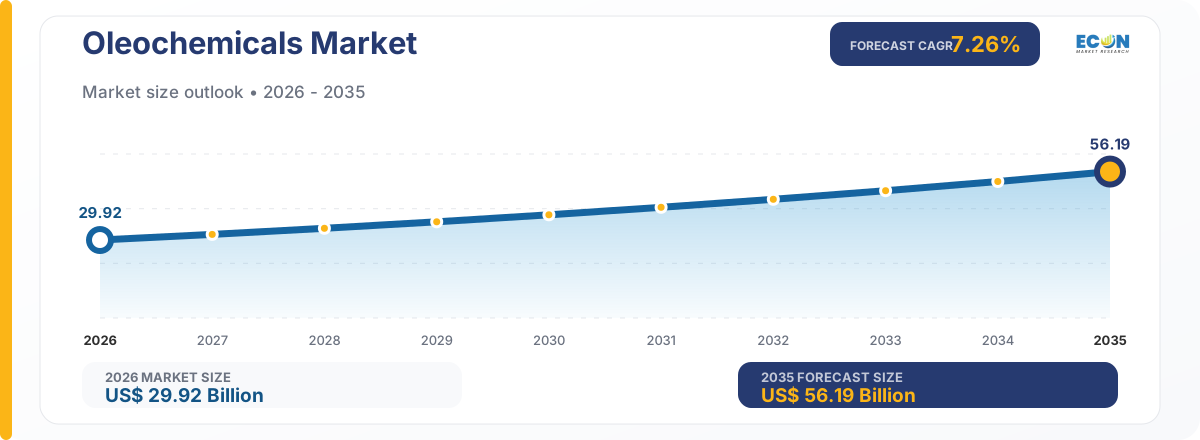
As per Econ Market Research analysis, the Global Oleochemicals Market accounted for US$ 29.92 Billion in 2026 and is expected to surpass US$ 56.19 Billion by 2035, witnessing a CAGR of 7.26% throughout 2026–2035. The analysis is based on 2025 as the base year.
Oleochemicals, including fatty acids, glycerol, and their derivatives, are also widely used in Personal Care, food, pharmaceuticals, and detergents industries. Compared with petrochemical-based products, oleochemical-based products have an easier way to be biodegradable and renewable. Increasing demand for bio-based and sustainable products, more and more people in the world are becoming concerned about synthetic chemicals and their impact on the environment.
It is witnessing increasing demands from the personal care and cosmetics industries, as oleochemicals continue to be consumed in a great many soaps, lotions, shampoos, and other related cosmetic products. Oleochemicals are also used by the food and beverage industry in preparing food products as well as in packaging materials. Added to this, the rising demand for eco-friendly substitutes in industrial applications such as lubricants, paints, and coatings supports the market. As consumers and industries keep continuing in a witch hunt for sustainability, steady growth is expected in the global oleochemicals market in future years due to innovations in renewable resources and new applications.
Dynamic Insights
Increased awareness among consumers and industries regarding being more environmentally conscious is fuelling the shift in preference from petrochemical products to oleochemical ones. Renewable sources such as vegetable oils and animal fats for oleochemicals are biodegradable, have less carbon emissions, and are hence increasingly applied in personal care, food processing, and cleaning products where green formulation is gaining ground. Another critical variable is the alteration in the supply and price of raw material.
The price and supply of vegetable oils, especially the price and supply of palm oil, are important variables that influence oleochemical production. Disruptions in supply chains, environmental issues surrounding the production of palm oil, and changes in agricultural approaches enhance volatility in price and market instability. Such improvements in the production process and substantial investment in research and development in terms of technology will help boost productivity and thereby growth in the oleochemicals market. New applications such as biodegradable plastics and green surfactants are opening up new avenues and expanding the scope of the market into other industries. However, regulatory limitation, such as deforestation or unsourced raw materials, could concern other developing markets and limit future growth.
Drivers Insights
Rising Demand for Sustainable Products:
Increased consumer awareness regarding environmental issues and sustainability has been one of the major drivers for the oleochemicals market. Consumers are increasingly seeking eco-friendly alternatives to replace petrochemical-based products. This trend has made manufacturers engaged in personal care, food, and cleaning products opt for renewable, biodegradable alternatives such as oleochemicals.
For example, in personal care, plant oil-extracted fatty acids are used for the production of soaps, lotions, and shampoos. All this pressure towards Sustainable Packaging and ",green", consumerism means the company needs to market their products as responsible, green solutions. Furthermore, the more bio-based, environmentally friendly chemicals get adopted, the more oleochemicals will be needed in the product lines of companies. This trend will probably be augmented even further.
Government Regulations Supporting Bio-based Products:
Other major drivers for the oleochemicals market are initiatives and regulations by governments that encourage utilization of renewable resources and production by sustainable means. Strict environmental regulation is adopted by most regions by reducing carbon footprints and requiring a considerable percentage of renewable resources in industries.
For example, European Union',s green deal and sustainability plans across Asia pave ways for bio-based chemicals such as oleochemicals alternatives to petroleum-based products. The regulatory policies, supported by rewarding schemes on bio-based production, are facilitating oleochemicals to gain market space as they make it attractive for manufacturers to be environmentally friendly, due to compliance with environmental standards.
Restraints Insights
Raw Material Price Volatility:
Major constraints in the oleochemicals market include price fluctuations of raw materials, such as palm oil, soybean oil, and other vegetable oils, through which materials are used to produce fatty acids and glycerol that embody the core of oleochemical products. In fact, the pricing of these oils may vary, which will often bring turbulence into the marketplace and increase costs of production because of changing weather patterns, agricultural practices, or general demand.
In the case of palm oil, the marketplace faces challenges of deforestation and sustainability, which drive the industry to higher prices and disruptions in the supply chain. This instability may affect the margins for profitability on the part of manufacturers as well as create uneconomic costs for the end-users, thus hampering their growth in terms of sales.
Environmental and Sustainability Concerns Regarding Raw Material Sourcing:
Sourcing raw materials such as palm oil has been under environmental and social concerns due to deforestation, loss of biodiversity, and human rights issues. This means that regulations and public review on industries that used such raw materials are stiffer. For example, multinational consumer goods firms receive pressure to ensure sustainable sourcing of palm oil. These processes escalate the cost of production and integrate more complexity in supply chains, as in the case of Roundtable on Sustainable Palm Oil (RSPO). Such challenges might hinder expansion of the oleochemicals market by raising operation challenges and limiting raw materials access for companies that fail to meet certification standards.
Opportunities Insights
Expansion into New Applications
One of the significant opportunities for the oleochemicals market would be entry into new and emerging applications. In fact, oleochemicals are gradually replacing traditional products in the production of biodegradable plastics, biopolymers, and bio-lubricants. For example, oleochemicals can replace traditional petro-based polyols to produce bio-based polyurethanes used in the automotive and construction industries.
Utilization of oleochemicals in non-chemical applications like food packaging and biodegradable agricultural products will open up the way for growth in several industries. The increased demand for circular economy solutions will create another opportunity for oleochemical products to replace synthetic chemicals in a number of industrial processes.
Segment Analysis
By Type
The oleochemicals market is primarily segmented by type into fatty acids, fatty alcohols, glycerine, and others. Fatty acids, derived from natural oils, are among the most widely used oleochemicals, playing a key role in the production of soaps, detergents, lubricants, and cosmetics. These acids are essential in manufacturing surfactants and are utilized in various industrial applications. Fatty alcohols, which are produced through the reduction of fatty acids, are used in surfactants, emulsifiers, and lubricants.
They are vital in industries such as personal care and home care. Glycerine, another important by-product of the oleochemical industry, is used primarily in the food, pharmaceutical, and cosmetics sectors due to its humectant and moisturizing properties. Other oleochemicals, such as fatty esters, amides, and alcohol ethoxylates, serve niche applications in industries like plastics, paints, and coatings, contributing to the market&rsquo,s diversity.
By Form
Form-wise, the oleochemical market is distinguished between liquid and solid forms. Liquid oleochemicals are most commonly used because they can easily be integrated into any formulation. They are commonly used in soap and detergent formulations, lubricant applications, and personal care products requiring a smooth, workable consistency. Liquid oleochemicals are also used more predominantly in industrial applications, like surfactants, emulsifiers, and solvents.
The oleochemicals in solid form play a critical role in applications where a stable solid consistency is required, such as in soaps, candles, plastics, and coatings. Often, the form of the oleochemical dictates its application and processing, liquids are easier to incorporate into formulations, whereas solids provide stability and structure to final products.
By Application:
Oleochemicals have diverse applications in several industries. In the soap and detergent industries, oleochemicals find a place in surfactant manufacture that cleans by lowering the surface tension. Here, they have an important role in the formulation of cleaning agents that are efficient and yet environment-friendly. Oleochemicals in the plastic industry are used in Biodegradable Polymers and additives to improve the properties of plastics materials and increase the sustainability of these. Oleochemicals are also used in large quantities in the paper industry as emulsifiers and coatings for the improvement of quality and performance of paper products.
In lubricants and rubber, oleochemicals improve the performance and industrial lubricant and rubber products', durability as well by reducing friction and wear in the mechanical systems. Oleochemicals also have many applications in coatings and resins for preparing bio-based coatings that are both environmentally friendly and of superior performance. The oleochemicals are largely used by the personal care industry for ingredients in skin and hair care products because of their moisturizing and emulsifying characteristics.
By Feedstock:
Oleochemicals are derived from various feedstocks, each having distinct characteristics, thereby also affecting the products. Palm oil is the most extensive feedstock for yield and cost-effectiveness and is a major source for fatty acids and glycerine. Other sources, such as soybean oil, are important feedstocks for fatty acids and fatty alcohols, mainly in North America and Europe. Rapeseed oil is also an important feedstock, particularly in Europe, and for a broad array of oleochemical uses-from lubricants to biodiesel. Sunflower oil is somewhat less common but has niche usages, especially in personal care products, as it is mild in nature and possess friendly skin property.
Tallow is utilized in traditional soap making and some other industrial operations, provided by animal fats. Palm kernel oil is the other valuable feedstock by product of palm oil production. It is used in specialty chemicals, such as esters, and surfactants. Coconut oil also finds an application in soaps, cosmetics, and personal care products due to its unique nature. Some feedstocks are employed in niche applications where the specialty chemical properties of each feedstock give an edge, for instance, castor oil and jatropha oil are used, together with other feeds, in some applications like those in the production of particular pharmaceuticals, coatings, and biofuels.
Regional Analysis
Asia-Pacific is the largest market in both production and consumption of oleochemicals. The region boasts an enormous agricultural base, particularly in Indonesia, Malaysia, and India, and all three countries are massive palm oil, soy, and other oil producing countries. This makes Asia-Pacific by far the most important supplier of raw materials in oleochemical production. The rising industrial and consumer demand for eco-friendly products in Asia-Pacific, especially the personal care, food, and detergent industries, has further aided this market increase. In addition, rapid urbanization and high disposable incomes in emerging economies in this region trigger oleochemical-based product demand for daily-use applications.
Expansion in North America is driven by the requirement for renewable, bio-based alternatives for personal care, lubricants, and industrial chemicals. Oleochemicals production is a significant business in the United States, particularly from soybean oil, with a growing interest in green chemistry and sustainable production patterns. Demand in Europe is for strict environmental regulations and movement towards sustainability.
Oleochemicals are being emphasized for reductions in carbon footprints by countries such as Germany, France, and the UK for applications in biodegradable plastics, surfactants, and coatings. Emerging markets, the Middle East and Africa, have rising industrial activities in countries such as Saudi Arabia and South Africa. However, compared with Asia-Pacific and North America, the market is still nascent. Countries in Latin America, including Brazil and Argentina, increasingly serve as sources for feedstocks for palm oil and soy, and biofuels and renewable products have gained ever growing attention to grow the region',s oleochemical market.
Competitive Landscape
The companies that dominate the market are Wilmar International, Cargill, BASF, Godrej Industries, and Emery Oleochemicals. They have established great supply chains and manufacturing facilities across key regions especially in Asia-Pacific, Europe, and North America. Their main strategy will be to diversify their product lines, expand production capacity, and use economies of scale to stay ahead in the game. Companies such as BASF and Cargill are also investing heavily in research and development for new oleochemical products along with process improvements, especially for bio-based and environment-friendly solutions.
Sustainability is the new theme that has grown to be central in competition in the market. The greatest operators now reflect sustainability values, use renewable feedstocks, undertake greener modes of production, and meet the certificates as in RSPO (Roundtable on Sustainable Palm Oil), especially in responding to the burgeoning consumer demand for products that are perceived as green. Such developments can be seen in companies such as Emery Oleochemicals, which promotes sustainability in their mode of production and use of renewable raw materials.
Further mergers and acquisition partnerships are followed to access new markets and enter into new technologies or sources of raw materials. For example, partnerships between suppliers and manufacturers of raw materials in the bio-based chemicals sector assist firms to increase the size of their market share. There are now new regional players and start-ups emerging, most often on niche applications, who rely on innovation to challenge the bigger companies. Regional players tend to concentrate on supplying feedstocks extracted locally and on service of specific regional demand, which gives them a competitive advantage in selected markets.
List of Key Players:
Evonik Industries AG
JNJ Oleochemicals, Incorporated
KLK OLEO
Vantage Specialty Chemicals, Inc.
Oleon NV
Sakamoto Yakuhin Kogyo Co., Ltd.
Cargill, Incorporated
Godrej Industries
Emery Oleochemicals
Corbion N.V
Wilmar International Ltd.
Kao Chemicals Global
Ecogreen Oleochemicals
IOI Corporation Berhad
Evyap
Recent Developments:
In April 2024, Emery Oleochemicals, a leading provider of natural-based specialty chemicals, has enhanced its global product development capabilities with the opening of a cutting-edge application laboratory in Rayong, Thailand. Located within the PTT Technology and Innovation Center, this new facility benefits from a strategic collaboration with one of its key shareholders, PTT Global Chemical Public Company Limited (PTTGC), a major player in Thailand&rsquo,s petrochemical and refining industry.
Global Oleochemicals Report Segmentation
Oleochemicals Market Report Scope & Segmentation
| Attributes | Details |
|---|---|
| Market Size (Current)Current market valuation | US$ 29.92 Billion in 2026 |
| Market Size (Forecast)Projected market valuation | US$ 56.19 Billion in 2035 |
| Growth RateCompound Annual Growth Rate | CAGR of 7.26% from 2026 to 2035 |
| Forecast PeriodAnalysis timeline | 2026 – 2035 |
| Base YearReference year for analysis | 2025 |
| Historical Data AvailablePast market data availability | Yes |
| Regional ScopeGeographical coverage | Global |
| Segments CoveredMarket segments analyzed | By Type
By Application
|
Frequently Asked Questions
Common questions about this report
The study period covers historical insights and forecast projections for the period 2026-2035.
About the Author
Market research expert with years of industry experience

Dipali Bhingare serves as the Market Research Director at Econ Market Research. With a focus on translating complex global economic shifts into actionable business intelligence, she oversees the strategic direction of comprehensive market studies. Her work empowers organizations to navigate volatile industries through data-driven forecasting and deep-dive competitive analysis.