

Marketing Consulting Market
Marketing Consulting Market Size, Share, Trends, Growth, and Industry Analysis, By Service Type (Strategy andamp; Planning, Digital Marketing Consulting, Branding andamp; Advertising, CX/Personalization Consulting, Market Research andamp; Analytics), By Client Size (Large Enterprises, SMEs), By Engagement Model (Project-based, Subscription/Retainer), Regional Analysis and Forecast Period 2026-2035
Marketing Consulting Market Overview
As per Econ Market Research analysis, the Global Marketing Consulting Market was recorded at US$ 36.65 Billion in 2026 and is projected to expand to US$ 54.12 Billion by 2035, registering a CAGR of 4.42% over the forecast period. The base year used is 2025.
Marketing Consulting Market Size 2025-2035 (USD Billion)

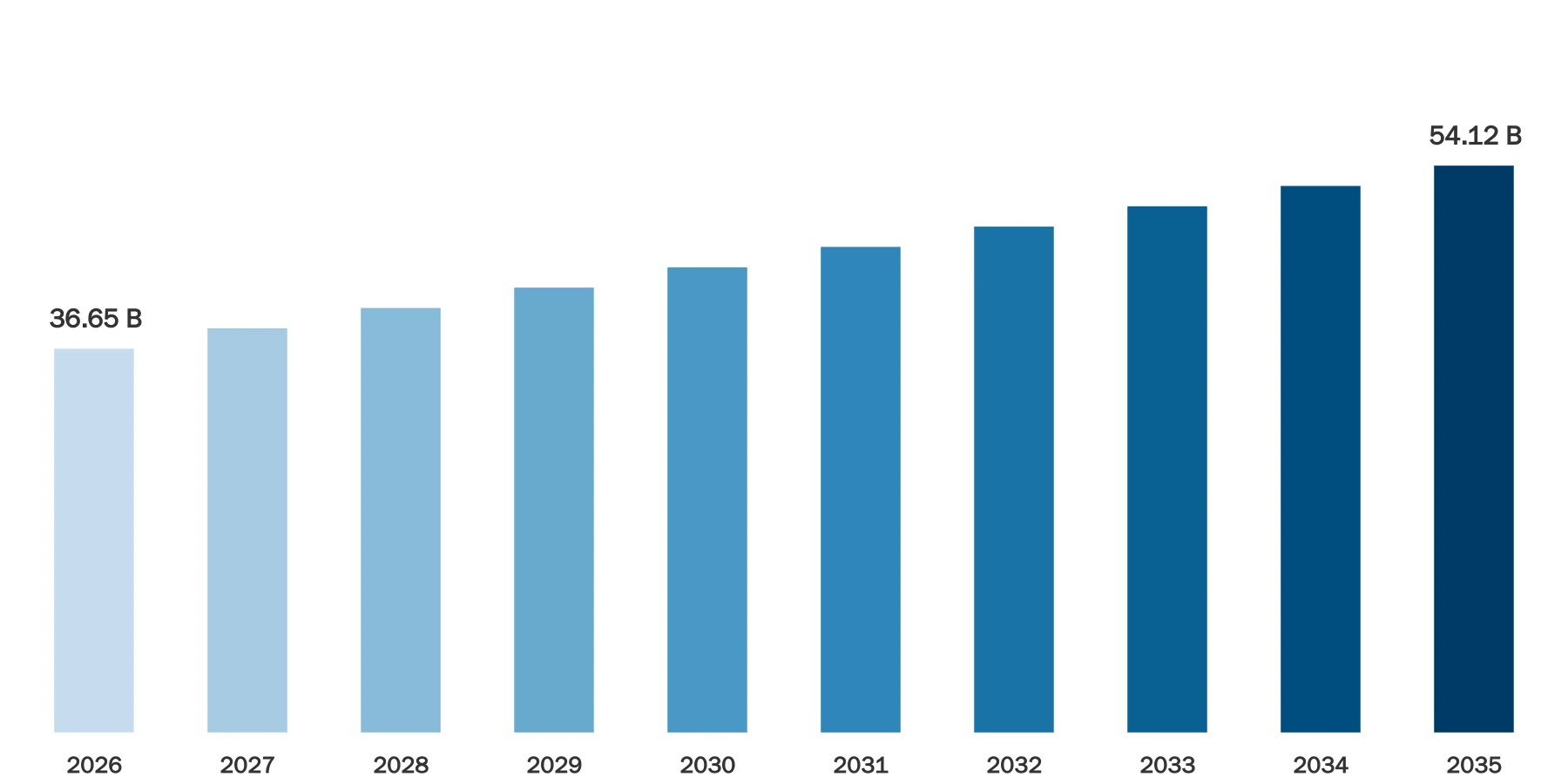
Source: Econ Market Research
The Marketing Consulting market is experiencing rapid transformation due to Artificial Intelligence integration, omnichannel customer engagement, and analytics-driven consulting demand. In 2025, more than 78% of organizations globally used AI in at least one business function, while 71% adopted Generative AI tools across marketing and operational activities. Digital marketing consulting accounted for 31.12% of total service demand in 2025, supported by rising enterprise investment in automation, customer data platforms, and personalization systems. Retail and consumer goods represented 28.24% of total end-user demand, while project-based consulting engagements contributed 54.11% of total contracts. Hybrid consulting delivery models expanded significantly as enterprises reduced travel expenses by nearly 18% between 2023 and 2025.
The United States marketing consulting market remains the largest globally, supported by high enterprise technology adoption and strong digital transformation spending. North America contributed 37.21% of total global market activity in 2025, with the United States accounting for the majority share. More than 87% of enterprises undergoing digital transformation relied on external consultants for strategic guidance, campaign optimization, and AI implementation. Around 42% of B2B marketing budgets were allocated to marketing programs in 2025, compared with 35% for personnel and 23% for technology. More than 200 chief marketing officers surveyed in 2025 indicated that 71% planned annual generative AI investments exceeding USD 10 million over the next three years.
The Europe marketing consulting market is driven by strict data privacy regulations, omnichannel retail growth, and expanding AI adoption among enterprises. More than 70% of organizations across major European economies implemented generative AI in marketing operations by late 2025. Germany, the United Kingdom, and France collectively represented over 58% of consulting demand in Europe due to digital commerce expansion and advanced customer analytics usage. Around 40% of CMOs in Europe coordinated marketing technology budgets jointly with CIOs to strengthen AI-driven personalization strategies. Manufacturing and BFSI sectors contributed strongly to regional consulting demand, with over 62% of enterprises using external consultants for compliance-focused marketing analytics and customer engagement optimization during 2024–2025.
Marketing Consulting Market Latest Trends
The Marketing Consulting market is witnessing substantial changes due to AI-enabled campaign management, predictive analytics, and customer experience optimization. In 2025, nearly 96% of B2B marketers used AI tools within marketing workflows, compared with 84% in 2023. AI spending represented approximately 9% of total marketing budgets in 2026, rising from 7% in 2024. Around 68% of high-performing marketing teams integrated AI into strategic decision-making processes, while 47% of B2B marketers identified AI as the leading trend shaping consulting demand. Video generation, customer personalization, and AI-driven content optimization emerged as top consulting priorities for more than 80% of CMOs globally.
Another major trend involves hybrid consulting engagement models. On-site consulting maintained 52.86% market share in 2025, but hybrid delivery frameworks expanded rapidly because enterprises reduced operational expenses by integrating virtual workshops and AI-enabled collaboration systems. Approximately 23% of enterprises scaled agentic AI systems across at least one business function during 2025, while 39% experimented with AI agents for campaign management and analytics reporting. Personalized B2B account-based marketing campaigns generated conversion rate improvements ranging between 15% and 25% within two quarters across multiple enterprise deployments. Customer experience consulting also expanded due to declining digital advertising efficiency and rising demand for first-party data strategies.
Marketing Consulting Market Dynamics
The Marketing Consulting market is shaped by increasing AI adoption, rising demand for customer personalization, and expanding digital commerce activities. Around 78% of enterprises globally used AI technologies in 2025, while 54% of executives stated that companies unable to scale AI implementation before 2030 could lose competitiveness. Digital marketing consulting retained more than 31% market share because enterprises increasingly outsourced analytics, automation, and omnichannel campaign management. Retail, BFSI, and healthcare sectors collectively contributed more than 55% of consulting demand due to customer acquisition pressure, compliance requirements, and digital engagement expansion.
DRIVER
Increasing Demand for AI-Driven Marketing Transformation
The primary growth driver in the Marketing Consulting market is increasing enterprise demand for AI-driven transformation strategies. In 2025, 71% of firms adopted generative AI across at least one operational function, compared with 55% in the previous year. More than 80% of CMOs expressed optimism regarding AI-enabled marketing outcomes, while 71% planned annual investments exceeding USD 10 million in generative AI systems. Marketing and sales AI adoption increased from 27% to 36% within six months during 2024. Enterprises implementing AI-driven account-based marketing strategies reported 125% higher audience reach and 41% stronger engagement across buying committees. AI-supported consulting also reduced campaign analysis time by nearly 55%, enabling faster strategic execution.
RESTRAINT
Data Privacy Regulations and Budget Constraints
Strict data privacy regulations and fluctuating enterprise marketing budgets remain significant restraints for the Marketing Consulting market. Around 40% of marketing leaders reported limited control over martech budgets, creating delays in consulting project approvals and digital transformation initiatives. Approximately 18% of marketing executives strongly believed their organizations successfully personalized customer interactions using AI technologies. The increasing complexity of GDPR compliance, first-party Data Governance, and consent management has increased consulting implementation timelines by 20% to 30% in several European projects. Additionally, more than 80% of organizations reported no measurable enterprise-wide EBIT impact from generative AI despite widespread adoption, creating skepticism regarding long-term consulting investments among mid-sized enterprises.
OPPORTUNITY
Expansion of Predictive Analytics and Personalization Consulting
Predictive analytics and hyper-personalization services provide major opportunities for the Marketing Consulting market. Around 1 in 4 B2B buyers used AI platforms as their primary source for vendor research in 2026, increasing demand for AI-optimized content and omnichannel customer engagement strategies. Personalized AI campaigns improved conversion rates between 15% and 25% within two quarters in enterprise implementations. More than 32% of enterprises reported advanced AI maturity, while 45% identified AI-powered marketing tools as top-three budget priorities in 2026. Customer experience consulting is also expanding rapidly because enterprises seek integrated solutions combining CRM analytics, behavioral insights, and predictive engagement systems across digital commerce platforms and mobile ecosystems.
CHALLENGES
Talent Gaps and AI Integration Complexity
The largest challenge in the Marketing Consulting market is the shortage of advanced AI and analytics talent. Only 32% of B2B marketers rated their AI expertise as highly advanced in 2026, while merely 38% of CMOs expressed strong confidence in AI-related strategic skills. Consulting firms face increasing pressure to retrain employees because AI integration requires technical, analytical, and customer strategy capabilities simultaneously. Tool fragmentation also creates operational inefficiencies, costing typical 20-person marketing teams more than USD 300,000 annually in productivity losses. Additionally, enterprises reported declining attention spans and reduced focus durations averaging only 13 minutes per session after AI adoption, increasing the complexity of campaign optimization and customer engagement measurement.
SWOT Analysis
Strengths
Digital marketing consulting represented 31.12% of total service demand in 2025 due to strong enterprise adoption of AI-driven campaign management.
Around 87% of enterprises undergoing digital transformation relied on external consultants for strategic implementation support.
North America accounted for 37.21% of global market activity due to advanced technology adoption and mature consulting ecosystems.
More than 78% of organizations globally integrated AI into at least one business function during 2025, increasing consulting demand.
Weaknesses
Only 18% of marketing leaders strongly believed their organizations effectively personalized customer interactions using AI.
Approximately 32% of marketers rated their AI expertise as highly advanced, indicating significant workforce skill shortages.
Over 80% of organizations reported no measurable enterprise-wide EBIT impact from generative AI adoption.
Tool fragmentation generated productivity losses exceeding USD 300,000 annually for mid-sized marketing teams.
Opportunities
Around 71% of CMOs planned annual generative AI investments exceeding USD 10 million during the next three years.
Personalized campaigns increased conversion rates by 15% to 25% across enterprise marketing projects.
Asia-Pacific emerged as the fastest-growing consulting region due to expanding digital commerce adoption.
More than 45% of enterprises identified AI-powered marketing tools among their top-three investment priorities in 2026.
Threats
Increasing GDPR and privacy compliance requirements expanded consulting implementation timelines by 20% to 30%.
AI-generated search results reduced traditional SEO click-through rates despite stable rankings.
Nearly 70% of marketing leaders believed agentic AI would transform marketing, yet only 7% observed measurable effectiveness gains.
AI-driven automation is restructuring consulting teams, reducing demand for traditional manual consulting activities.
Segmentation Analysis
The Marketing Consulting market is segmented by service, end-user industry, client size, and engagement model. Digital marketing consulting and analytics services dominate due to increasing enterprise focus on customer acquisition optimization and AI integration. Retail, BFSI, and technology sectors account for substantial consulting demand because digital engagement channels expanded by over 40% globally between 2023 and 2025. Large enterprises remain the primary client category with more than 58% market participation, while subscription-based consulting models are growing because organizations require continuous optimization, compliance monitoring, and campaign performance tracking.
By Service
Digital marketing consulting held 31.12% market share in 2025 due to increasing enterprise demand for SEO optimization, automation systems, AI-powered content strategies, and omnichannel campaign management. Branding and advertising consulting maintained strong adoption because over 68% of high-performing marketing teams integrated AI into strategic decision-making workflows. Market research and analytics consulting expanded as enterprises processed large customer datasets and predictive analytics systems.
Customer experience consulting gained momentum because more than 1 in 4 B2B buyers used AI-driven platforms for vendor evaluation in 2026. Strategy and planning services remained critical among BFSI and healthcare organizations where compliance-focused marketing transformation projects increased by over 25% during 2024–2025. Hybrid consulting delivery models further strengthened service diversification across global markets.
By End-User Industry
Retail and consumer goods represented 28.24% of total consulting demand in 2025 because enterprises accelerated social commerce, omnichannel personalization, and loyalty analytics initiatives. Technology and media companies increased consulting adoption due to rising AI content deployment and customer acquisition competition. BFSI organizations relied heavily on consulting firms for compliance-based marketing analytics and customer engagement frameworks. Healthcare companies expanded consulting partnerships to improve patient engagement and digital communication systems, while manufacturing firms integrated predictive analytics and automation within distribution-focused marketing strategies. IT and telecommunications sectors increased spending on customer retention consulting because mobile user engagement rates declined by nearly 12% globally between 2023 and 2025. These developments strengthened demand for data-driven consulting services across industry verticals.
By Client Size
Large enterprises accounted for 58.53% of total market demand in 2025 due to extensive digital transformation initiatives, AI integration projects, and global omnichannel operations. Medium-sized enterprises increased consulting adoption because AI-powered marketing tools became more accessible through cloud-based subscription models. Small and micro enterprises expanded consulting partnerships for SEO optimization, customer analytics, and social media automation as digital competition intensified. Around 45% of B2B organizations identified AI-powered marketing systems among their top investment priorities in 2026, encouraging smaller businesses to outsource advanced analytics capabilities. Medium-sized enterprises also reported conversion improvements between 15% and 25% after implementing AI-driven personalization consulting strategies, particularly within e-commerce and software sectors.
By Engagement Model
Project-based consulting retained 54.11% market share in 2025 because enterprises preferred clearly defined deliverables, campaign audits, and analytics implementation projects. Subscription and retainer models expanded rapidly as organizations required continuous support for AI optimization, compliance monitoring, and omnichannel campaign performance tracking. Hybrid consulting frameworks combining virtual workshops and periodic on-site collaboration reduced operational expenses by nearly 18% between 2023 and 2025.
Outcome-based consulting models also gained traction as enterprises increasingly linked consultant compensation with customer acquisition performance, engagement metrics, and lead generation efficiency. Continuous digital commerce expansion and increasing demand for predictive analytics services strengthened long-term consulting agreements among BFSI, retail, and healthcare enterprises globally.
Regional Analysis
Global consulting demand remains concentrated in North America and Europe, while Asia-Pacific demonstrates the fastest expansion due to rising digital commerce adoption and AI integration. Retail, BFSI, healthcare, and technology sectors collectively represent more than 60% of regional consulting demand. Hybrid delivery models and predictive analytics services continue reshaping consulting operations across all regions.
North America
North America accounted for 37.21% of global marketing consulting activity in 2025 due to advanced enterprise digitization and strong AI adoption. The United States represented the largest share within the region because more than 87% of enterprises relied on external consultants during digital transformation projects. Around 71% of CMOs planned annual generative AI investments exceeding USD 10 million, strengthening consulting demand across retail, BFSI, and healthcare sectors. AI adoption in marketing and sales increased from 27% to 36% within six months during 2024, accelerating demand for predictive analytics and customer experience consulting. Large enterprises represented more than 60% of consulting engagements in North America because multinational corporations expanded omnichannel marketing and personalization initiatives.
Europe
Europe remains a significant market due to strong regulatory frameworks, customer data governance requirements, and expanding AI integration. Germany, France, and the United Kingdom collectively represented over 58% of regional consulting demand during 2025. More than 70% of organizations across Europe integrated generative AI into marketing operations, while approximately 40% of marketing leaders coordinated technology investments jointly with CIOs. Retail and manufacturing industries accounted for nearly 45% of European consulting demand because enterprises increasingly focused on digital commerce optimization and first-party data strategies. Privacy regulations and GDPR compliance also increased demand for analytics consulting and consent management services, extending consulting implementation timelines by 20% to 30% across several enterprise projects.
Asia-Pacific
Asia-Pacific is the fastest-expanding regional market due to rapid e-commerce growth, mobile internet penetration, and AI-driven customer engagement strategies. China, India, Japan, and South Korea collectively contributed more than 65% of regional consulting demand. Mobile commerce transactions increased by over 35% between 2023 and 2025, creating strong demand for digital marketing consulting and analytics services. More than 50% of regional enterprises increased investments in AI-driven personalization and customer experience optimization. Retail and technology industries dominated consulting adoption because enterprises competed aggressively across digital marketplaces and social commerce channels. Additionally, SMEs in Asia-Pacific increasingly outsourced marketing analytics and campaign automation due to lower cloud technology costs and rising online customer acquisition competition.
Middle East & Africa
The Middle East & Africa market is expanding steadily because governments and enterprises are accelerating digital transformation initiatives. United Arab Emirates and Saudi Arabia represented more than 55% of regional consulting activity during 2025 due to smart city projects and AI-focused economic diversification strategies. Telecommunications and BFSI sectors accounted for over 40% of regional consulting demand because organizations increased investment in customer engagement analytics and omnichannel communication systems. Around 48% of enterprises in the Gulf region implemented AI-powered marketing automation during 2024–2025. African markets also experienced rising consulting demand as internet penetration exceeded 43% across multiple economies and mobile commerce transactions increased significantly. Digital branding, social media strategy, and performance analytics consulting remained key growth segments throughout the region.

Competitive Landscape
The Marketing Consulting market remains highly competitive, with multinational consulting firms strengthening AI capabilities, analytics services, and digital transformation expertise. Leading firms increasingly invest in AI infrastructure, customer analytics platforms, and cloud-based consulting tools to improve operational efficiency and campaign performance. More than 40% of consulting revenues among major global firms are linked to AI and technology services. Around 4,000 consultants within one major global advisory company were involved in advanced automation and AI coding projects during 2025. Workforce restructuring also intensified because firms reduced manual consulting roles while expanding technical hiring across AI engineering, predictive analytics, and customer data management functions. Large consulting firms collectively employed hundreds of thousands of professionals globally, with several organizations retraining over 50% of staff in generative AI systems between 2024 and 2026. Competitive differentiation increasingly depends on AI integration capabilities, customer personalization expertise, omnichannel campaign optimization, and industry-specific consulting specialization.
List of Top Marketing Consulting Companies
Accenture
Deloitte
McKinsey & Company
Boston Consulting Group
Bain & Company
PwC
EY
KPMG
Publicis Sapient
Capgemini
Leading Companies by Market Share
Accenture and Deloitte remain among the leading companies by market share due to extensive AI consulting capabilities, global enterprise partnerships, and large-scale digital transformation operations. Accenture employed nearly 800,000 professionals globally in 2025 and significantly expanded AI-focused consulting services. Deloitte maintained one of the largest enterprise consulting networks with strong adoption across BFSI, healthcare, and technology sectors. Both companies invested heavily in AI retraining, predictive analytics systems, and customer experience consulting frameworks between 2023 and 2025.
Market Investment Outlook
Investment activity in the Marketing Consulting market is increasing due to AI integration, omnichannel customer engagement, and enterprise digital transformation initiatives. Around 71% of CMOs planned annual investments exceeding USD 10 million in generative AI systems over the next three years. Technology consulting spending exceeded USD 400 billion globally in 2025, reflecting growing enterprise dependence on external advisors for AI implementation, cloud migration, and customer analytics optimization. Approximately 45% of B2B enterprises ranked AI-powered marketing tools among their top-three investment priorities in 2026. Consulting firms also increased investments in proprietary martech stacks, predictive analytics systems, and AI-enabled customer engagement platforms. Workforce expansion in AI engineering and data science accelerated because consulting organizations sought to strengthen automation and analytics capabilities. Hybrid consulting delivery frameworks further attracted investment because enterprises reduced operational expenses by integrating virtual collaboration systems with on-site advisory services. Retail, BFSI, healthcare, and telecommunications sectors remain major investment hotspots due to increasing competition for digital customer acquisition and retention optimization.
New Product Development
Innovation in the Marketing Consulting market is increasingly focused on AI-driven analytics platforms, predictive customer engagement systems, and automation-enabled campaign management solutions. More than 100 internal AI applications and 1,000 AI agents were deployed by one major consulting company during 2025 to optimize strategic advisory operations. AI-powered customer segmentation tools improved personalization efficiency by over 40% across several enterprise deployments. Video generation systems, conversational AI assistants, and agentic AI platforms emerged as major consulting innovation categories between 2024 and 2026. Around 23% of enterprises globally scaled AI agents in at least one operational function during 2025, while 39% actively experimented with autonomous campaign optimization systems. Consulting firms also launched AI-enabled dashboards integrating social media analytics, customer sentiment analysis, and predictive sales forecasting into unified reporting environments. Cloud-based subscription consulting platforms expanded rapidly because SMEs increasingly required affordable access to enterprise-grade analytics, SEO optimization, and omnichannel marketing systems.
Recent Developments
In 2025, Boston Consulting Group reported a 25% increase in AI-related business activity, while AI and technology services represented more than 40% of company operations.
In 2025, EY deployed more than 100 internal AI applications and over 1,000 AI agents to strengthen consulting automation and enterprise AI advisory services.
In 2025, nearly 70% of marketing leaders identified agentic AI as transformational for future marketing operations, while 7 in 10 organizations integrated generative AI into marketing workflows.
In 2025, AI adoption among organizations increased to 78%, compared with 55% one year earlier, driving significant expansion in predictive analytics and customer experience consulting services.
In 2025, project-based consulting engagements retained 54.11% market share, while hybrid consulting delivery models expanded due to increased enterprise preference for virtual collaboration and cost optimization.
Report Coverage of Marketing Consulting Market
The Marketing Consulting market report provides detailed analysis of service categories, engagement models, client size segmentation, regional performance, competitive positioning, and emerging technology trends. The report evaluates digital marketing consulting, branding, analytics, customer experience consulting, and strategic advisory services across major industries including retail, BFSI, healthcare, manufacturing, and telecommunications. More than 31.12% of market activity originated from digital marketing consulting services in 2025, while large enterprises accounted for 58.53% of total demand. Regional analysis covers North America, Europe, Asia-Pacific, and Middle East & Africa with detailed insights regarding AI adoption, omnichannel transformation, and customer analytics integration. The report also examines AI implementation trends, predictive analytics adoption, hybrid consulting delivery models, and enterprise personalization strategies. Competitive analysis includes multinational consulting firms, AI-focused advisory providers, and specialized analytics companies operating across global markets. Market insights additionally focus on customer engagement optimization, SEO transformation, compliance consulting, AI-powered campaign management, and evolving B2B purchasing behavior between 2023 and 2026.
Marketing Consulting Market Report Scope & Segmentation
| Attributes | Details |
|---|---|
Market Size (Current) | US$ 36.65 Billion in 2026 |
Market Size (Forecast) | US$ 54.12 Billion in 2035 |
Growth Rate | CAGR of 4.42% from 2026 to 2035 |
Forecast Period | 2026 – 2035 |
Base Year | 2025 |
Historical Data Available | Yes |
Regional Scope | Global |
Segments Covered | By Service Type
By Client Size
By Engagement Model
|
Frequently Asked Questions
Common questions about this report
The study period covers historical insights and forecast projections for the period 2026-2035.
About the Author
Market research expert with years of industry experience

Dipali Bhingare serves as the Market Research Director at Econ Market Research. With a focus on translating complex global economic shifts into actionable business intelligence, she oversees the strategic direction of comprehensive market studies. Her work empowers organizations to navigate volatile industries through data-driven forecasting and deep-dive competitive analysis.
Related Reports
Explore more market insights from the same category