

Life Science Analytics Market
Life Science Analytics Market Size, Share, Trends, Growth, and Industry Analysis, By Type (Descriptive Analytics, Predictive Analytics, Prescriptive Analytics), By End-User (Pharmaceutical andamp; Biotechnology Companies, Medical Device Companies, Research Centers), Regional Analysis and Forecast Period 2026-2035
Life Science Analytics Market Overview
As per Econ Market Research analysis, the Global Life Science Analytics Market was valued at US$ 15 Billion in 2026 and is expected to reach US$ 39.79 Billion by 2035, registering a CAGR of 11.45% during the forecast period 2026–2035. The base year considered is 2025.
Life Science Analytics Market Size 2025-2035 (USD Billion)

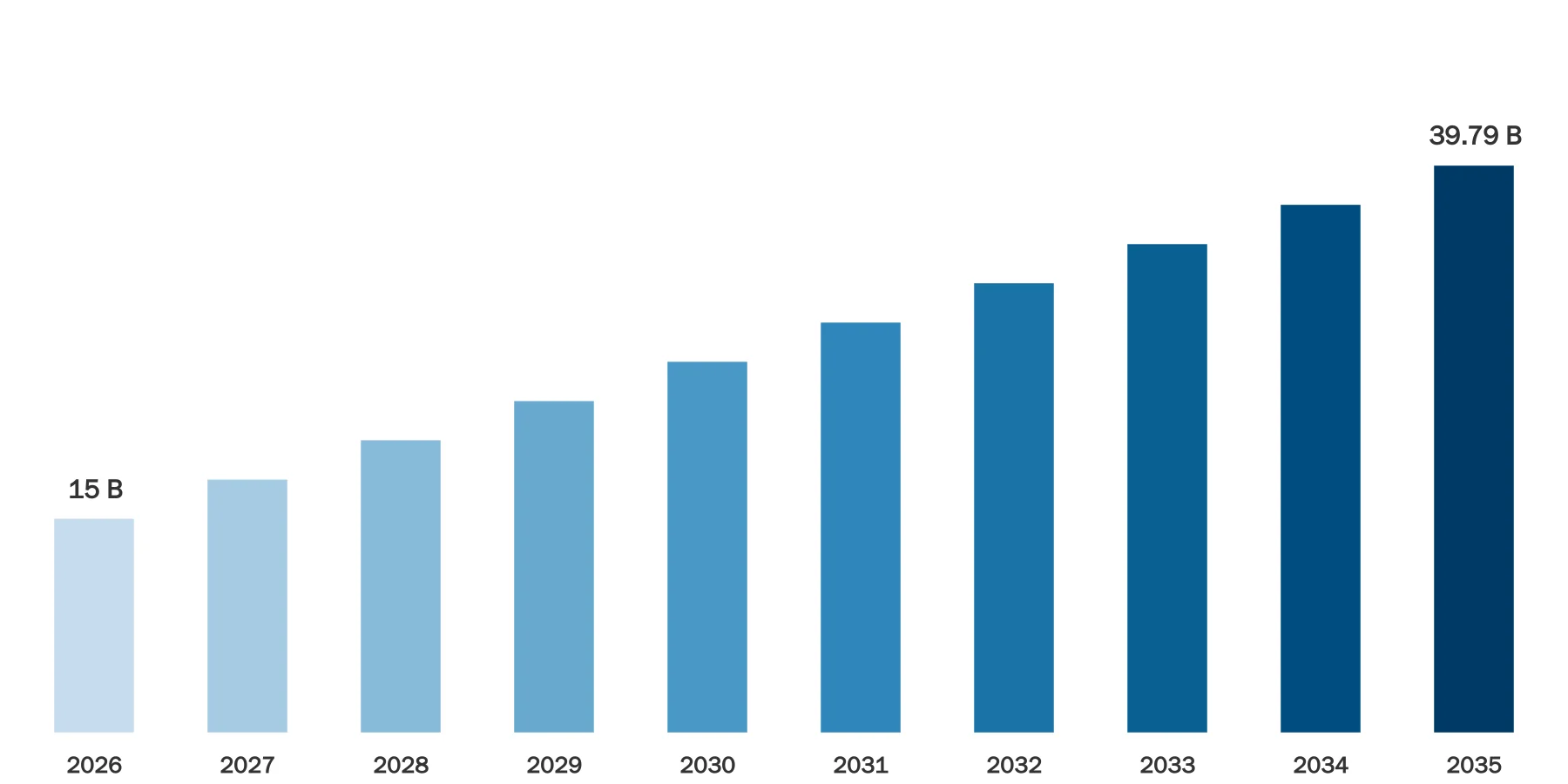
Source: Econ Market Research
Life science analytics includes the sectors of health care, pharmaceuticals, biotechnology, and medical devices. Analytics in life science allow organizations to slice through complex data, make better decisions about problems at hand, and improve the outcome of their discoveries and patient cares. This involves collecting, interpreting, and visualizing data by using complex software and tool that would identify trends, patterns, and insights.
The life science analytics market has experienced significant growth as driven by the increasing volume of data in healthcare and life science industries, along with the pressure on organizations to improve efficiency operations in making more accurate clinical decisions. Some of the prime drivers include high demand for personalized medicine, growth in the genomics, adoption of EHRs, and the need to speed up the development process for drugs.
This is further applied for various applications in clinical trials, research and development, patient monitoring, and predictive analytics. In such a scenario, the increasing demand of data-driven insights in the healthcare systems that are on the way to more digital transformation essentially makes life science analytics critical to the development of the industry.
Dynamic Insights
Rapid growth in digital health technologies, such as EHRs, wearable devices, and mobile health apps, have created an enormous amount of data that must be processed and analysed. The growing volume of data, in combination with the imperative to enhance patient outcomes, is compelling healthcare providers and pharmaceutical companies to implement analytics solutions for actionable insights. Moreover, personalization of medicine, precision healthcare, among other factors are setting the demand for data analytics and tailoring treatment approaches for each patient.
In addition to those advantages, a few disadvantages follow, among them some are data privacy concerns and regulation barriers related to collecting, storing, and sharing personal health information. Security and regulatory compliance of data will be the most challenging issue for organizations working in the area, ensuring security and full compliance with HIPAA and GDPR.
Additionally, in this industry, there is a scarcity of professionals who have experience in managing and analyzing large datasets, it might be a growth-limiting factor for the market. The life science analytics market notwithstanding challenges, there are significant opportunities, especially in the integration of Artificial Intelligence and machine learning technologies. Technology innovations have resulted in the improvement of accuracy in prediction, optimization in clinical trials, and enhanced discovery of drugs. This has presented a new avenue for growth.
Drivers Insights
Increasing Volume of Healthcare Data
The exponential growth of healthcare data, driven by advancements in digital health technologies like Electronic Health Records (EHRs), wearable devices, and health apps, is a major driver for the life science analytics market. As healthcare providers and pharmaceutical companies increasingly adopt digital solutions, vast amounts of data are being generated, including patient health records, diagnostic results, and treatment histories.
The ability to analyse this data allows organizations to identify trends, improve clinical decision-making, and personalize patient care. Life science analytics tools enable the extraction of meaningful insights from this complex data, improving operational efficiency and patient outcomes. As healthcare systems and organizations aim to leverage these large datasets, the demand for life science analytics solutions is growing, pushing the market forward.
Focus on Personalized Medicine and Precision Healthcare
There is the emerging global trend of personalized medicine in which prescription or treatment is targeted to individual characteristics whether in terms of genetics, lifestyle, or environmental aspects. This shift is critical for life science analytics because it enables health practitioners to decipher genetic data and patient history in order to deliver treatment plans tailored to fit individuals.
Analysing genetic sequences, biomarkers, and clinical data helps analytics solutions predict which patients will respond well to their treatment. Through analytics, the drug development process becomes optimized by minimizing side effects on the patients. This is why more and more using data analytics for drug discovery and clinical trials are-this is what is driving the growth of the life science analytics market.
Restraints Insights
Data Privacy and Security Concerns
Handling sensitive health care data is one of the major restraints for the life science analytics market. With the growth in data, healthcare providers are finding it difficult to protect and keep patient information safe. Regulatory compliance on data protection, such as the Health Insurance Portability and Accountability Act in the United States and General Data Protection Regulation in Europe, sets the highest benchmarks with regard to protection of data.
Organizations would have to be highly invested in secured storage and encryption technologies to prevent a data breach, which will cost them dearly and an organization',s reputation. Data misuse or unauthorized access yet again deters healthcare organizations from fully pursuing analytics solutions, thus limiting the growth of the market.
Lack of Skilled Workforce
Another major constraint is the lack of sufficient professionals with needed competencies to successfully handle and analyse the rapidly increasing volumes of healthcare data. Analytics in the life sciences requires data scientists, bioinformaticians, and health analysts with skills in various areas of machine learning (ML), AI, and big data. Such skilled workforce, however, remains severely lacking worldwide. This gap in the workforce may prevent analytics solutions from being correctly adopted and utilized-that is problematic in small and medium-sized healthcare institutions where there is little to no capability to sustain world-class talent. The shortcoming creates significant obstacles in scaling life science analytics operations across the industry.
Opportunities Insights
Integration of Artificial Intelligence (AI) and Machine Learning (ML)
The integration of AI and ML in life science analytics is a potential market growth opportunity. It can bring much more advanced data analysis, predictive modelling, and automation of many complex processes. For instance, AI can be of great help in studying patient records, medical imaging, and genetic data, by which patterns may be easily unravelled and predicted outcomes much better than the traditional method. AI and ML algorithms can identify candidates for drugs and accelerate R&,D processes. With such technologies in development, incorporating them into the life science analytics platform opens opportunities for improvements of clinical trials optimization of healthcare increase productivity and reduce costs hence increase market size.
Segment Analysis
By Type
The Type segment in the life science analytics market includes Descriptive Analytics, Predictive Analytics, Prescriptive Analytics, Diagnostic Analytics, and Discovery Analytics. These analytics types are used to process large sets of healthcare and life science data to derive valuable insights. Descriptive Analytics helps summarize historical data to understand trends and outcomes, while Predictive Analytics uses statistical models and machine learning to forecast future trends and behaviors, which is particularly useful in clinical trials and drug development.
Prescriptive Analytics goes a step further by providing recommendations for optimal decisions, often used in patient care management and clinical decision-making. Diagnostic Analytics helps in identifying the causes of specific outcomes or events, aiding in the identification of disease patterns or treatment responses.
By Component
The Component Type segment is further divided into Services and Software. Services, under the life science analytics market, refer to Professional Services offered for the implementation, integration, and maintenance of analytics solutions like consulting, training, and system integration. Such services are very important for the effective exploitation of life science analytics platforms and solutions.
By contrast, software includes the actual tools and platforms used for data analysis, like analytics software specialized in managing large datasets, running statistical models, and report generation. This segment is rising fast because of the increasing demand from the health and life sciences industries for more advanced data analysis capabilities that will enable better clinical decisions and operational efficiencies.
By Delivery Model
The Delivery Model category consists of two subcategories: On-premise models, and On-demand models. In on-premise models, the organization will actually set up life science analytics solutions in their own data centers or other IT infrastructure. This model provides greater control of data security and compliance but typically requires huge initial investments in hardware and IT staff.
On-demand models typically offered through cloud platforms offer a flexible, scalable, and cost-effective approach to data analytics. Cloud-based solutions have all the prospects of easy access to data, collaboration across various stakeholders, as well as reducing infrastructure costs. All of these attract smaller organizations and even those without much resource availability. As a matter of fact, the advent of cloud computing has pushed the adoption of on-demand models significantly. It provides analytics solutions that are better to use and more cost-effective.
By Application
The Application segment includes the following use cases: Research &, Development (R&,D), Preclinical Trials, Clinical Trials, Sales &, Marketing, Regulatory Compliance, Supply Chain Optimization, and Pharmacovigilance. The analytics in life science for drug research and development helps in in-depth data analysis for faster discovery of new drugs and their related therapies.
Analytics support preclinical and clinical trials by optimising the patient selection, designing trials, and monitoring to arrive at faster and more accurate outcomes. Analytics in Sales &, Marketing Enables optimizing product position and targeting. It ensures regulatory compliance-for-the system to be in accordance with industry standards and regulations. Analytics is also applied in Supply Chain Optimization where inefficiencies are found and logistics are improved.
By End User
The major end-users of life science analytics fall into the category of Pharmaceutical &, Biotechnology Companies, Medical Device Companies, Research Centers, and Third-party Administrators. The most important end-users are pharmaceutical &, biotechnology companies, relying on life science analytics for drug discovery, clinical trials, and patient data management. Advanced analytics also helps these firms optimize R&,D processes and improve product development timelines.
Other firms dealing with medical equipment apply analytics in testing of products, tracking compliance to regulations, and marketplace performance. Research institutions use analytics to deliver scientific discoveries, particularly on genetics, genomics, and diseases. Third-party administrators of health and insurance firms utilize analytics in claims processing, detection of fraud, and enhancing patient care management towards improved outcomes and cost-efficiency in healthcare delivery.
Regional Analysis
North America holds the largest share of the market, primarily due to the well-established healthcare infrastructure, strong presence of key players, and continuous advancements in healthcare technologies. The United States, in particular, benefits from robust government initiatives aimed at enhancing healthcare delivery through digital solutions, as well as a high rate of investment in research and development. The region&rsquo,s increasing focus on personalized medicine, precision healthcare, and clinical trials further fuels the demand for life science analytics.
Europe is also one of the large markets for life science analytics, driven by the aged population, the strength of the pharmaceutical sector, and an increasing importance given to healthcare efficiency and patient safety. The European Union',s regulations, such as GDPR and EudraLex, ensure the adoption of data analytics in healthcare organizations with adequate privacy and compliance.
Increasing biotechnology companies in Germany, France, and the UK are also pushing the growth of the market. Asia Pacific is moving at a very brisk clip with market growth bolstered by increased healthcare expenditure, development in healthcare infrastructure, and heightened awareness of how data analytics becomes a boon in clinical and research setups. Amongst countries, China, India, and Japan are spending heavily on digital health programs, biotechnology, and clinical research, thus fuelling analytics demand in the region.
Latin America and Middle East &, Africa are emerging markets for life science analytics, with gradual adoption of analytics technologies. There is an increasing demand for data-driven healthcare and research solutions in these regions to overcome issues such as care quality improvement, supply chain optimization, and patient safety.
Competitive Landscape
Some of the major players in the market are IBM Corporation, SAS Institute, Oracle Corporation, Wipro Limited, Accenture, and Tata Consultancy Services amongst others. These companies hold a significant share of the market due to the different analytics solutions that they offer for application across various applications in drug discovery, clinical trials, personalized medicine, and patient care management.
They apply the most modern technologies, such as AI and ML, to bring key value additions to the capabilities of their life science analytics. For instance, IBM',s Watson Health utilizes AI in order to empower healthcare organizations to analyze vast, complex medical data which should contribute to better clinical decision-making and outcomes for patients. Something similar, SAS is providing advanced analytics software as well as solutions that are commonly used in clinical research and pharmaceutical development.
Along with the leaders in the market, many small companies also came up in the market focusing on niche sectors such as precision medicine, regulatory compliance, and pharmacovigilance. Veeva Systems, Cerner Corporation, and Medidata Solutions companies are becoming very popular in the market due to customized solutions required for the specific unique life sciences organization that they cater to, and their core areas of focus are the upgradation of user experience, cloud-based solutions, and compliance with global regulatory standards.
There is a very recent increase in competition, with the advent of cloud-based analytics platforms that help health care providers as well as pharmaceutical companies use data insights in more cost-effective and flexible ways. Partnerships, collaborations, and mergers become pretty common because the companies are looking to expand their capabilities and market reach.
List of Key Players:
Wipro
IBM Corporation
Optum
Cognizant
Microsoft
Accenture
MaxisIT
Cerner Corporation
IQVIA
Allscripts Healthcare Solutions
Cotiviti
SAS Institute Inc.
Oracle Corporation
Infosys Limited
SCIO Health Analytics
Recent Developments:
In March 2024, Cognizant partnered with NVIDIA to utilize the BioNeMo generative AI platform, aiming to speed up drug discovery and enhance productivity while reducing development costs in the life sciences sector.
April 2024, IQVIA, a prominent global provider of data, analytics, technology, and services to the life sciences sector, has announced an expanded global strategic partnership with Salesforce the leading AI-powered CRM. This collaboration aims to accelerate the development of Salesforce&rsquo,s Life Sciences Cloud, an advanced customer engagement platform designed for the global life sciences industry.
Global Life Science Analytics Report Segmentation
Life Science Analytics Market Report Scope & Segmentation
| Attributes | Details |
|---|---|
Market Size (Current) | US$ 15 Billion in 2026 |
Market Size (Forecast) | US$ 39.79 Billion in 2035 |
Growth Rate | CAGR of 11.45% from 2026 to 2035 |
Forecast Period | 2026 – 2035 |
Base Year | 2025 |
Historical Data Available | Yes |
Regional Scope | Global |
Segments Covered | By Type
By End-User
|
Frequently Asked Questions
Common questions about this report
The study period covers historical insights and forecast projections for the period 2026-2035.
About the Author
Market research expert with years of industry experience

Dipali Bhingare serves as the Market Research Director at Econ Market Research. With a focus on translating complex global economic shifts into actionable business intelligence, she oversees the strategic direction of comprehensive market studies. Her work empowers organizations to navigate volatile industries through data-driven forecasting and deep-dive competitive analysis.
Related Reports
Explore more market insights from the same category