

Laser Micromachining Market
Laser Micromachining Market Size, Share, Trends, Growth, and Industry Analysis, By Type (IR Laser, Green Laser, UV Laser, CO2 Laser), By Process (Laser Micro Drilling, Laser Micro Cutting, Laser Micro Milling, Laser Micro Marking), By Application (Electronics andamp; Semiconductors, Medical, Automotive, Industrial), Regional Analysis and Forecast Period 2026-2035
Market Overview
As per Econ Market Research analysis, the Global Laser Micromachining Market was estimated at US$ 0.36 Billion in 2026 and is forecast to attain US$ 0.61 Billion by 2035, expanding at a CAGR of 5.8% between 2026 and 2035. The base year for the study is 2025.
Laser Micromachining Market Size 2025-2035 (USD Billion)

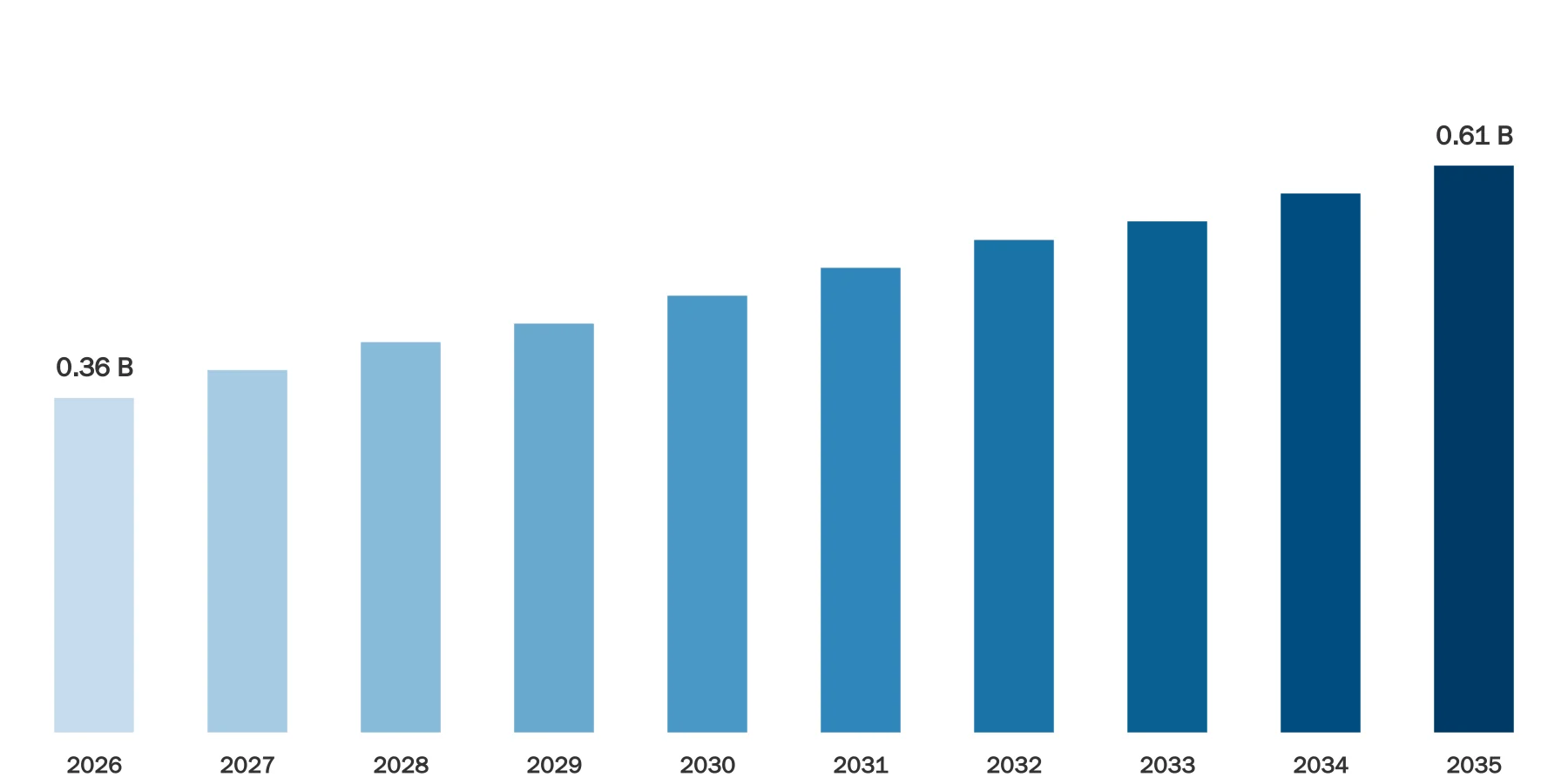
Source: Econ Market Research
The increasing adoption of precision manufacturing techniques by various industries is leading to a notable growth in the global laser micromachining market. Using concentrated laser beams, materials can be precisely cut, drilled, or engraved at the microscale level through the process of laser micromachining. In sectors where complex and tiny components are required, like electronics, Medical Devices, automotive, and aerospace, this process is critical. The market',s growth has been driven by the need for miniaturisation and improvements in laser technology. Unmatched accuracy, minimal material waste, and versatility in handling a variety of materials, such as metals, polymers, ceramics, and composites, are all provided by laser micromachining.
Laser Micromachining Dynamics
Improvements in beam delivery systems and the creation of ultrafast lasers are examples of how technological developments in laser systems are improving the accuracy and productivity of micromachining operations. One of the main forces driving manufacturers to use laser micromachining is the growing need for smaller components in sectors like electronics and medical devices. This is because laser micromachining can accomplish complex designs at the microscale. Furthermore, the market is being helped by the growing trend of Additive Manufacturing, since this industry relies heavily on laser micromachining to create complex structures.
The automotive and aerospace sectors, which use laser micromachining to create lightweight, high-performance components, are further driving market expansion. Entry barriers, however, include things like expensive initial setup costs and the requirement for experienced operators. Furthermore, safety standards and regulatory compliance are major factors that influence the market environment. The market is becoming more competitive, which encourages ongoing innovation and the release of new laser micromachining products.
Laser Micromachining Drivers
Increasing Demand for Miniaturization
The demand for increasingly complex and smaller components in sectors like electronics and medical devices is a major factor propelling the laser micromachining market. Due to its unmatched precision in producing complex features at the microscale, manufacturers are turning to laser micromachining as consumer electronics, medical implants, and microelectromechanical systems (MEMS) become more common. This pattern is driving the market',s expansion by encouraging the use of laser micromachining in a variety of industries.
Technological Advancements in Laser Systems
Relentless progress in laser technology, such as the creation of ultrafast lasers and enhanced beam delivery mechanisms, is propelling the effectiveness and potential of laser micromachining procedures. The precision, speed, and versatility of laser micromachining are improved by these technological advancements, making it a more appealing and practical option for industries that need precise micro-level machining. The market is expected to grow steadily as laser systems continue to advance, providing increased power, shorter pulse durations, and better control. This is because laser micromachining is finding more and more applications.
Restraints:
The high upfront costs of purchasing and setting up cutting-edge laser systems are one of the main obstacles preventing laser micromachining from being widely used. The equipment needed, such as laser sources and precision control systems, can require a sizable capital investment. This is a hindrance, particularly for small and medium-sized businesses (SMEs), who might find it difficult to afford to invest in the advanced infrastructure needed for laser micromachining.
Skilled Operator Requirements
An additional impediment to the laser micromachining industry is the requirement for proficient operators capable of efficiently programming and managing intricate laser systems. Because micromachining is so complex, it requires a high degree of expertise to optimise process parameters and guarantee quality results. The adoption of laser micromachining technologies may be hampered by the lack of qualified workers in this area, which would restrict the market',s potential for growth.
Opportunities:
Rising Adoption of Additive Manufacturing
The market for laser micromachining has a lot of potential due to the growing use of additive manufacturing, or 3D printing. In additive manufacturing processes, laser micromachining is essential because it makes it possible to create complex structures and fine details in 3D-printed components. Laser micromachining will likely become more in demand as a complementary technology as additive manufacturing continues to gain traction across industries, creating new opportunities for market expansion.
Segment Overview
By Process
The laser micromachining market is categorized into two primary processes: Additive and Subtractive. In Additive processes, materials are built up layer by layer to create three-dimensional structures. This is particularly significant in the context of 3D printing and additive manufacturing, where laser micromachining plays a crucial role in achieving precision in creating intricate details. On the other hand, Subtractive processes involve the removal of material through cutting, drilling, or engraving, resulting in the desired shape or structure. Both Additive and Subtractive processes contribute to the market',s versatility, catering to diverse manufacturing needs across various industries.
By Application
Laser micromachining has a wide range of applications in precision processes. Among these uses are milling, drilling, and cutting&mdash,all essential processes in the production of micro-scale parts. While scribing is necessary to create fine lines or grooves, marking and engraving are useful for adding identifiers or decorative details to products. Surface modifications are involved in texturing and patterning, and complex geometries require structuring. Furthermore, gratings and other specialised applications fall under the others category. The variety of uses highlights how flexible laser micromachining is, making it an adaptable option for meeting a wide range of manufacturing needs in a variety of industries.
By End Users
The end-users of laser micromachining span various industries, reflecting the technology',s broad applicability. In the automotive sector, laser micromachining is employed for manufacturing intricate components crucial for enhancing vehicle performance. Aerospace and defence industries leverage laser micromachining for lightweight materials and precision components. In the medical and pharmaceutical field, it is utilized for manufacturing medical devices and implants with high precision.
Electronic products benefit from laser micromachining for creating micro-scale features, while optoelectronics and photonics industries use it for crafting precise optical components. The ",Others", category encompasses additional industries that recognize the value of laser micromachining in achieving precision and miniaturization. The segmentation by end-users emphasizes the widespread adoption of laser micromachining across diverse sectors, contributing to its continuous market growth.
Laser Micromachining Overview by Region
North America stands as a prominent player, driven by the strong presence of key industries, particularly in the United States. The region experiences significant demand for laser micromachining in aerospace, automotive, and medical sectors, fuelled by a continuous emphasis on technological innovation and precision manufacturing. Government initiatives supporting research and development further contribute to the market',s growth in North America.
The demand for laser micromachining in Asia-Pacific is driven by the region',s fast industrialization as well as the growing electronics and automotive industries. The market is progressing due to the adoption of advanced manufacturing technologies by leading nations like China, Japan, and South Korea. The Asia-Pacific laser micromachining market is growing as a result of the region',s emphasis on developing into a manufacturing hub and rising R&,D spending.
Europe is a major player in the laser micromachining market thanks to its robust manufacturing sector, especially in the automotive and aerospace industries. Nations such as the United Kingdom and Germany are key players in promoting innovation and technology uptake. Because of the region',s well-established infrastructure, laser micromachining solutions are integrated across a variety of industries.
Laser Micromachining Market Competitive Landscape
Prominent companies such as Trumpf, Rofin-Sinar, Universal Laser Systems, and Trotec Laser are at the forefront of technological advancements, consistently introducing cutting-edge laser micromachining solutions. These industry leaders are actively involved in research and development activities to enhance the precision, speed, and versatility of their laser systems, catering to the evolving demands of various industries.
Additionally, strategic collaborations, partnerships, and acquisitions are prevalent in the market, as companies seek to expand their product portfolios and market reach. The pursuit of mergers and acquisitions allows companies to integrate complementary technologies, strengthen their market position, and offer comprehensive solutions to a diverse customer base. Moreover, the competitive landscape is characterized by a continual emphasis on product differentiation and customization to meet specific industry requirements.
Laser Micromachining Market Leading Companies:
Coherent, Inc.
GF Machining Solutions
IPG Photonics Corporation
3D-Micromac AG
Lumentum Operations LLC
MKS Instruments, Inc.
Trumpf
Laser Micromachining Recent Developments
Dec 2023, 3D-Micromac AG, a prominent player in laser micromachining and roll-to-roll laser systems for the semiconductor, photovoltaic, glass, and display sectors, revealed its collaboration through a joint-development partnership (JDP) with SCHOTT. SCHOTT, an innovative global technology group and pioneer in specialty glass, aims to enhance the processing capabilities of its RealView high refractive index wafers. These wafers are integral in the production of waveguides for advanced augmented reality (AR) and mixed reality (MR) headsets.
Nov 2023, RPMC Lasers Inc, North America',s premier laser distributor, is thrilled to unveil an exclusive distribution partnership with Fluence Technology. This collaboration enables RPMC to present a comprehensive selection of all-fiber, ultrafast, femtosecond fiber lasers, oscillators, and cutting-edge laser pulse characterization devices from Fluence Technology. Renowned for their expertise in ultrafast fiber laser production, Fluence Technology has pioneered an exceptional all-fiber technology, guaranteeing unparalleled stability, resilience to environmental conditions, and maintenance-free operation. This breakthrough technology is ideal for advanced micromachining and various other high-demand applications.
Global Laser Micromachining Report Segmentation
Laser Micromachining Market Report Scope & Segmentation
| Attributes | Details |
|---|---|
Market Size (Current) | US$ 0.36 Billion in 2026 |
Market Size (Forecast) | US$ 0.61 Billion in 2035 |
Growth Rate | CAGR of 5.8% from 2026 to 2035 |
Forecast Period | 2026 – 2035 |
Base Year | 2025 |
Historical Data Available | Yes |
Regional Scope | Global |
Segments Covered | By Type
By Process
By Application
|
Frequently Asked Questions
Common questions about this report
The study period covers historical insights and forecast projections for the period 2026-2035.
About the Author
Market research expert with years of industry experience

Related Reports
Explore more market insights from the same category