Investment Banking Market Overview
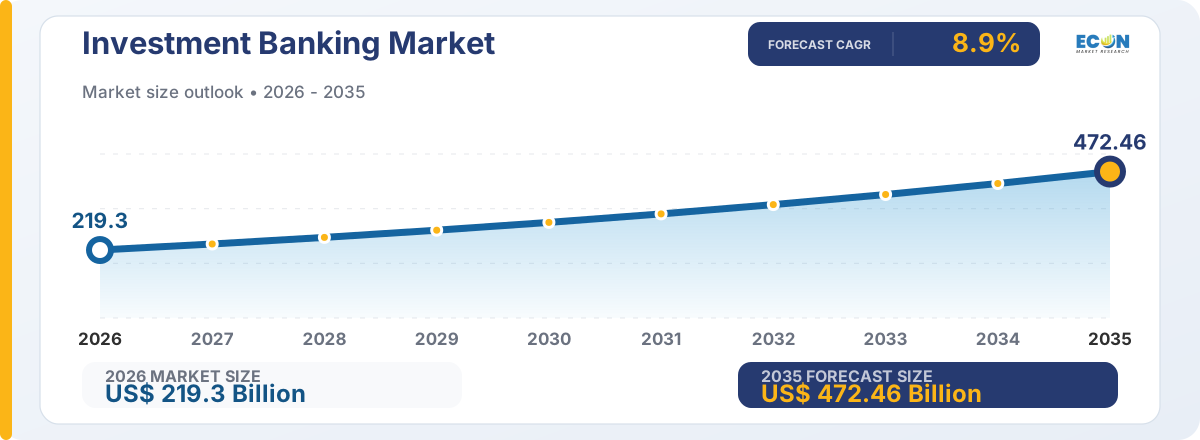
As per Econ Market Research analysis, the Global Investment Banking Market was valued at approximately US$ 219.3 Billion in 2026 and is predicted to reach US$ 472.46 Billion by 2035, expanding at a CAGR of 8.9% over the forecast duration. The base year is 2025.
Investment banks provide a range of services. These include underwriting newly issued debt and equity securities, advising on mergers and acquisitions, providing advice, and making markets. Such a market is an integral part of the financial system because it brings together the investor with the business entity in need of finance or provides strategic advice on issues of finance.
The investment banking industry has experienced significant growth during the past few years with the growth of global economic activities, corporate profits, as well as an increase in merger and acquisition deals. More importantly, the industry transformed with the advancement in technology, which provides investment banks with the facilitation of analysing the data, risk management, and enhancing interaction with customers. However, there exist challenges, which include more regulatory pressures as well as competition from other non-traditional financial institutions. With this evolution, investment banking, being part of the new global economy, should evolve and introduce new services and solutions to suit the new clients', demands.
Dynamic Insights
The major drivers are the increased need for capital from companies that want to expand their operations or invest in new projects. As businesses raise funds for mergers and acquisitions and other strategic initiatives, investment banks are in an excellent position to enable such transactions, thereby increasing revenue. Emerging technology and digital platforms have further changed the mode of investment banking operations, where investments can be done with increased efficiency and effectiveness in data analysis and client engagement, thus improving service delivery.
However, the market is not without its challenges. Regulatory changes aimed at increasing transparency and reducing systemic risks have added compliance costs for investment banks, which they pass on to investors, thereby reducing profitability. Changes in the competitive landscape and increased participation of non-traditional financial institutions and fintech in the space offer innovative solutions that challenge traditional business models with frequent economic fluctuations, such as interest rates or global downturns, can also affect deal-making activity and investor sentiment.
Drivers Insights
Growing Demand for Capital
One of the primary drivers of the global investment banking market is the growing demand for capital by businesses and governments. As companies expand operations, launch new products, or enter new markets, they require large amounts of financial resources. Investment banks play a crucial role in facilitating this capital flow by underwriting equity and debt securities, enabling organizations to raise funds efficiently. This demand for financing is also further augmented by mergers and acquisitions as companies seek strategic partnerships that would enhance their competitive edge. Globalisation is another trend, and there is an increase in the demand for cross-border transactions. All these see investment banks in a role of building and understanding complex financial landscapes.
Technological Advancements
Technology advancement has really changed the investment banking sector at a very fast pace. The introduction of Artificial Intelligence, big Data Analytics, and blockchain has changed the way things are done and made things more efficient when it comes to decision-making in an investment bank.
Technology makes it possible for banks to analyse huge volumes of data faster, identify more opportunities in investments, and handle risk better. In addition, digital platforms have improved relationships with clients and service delivery, making it possible to access investment banking services. Since firms continue and expand these applications, they could provide rich insights and customized solutions to clients regarding growth in the market.
Restraints Insights
Regulatory Challenges
The investment banking market has been constrained by the very complex regulatory environment that emerged in the wake of financial crises. Stricter regulations such as the Dodd-Frank Act in the U.S. and similar frameworks worldwide are aimed at increasing transparency and reducing systemic risk.
These regulations are important for maintaining financial stability, but they also create significant compliance costs for investment banks. Such investment into compliance infrastructure and reporting may waste precious resources away from the core business activities. This could dampen profitability and operational efficiency.
Economic Volatility
Economic fluctuations pose a significant restraint to the investment banking sector. Changes in interest rates, inflation, or geopolitical tensions can lead to uncertainty in the financial markets, affecting investor sentiment and deal-making activity. During economic downturns, companies may delay or cancel planned mergers and acquisitions, leading to reduced revenues for investment banks.
Additionally, market volatility can impact asset valuations, making it challenging for banks to execute transactions at favourable terms. This unpredictability can hinder growth prospects and make it difficult for investment banks to maintain stable revenues.
Opportunities Insights
Sustainable Finance
Investment banking will have another shot at increasing focus on sustainable and responsible investing. ESG factors are becoming very important for investors, thus investment banks are well-placed to play a significant role in green finance by advising and underwriting sustainable bonds. This resonates well with the changing investor demands while placing investment banks at the forefront of promoting responsible investing, which could build their reputation and attract new clients.
Segment Analysis
By Type
The investment banking market is primarily segmented based on the types of services provided. These include M&,A advisory, financial sponsor/syndicated loans, equity capital markets, underwriting, and debt capital markets underwriting. M&,A advisory services provide strategic advice for companies seeking to merge or acquire another business and navigate its complexities.
Coordinating large loans provided by a group of lenders usually happens for private equity firms to acquire businesses, thus suggesting financial sponsor/syndicated loans. Underneath the equity capital markets sit the issuance and underwriting of equity securities, although underwriting services offer the chance for companies to finance themselves by promising the selling of securities. Last to come is debt capital market underwriting, which also assists clients in issuing debt securities while receiving preferable terms and conditions in return.
By Enterprise Size
The market is also segmented based on enterprise size, which includes large, medium, and small enterprises. Large enterprises typically seek comprehensive investment banking services due to their complex financial needs and significant capital requirements. They often engage in high-value mergers and acquisitions, large equity and debt issuances, and extensive financial restructuring.
Medium enterprises, while smaller in scale, also require investment banking services, particularly for growth financing, capital restructuring, or navigating significant transactions. Small enterprises may engage investment banks for advisory services to raise initial capital or explore M&,A opportunities, though their needs are often less complex.
By End-Use Industry
The investment banking market is again divided by end-use industry, such as financial services, retail and wholesale, information technology, manufacturing, healthcare, construction, etc. Investment banks provide much-needed services for asset management firms, insurance companies, and private equity funds while facilitating complex financial transactions for capital-raising efforts for the financial services sector. Investment banks also help retailers and wholesalers with advisory mergers, expansions, as well as supply chain finance.
The information technology sector, with rapid innovation, depends on investment banks for strategic investment advice and funding for new start-ups. Manufacturing firms also use the services of investment banks in capital investments, mergers, and acquisitions to achieve operational efficiencies. In the healthcare sector, investment banks help finance new technologies and consolidate healthcare providers to achieve better service delivery. The construction industries utilize investment banks for project financing and mergers for exploiting growth opportunities.
Regional Analysis
The North American investment banking world, predominantly the United States, stands out as quite strong regarding its economy, multinational companies count, and the concomitant financial structure. Mergers and acquisitions leadership, capital markets transactions, and advisory services rest in the hands of a few largest United States-based investment banks, who have their skills and experience to scout complex financial markets. In addition, the growing start-up ecosystem of the tech hubs along with the favourable regulatory environment are supporting the growth of investment banking in this region.
Europe is the other very important market, representing various economies and a strong number of investment banks that are located in big financial centers such as London, Frankfurt, and Paris. Regulatory changes and the policies of the European Union tend to dominate the European market and the way investment banks operate and serve clients. The countries in the Asia-Pacific region, LED by China and India, are emerging as important investment banking players due to fast-paced economic growth, rising foreign direct investment, and enhanced local enterprise demand for capital.
A new spate of initial public offerings and cross-border mergers will provide ample opportunities for investment banks in the region. In addition, the investment banking business in the Middle East and Africa is expected to grow further because the infrastructure development projects and a rise in interest from international investors are increasingly driving activity.
Competitive Landscape
Major players in the market include Goldman Sachs, JPMorgan Chase, Morgan Stanley, and Bank of America Merrill Lynch, which have enormous resources, a global presence, and deep industry experience that enables them to offer wide-ranging financial services. This is because these companies specialize in mergers and acquisitions, underwriting, and capital markets transactions that could be too big for a smaller firm to deal with. With their reputations well established, and relationships with both institutional investors and corporations, they are able to corner a big chunk of the high-profile deals.
In contrast, boutique investment banks like Lazard, Evercore, and Moelis &, Company concentrate on advisory services that are more bespoke and personal in nature, usually developed on the basis of tight relationships with clients and customised solutions. They have thrived by providing highly professional advice in a focused industry or type of transaction that can give competitive edges in niche markets. Fintech companies and alternative financing platforms are creating new competition through innovative solutions that challenge traditional investment banking models. New entrants are using technology to enhance efficiency and reduce costs, which appeals to clients who prioritize speed and flexibility.
List of Key Players:
JPMorgan Chase &, Co.
Bank of America Corporation
HSBC Holdings
Citigroup Inc.
Wells Fargo &, Company
Morgan Stanley
BNP Paribas
Goldman Sachs Group Inc.
UBS Group AG
Barclays
Deutsche Bank AG
Credit Suisse Group AG
Mizuho Financial Group Inc.
Raymond James Financial Inc.
Nomura Holdings Inc.
Jefferies Financial Group Inc.
Stifel Financial Corp.
Lazard Ltd.
Evercore Inc.
RBC Capital Markets
Houlihan Lokey Inc.
Recent Developments:
Sept 2023, Deutsche Bank has officially announced the launch of DB Investment Partners (DBIP), a new investment management firm aimed at providing institutional and high-net-worth clients with access to private credit investment opportunities. This entity will operate independently from Deutsche Bank, which will continue to maintain its current balance sheet-driven private credit operations.
Global Investment Banking Report Segmentation
Investment Banking Market Report Scope & Segmentation
| Attributes | Details |
|---|---|
| Market Size (Current)Current market valuation | US$ 219.3 Billion in 2026 |
| Market Size (Forecast)Projected market valuation | US$ 472.46 Billion in 2035 |
| Growth RateCompound Annual Growth Rate | CAGR of 8.9% from 2026 to 2035 |
| Forecast PeriodAnalysis timeline | 2026 – 2035 |
| Base YearReference year for analysis | 2025 |
| Historical Data AvailablePast market data availability | Yes |
| Regional ScopeGeographical coverage | Global |
| Segments CoveredMarket segments analyzed | By Service Type
By Client Type
|
Leading companies covered in this report
- JPMorgan Chase
- Goldman Sachs
- Morgan Stanley
- Bank of America
- Citigroup
- UBS
- Barclays
- Deutsche Bank
Frequently Asked Questions
Common questions about this report
The study period covers historical insights and forecast projections for the period 2026-2035.
About the Author
Market research expert with years of industry experience