

Internal Combustion Engine Market
Internal Combustion Engine Market Size, Share, Trends, Growth, and Industry Analysis, By Fuel Type (Petroleum, Natural Gas), By End-Use (Automotive, Marine, Industrial, Aircraft), By Power Output (100-300 kW, 300-500 kW, Above 500 kW), Regional Analysis and Forecast Period 2026-2035
Internal Combustion Engine Market Overview
As per Econ Market Research analysis, the Global Internal Combustion Engine Market reached a valuation of US$ 309.4 Billion in 2026 and is anticipated to grow to US$ 683.24 Billion by 2035, at a CAGR of 9.2% during the forecast timeline 2026–2035. The base year considered is 2025.
Internal Combustion Engine Market Size 2025-2035 (USD Billion)

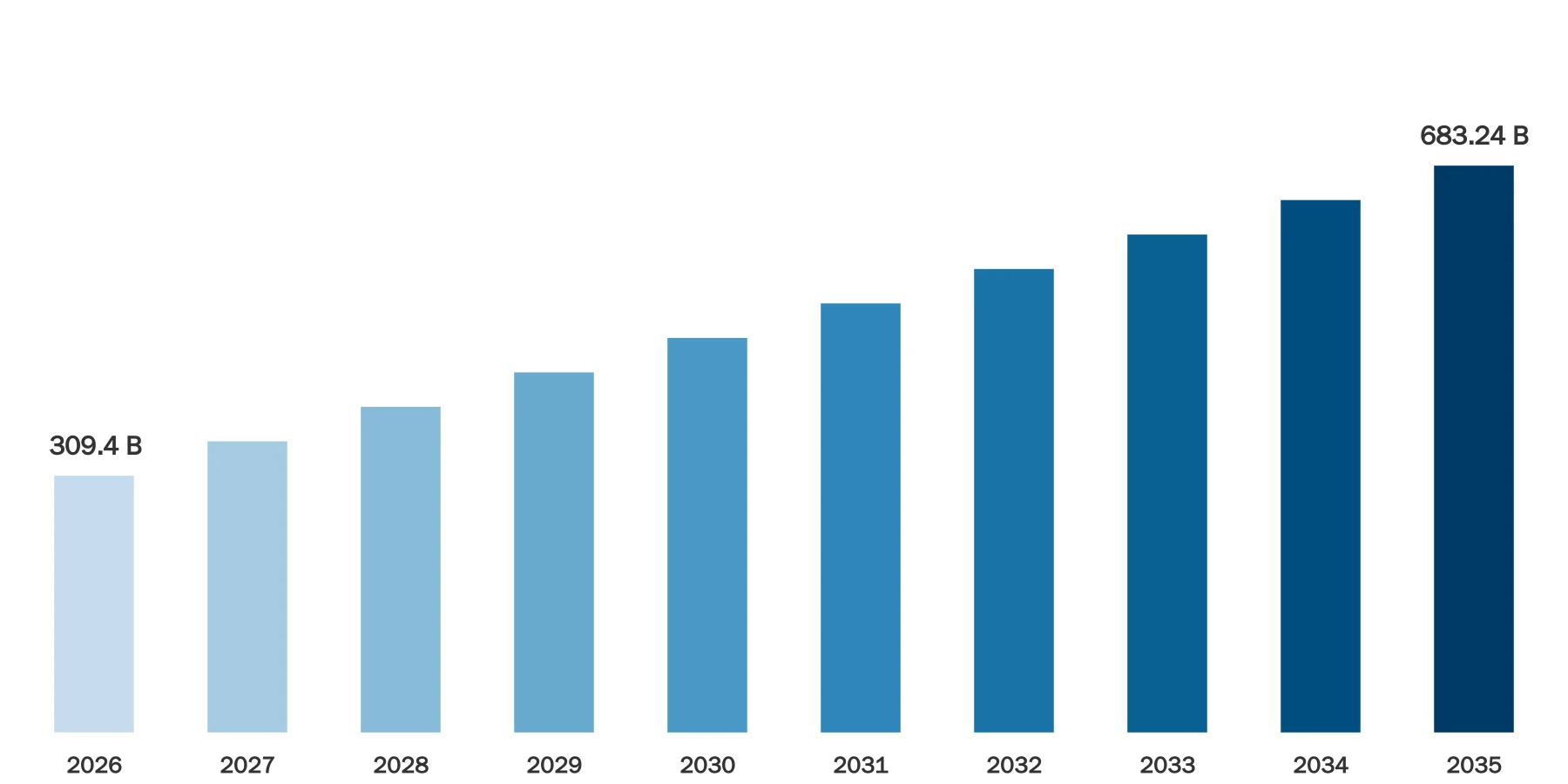
Source: Econ Market Research
After its invention, the internal combustion engine transformed both industry and transportation. These engines have been around since the 19th century, and because of how well they converted fuel into mechanical energy, their market was enormous. These engines were first employed in fixed settings, such as factories, but they soon made their way into cars, spurring the expansion of the automotive sector. The market',s growth was greatly accelerated in the late 1880s when Karl Benz invented the first usable vehicle.
These engines gained more traction thanks to Henry Ford',s mass production techniques, which also increased accessibility to cars for the general people. Engine technology continued to progress throughout the 20th century, improving pollution management, fuel efficiency, and performance. The internal combustion engine is still a major force in many industries, even in the face of growing competition from alternative power sources like electric cars. However, environmental sustainability and the research and development of alternative fuels are becoming more and more important.
INTERNAL COMBUSTION ENGINE MARKET:
Internal Combustion Engine Market Dynamics
Its trajectory has been continuously altered by regulatory changes and technological developments. Environmental concerns and strict restrictions have LED to a push for improved fuel efficiency and lower emissions in this industry throughout time. This push led to advancements in fuel systems, materials, and engine design, which encouraged manufacturers to compete to produce cleaner, more efficient engines. Furthermore, the market dynamics were impacted by consumer demands for sustainability and performance, which resulted in the development of hybrid engines and the investigation of alternative fuels such as hydrogen and biofuels. Demand changes in the market were also impacted by geopolitical issues, shifting customer tastes, and worldwide economic situations.
Economic downturns frequently affected car sales, which in turn affected the market for internal combustion engines. Fuel costs were impacted by geopolitical tensions and oil price swings, which in turn affected consumer preferences and market demand. Furthermore, customer tastes changed, challenging the conventional dominance of internal combustion engines with a growing interest in electric vehicles. Despite these obstacles, the market for internal combustion engines kept evolving, taking advantage of technological advancements to raise efficiency and lessen environmental effects while also having to contend with the escalating rivalry from alternative powertrain technologies. The dynamic aspect of the internal combustion engine market is highlighted by its continuous change, which strikes a balance between consumer needs, regulation, and innovation.
Internal Combustion Engine Market Drivers
Technological Innovation
Within the internal combustion engine market, technological innovation plays a key role in driving the industry',s continuous evolution. The main components of this driver are advancements in engine design, combustion techniques, and materials. Innovation produces engines with more performance, lower emissions, and increased efficiency. Direct injection, turbocharging, and variable valve timing are examples of advancements that optimize combustion to increase power production while reducing fuel usage. Engine longevity and efficiency are increased by the introduction of stronger and lighter components thanks to materials innovation.
Additionally, improvements in engine management systems and sensors allow for more exact control over the timing of ignition, fuel delivery, and exhaust treatment all of which contribute to the reduction of emissions. By reducing their ecological impact, these advances not only improve internal combustion engines', overall performance but also address environmental issues. Additionally, continued research into hybridization technologies such as mild-hybrid systems and alternative fuels combines innovation by enhancing conventional engines with electric power, pushing the limits of sustainability and efficiency. In the end, technical innovation continues to be a driving force, consistently redefining the market for internal combustion engines in the direction of increased performance, reduced emissions, and more efficiency.
Increasing awareness of environmental issues
Changes in consumer preferences, political legislation, and corporate practices are sparked by increased awareness of climate change, air pollution, and resource depletion. Stricter emission standards and restrictions are a result of worries about greenhouse gas emissions and their effect on global warming. These regulations force automakers to create engines that are less harmful to the environment and use less fuel.
Public opinion also matters a lot because buyers who care about the environment choose cars with lower emissions and better fuel economy, which affects market demand. This knowledge not only shapes personal decisions but also increases the need for environmentally friendly transportation options in society. As a result, producers are forced to develop novel ideas, looking at hybrid technology, alternative fuels, and ways to cut emissions. Furthermore, public awareness is raised by environmental advocacy groups and programs, which influence industry practices to adopt more environmentally friendly activities.
Restraints:
Stringent Emission Regulations
These laws, which were passed to lessen greenhouse gas emissions and air pollution, place strict requirements on automakers. To design engines that satisfy these strict requirements, compliance with these rules necessitates large investments in R&,D and technology. Adhering to these laws frequently results in higher production costs, which affects how affordable internal combustion engine automobiles are overall. Moreover, these limitations force manufacturers to commit large sums of money to the development of emissions control systems, which may take funds away from other possible improvements.
Furthermore, strict emission rules increase the need for ongoing developments and put pressure on manufacturers to upgrade their products frequently in order to comply with changing legislation. The market',s ability to adapt is also impacted by this dynamic regulatory environment, which may hold down technological innovation because of the need for compliance. In the end, even while these laws promote environmental benefits, they also impose constraints because they call for large expenditures and rapidly advancing technology, which put the market',s adaptability and affordability under pressure.
Technological Transition Challenges
Transitioning from internal combustion engines to alternate fuels, hybrid systems, or electrification presents complex issues. The development of infrastructure is one major obstacle. Widespread adoption is hampered by the requirement for alternate fuel and charging stations for electric vehicles as well as large time and money commitments. Furthermore, the current production infrastructure and supply chain are largely designed to serve conventional engines, which means that retooling and restructuring are required. These actions come with a high cost and cause disruptions to operations.
The incorporation of newer technology also presents technical challenges that necessitate significant research and development. These difficulties lengthen the time it takes for novel solutions to reach the market, which delays their broad acceptance and availability. Furthermore, customer acceptability and adoption are crucial, resistance or apprehension towards more recent technologies can obstruct their market expansion. The ever-changing nature of technology presents difficulties for regulatory bodies and standards, resulting in uncertainty that hinders industry adaption.
Opportunities:
Advanced Engine Technologies
Within the internal combustion engine market, advanced engine technologies provide enormous potential and act as a spur for advancement and innovation. Innovations in materials science, design, and efficiency optimization provide engines new opportunities to reach better performance levels while lowering emissions at the same time. Engines can now provide higher power outputs while using less gasoline because to innovations like direct fuel injection, turbocharging, and downsizing. This satisfies consumer demands for both performance and sustainability.
The combustion processes are optimized for greater efficiency and fewer emissions thanks to developments in engine management systems, which include smart sensors and control units. High-strength alloys and composites are examples of lightweight materials that improve fuel efficiency by lowering total vehicle weight and enhancing engine reliability. Moreover, improvements in cylinder deactivation, variable valve timing, and sophisticated cooling systems raise the engine',s thermal efficiency and lower fuel consumption. These technical advancements help internal combustion engines become more competitive while also making it easier to comply with strict emission standards.
Hybridization and Mild Hybrid Systems
These developments provide a route toward increased efficiency and lower emissions by fusing the advantages of electric power with conventional combustion engine technology. In mild hybrid systems, the combustion engine is assisted by an electric motor that allows for energy recovery during coasting or braking as well as a power increase during acceleration. This integration lessens the burden on the internal combustion engine, which not only improves fuel efficiency but also helps to reduce emissions.
Furthermore, hybridization makes it possible to install start-stop systems, which let the engine briefly cut off at idle to save gasoline and cut pollutants when driving in cities. These systems', versatility enables smooth switching between power sources, improving performance and reducing environmental impact. Automakers may now match consumer expectations for fuel efficiency and sustainability by offering vehicles with mild hybrid systems and hybridization, which allow for lower emissions and better fuel economy without sacrificing performance or range.
Segment Overview
By Fuel Type
Based on fuel type, the global internal combustion engine market is divided into petroleum and natural gas. The petroleum category dominates the market with the largest revenue share in 2023. This group includes a broad variety of fuels made from crude oil, such as diesel, gasoline, and different blends. Fuel has a high energy density and is widely utilized in spark-ignition engines, which are used in passenger cars. A spark plug ignites it, propelling the piston of the engine. Diesel has a higher energy density and is more fuel-efficient when used in compression-ignition engines, but it also produces more nitrogen oxides and particulate matter. Petroleum-based fuel production and refinement are well-established sectors, with gasoline being the most widely used fuel for light-duty vehicles worldwide.
Compressed Natural Gas (CNG) and liquefied natural gas (LNG) are two types of natural gas that are utilized as substitutes for conventional fuels derived from petroleum. In comparison to gasoline or diesel, natural gas is more plentiful, burns cleaner, and releases fewer pollutants like carbon dioxide and nitrogen oxides. For vehicles like buses, lorries, and some passenger cars, compressed natural gas (CNG) is typically utilized, although liquid LNG is better suited for long-distance travel because of its higher energy density. However, compared to fuels derived from petroleum, natural gas distribution infrastructure is less developed, which restricts its widespread adoption despite its environmental benefits.
By End-Use
Based on end-use, the global internal combustion engine market is segmented into automotive, marine, and aircraft. The automotive segment dominates the internal combustion engine market. The greatest market share for internal combustion engines is represented by this segment. It includes engines found in automobiles, trucks, buses, and other types of vehicles used for both private and public transportation. To accommodate a variety of vehicle kinds and uses, engines in this industry come in a wide range of sizes, fuel types (gasoline, diesel, or alternative fuels), and technological advancements.
The bulk of cars on the road today, from little city cars to large trucks, are powered by internal combustion engines, which greatly increases the market share of this industry. In the maritime industry, internal combustion engines are essential because they power a wide range of vessels, including yachts, ferries, ships, and boats. Marine engines are built to endure a variety of operational environments, frequently necessitating large power outputs for propulsion. Diesel, gasoline, or alternate fuels can be used to power them, according on the size, function, and efficiency standards of the vessel.
Internal combustion engines are necessary for transportation, recreational activities, commercial fishing, and maritime operations in this industry. Although internal combustion engines are still used in some smaller aircraft, particularly in general aviation and light aircraft, the employment of jet engines and electric propulsion in specific applications has gradually shifted the focus of aircraft propulsion. These tiny aircraft are powered by piston engines, which are similar to those used in cars and provide flight control and propulsion. They run at higher altitudes and are primarily powered by aviation gasoline (avgas), providing dependability and economy for certain flying operations.
Internal Combustion Engine Market Overview by Region
The global internal combustion engine market is categorized into North America, Europe, Asia-Pacific, and the Rest of the World. Asia-Pacific emerged as the leading region, capturing the largest market share in 2023. The market is being pushed by strong demand for cars, heavy machinery, and marine vessels due to rapid industrialization, economic growth, and population expansion. A robust engine manufacturing base has also been established in the region as a result of its emphasis on technological breakthroughs and infrastructure development, which serves as a hub for both domestic and international exports. Asia-Pacific is leading the way in the expansion and development of the internal combustion engine market, with a growing focus on innovation and a wide range of applications.
For the duration of the internal combustion engine market forecast, North America is anticipated to grow at the fastest rate (CAGR). This expansion is being driven by the region',s thriving automotive sector, technological developments in engine design, and an increasing emphasis on environmental solutions. Additionally, the market for internal combustion engines is seeing innovation driven by an increasing emphasis on alternative and renewable fuels as well as the incorporation of hybrid technologies. Furthermore, North America is at the forefront of engine technology innovation due to increased investments in R&,D and a robust manufacturing base. This creates a climate that is favorable for significant growth in the upcoming years.
Internal Combustion Engine Competitive Landscape
In the global internal combustion engine market, a few major players exert significant market dominance and have established a strong regional presence. These leading companies remain committed to continuous research and development endeavors and actively engage in strategic growth initiatives, including product development, launches, joint ventures, and partnerships. By pursuing these strategies, these companies aim to strengthen their market position, expand their customer base, and capture a substantial share of the market.
Some of the prominent players in the global internal combustion engine market include,
AB Volvo
Toyota Motor Corporation
Volkswagen Group
Rolls-Royce plc
Mahindra &, Mahindra Ltd.
Renault Group
Mitsubishi Heavy Industries, Ltd.
MAN, General Motors
Ford Motor Company
FCA US LLC
Robert Bosch GmbH
AGCO Corporation
Caterpillar
Shanghai Diesel Engine Co., Ltd, and various others.
Internal Combustion Engine Recent Developments
In June 2023, General Motors announced plans to upgrade its Fort Wayne Assembly factory in Indiana with a large expenditure of USD 632 million. With this investment, the company will be prepared to make the upcoming full-sized ICE truck generation. The company',s commitment to improving production capabilities and meeting the changing needs of the automotive industry is demonstrated by this strategic project.
In March 2023, The goal of Rolls-Royce Power Systems is to develop a prototype high-speed internal combustion engine for use in marine applications. This engine',s cutting-edge design is optimized to run on environmentally friendly methanol, allowing for carbon dioxide-neutral operations. The joint venture, designated as ",MeOHmare,", has combined the knowledge and experience of Woodward L',Orange, WTZ Roß,lau, and Rolls-Royce. The collaboration dates back to early 2023.
In March 2023, With zero CO2 emissions at the point of use, the remarkable hydrogen combustion engine from JCB Power Systems Ltd. is based on combustion technology and offers a cost-effective and environmentally responsible alternative. Comparing the JCB hydrogen-powered engine to conventional diesel or gasoline counterparts reveals a number of benefits.
Internal Combustion Engine Market Report Segmentation
Internal Combustion Engine Market Report Scope & Segmentation
| Attributes | Details |
|---|---|
Market Size (Current) | US$ 309.4 Billion in 2026 |
Market Size (Forecast) | US$ 683.24 Billion in 2035 |
Growth Rate | CAGR of 9.2% from 2026 to 2035 |
Forecast Period | 2026 – 2035 |
Base Year | 2025 |
Historical Data Available | Yes |
Regional Scope | Global |
Segments Covered | By Fuel Type
By End-Use
By Power Output
|
Frequently Asked Questions
Common questions about this report
The study period covers historical insights and forecast projections for the period 2026-2035.
About the Author
Market research expert with years of industry experience

Related Reports
Explore more market insights from the same category