

Interactive White Board Market
Interactive White Board Market Size, Share, Trends, Growth, and Industry Analysis, By Technology (Resistive Membrane, Infrared, Capacitive, Electromagnetic Pen, Others), By Form (Fixed, Portable), By Projection Technique (Front Projection, Rear Projection), By Application (Education, Commercial, Corporate, Others), Regional Analysis and Forecast Period 2026-2035
Interactive White Board Market Overview
As per Econ Market Research analysis, the Global Interactive White Board Market was estimated at US$ 5.65 Billion in 2026 and is forecast to attain US$ 10.69 Billion by 2035, expanding at a CAGR of 7.35% between 2026 and 2035. The base year for the study is 2025.
Interactive White Board Market Size 2025-2035 (USD Billion)

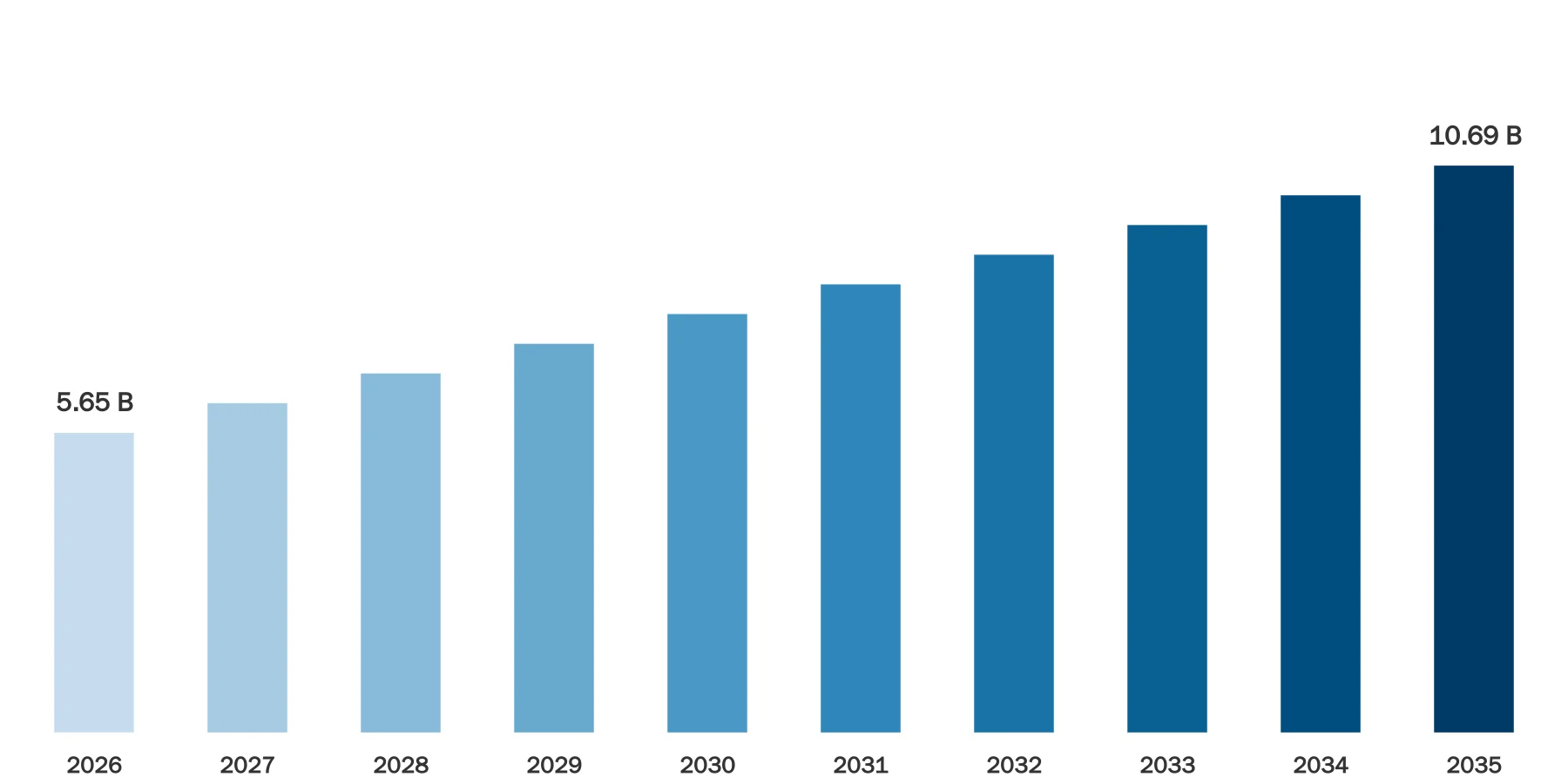
Source: Econ Market Research
The Interactive White Board Market continues to expand due to digital classroom modernization, hybrid collaboration demand, and touchscreen technology adoption across education and enterprise sectors. More than 1.4 million Interactive Whiteboard units were shipped globally during 2024, with over 55% deployed in educational institutions. North America and Asia-Pacific together represented nearly 62% of worldwide unit installations. The education segment accounted for more than 68% of total deployments in 2024 due to rising STEM-focused digital learning environments and smart classroom integration. Interactive whiteboards between 50 inches and 70 inches represented the highest installation volume because schools and small businesses preferred compact touchscreen displays with lower maintenance requirements.
Around 38% of new installations integrated 4K display technology, while 31% used capacitive touch interfaces for enhanced response accuracy. Corporate adoption also increased significantly, with hybrid meeting room installations rising by 47% between 2022 and 2025. Interactive whiteboard software platforms increasingly support AI-based annotation, cloud collaboration, multilingual functionality, and real-time content sharing across Windows, Android, and macOS ecosystems.
The United States Interactive White Board Market demonstrates strong penetration across K-12 schools, universities, healthcare training centers, and enterprise conference rooms. North America held more than 28% of global market share in 2024, and the United States contributed the largest regional installation base. More than 70% of public school districts in major metropolitan regions integrated at least one smart classroom display system by 2025. Hybrid work adoption accelerated enterprise demand, with over 45% of large conference room upgrades including interactive collaboration displays.
The U.S. education sector increasingly deploys 75-inch and 86-inch touchscreen boards for digital curriculum support, distance learning, and real-time collaboration. More than 41% of schools upgrading classroom technology preferred cloud-enabled whiteboards integrated with video conferencing systems. The corporate sector also showed strong demand due to agile meeting spaces and remote collaboration tools. Interactive whiteboards supporting Microsoft Teams, Zoom, and Webex integrations witnessed installation growth exceeding 30% across enterprise campuses between 2023 and 2025.
The European Interactive White Board Market is supported by digital education initiatives, multilingual learning requirements, and increasing enterprise collaboration investments. Europe represented approximately 27% of global market installations during 2024. Germany, the United Kingdom, France, Italy, and Spain remain major contributors to regional deployment activity. Germany’s DigitalPakt Schule initiative accelerated installations in public educational institutions, while the United Kingdom expanded smart classroom programs through EdTech-focused modernization policies. More than 58% of newly deployed educational boards in Europe included wireless screen sharing and remote classroom functionality by 2025.
Educational institutions across Europe increasingly adopted 4K ultra-HD interactive panels to improve student engagement and digital participation. Around 36% of enterprise conference room upgrades in Western Europe included touchscreen collaboration displays integrated with cloud-based communication software. Portable interactive whiteboards also gained popularity, accounting for more than 20% of educational deployments in secondary schools and vocational training centers. Multilingual interface support remains a critical competitive factor across the European market landscape.
Interactive White Board Market Latest Trends
The Interactive White Board Market is witnessing rapid transformation driven by smart classroom expansion, AI-powered collaboration tools, and hybrid workplace modernization. One of the strongest trends involves increasing demand for interactive flat panel displays larger than 75 inches. Large-format displays accounted for more than 40% of premium institutional installations during 2025 due to improved classroom visibility and collaborative functionality. Another important trend is the migration from projector-based boards toward all-in-one LED and LCD interactive panels, reducing maintenance requirements by nearly 25%.
Cloud-based collaboration functionality continues gaining traction, with more than 48% of newly launched whiteboard systems integrating cloud storage, remote access, and multi-device synchronization. AI-supported handwriting recognition, real-time translation, and voice annotation are becoming standard features across enterprise-grade products. More than 35% of newly released interactive whiteboards during 2025 included AI-enabled meeting assistance and automated note-generation capabilities.
The education segment remains the strongest adopter, with over 68% of installations concentrated in schools and universities. Governments across Asia-Pacific and Europe continue increasing investments in digital classrooms, especially in rural and semi-urban regions. Hybrid learning functionality also accelerated demand for integrated cameras, microphones, and wireless casting systems.
Corporate offices are increasingly redesigning collaboration spaces. Around 55% of modern enterprise meeting rooms introduced touchscreen collaboration systems between 2023 and 2025. Businesses prefer ultra-wide interactive displays supporting simultaneous multi-user annotation. BYOD compatibility is another major trend, with USB-C connectivity and wireless device integration becoming standard features.
Interactive whiteboards are also expanding beyond education and offices into healthcare, retail, and government sectors. Hospitals increasingly use interactive displays for medical training and patient education, while retailers integrate touchscreen boards for product demonstrations and customer engagement.
Interactive White Board Market Dynamics
The Interactive White Board Market is influenced by rising digital learning investments, collaborative workplace transformation, and increasing touchscreen display adoption. More than 60% of educational institutions in developed economies have already integrated at least one digital collaboration display into classrooms or lecture halls. Corporate demand is also expanding rapidly due to hybrid work adoption and video conferencing integration requirements. Around 45% of new conference room upgrades globally included interactive collaboration technologies during 2025. Technological advancements such as 4K displays, AI-assisted annotation, and wireless connectivity are improving product functionality and increasing replacement demand.
However, market expansion faces challenges including high initial installation costs, teacher training limitations, and infrastructure disparities in developing regions. Approximately 41% of deployed systems remain underutilized because of insufficient training or software integration issues. Manufacturers are focusing on scalable cloud-based platforms, AI integration, and lower-maintenance flat-panel systems to strengthen long-term adoption across education, healthcare, government, and commercial sectors.
DRIVER
Increasing Demand for Smart Classrooms and Hybrid Learning
The primary driver of the Interactive White Board Market is the rapid adoption of smart classroom infrastructure and hybrid learning environments. More than 55% of global interactive whiteboard deployments during 2024 occurred within educational institutions. Governments across North America, Europe, China, India, Japan, and Southeast Asia continue investing in digital education initiatives, significantly boosting installation volumes. Around 70% of urban schools in developed economies integrated digital collaboration displays into classrooms by 2025.
Interactive whiteboards improve student engagement through multimedia content, real-time annotation, simulations, and collaborative exercises. Educational institutions implementing interactive displays reported up to 32% higher classroom participation compared with traditional teaching systems. STEM-focused learning programs increasingly rely on touchscreen boards to visualize mathematical models, engineering concepts, and scientific simulations.
Hybrid education trends also accelerated demand for integrated cameras, microphones, and remote collaboration functionality. More than 46% of newly installed education-focused whiteboards support simultaneous online and offline teaching. Universities increasingly use large-format 86-inch displays for lecture streaming and collaborative research activities.
Corporate training environments represent another major growth driver. Around 38% of enterprise training centers upgraded to interactive collaboration systems between 2023 and 2025. Hybrid work culture continues driving demand for video-integrated digital boards that support real-time brainstorming, cloud sharing, and cross-location meetings.
RESTRAINT
High Installation and Maintenance Costs
High acquisition, installation, and maintenance expenses remain major restraints affecting Interactive White Board Market penetration in cost-sensitive regions. Premium interactive whiteboards larger than 75 inches require advanced processors, 4K displays, multi-touch capabilities, and integrated software ecosystems, increasing procurement complexity for schools and small businesses.
Approximately 43% of educational institutions in developing economies identified budget constraints as the main barrier to digital classroom adoption. Infrastructure limitations including poor internet connectivity, outdated electrical systems, and limited IT support also slow deployment rates. Interactive projector-based systems often require recurring maintenance, lamp replacement, and calibration adjustments, increasing long-term operational costs by nearly 18%.
Teacher and employee training challenges further impact utilization efficiency. Around 41% of deployed systems globally remain underused because users lack familiarity with advanced collaboration software or interactive teaching methods. Small enterprises frequently delay upgrades because meeting rooms require network modernization and compatibility testing before installation.
Portable whiteboards offer lower deployment costs, but they represent only a limited percentage of enterprise-grade collaboration environments due to lower screen durability and reduced functionality. Economic uncertainty in several regions also slowed institutional procurement cycles during 2024 and 2025. Educational authorities increasingly prioritize low-cost alternatives such as tablets and shared display systems when budget allocations remain constrained.
OPPORTUNITY
Expansion of AI-Integrated Collaboration Platforms
AI-enabled collaboration platforms represent one of the strongest opportunities within the Interactive White Board Market. More than 35% of newly introduced interactive whiteboards during 2025 included AI-supported features such as handwriting recognition, automated transcription, multilingual translation, and smart meeting summaries. Enterprise buyers increasingly prioritize intelligent collaboration systems capable of improving productivity and communication efficiency.
Cloud-based ecosystems are creating additional opportunities. Approximately 48% of recently launched whiteboard solutions support cloud synchronization, enabling users to access annotations, presentations, and recorded meetings from multiple devices. Educational institutions increasingly deploy AI-powered learning analytics to monitor classroom participation and personalize lesson delivery.
Healthcare and government sectors also present expanding opportunities. Hospitals increasingly use interactive whiteboards for surgical planning, medical simulations, and telemedicine collaboration. Government agencies deploy large-format touchscreen boards for command centers, emergency response coordination, and digital public communication systems.
Emerging markets remain highly attractive due to ongoing digital transformation initiatives. Asia-Pacific accounted for nearly 38% of global investments in educational display modernization projects during 2025. Rural digitization programs across India, Indonesia, Vietnam, and Africa continue increasing demand for durable, energy-efficient touchscreen displays.
Manufacturers focusing on energy-efficient LED panels, anti-glare coatings, and integrated Cyber Security features are expected to capture increasing institutional demand. Interactive whiteboards with accessibility functions such as captions, screen magnification, and voice assistance are also gaining traction among inclusive education initiatives.
CHALLENGES
Infrastructure Gaps and Technology Compatibility Issues
Infrastructure disparities and compatibility challenges continue affecting Interactive White Board Market expansion across multiple regions. Around 60% of schools in low-income regions reported insufficient technical training and IT support for Interactive Display systems. Limited broadband availability and unstable power infrastructure create operational disruptions, especially in rural educational institutions.
Compatibility issues between software platforms, operating systems, and conferencing applications remain another significant challenge. Approximately 29% of enterprise users reported integration problems involving cloud collaboration tools, wireless casting applications, or legacy presentation systems. Organizations often require additional middleware or software updates to ensure compatibility with Zoom, Teams, and Webex ecosystems.
Rapid technological evolution also creates replacement pressure. Many institutions that deployed projector-based systems between 2015 and 2019 now face obsolescence concerns due to lower resolution, limited touch responsiveness, and outdated operating systems. Replacement cycles shortened from nearly 10 years to approximately 6–7 years for advanced flat-panel systems.
Cybersecurity risks are increasing because interactive whiteboards increasingly connect with cloud platforms and enterprise networks. Institutions handling sensitive student or corporate information require stronger encryption and access-control protocols. Around 34% of enterprise buyers identified data privacy compliance as a critical purchasing consideration during 2025.
Supply chain volatility also affects manufacturing consistency. Touchscreen sensors, semiconductor chips, and LCD panels experienced procurement delays of up to 12 weeks during peak production periods between 2023 and 2025, influencing delivery schedules and procurement planning.
SWOT Analysis
Strengths
More than 68% of global installations are concentrated in the education sector, ensuring stable institutional demand.
Interactive whiteboards improve classroom engagement by up to 32% through multimedia learning and collaborative activities.
Over 48% of modern systems integrate cloud collaboration and remote synchronization features.
Multi-touch functionality allows simultaneous participation from 10 to 40 users depending on display size.
4K-enabled boards represented nearly 38% of global shipments during 2025.
Hybrid workplace transformation increased enterprise meeting room adoption by approximately 45%.
Weaknesses
Around 41% of deployed systems remain underutilized because of insufficient user training.
High installation and maintenance costs limit adoption among small institutions.
Projector-based systems require regular calibration and lamp replacement every 2,000–5,000 operating hours.
Infrastructure limitations affect deployment across rural and low-connectivity regions.
Large-format displays above 86 inches require reinforced mounting infrastructure and higher energy consumption.
Opportunities
Asia-Pacific accounted for nearly 38% of smart education infrastructure investments during 2025.
AI-enabled annotation and transcription features are expanding rapidly across enterprise products.
Healthcare and government sectors increasingly deploy interactive collaboration displays for operational coordination.
Portable whiteboards continue gaining adoption in vocational training centers and mobile learning programs.
Wireless collaboration technology adoption exceeded 50% among newly installed enterprise systems.
Demand for multilingual interfaces is increasing across Europe and the Middle East.
Threats
Competition from tablets, laptops, and low-cost digital display alternatives continues intensifying.
Semiconductor and display panel shortages caused delivery delays of up to 12 weeks during 2024–2025.
Cybersecurity concerns are increasing due to cloud-connected classroom and enterprise systems.
Economic uncertainty affects institutional procurement cycles and modernization budgets.
Rapid technological obsolescence shortens product replacement cycles to nearly 6 years.
Open-source collaboration software reduces differentiation opportunities for hardware manufacturers.
Segmentation Analysis
The Interactive White Board Market is segmented according to technology, form, projection technique, and application. Educational institutions continue representing the largest deployment category, accounting for more than 68% of overall installations during 2024. Corporate offices represent the second-largest application area due to rising hybrid collaboration demand. Portable systems accounted for over 53% of installations because schools and training centers increasingly prefer flexible deployment models. Front-projection systems still maintain a large installed base, although rear-projection and direct-view flat panels are gaining popularity because of lower maintenance requirements and improved brightness levels.
Interactive whiteboards are increasingly differentiated by touch responsiveness, screen size, connectivity, and AI functionality. Capacitive and infrared technologies remain dominant due to higher touch accuracy and multi-user interaction capabilities. Enterprise buyers prioritize systems supporting video conferencing integration, while educational institutions focus on collaborative software ecosystems and digital curriculum compatibility. Demand for wireless casting, cloud synchronization, and USB-C connectivity continues accelerating across all installation categories.
By Technology
Infrared technology accounted for a major portion of global installations because it offers strong touch accuracy and scalability across large display sizes. Infrared systems represented approximately 34% of installations during 2024 due to their durability and support for simultaneous multi-user interaction. Capacitive interactive whiteboards accounted for nearly 31% of newly deployed units because of smoother touchscreen responsiveness and smartphone-like usability. Educational institutions increasingly prefer capacitive displays for interactive learning applications.
Resistive membrane technology continues maintaining demand in budget-sensitive regions because it supports stylus input and lower production costs. However, its market penetration declined due to lower touch sensitivity and limited multitouch capability. Electromagnetic pen technology remains relevant in technical education, architecture, and engineering applications where precision drawing functionality is required.
“Others” technology categories include optical imaging and laser-based interaction systems used in specialized industrial and government applications. Around 38% of advanced enterprise deployments included AI-enabled touch processing and gesture recognition capabilities during 2025. Multi-touch systems supporting 20 or more simultaneous touch points are becoming standard in corporate collaboration environments. Manufacturers increasingly prioritize anti-glare coatings, low-latency response times below 8 milliseconds, and energy-efficient display architectures to strengthen competitiveness.
By Form
Portable interactive whiteboards accounted for more than 53% of market deployments during 2024 due to rising demand for flexible teaching and mobile presentation environments. Educational institutions increasingly prefer portable systems because they can be relocated between classrooms, conference halls, and training centers. Portable systems are particularly popular among coaching institutes, vocational education centers, and small enterprises with limited infrastructure capacity.
Fixed interactive whiteboards continue dominating premium enterprise and university installations because of superior display stability, larger screen sizes, and integrated conferencing capabilities. Fixed installations represented approximately 47% of total deployments globally. Large-format fixed displays above 75 inches experienced increasing demand from hybrid collaboration spaces and auditorium-based learning environments.
Portable systems generally support wireless connectivity, battery-powered operation, and compact mounting solutions. Around 29% of portable installations included integrated cloud collaboration software by 2025. However, fixed systems maintain advantages in durability, image brightness, and multi-user functionality.
Corporate organizations increasingly standardize fixed touchscreen displays across global office networks to improve communication consistency. Educational buyers prioritize portability for shared infrastructure utilization, while enterprises focus on permanent collaboration ecosystems integrated with conferencing platforms. Energy-efficient flat-panel displays and lightweight aluminum chassis designs are further strengthening portable whiteboard adoption across emerging markets.
By Application
Front-projection systems continue representing a significant installed base because they remain cost-effective for classrooms and training environments. However, rear-projection and direct-view display systems are gaining popularity because of higher brightness levels and reduced shadow interference. Rear-projection systems witnessed increased adoption in high-ambient-light environments and large conference spaces during 2025.
The education segment accounted for over 68% of global deployments due to smart classroom modernization and digital curriculum expansion. Universities and K-12 schools increasingly deploy touchscreen boards supporting collaborative simulations, multimedia content, and hybrid learning functionality. Corporate applications represented around 21% of installations due to rising hybrid work adoption and collaborative workspace redesign.
Commercial sectors including retail, healthcare, and hospitality continue increasing adoption of touchscreen collaboration systems for presentations, customer engagement, and training purposes. Government institutions also deploy interactive whiteboards in command centers, municipal offices, and public communication facilities.
Around 45% of newly upgraded enterprise meeting rooms integrated interactive displays between 2023 and 2025. Educational institutions remain focused on cloud-based teaching software, while corporate buyers prioritize AI-enabled conferencing tools and cybersecurity integration. The “Others” application category includes museums, transportation hubs, and entertainment venues using interactive displays for public engagement and digital navigation.
Regional Analysis
North America remained the leading regional market with more than 28% global share during 2024.
Europe accounted for nearly 27% of installations due to strong digital education initiatives.
Asia-Pacific represented one of the fastest-expanding deployment regions driven by smart classroom investments.
Middle East & Africa experienced rising adoption across GCC education modernization projects and enterprise collaboration initiatives.
More than 62% of worldwide interactive whiteboard installations were concentrated in North America and Asia-Pacific combined.
Educational institutions remained the dominant deployment channel across all regions.
North America
North America accounted for more than 28% of global Interactive White Board Market share during 2024, supported by strong digital education infrastructure and rapid enterprise collaboration technology adoption. The United States represented the dominant regional market due to extensive smart classroom modernization and hybrid workplace transformation. More than 70% of metropolitan school districts implemented at least one touchscreen collaboration display across classrooms or lecture halls by 2025.
Educational institutions across the United States increasingly deploy 75-inch and 86-inch displays to support digital curriculum delivery and STEM-focused teaching models. Around 44% of newly procured classroom displays integrated 4K resolution and AI-enabled annotation capabilities. Enterprise demand also accelerated because more than 45% of modern conference room upgrades included interactive collaboration systems integrated with Teams, Zoom, or Webex.
Canada continues expanding adoption across universities, technical institutes, and government facilities. Wireless collaboration functionality, cloud synchronization, and multilingual support are major purchasing priorities across North America. Healthcare organizations increasingly use interactive whiteboards for telemedicine consultations, staff training, and operational coordination.
Corporate training centers also represent an important growth area. Approximately 38% of enterprise training facilities introduced touchscreen collaboration displays between 2023 and 2025. Manufacturers continue prioritizing cybersecurity, accessibility features, and low-latency touch performance to satisfy institutional procurement standards. The region also maintains a high replacement cycle because older projector-based systems are increasingly replaced by all-in-one flat-panel displays.
Europe
Europe represented approximately 27% of the global Interactive White Board Market during 2024, supported by digital education initiatives, multilingual collaboration requirements, and enterprise modernization programs. Germany, the United Kingdom, France, and Italy remain the largest contributors to regional deployment activity.
Germany expanded installations through DigitalPakt Schule programs focused on public education modernization. More than 58% of newly installed classroom displays across Western Europe supported wireless screen sharing and cloud-based collaboration functionality by 2025. The United Kingdom also accelerated deployment through smart education policies and personalized digital learning initiatives.
European enterprises increasingly redesign collaborative office environments. Around 36% of upgraded conference rooms in Western Europe integrated touchscreen collaboration systems between 2023 and 2025. Large-format interactive displays above 75 inches gained popularity across multinational corporations because they improve hybrid meeting visibility and collaborative brainstorming.
Universities across France and Scandinavia increasingly deploy AI-enabled whiteboards supporting multilingual translation and remote participation. Accessibility features such as captions, voice assistance, and adaptive display modes are becoming standard procurement requirements.
Eastern European markets continue expanding due to increasing internet penetration and digital infrastructure investments. Portable interactive whiteboards gained traction in vocational training centers and technical institutes. Sustainability is another important trend across Europe, with manufacturers prioritizing energy-efficient LED panels and recyclable materials in compliance with environmental procurement regulations.
Asia-Pacific
Asia-Pacific remains one of the fastest-growing regions in the Interactive White Board Market due to rapid urbanization, large student populations, and aggressive smart education investments. The region accounted for nearly 29% of global market activity during 2025 and represented approximately 38% of educational infrastructure investments related to digital classroom technologies.
China continues dominating regional manufacturing and deployment activity. Large-scale smart education programs accelerated touchscreen board installations across public schools, especially in urban provinces. More than 50% of educational institutions in tier-1 Chinese cities integrated cloud-enabled digital boards by 2025. India also experienced rising demand due to Digital India initiatives, increasing private school modernization, and hybrid learning adoption.
Japan’s GIGA School Program significantly expanded digital classroom deployment across primary and secondary schools. South Korea and Singapore remain technologically advanced markets emphasizing AI-powered teaching systems, multilingual functionality, and ultra-low-latency displays.
Large-format 75-inch and 86-inch panels witnessed strong demand across universities and coaching institutions throughout the region. Educational institutions increasingly prioritize wireless casting and remote classroom integration. Enterprise demand also accelerated due to rapid coworking space expansion and hybrid work adoption.
Regional manufacturers benefit from localized production capabilities and competitive pricing structures. Around 35.6% of India’s interactive flat-panel market was controlled by the top three brands during 2025. Government procurement programs and smart city initiatives continue creating opportunities for manufacturers specializing in affordable, durable touchscreen collaboration systems.
Middle East & Africa
The Middle East & Africa Interactive White Board Market continues expanding due to education modernization programs, smart city initiatives, and enterprise digital transformation investments. GCC countries including the UAE, Saudi Arabia, and Qatar remain the primary regional adopters because governments continue allocating substantial budgets toward digital learning infrastructure.
Educational institutions across the Gulf region increasingly deploy interactive flat panels larger than 75 inches to improve collaborative teaching environments. More than 40% of premium private schools in the UAE introduced AI-enabled classroom collaboration systems by 2025. Saudi Arabia’s education modernization strategy accelerated demand for cloud-connected learning displays and hybrid teaching tools.
Enterprise adoption is also increasing rapidly. Financial institutions, government agencies, and healthcare providers increasingly deploy touchscreen collaboration systems in command centers and meeting facilities. Around 28% of newly upgraded enterprise meeting spaces across GCC metropolitan areas integrated interactive displays between 2023 and 2025.
Africa represents an emerging opportunity due to rising internet penetration and educational digitization initiatives. South Africa, Kenya, and Nigeria are witnessing increasing demand from universities, vocational institutes, and urban private schools. Portable interactive whiteboards remain particularly attractive due to infrastructure flexibility and lower installation complexity.
Infrastructure challenges continue affecting deployment speed across several African countries because broadband connectivity and technical support remain limited. However, international education partnerships and smart learning initiatives continue improving technology access. Manufacturers increasingly focus on energy-efficient and dust-resistant systems suitable for harsh environmental conditions common across Middle Eastern and African regions.

Competitive Landscape
The Interactive White Board Market remains highly competitive with global electronics manufacturers, educational technology specialists, and collaboration software providers competing through innovation, display quality, and ecosystem integration. Competition intensified between 2023 and 2025 as manufacturers expanded AI functionality, 4K display adoption, and hybrid meeting integration capabilities.
Leading companies increasingly prioritize all-in-one flat-panel systems over projector-based solutions. More than 38% of newly introduced products integrated AI-enabled meeting tools, cloud synchronization, and wireless collaboration software. Companies also compete through larger display formats, with 75-inch and 86-inch panels becoming mainstream across enterprise and university installations.
Education remains the most competitive application segment because it represented over 68% of global deployments during 2024. Manufacturers focus heavily on classroom management software, digital annotation tools, and curriculum compatibility. Enterprise-focused vendors prioritize cybersecurity, conferencing integration, and multi-user collaboration.
Regional manufacturers continue gaining traction through lower-cost solutions and localized support networks. Asian companies particularly strengthened their market position by offering competitively priced interactive flat panels with integrated Android operating systems and wireless casting functionality.
Strategic partnerships between display manufacturers and software providers are becoming increasingly important. Interactive whiteboard vendors now integrate productivity ecosystems including Teams, Zoom, Google Workspace, and cloud collaboration applications. Product differentiation increasingly depends on AI features, latency reduction, touch responsiveness, and accessibility support.
The competitive environment also includes increasing investments in sustainability and energy efficiency. Manufacturers continue introducing low-power LED panels, recyclable packaging, and eco-certified display technologies to align with institutional procurement policies.
List of Top Interactive White Board Companies
SMART Technologies
Promethean
Samsung Electronics
LG Electronics
BenQ
Panasonic
ViewSonic
Hitachi
Seiko Epson
Ricoh
Leading Companies by Market Share
SMART Technologies remains one of the leading companies in the Interactive White Board Market due to early smartboard innovation and extensive educational deployment networks. The company maintains a strong presence across North America and Europe, with large-scale installations in K-12 schools and universities.
Promethean continues holding a significant market position due to strong education-sector penetration and advanced classroom software ecosystems. The company expanded interactive panel installations across Europe, Asia-Pacific, and the Middle East through cloud-enabled teaching platforms and AI-supported learning tools.
Investment Trends & Opportunities
The Interactive White Board Market continues attracting investments from educational institutions, enterprise collaboration providers, and smart infrastructure developers. Governments worldwide increasingly allocate budgets toward digital classroom transformation and hybrid learning technologies. More than 38% of education-related display investments during 2025 originated from Asia-Pacific markets.
Private educational groups and universities continue investing in smart campuses integrating interactive collaboration displays, cloud learning platforms, and AI-supported analytics systems. Around 46% of newly funded classroom modernization projects included touchscreen display technology as a primary infrastructure component.
Enterprise investment also accelerated due to hybrid work adoption. Approximately 45% of modern office renovation projects included collaborative display deployment between 2023 and 2025. Businesses increasingly prioritize AI-integrated meeting systems capable of improving productivity and reducing communication delays.
Healthcare, retail, and government sectors represent emerging investment opportunities. Hospitals increasingly allocate funding toward digital simulation labs and telemedicine collaboration platforms. Retailers continue deploying interactive displays for customer engagement and product visualization.
Manufacturers are investing heavily in localized production and supply chain resilience to minimize semiconductor shortages and logistics disruptions. Sustainability-focused investments also increased, with companies prioritizing energy-efficient LED panels and recyclable materials.
Cloud-based subscription software ecosystems create recurring service opportunities for vendors. Educational institutions increasingly prefer integrated software licensing, remote management tools, and cybersecurity packages. Venture capital activity also increased in AI-powered collaboration software and touchscreen interaction technologies supporting multilingual communication and accessibility enhancement.
Product Innovation & Development
Product innovation within the Interactive White Board Market increasingly focuses on AI integration, ultra-high-definition displays, wireless collaboration, and accessibility improvements. More than 38% of newly launched products during 2025 included 4K display support, while large-format screens above 75 inches gained widespread popularity in universities and enterprise meeting spaces.
AI-powered handwriting recognition and automatic transcription features are becoming standard across premium models. Several manufacturers introduced systems capable of generating meeting summaries, translating content into multiple languages, and synchronizing annotations directly with cloud storage platforms.
Touch accuracy and latency reduction remain major innovation priorities. Advanced capacitive displays now support response times below 8 milliseconds and more than 20 simultaneous touch points. Interactive displays increasingly include integrated microphones, cameras, and speaker systems optimized for hybrid collaboration environments.
Manufacturers also focus heavily on wireless interoperability. Around 50% of enterprise-focused products launched during 2025 supported USB-C connectivity, BYOD functionality, and wireless screen sharing without additional adapters. Educational products increasingly integrate polling systems, digital quizzes, and collaborative learning applications.
Durability improvements continue across institutional products. Anti-glare glass coatings, antimicrobial surfaces, and dust-resistant enclosures are increasingly common. Energy-efficient LED backlighting and automated brightness adjustment technologies are reducing operational power consumption by approximately 15% compared with earlier-generation systems.
Accessibility innovation is another major focus area. Interactive whiteboards increasingly support captions, voice assistance, screen magnification, and adaptive display modes designed for inclusive learning environments. Cloud-based device management and remote diagnostics further simplify maintenance for schools and enterprises operating large deployment networks.
Recent Developments
In 2025, multiple manufacturers introduced AI-enabled interactive whiteboards supporting automatic transcription, multilingual translation, and cloud-based collaboration synchronization across enterprise meeting systems. More than 35% of newly launched premium models included AI-supported functionality.
During 2024, educational institutions across North America expanded large-format touchscreen deployment, with 75-inch and 86-inch panels representing over 40% of premium classroom installations.
In 2025, enterprise collaboration upgrades increased significantly, with approximately 45% of modern meeting room renovations integrating interactive displays supporting Teams and Zoom compatibility.
During 2024, cloud-enabled educational software integration accelerated, with over 48% of newly installed whiteboards supporting remote synchronization and multi-device collaboration.
In 2025, Asia-Pacific governments expanded digital education initiatives, increasing smart classroom investments and strengthening deployment across India, China, Japan, and Southeast Asia. The region represented nearly 38% of education-related display modernization investments.
Scope of the Interactive White Board Market Report
The Interactive White Board Market Report provides comprehensive analysis across technology, form factor, projection technique, application, and regional deployment patterns. The report evaluates interactive display adoption across educational institutions, enterprise meeting environments, healthcare facilities, government organizations, and commercial establishments. More than 1.4 million annual shipment volumes and over 55% education-sector deployment trends are analyzed to identify long-term demand patterns.
The report includes detailed segmentation by infrared, capacitive, resistive membrane, electromagnetic pen, and other touchscreen technologies. Analysis covers portable and fixed installation categories along with front-projection and rear-projection systems. Screen-size trends ranging from 50 inches to over 90 inches are also examined.
Regional analysis includes North America, Europe, Asia-Pacific, and Middle East & Africa, focusing on market share distribution, digital education investments, enterprise modernization activity, and smart infrastructure deployment. The report evaluates smart classroom penetration rates, hybrid work adoption statistics, and cloud collaboration trends across multiple industries.
Competitive analysis examines product launches, AI integration strategies, wireless collaboration technologies, and software ecosystem partnerships among leading manufacturers. The report additionally studies institutional procurement patterns, cybersecurity requirements, energy-efficient display innovations, and accessibility-focused product development.
The study also assesses infrastructure challenges, replacement cycles, training limitations, and semiconductor supply constraints affecting deployment activity. Market opportunities involving AI-enabled collaboration, hybrid education, healthcare digitalization, and enterprise communication modernization are extensively evaluated alongside evolving consumer preferences for integrated cloud-based ecosystems.
Interactive White Board Market Report Scope & Segmentation
| Attributes | Details |
|---|---|
Market Size (Current) | US$ 5.65 Billion in 2026 |
Market Size (Forecast) | US$ 10.69 Billion in 2035 |
Growth Rate | CAGR of 7.35% from 2026 to 2035 |
Forecast Period | 2026 – 2035 |
Base Year | 2025 |
Historical Data Available | Yes |
Regional Scope | Global |
Segments Covered | By Technology
By Form
By Projection Technique
By Application
|
Frequently Asked Questions
Common questions about this report
The study period covers historical insights and forecast projections for the period 2026-2035.
About the Author
Market research expert with years of industry experience

Related Reports
Explore more market insights from the same category