

Ingaas Camera Market
Ingaas Camera Market Size, Share, Trends, Growth, and Industry Analysis, By Cooling Technology (Cooled Camera, Uncooled Camera), By Application (Military andamp; Defense, Industrial Automation, Scientific Research, Others), Regional Analysis and Forecast Period 2026-2035
Ingaas Camera Market Overview
As per Econ Market Research analysis, the Global Ingaas Camera Market valuation stood at US$ 0.17 Billion in 2026 and is expected to reach US$ 0.39 Billion by 2035, growing at a steady CAGR of 9.2% from 2026 to 2035. 2025 serves as the base year.
Ingaas Camera Market Size 2025-2035 (USD Billion)

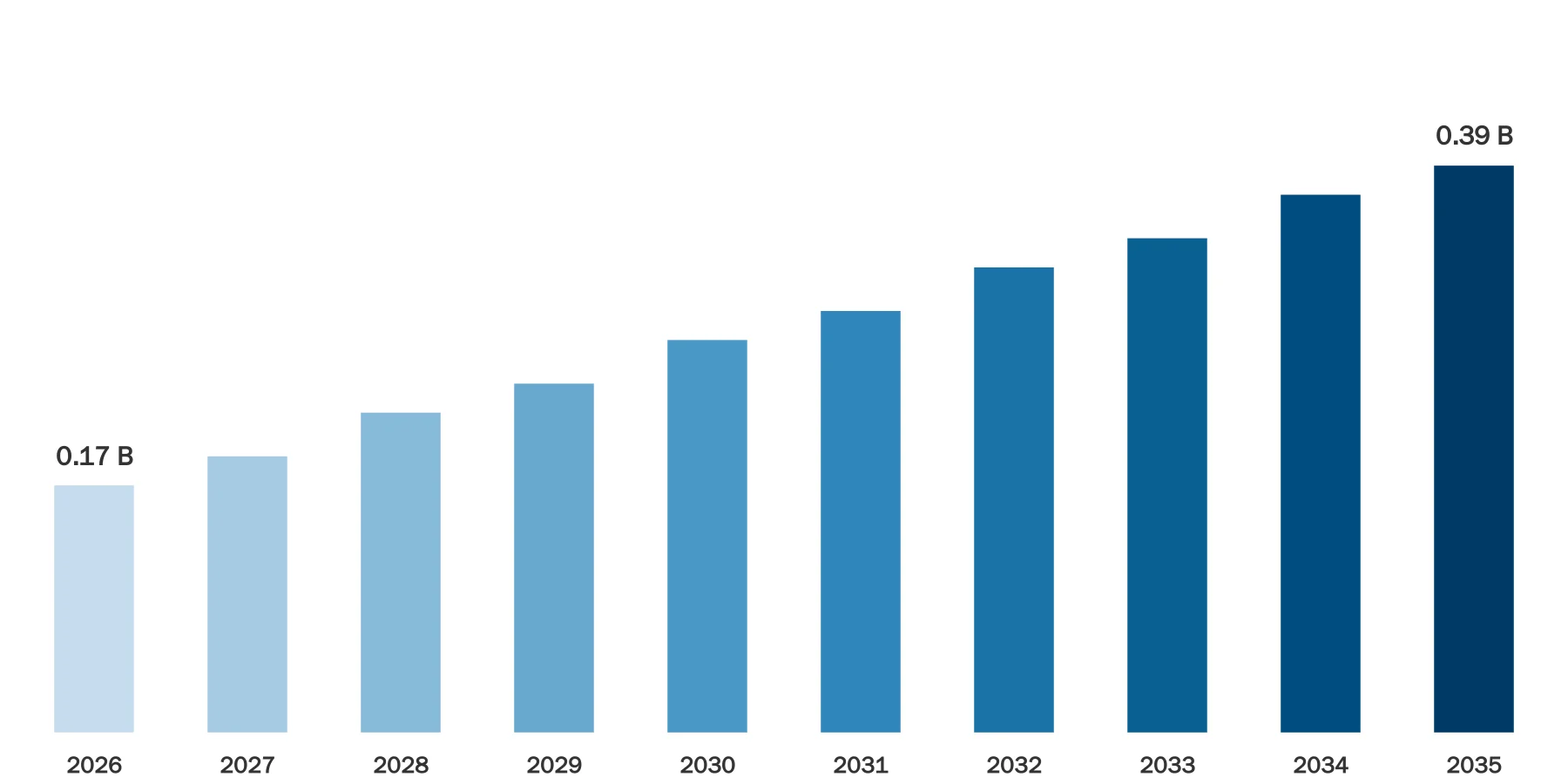
Source: Econ Market Research
The Global InGaAs (Indium Gallium Arsenide) Camera market is experiencing rapid growth, driven by its wide application in industries such as aerospace, defense, healthcare, and research. InGaAs cameras utilize a unique semiconductor material, InGaAs, which allows for imaging in near-infrared wavelengths, making them ideal for low-light conditions and high-speed imaging. These cameras offer superior performance compared to traditional silicon-based cameras, especially in applications requiring high sensitivity and resolution beyond the visible spectrum.
The market is propelled further by the increasing demand for advanced imaging solutions in various sectors, including surveillance, spectroscopy, and Industrial Automation. Moreover, technological advancements, such as the development of compact and cost-effective InGaAs camera modules, are fuelling market expansion. However, challenges such as high manufacturing costs and limited availability of raw materials may hinder market growth to some extent.
Ingaas Camera Dynamics
The market is expanding because to technological advancements including the creation of more compact and effective InGaAs sensors and the incorporation of sophisticated features like time-resolved imaging and multispectral imaging. Additionally, the market is expanding due to the growing need for high-performance imaging solutions across a variety of applications, such as industrial automation, medical imaging, and military and security surveillance. Furthermore, new opportunities are being created for market players by the increasing use of InGaAs cameras in developing industries like Augmented Reality applications and driverless cars.
In addition, the market',s vitality is being bolstered by leading industry players forming strategic agreements and collaborations. Businesses are concentrating more on joint ventures, mergers, and acquisitions in order to broaden their product offerings, reach a wider audience, and seize new opportunities. The market is also being shaped by investments in R&,D projects that attempt to lower production costs, enhance the performance of InGaAs cameras, and solve important technological issues. Nevertheless, the market confronts obstacles like the scarcity of premium InGaAs substrates and the difficulty of producing InGaAs-based products. Market participants also face substantial obstacles from volatile raw material prices and strict regulations around export controls and intellectual property rights.
Ingaas Camera Drivers
Technological Advancements
The market is expected to increase significantly due to the ongoing technological advancements in InGaAs camera technology. These developments include the development of more compact and effective sensors, increased spectrum sensitivity, and better image processing powers. For example, the incorporation of time-resolved imaging and multispectral imaging capabilities into InGaAs cameras allows users to take more precise and detailed pictures at a greater variety of wavelengths and speeds. Consequently, the market is expanding as a result of the growing adoption of InGaAs cameras by the aerospace, defense, and healthcare industries for uses such target recognition, remote sensing, and medical diagnostics.
Increasing Demand Across Diverse Industries
The growing demand for high-performance imaging solutions across various industries is another key driver for the InGaAs camera market. InGaAs cameras offer unique advantages such as high sensitivity, low noise, and fast imaging speeds, making them well-suited for applications that require imaging beyond the visible spectrum, such as near-infrared spectroscopy and thermal imaging. Industries such as pharmaceuticals, agriculture, and semiconductor manufacturing are leveraging InGaAs cameras for quality control, process monitoring, and defect detection, fueling market growth. Additionally, the rising adoption of InGaAs cameras in emerging fields like Autonomous Vehicles, augmented reality, and virtual reality presents new growth opportunities for market players.
Restraints:
High Manufacturing Costs
One of the primary restraints for the InGaAs camera market is the high manufacturing costs associated with InGaAs sensors and camera modules. The complex manufacturing processes involved in producing high-quality InGaAs devices contribute to elevated production expenses, which are ultimately passed on to end-users in the form of higher prices. As a result, the affordability of InGaAs cameras remains a significant barrier for widespread adoption, particularly in cost-sensitive applications and industries.
Limited Availability of Raw Materials
The limited availability of high-quality InGaAs substrates is another restraint impacting the market. InGaAs is a compound semiconductor material comprised of indium, gallium, and arsenic, which are not as abundant or readily available as silicon. This scarcity of raw materials can lead to supply chain disruptions, price fluctuations, and production delays, hindering market growth. Additionally, stringent regulations governing the export and use of certain materials, particularly indium and gallium, further exacerbate supply challenges for InGaAs camera manufacturers.
Opportunities:
Emerging Applications in Advanced Technologies
The rapid advancement of technologies such as autonomous vehicles, augmented reality (AR), and virtual reality (VR) presents significant opportunities for the InGaAs camera market. InGaAs cameras are well-suited for these applications due to their ability to capture high-resolution images in low-light conditions and beyond the visible spectrum. For example, InGaAs cameras can be used in autonomous vehicles for night vision systems, obstacle detection, and pedestrian recognition, enhancing safety and driving efficiency. Similarly, in AR/VR applications, InGaAs cameras enable users to interact with virtual environments more realistically by capturing detailed depth and spatial information.
Segment Overview
By Cooling Technology
InGaAs cameras are categorized based on their cooling technology, which significantly impacts their performance and application range. Cooled cameras utilize advanced cooling systems such as thermoelectric or Stirling coolers to maintain the sensor at low temperatures, enhancing sensitivity and reducing noise levels. These cameras are preferred for demanding applications requiring high sensitivity and long exposure times, such as spectroscopy and astronomy.
On the other hand, uncooled cameras do not require cooling systems and operate at ambient temperatures, making them more compact, energy-efficient, and cost-effective. While uncooled cameras offer lower sensitivity compared to cooled counterparts, they are suitable for applications where size, power consumption, and cost are critical factors, such as industrial automation, thermal imaging, and portable devices.
By Scanning Type
Another key segmentation criterion is based on the scanning type employed by InGaAs cameras. Area scan cameras capture images of entire scenes at once, making them suitable for applications requiring high-resolution imaging of stationary objects or scenes. These cameras are commonly used in industrial inspection, medical imaging, and surveillance applications. In contrast, line scan cameras capture images line by line, enabling the scanning of moving objects or continuous processes with high precision and speed. Line scan cameras are ideal for applications such as web inspection, food sorting, and document scanning, where continuous monitoring and high-speed imaging are essential.
By Application
InGaAs cameras find diverse applications across various industries and sectors, including military and defense, industrial automation, surveillance, safety, security, scientific research, and others. In military and defense applications, InGaAs cameras are used for night vision, target identification, and remote sensing. In industrial automation, these cameras facilitate quality control, process monitoring, and defect detection in manufacturing processes.
Surveillance, safety, and security applications leverage InGaAs cameras for perimeter monitoring, intruder detection, and critical infrastructure protection. In scientific research, these cameras enable spectroscopy, fluorescence imaging, and hyperspectral imaging for studying materials, chemicals, and biological samples. Furthermore, InGaAs cameras are deployed in a wide range of other applications, including environmental monitoring, agriculture, healthcare, and telecommunications, showcasing their versatility and importance across multiple domains.
Ingaas Camera Overview by Region
North America dominates the global market, driven by the presence of key market players, substantial investments in research and development, and high demand from industries such as aerospace, defense, and healthcare. The region benefits from robust infrastructure, strong government support for innovation, and a mature industrial ecosystem, contributing to the widespread adoption of InGaAs cameras across diverse applications.
Europe follows closely, buoyed by growing demand from sectors like industrial automation, surveillance, and scientific research. The region boasts a strong manufacturing base, a skilled workforce, and stringent quality standards, fostering the development and adoption of advanced imaging solutions. Additionally, initiatives promoting sustainable development and investments in emerging technologies further fuel market growth in Europe.
The Asia Pacific region is poised for rapid growth, driven by expanding industrialization, increasing investments in infrastructure, and rising demand from sectors such as automotive, electronics, and healthcare. Countries like China, Japan, and South Korea are at the forefront of technological innovation and manufacturing excellence, driving the adoption of InGaAs cameras for various applications. Moreover, the region',s growing population, urbanization, and focus on enhancing security and safety standards present significant opportunities for market players.
Latin America and the Middle East &, Africa regions are also witnessing steady growth, albeit at a slower pace compared to other regions. Factors such as improving economic conditions, infrastructure development, and increasing investments in sectors like healthcare, oil &, gas, and agriculture contribute to market expansion in these regions.
Ingaas Camera Market Competitive Landscape
Leading companies such as Hamamatsu Photonics, Teledyne DALSA, Sensors Unlimited (a part of Collins Aerospace), and Xenics dominate the market, leveraging their strong R&,D capabilities, extensive industry experience, and global presence to maintain competitive positions. These companies focus on developing advanced InGaAs camera solutions tailored to specific industry requirements, including high sensitivity, high resolution, and fast imaging speeds. Moreover, strategic partnerships, mergers, and acquisitions are common strategies employed by market players to strengthen their market foothold and gain a competitive edge. Additionally, emerging players and start-ups are entering the market with innovative technologies and niche offerings, intensifying competition further.
Ingaas Camera Market Leading Companies:
Hamamatsu Photonics K.K.
Allied Vision Technologies GmbH
FLIR Systems Inc.
Teledyne Technologies Inc.
Jenoptik AG
Thorlabs Inc.
Coherent Inc.
Xenics nv
Raptor Photonics Limited
New Imaging Technologies (NIT)
Ingaas Camera Recent Developments
In January 2023, Lucid Vision Labs introduced its latest industrial vision cameras, the Triton SWIR series, featuring 1.3MP and 0.3MP models. These cameras are IP67-rated and utilize GigE PoE technology. Equipped with Sony SenSWIR sensors (1.3MP IMX990 and 0.3MP IMX991 InGaAs), they offer wide-band coverage and high sensitivity, allowing them to capture images across both visible and invisible light spectra. Additionally, these cameras boast a pixel size of 5&mu,m.
Ingaas Camera Report Segmentation
Ingaas Camera Market Report Scope & Segmentation
| Attributes | Details |
|---|---|
Market Size (Current) | US$ 0.17 Billion in 2026 |
Market Size (Forecast) | US$ 0.39 Billion in 2035 |
Growth Rate | CAGR of 9.2% from 2026 to 2035 |
Forecast Period | 2026 – 2035 |
Base Year | 2025 |
Historical Data Available | Yes |
Regional Scope | Global |
Segments Covered | By Cooling Technology
By Application
|
Frequently Asked Questions
Common questions about this report
The study period covers historical insights and forecast projections for the period 2026-2035.
About the Author
Market research expert with years of industry experience

Related Reports
Explore more market insights from the same category