

Grid Scale Battery Source Market
Grid Scale Battery Source Market Size, Share, Trends, Growth, and Industry Analysis, By Battery Chemistry (Lithium-ion, Lead-acid, Redox Flow, Sodium-based, Others), By Ownership (Third-party Owned, Utility Owned), By Application (Renewables, Peak Shifting, Ancillary Services, Backup Power, Others), Regional Analysis and Forecast Period 2026-2035
Grid Scale Battery Source Market Overview
As per Econ Market Research analysis, the Global Grid Scale Battery Source Market was recorded at US$ 14.59 Billion in 2026 and is projected to expand to US$ 56.3 Billion by 2035, registering a CAGR of 15.7% over the forecast period. The base year used is 2025.
Grid Scale Battery Source Market Size 2025-2035 (USD Billion)

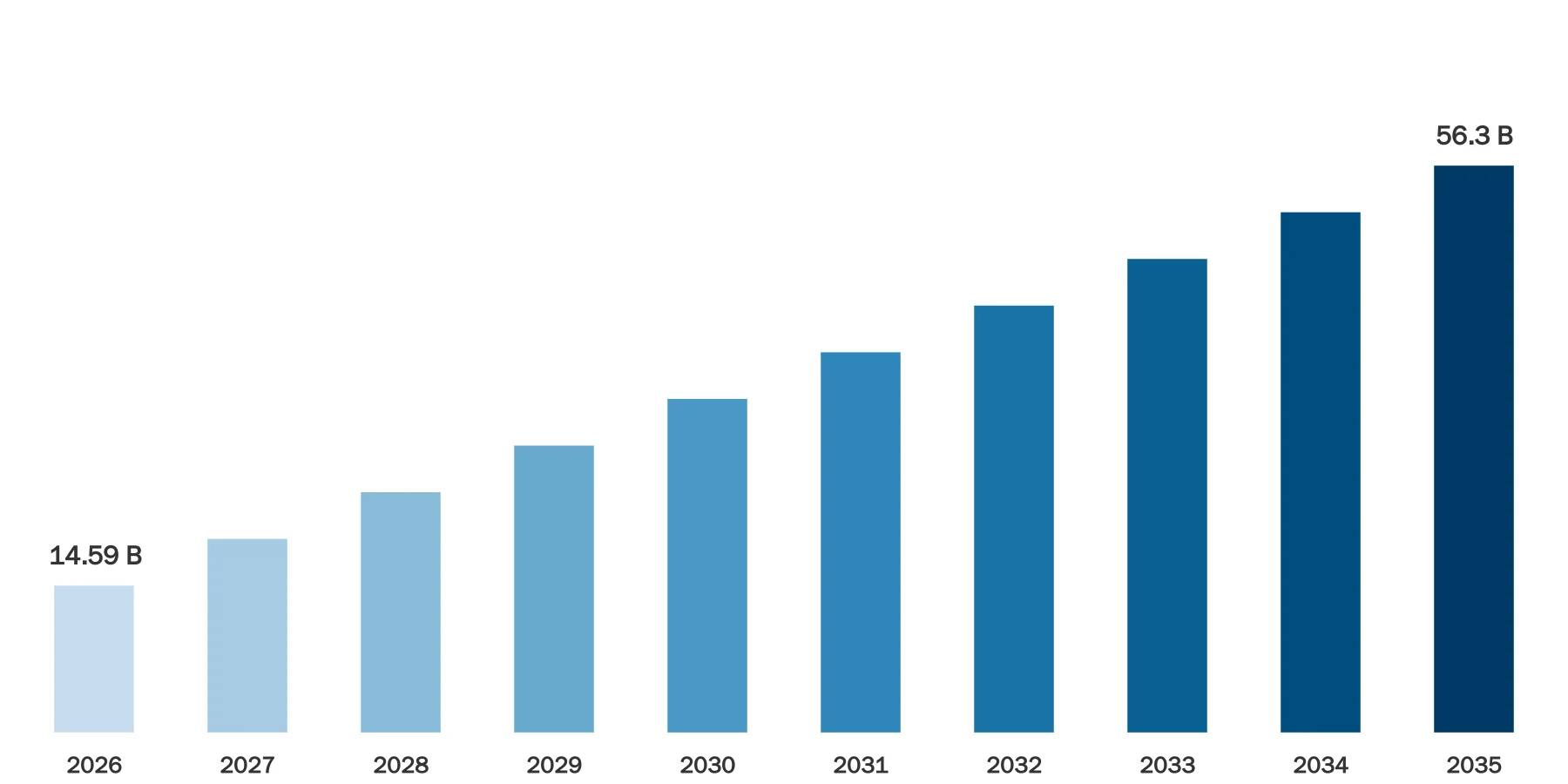
Source: Econ Market Research
The Global Grid-Scale Battery Storage Market encompasses the deployment of large-scale energy storage systems designed to store electricity generated from various sources like renewable energy, fossil fuels, or nuclear power plants. These batteries are integrated into power grids to provide stability, manage peak demand, enhance reliability, and support the integration of renewable energy sources by storing excess electricity for later use. The market has witnessed significant growth due to increasing renewable energy integration, grid modernization efforts, and the need for reliable energy storage solutions to address intermittency issues associated with renewable sources.
Technological advancements, declining battery costs, and supportive government policies promoting energy storage deployment further drive market expansion. Key players in the market include Tesla, LG Chem, BYD, and Panasonic, among others, with lithium-ion batteries dominating the market due to their high energy density, efficiency, and declining costs. The Asia-Pacific region leads in grid-scale battery deployments, followed by North America and Europe. However, challenges such as regulatory barriers, limited grid infrastructure, and concerns regarding battery safety and environmental impact pose constraints to market growth. Nonetheless, the increasing demand for energy storage solutions, coupled with efforts to decarbonize the energy sector and achieve sustainability goals, is expected to drive substantial market growth in the coming years.
Grid Scale Battery Source Dynamics
Grid-scale batteries are becoming more and more efficient and cost-effective due to technological advancements in battery storage systems, particularly in lithium-ion technology, which is lowering costs and increasing energy density. Further driving market expansion is the growing need for energy storage solutions to mitigate intermittency problems and guarantee grid stability as renewable energy sources like solar and wind become more common.
Grid-scale battery deployments are encouraged and subsidised by government programmes and policies that aim to integrate renewable energy sources, lower carbon emissions, and update grid infrastructure. Furthermore, new opportunities for grid-scale batteries to provide vehicle-to-grid (V2G) services are being created by the electrification of transportation and the rise of electric vehicles (EVs). These opportunities will improve grid flexibility and resilience and facilitate the integration of EVs into the energy ecosystem.
However, the market faces several challenges and uncertainties. Regulatory complexities and grid interconnection standards vary across regions, posing barriers to market entry and deployment. Concerns regarding battery safety, performance degradation, and environmental impact also remain significant considerations for stakeholders. Moreover, the economic viability of grid-scale battery projects and the lack of standardized business models for energy storage pose challenges for investors and developers.
Grid Scale Battery Source Drivers
Renewable Energy Integration:
The increasing penetration of renewable energy sources such as solar and wind power is a major driver for the grid-scale battery storage market. Renewable energy generation is inherently intermittent, depending on weather conditions, and often does not align with peak demand periods. Grid-scale batteries help mitigate this intermittency by storing excess renewable energy during times of low demand and releasing it during peak periods, enhancing grid stability and reliability. As countries worldwide strive to transition towards cleaner energy systems and reduce dependence on fossil fuels, the demand for grid-scale battery storage solutions is expected to surge, driven by the need to efficiently integrate renewable energy into existing grids.
Technological Advancements and Cost Reductions:
The cost of batteries has significantly decreased, and their energy density and efficiency have increased as a result of ongoing advancements in battery technologies, particularly in lithium-ion chemistry. Grid-scale battery storage projects become more economically feasible as battery costs decrease, which attracts utilities, grid operators, and developers of renewable energy sources.
Furthermore, developments in materials science, manufacturing techniques, and battery management systems are boosting battery lifespans and performance, which raises the value proposition of grid-scale battery storage solutions. Because of this, the global market is seeing an increase in grid-scale battery deployments, especially in areas where renewable energy is widely used. This is because stakeholders want to use energy storage',s advantages to improve grid performance and encourage the integration of renewable energy sources.
Restraints:
Regulatory and Policy Uncertainty:
The regulatory frameworks pertaining to grid-scale battery storage exhibit significant regional variation, complexity, and frequent modifications. Regulations, permitting procedures, and grid interconnection standards that lack clarity can impede market expansion and discourage investment in grid-scale battery projects. The scalability of grid-scale battery deployments may be limited by inconsistent policy support and incentive programmes, especially in emerging markets where regulatory frameworks may be less developed or stable.
Environmental and Safety Concerns:
Despite the environmental benefits of grid-scale battery storage in facilitating renewable energy integration and reducing greenhouse gas emissions, concerns persist regarding the environmental and safety impacts of battery manufacturing, operation, and disposal. The extraction of raw materials such as lithium, cobalt, and nickel for battery production can have adverse environmental consequences, including habitat destruction, water pollution, and carbon emissions.
Additionally, the risk of battery fires, chemical leaks, and hazardous waste disposal poses safety concerns for communities and regulators. Addressing these environmental and safety challenges is essential to ensure the sustainable growth of the grid-scale battery storage market and build public confidence in the safety and reliability of energy storage technologies.
Opportunities:
Electric Vehicle Integration and Vehicle-to-Grid (V2G) Services:
With the increasing popularity of EVs, grid-scale battery storage has a big chance to offer vehicle-to-grid (V2G) services that allow energy to flow both ways between EV batteries and the grid. With the use of V2G technology, extra renewable energy from EV batteries can be stored and released back into the grid during periods of high demand, assisting in the stabilisation of grid operations and the balancing of supply and demand.
Grid operators can improve grid flexibility, optimise energy consumption, and reduce infrastructure investments by utilising EV batteries as mobile energy storage assets. Meanwhile, EV owners may be able to profit from their vehicle batteries by taking part in grid services, which would open up new revenue streams and provide incentives for EV adoption and grid-scale battery deployment.
Segment Overview
By Battery Type
The segmentation of the grid-scale battery storage market by battery type encompasses three primary categories: Lead-Acid Battery, Lithium-ion Battery, and Others. Lead-acid batteries, while being one of the oldest and most established battery technologies, offer relatively low upfront costs but are limited in terms of energy density, cycle life, and efficiency compared to newer battery chemistries. Lithium-ion batteries, on the other hand, have emerged as the preferred choice for grid-scale applications due to their high energy density, longer cycle life, and faster response times.
Lithium-ion batteries offer superior performance and efficiency, making them well-suited for applications requiring frequent cycling, high power output, and fast charging/discharging capabilities. The ",Others", category encompasses a variety of battery chemistries and technologies, including sodium-ion, flow batteries, and advanced lead-acid batteries, which are being researched and developed for specific grid-scale applications but have not yet achieved widespread commercial adoption.
By Application
Regarding application segmentation, grid-scale battery storage finds diverse use cases across multiple applications. Frequency regulation involves the real-time adjustment of power output to match fluctuations in grid frequency, helping maintain grid stability and reliability. Battery storage systems provide rapid response times and precise control, making them well-suited for frequency regulation services. Bill management applications involve peak shaving and demand charge management, where batteries are used to reduce electricity costs by storing energy during off-peak periods and discharging it during peak demand hours when electricity prices are higher.
Load shifting involves storing surplus energy during times of low demand and releasing it during peak demand periods, helping utilities manage load profiles and optimize grid operations. Other applications of grid-scale battery storage include renewable energy integration, backup power supply, voltage support, and grid congestion management, among others.
Each application leverages the unique capabilities of battery storage systems to address specific grid challenges and optimize energy management strategies, contributing to the overall reliability, resilience, and efficiency of modern power grids. As the grid-scale battery storage market continues to evolve and mature, innovations in battery technology, system design, and business models are expected to unlock new opportunities and drive further growth across these diverse application segment.
Grid Scale Battery Source Overview by Region
In the Asia-Pacific region, countries like China, Japan, South Korea, and Australia are leading the market with ambitious renewable energy targets and supportive government policies promoting energy storage deployment. China, in particular, has emerged as a dominant player in the global battery storage industry, driven by its significant investments in lithium-ion battery manufacturing and deployment. Japan and South Korea are also actively investing in grid-scale battery storage to support their renewable energy transition and enhance grid stability. Australia, with its abundant solar and wind resources, has become a hotbed for grid-scale battery projects, spurred by initiatives like the South Australian Virtual Power Plant and the Hornsdale Power Reserve.
In North America, the United States is the largest market for grid-scale battery storage, driven by state-level renewable energy mandates, declining battery costs, and federal tax incentives supporting energy storage deployment. California leads the way with ambitious energy storage targets and innovative procurement mechanisms like the Integrated Resource Plan and the Self-Generation Incentive Program. Other regions in North America, including New York, Texas, and Hawaii, are also witnessing significant investments in grid-scale battery storage to integrate renewable energy, enhance grid resilience, and reduce greenhouse gas emissions.
In Europe, countries like Germany, the United Kingdom, and France are driving grid-scale battery deployment as part of their efforts to transition towards low-carbon energy systems and achieve renewable energy targets. The European Union',s Clean Energy for All Europeans package and initiatives like the European Battery Alliance are fostering collaboration and investment in battery manufacturing and research to support the region',s energy transition goals. Additionally, emerging markets in Latin America, Africa, and the Middle East are beginning to explore grid-scale battery storage as a means to address energy access challenges, improve grid reliability, and capitalize on abundant renewable energy resources.
Grid Scale Battery Source Market Competitive Landscape
Key players such as Tesla, LG Chem, BYD, Panasonic, and Samsung SDI dominate the market with extensive portfolios of lithium-ion battery products and solutions tailored for grid-scale applications. These companies leverage their technological expertise, manufacturing capabilities, and economies of scale to offer high-performance battery storage systems with competitive pricing and reliability.
In addition to established players, a growing number of startups and emerging companies are entering the market with innovative battery chemistries, system designs, and software solutions aimed at addressing specific challenges in grid-scale energy storage. Companies like Fluence Energy, Stem Inc., and Greensmith Energy (a Wä,rtsilä, company) specialize in providing advanced energy storage solutions and grid optimization services, leveraging Artificial Intelligence, machine learning, and predictive analytics to maximize the value of battery assets for utilities, grid operators, and commercial customers.
Furthermore, traditional energy companies and industrial conglomerates are expanding their presence in the grid-scale battery storage market through strategic partnerships, acquisitions, and investments in battery technology and project development. Utilities such as NextEra Energy, Duke Energy, and Enel are actively investing in battery storage projects to enhance grid reliability, integrate renewable energy, and optimize asset performance. Similarly, major industrial players like Siemens, General Electric, and ABB are developing grid-scale energy storage solutions and smart grid technologies to capitalize on the growing demand for flexible and resilient energy infrastructure.
Grid Scale Battery Source Market Leading Companies:
ABB Ltd
BYD Co. Ltd.
Contemporary Amperex Technology Co. Ltd. (CATL)
Fluence Energy
General Electric (GE)
GS Yuasa Corporation
LG Chem Ltd.
Mitsubishi Electric Corporation
NGK Insulators Ltd.
Panasonic Corporation
Samsung SDI Co. Ltd.
Saft Groupe S.A.
Tesla Inc.
Grid Scale Battery Source Recent Developments
Oct 2023, Plus Power LLC has finalized $1.8 billion in fresh financing dedicated to standalone battery storage, marking the largest project financing of its kind to date. This initiative aims to enhance the stability of the U.S. electrical grid while accommodating the increased integration of solar and wind energy sources.
Global Grid Scale Battery Source Report Segmentation
Grid Scale Battery Source Market Report Scope & Segmentation
| Attributes | Details |
|---|---|
Market Size (Current) | US$ 14.59 Billion in 2026 |
Market Size (Forecast) | US$ 56.3 Billion in 2035 |
Growth Rate | CAGR of 15.7% from 2026 to 2035 |
Forecast Period | 2026 – 2035 |
Base Year | 2025 |
Historical Data Available | Yes |
Regional Scope | Global |
Segments Covered | By Battery Chemistry
By Ownership
By Application
|
Frequently Asked Questions
Common questions about this report
The study period covers historical insights and forecast projections for the period 2026-2035.
About the Author
Market research expert with years of industry experience

Related Reports
Explore more market insights from the same category