

Geogrid Market
Geogrid Market Size, Share, Trends, Growth, and Industry Analysis, By Material Type (Polymer, Metallic, Fiberglass), By Application (Road Construction, Railway Construction, Soil Reinforcement, Slope Protection, Retaining Walls), By End-Use (Infrastructure, Transportation, Mining, Environmental Engineering), Regional Analysis and Forecast Period 2026-2035
Geogrid Market Overview
As per Econ Market Research analysis, the Global Geogrid Market accounted for US$ 2.69 Billion in 2026 and is expected to surpass US$ 4.51 Billion by 2035, witnessing a CAGR of 5.90% throughout 2026–2035. The analysis is based on 2025 as the base year.
Geogrid Market Size 2025-2035 (USD Billion)

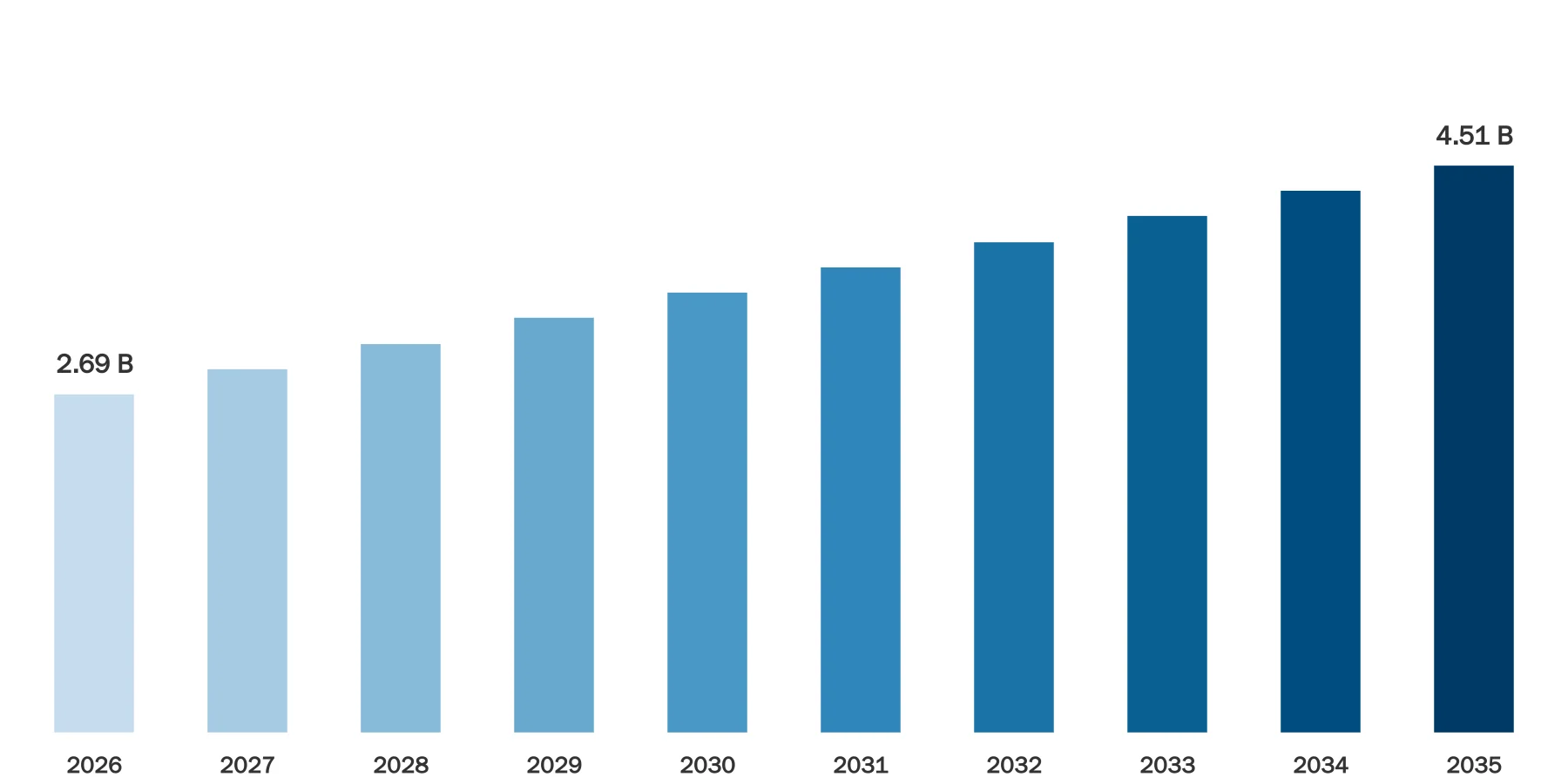
Source: Econ Market Research
The Geogrid Market Report highlights that geogrids are polymer-based reinforcement materials widely used in civil engineering, with over 65% of global demand linked to road construction projects involving more than 1.2 million kilometers of highways annually. Geogrids improve load distribution by up to 40% and extend pavement life by approximately 2–3 times compared to conventional methods. More than 70 countries actively use geogrid-based reinforcement systems in infrastructure development. The Geogrid Industry Analysis indicates that biaxial geogrids account for nearly 45% of total installations, while uniaxial variants contribute around 35%, demonstrating diversified usage across 3 major application segments: roads, railways, and retaining walls.
The USA Geogrid Market Analysis shows that over 4 million kilometers of roads exist nationwide, with approximately 25% requiring rehabilitation every 5–7 years, driving demand for geogrid materials. Around 60% of geogrid consumption in the U.S. is associated with highway and interstate maintenance projects exceeding 80,000 miles. The Geogrid Market Insights reveal that state-level transportation departments in all 50 states utilize geogrids in some capacity, with over 35% adoption in soil stabilization projects. Additionally, landfill applications in the USA account for nearly 15% of geogrid use, supporting over 2,600 active landfill sites with reinforced liners and slopes.
Market Latest Trends
The Geogrid Market Trends indicate increasing adoption of high-performance polymer geogrids, with polyethylene and polypropylene accounting for over 85% of production materials globally. Around 55% of infrastructure projects initiated in 2024 incorporated geogrids for soil stabilization and erosion control. The Geogrid Market Research Report shows that digital modeling and simulation tools have improved design accuracy by nearly 30%, enabling optimized geogrid placement across 10+ engineering applications. Sustainable construction trends reveal that approximately 40% of new projects prioritize recyclable geogrid materials, reducing environmental impact by up to 25%.
The Geogrid Market Outlook highlights the integration of geogrids in railway expansion projects, with more than 150,000 kilometers of railway tracks globally utilizing reinforcement systems. Smart infrastructure initiatives in over 20 countries are incorporating geogrids into foundation systems, improving load-bearing capacity by 35%. The Geogrid Industry Report also identifies growing use in mining operations, where geogrids enhance slope stability in over 1,200 mining sites worldwide. Additionally, Modular Construction methods have increased geogrid installation efficiency by nearly 20%, supporting faster project completion timelines across 5 major sectors.
Market Dynamics
The Geogrid Market Analysis identifies key dynamics influencing demand, including infrastructure expansion, environmental regulations, and technological innovation. Approximately 70% of global infrastructure investments involve soil reinforcement techniques, where geogrids play a critical role. Urbanization rates exceeding 55% globally have increased demand for stable foundations across 200+ metropolitan regions. The Geogrid Market Growth is further supported by government initiatives in over 30 countries focusing on sustainable construction practices and reducing maintenance costs by up to 30%.
DRIVER
Increasing Infrastructure Development Activities
Infrastructure development is the primary driver of the Geogrid Market Size, with over 2 trillion square meters of construction projects initiated annually worldwide. Road construction alone accounts for nearly 50% of geogrid demand, with over 500,000 kilometers of new roads constructed each year. Geogrids enhance pavement durability by 2–3 times and reduce aggregate usage by approximately 30%, making them cost-efficient for large-scale projects. The Geogrid Market Forecast indicates that more than 60% of developing nations are investing heavily in transportation infrastructure, including highways, railways, and ports, creating sustained demand for geogrid solutions across 4 key regions.
RESTRAINT
High Initial Installation Costs
Despite widespread adoption, high initial installation costs remain a significant restraint in the Geogrid Market Insights. Geogrid materials can increase upfront project costs by 10–20% compared to traditional methods, limiting adoption in cost-sensitive regions. Approximately 40% of small-scale contractors prefer conventional reinforcement techniques due to lower initial expenses. The Geogrid Industry Analysis also reveals that installation requires skilled labor, with training costs increasing project budgets by nearly 15%. Additionally, fluctuations in raw material prices, particularly polymers, impact production costs in over 25% of manufacturing facilities globally.
OPPORTUNITY
Expansion in Emerging Economies
Emerging economies present significant opportunities in the Geogrid Market Opportunities, with over 60% of infrastructure growth occurring in Asia-Pacific and Africa. Countries such as India and China collectively account for more than 35% of global construction activities, with over 100,000 kilometers of roads under development annually. The Geogrid Market Report shows that government initiatives supporting sustainable construction have increased adoption rates by nearly 20% in these regions. Additionally, urban population growth exceeding 3 billion people globally drives demand for reinforced foundations in residential and commercial projects across 10 major urban clusters.
CHALLENGES
Limited Awareness and Technical Expertise
Limited awareness and technical expertise pose challenges in the Geogrid Market Growth, particularly in developing regions where less than 30% of contractors are familiar with advanced geogrid applications. Training programs are required in over 50 countries to improve adoption rates. The Geogrid Industry Report indicates that improper installation can reduce effectiveness by up to 25%, leading to performance issues. Furthermore, lack of standardized guidelines in approximately 20% of regions creates inconsistencies in application, affecting overall market penetration across 3 major construction sectors.
SWOT Analysis
Strengths
Geogrids improve load-bearing capacity by up to 40%, enhancing infrastructure durability.
Over 70% of road construction projects benefit from geogrid reinforcement systems.
Polymer-based materials ensure longevity exceeding 20–30 years in most applications.
Reduction in maintenance frequency by nearly 25% supports long-term cost efficiency.
Weaknesses
Initial installation costs are 10–20% higher than traditional methods.
Skilled labor requirements increase project costs by approximately 15%.
Limited awareness in 40% of developing regions restricts adoption.
Raw material price fluctuations affect production stability in over 25% of facilities.
Opportunities
Infrastructure investments exceeding 60% growth in emerging economies.
Railway expansion projects covering over 150,000 kilometers globally.
Sustainable construction demand rising in 40% of new projects.
Mining sector applications across 1,200+ sites worldwide.
Threats
Competition from alternative reinforcement methods used in 30% of projects.
Regulatory variations in over 20 countries affecting standardization.
Economic slowdowns impacting construction activities in 15% of regions.
Supply chain disruptions influencing polymer availability in 25% of markets.
Segmentation Analysis
The Geogrid Market Segmentation is categorized by material type, application, and end-use, covering over 3 major dimensions of industry demand. Material types include polypropylene, polyester, and polyethylene, accounting for more than 90% of total production. Applications span roads, railways, and retaining walls, representing over 80% of usage. End-use sectors include construction, mining, and agriculture, contributing to diversified demand across 10+ industries. The Geogrid Market Share distribution highlights that construction dominates with nearly 65%, followed by mining at 20% and agriculture at 15%.
By Material Type
Polypropylene geogrids dominate the Geogrid Market Size with approximately 50% share due to their high tensile strength exceeding 30 kN/m and durability in extreme conditions. Polyester geogrids account for nearly 30% of the market, offering superior creep resistance and long-term stability for over 25 years. Polyethylene geogrids contribute around 20%, widely used in environmental applications such as landfills and erosion control. The Geogrid Industry Analysis indicates that over 80% of biaxial geogrids are made from polypropylene, while uniaxial variants primarily use polyester materials in 60% of cases.
By Application
Road construction leads the Geogrid Market Growth with nearly 50% share, supported by over 1.2 million kilometers of global road networks requiring reinforcement. Railway applications account for approximately 20%, with geogrids improving track stability by up to 35%. Retaining walls represent around 15%, while erosion control and landfill applications collectively contribute 15%. The Geogrid Market Insights show that over 70% of highway projects incorporate geogrids, reducing maintenance costs by nearly 30% and increasing pavement lifespan by 2–3 times.
By End-Use
The construction sector dominates the Geogrid Market Outlook with around 65% share, driven by infrastructure projects exceeding 2 trillion square meters annually. Mining applications account for approximately 20%, with geogrids used in over 1,200 mining sites for slope stabilization. Agriculture contributes about 15%, primarily for soil reinforcement and irrigation channel stabilization. The Geogrid Market Opportunities highlight that urban development projects in over 200 cities are increasingly adopting geogrids to improve foundation stability and reduce soil erosion by up to 25%.
Regional Analysis
The Geogrid Market Forecast shows strong regional variations, with Asia-Pacific leading at approximately 40% share, followed by North America at 25%, Europe at 20%, and Middle East & Africa at 15%. Infrastructure investments exceeding 60% in emerging economies drive regional growth, while developed regions focus on maintenance and rehabilitation projects covering over 500,000 kilometers annually.
North America
North America holds around 25% of the Geogrid Market Share, with the United States contributing nearly 80% of regional demand. Over 4 million kilometers of roads and 80,000 miles of highways require continuous maintenance, driving geogrid adoption in approximately 60% of projects. Canada accounts for around 15% of regional demand, with over 1 million kilometers of road networks supported by geogrid reinforcement. The Geogrid Market Insights indicate that landfill applications in North America exceed 2,600 sites, with geogrids used in 70% of liner systems to enhance stability.
Europe
Europe represents approximately 20% of the Geogrid Market Size, with Germany, France, and the UK collectively contributing over 60% of regional demand. The region has more than 5 million kilometers of road networks, with 40% requiring rehabilitation every 5–10 years. Railway projects covering over 220,000 kilometers utilize geogrids in approximately 30% of tracks. The Geogrid Industry Report highlights that environmental regulations in over 25 European countries promote sustainable materials, increasing adoption rates by nearly 20% across construction projects.
Asia-Pacific
Asia-Pacific dominates the Geogrid Market Growth with around 40% share, driven by rapid urbanization and infrastructure development. China and India together account for over 35% of global construction activities, with more than 100,000 kilometers of roads built annually. Japan and South Korea contribute approximately 15% of regional demand, focusing on advanced geogrid technologies. The Geogrid Market Opportunities reveal that over 3 billion people in urban areas require stable infrastructure, driving demand across 10 major cities with large-scale construction projects.
Middle East & Africa
The Middle East & Africa region accounts for approximately 15% of the Geogrid Market Share, with infrastructure projects exceeding 500 billion square meters annually. The UAE and Saudi Arabia contribute nearly 40% of regional demand, focusing on transportation and urban development projects. Africa accounts for around 35%, with over 50,000 kilometers of roads under development. The Geogrid Market Outlook indicates increasing adoption in mining applications across 300+ sites, enhancing slope stability and reducing erosion by up to 25%.
Competitive Landscape
The Geogrid Market Analysis reveals a moderately consolidated competitive landscape, with top 7 companies accounting for nearly 60% of global market share. Leading players operate in over 50 countries, with production facilities exceeding 100 manufacturing units worldwide. The Geogrid Industry Report indicates that product innovation accounts for approximately 30% of competitive differentiation, while distribution networks covering 70% of global regions play a crucial role in market penetration.
Strategic partnerships and acquisitions have increased by nearly 20% between 2023 and 2025, enabling companies to expand their geographic presence across 4 major regions. The Geogrid Market Insights highlight that top manufacturers invest approximately 10–15% of their operational budgets in research and development, focusing on advanced polymer technologies and sustainable materials. Additionally, capacity expansion projects in over 15 countries have increased production output by nearly 25%, supporting growing demand across infrastructure and mining sectors.
List of Top Geogrid Companies
Tensar International
HUESKER Synthetic GmbH
NAUE GmbH & Co. KG
Officine Maccaferri
Strata Systems
Solmax
Tenax SpA
Leading Companies by Market Share
Tensar International and HUESKER Synthetic GmbH collectively account for approximately 25–30% of the Geogrid Market Share, with operations spanning over 70 countries and production capacities exceeding 500 million square meters annually. Tensar International leads with a presence in more than 50 countries and over 100 product variants, while HUESKER Synthetic GmbH operates in 60+ countries with advanced manufacturing facilities producing over 200 million square meters of geogrids annually.
Market Investment Outlook
The Geogrid Market Outlook highlights increasing investments in infrastructure projects exceeding 2 trillion square meters globally, with over 60% allocated to transportation and urban development. Governments in more than 30 countries have introduced funding programs supporting sustainable construction, driving geogrid adoption in approximately 40% of new projects. The Geogrid Market Opportunities indicate that private sector investments in construction and mining have increased by nearly 25% between 2023 and 2025.
Investment in manufacturing facilities has expanded across 15 countries, increasing production capacity by approximately 20%. The Geogrid Market Insights show that research and development spending accounts for 10–15% of total investments, focusing on high-performance materials and digital design tools. Additionally, public-private partnerships in over 20 regions have accelerated infrastructure development, creating demand for geogrid solutions across 3 major sectors: transportation, energy, and mining.
New Product Development
The Geogrid Market Trends highlight significant advancements in product development, with over 50 new geogrid variants introduced between 2023 and 2025. High-strength geogrids with tensile capacities exceeding 40 kN/m have improved load distribution by nearly 35%. The Geogrid Market Research Report indicates that biodegradable geogrids are gaining traction, accounting for approximately 10% of new product launches, reducing environmental impact by up to 20%.
Smart geogrids integrated with sensors have been developed for real-time monitoring, improving infrastructure maintenance efficiency by nearly 25%. The Geogrid Market Insights reveal that modular designs have reduced installation time by approximately 20%, enhancing project efficiency. Additionally, hybrid geogrids combining multiple materials have increased durability by up to 30%, supporting long-term performance across 5 major applications.
Recent Developments
In 2023, a major manufacturer expanded production capacity by 15%, adding 50 million square meters annually.
In 2024, a new high-strength geogrid with 45 kN/m tensile capacity was launched, improving load-bearing efficiency by 30%.
In 2025, a partnership between 2 companies enabled distribution expansion across 20 new countries.
In 2024, biodegradable geogrids were introduced, reducing environmental impact by approximately 20%.
In 2023, digital modeling tools were integrated into design processes, increasing accuracy by nearly 30%.
Report Coverage of Geogrid Market
The Geogrid Market Report provides comprehensive coverage of industry trends, segmentation, and regional analysis across 4 major regions and 10+ countries. The report includes detailed insights into material types, applications, and end-use sectors, covering over 90% of market segments. The Geogrid Market Analysis evaluates infrastructure projects exceeding 2 trillion square meters annually, highlighting demand drivers and challenges.
The Geogrid Industry Report also examines competitive dynamics, profiling 7 major companies and analyzing market share distribution across 50+ countries. Technological advancements, including smart geogrids and sustainable materials, are covered with data on over 50 product innovations. Additionally, the report includes investment trends, highlighting funding initiatives in more than 30 countries and capacity expansions across 15 regions, providing actionable insights for stakeholders operating in the global geogrid market.
Geogrid Market Report Scope & Segmentation
| Attributes | Details |
|---|---|
Market Size (Current) | US$ 2.69 Billion in 2026 |
Market Size (Forecast) | US$ 4.51 Billion in 2035 |
Growth Rate | CAGR of 5.90% from 2026 to 2035 |
Forecast Period | 2026 – 2035 |
Base Year | 2025 |
Historical Data Available | Yes |
Regional Scope | Global |
Segments Covered | By Material Type
By Application
By End-Use
|
Frequently Asked Questions
Common questions about this report
The study period covers historical insights and forecast projections for the period 2026-2035.
About the Author
Market research expert with years of industry experience

Dipali Bhingare serves as the Market Research Director at Econ Market Research. With a focus on translating complex global economic shifts into actionable business intelligence, she oversees the strategic direction of comprehensive market studies. Her work empowers organizations to navigate volatile industries through data-driven forecasting and deep-dive competitive analysis.
Related Reports
Explore more market insights from the same category