

Fuel Cells In Aerospace And Defense Market
Fuel Cells in Aerospace and Defense Market Size, Share, Trends, Growth, and Industry Analysis, By Product (PEMFC, SOFC), By Application (Aerospace, Defense), Regional Insights and Forecast Period 2026-2035
Market Overview
As per Econ Market Research analysis, the Global Fuel Cells In Aerospace And Defense Market was valued at approximately US$ 11.51 Billion in 2026 and is predicted to reach US$ 78.41 Billion by 2035, expanding at a CAGR of 23.5% over the forecast duration. The base year is 2025.
Fuel Cells In Aerospace And Defense Market Size 2025-2035 (USD Billion)

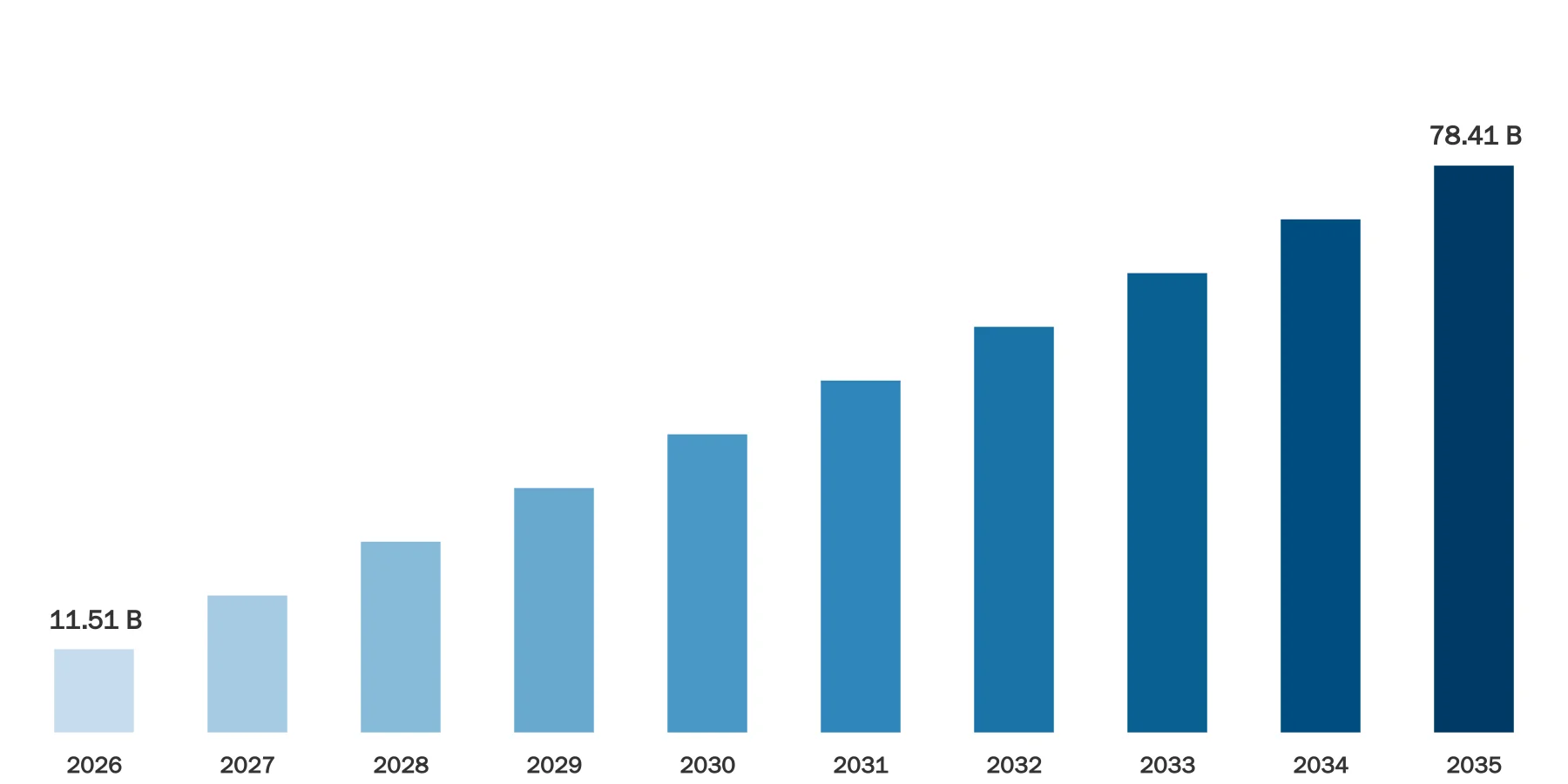
Source: Econ Market Research
The global fuel cell aerospace and defense market is highly competitive owing to the continuous technological advancements being introduced by existing vendors and new entrants. Industry key players are focusing on strengthening their relations with system installers and are looking at collaborations and mergers as strategies to help them enhance their presence in the value chain and expand their geographical presence.
Market Growth
The North American market for fuel cells in aerospace and defence is driven by significant support from the federal governments of both countries. The United Kingdom is the leading country for fuel cells in aerospace and defence in the European region. Rising military spending in the APAC region has increased demand for military defense, UAVs, and military vehicles. This, in turn, is anticipated to lead to a demand for fuel cells used in defence applications. Due to rising demand for good aerospace and defence applications, coupled with growing support from the government, this is fueling market growth. The North American region seems to be in a substantial position in terms of revenue share due to substantial support from the federal government. In the European region, the U.K. is in a leading position in terms of profits.
Growing demand for non-conventional energy resources in various countries and regions is fueling the market. Because of their ability to convert electricity through a variety of fuels, fuel cells are one of the fastest-growing alternative energy resources. Along with this, the fuel cells are conventional resources, which are eco-friendly as their by-products do not harm nature.
COVID-19 IMPACT
The recent pandemic has led to dramatic losses of human life globally and an unprecedented challenge to the manufacturing industry. The virus spread at breakneck speed around the world, contaminating millions. The unprecedented global lockdowns had resulted in a monetary fall, posing catastrophic financial challenges across sectors. Thus, the supply chain and logistics can stand still, which affects the production of fuel cells.
However, manufacturers faced bottlenecks and shortages owing to limited production in countries severely affected by COVID-19. Furthermore, upcoming fuel cell-based large-scale projects witnessed delays in commissioning due to disruptions in the supply chain and the halting of onsite construction activities in severely affected areas.
Market Driving Factors
Fuel Cells in Aerospace and Defense Market Revenue is expected to grow at a healthy CAGR, driven by unprecedented demand from emerging markets. Digital technology advances in the Fuel Cells for Aerospace and Defense market are enabling efficient production, effective operational maintenance, expanding portfolios, and sales monitoring. Proliferating demand for smart storage, decentralised networks, intelligent automation, and increasing disposable incomes in fast-flourishing developing nations are a few of the key market developments. The post-pandemic economic recovery, which boosts energy consumption and automotive, industrial, and consumer goods sales, leads to an impressive growth rate in 2021.
However, complying with stringent regulations and varying standards around the world, growing competition, and inflation are estimated to remain above. The upper band during the short term in key nations and fluctuating raw material prices are some of the Fuel Cells In Aerospace and Defense market restraints for the forecast period.
Market Analytics
The research analyses various direct and indirect forces that can potentially impact the supply and demand conditions for fuel cells in the aerospace and defence markets. To better prospect Fuel Cells in Aerospace and Defense market opportunities, the parent market, derived market, intermediaries', market, raw material market, and substitute market are all evaluated. To estimate the best fuel cell market projections for aerospace and defense, geopolitical analysis, demographic analysis, and Porter',s five forces analysis are prudently assessed.
Fuel Cells in Aerospace and Defense: Trade and Price Analysis helps comprehend Fuel Cells in Aerospace and Defense',s international market scenario with top exporters, suppliers, and importers, as well as customer information. The data and analysis assist our clients in planning procurement, identifying potential vendors or clients to associate with, understanding Fuel Cells in Aerospace and Defense price trends and patterns, and exploring new Fuel Cells in Aerospace and Defense market sales channels. The research will be updated to the latest month to include the impact of the latest developments, such as the Russia-Ukraine war, on the fuel cell market in aerospace and defence.
Segment Analysis
By Product Type
&bull, PEMFC (Proton exchange membrane fuel cells)
&bull, SOFC (solid oxide fuel cell)
Where PEMFC dominated the market with an 8.9% revenue share in 2021. The PEMFC is widely used for transportation applications due to its efficiency, compactness, temperature range, etc. As per Honeywell Aerospace, air-cooled PEMFC is best suited for aerospace applications However, in the aviation industry, SOFC is more efficient than PEMFC in terms of output power.
By Application
The commercial segment is projected to garner notable gain over 2023-2031 ascribing to rising domestic and international travels driven by growth in per capita income. Also, the military vehicles segments is predicted to garner substantial returns over the assessment duration due to technological advancements and surging expenditure in the field.
Regional Analysis
North America held the largest revenue share of over 45.0% in 2022 in the aerospace market. The North American fuel cell market is very beneficial for investments in various research projects that are getting commercialize. The United States is one of the major markets for fuel cells and is at the forefront of innovation with support from the country. Department of Energy (DOE). The U.S. Army and Navy are among the largest users of fuel cells in North America. Vendors operating in the market are continuously developing components for fuel cells that are used in rotorcraft.
The European Union has plans to considerably decrease GHG emissions, as a result, several countries in Europe have identified the implementation of innovative technologies, such as fuel cells (primarily PEMFC), as a way to meet these objectives. This, in turn, is expected to provide a significant opportunity for fuel cell manufacturers in the aerospace and defense markets over the forecast period.
Who are the Major Vendors in the Fuel Cells In Aerospace And Defense Market
The report analyses the competitive landscape of the market and provides information on several market vendors, including:
Honeywell International Inc.
Advent Technologies
Infinity Fuel Cell and Hydrogen, Inc.
ITM Power
Cummins Inc.
Australian Fuel Cells Pty Ltd.
Intelligent Energy Limited
HyPoint, Inc.
ElringKlinger AG
GenCell Ltd.
Plug Power, Inc.
Recent Developments
In January 2021, DLR, Germany&rsquo,s aerospace center, announced that for the BALIS project, it is developing a 1.5 MW fuel cell powertrain that will be used by aircrafts. The initial focus and goal of this project are the use of fuel cells in the aviation sector and emission-free air transport in Germany.
Fuel Cells In Aerospace And Defense Market Report Scope & Segmentation
| Attributes | Details |
|---|---|
Market Size (Current) | US$ 11.51 Billion in 2026 |
Market Size (Forecast) | US$ 78.41 Billion in 2035 |
Growth Rate | CAGR of 23.5% from 2026 to 2035 |
Forecast Period | 2026 – 2035 |
Base Year | 2025 |
Historical Data Available | Yes |
Regional Scope | Global |
Segments Covered | By Fuel Cell Type
By Fuel Type
By Platform
By Power Output
By Application
By End User
|
Frequently Asked Questions
Common questions about this report
The study period covers historical insights and forecast projections for the period 2026-2035.
About the Author
Market research expert with years of industry experience

Dipali Bhingare serves as the Market Research Director at Econ Market Research. With a focus on translating complex global economic shifts into actionable business intelligence, she oversees the strategic direction of comprehensive market studies. Her work empowers organizations to navigate volatile industries through data-driven forecasting and deep-dive competitive analysis.
Related Reports
Explore more market insights from the same category