Forex Market Overview
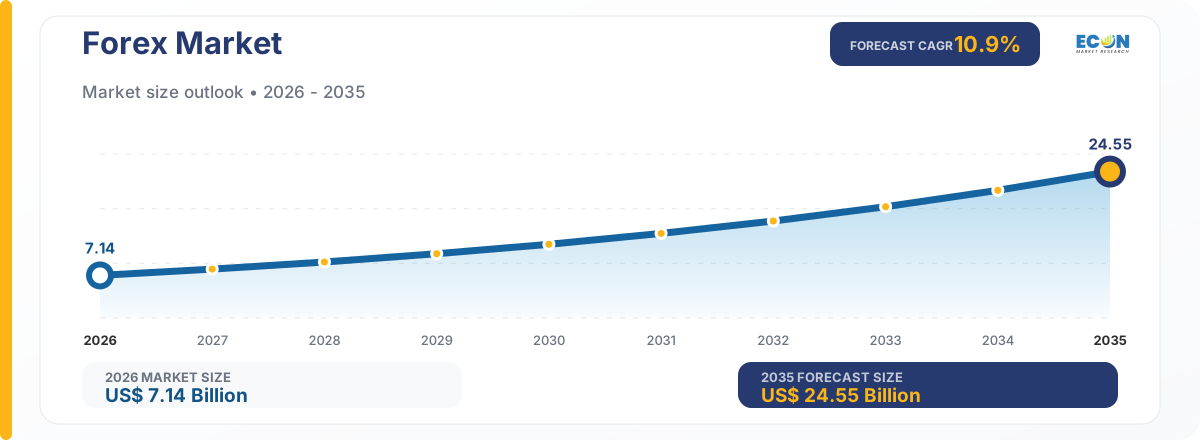
As per Econ Market Research analysis, the Global Forex Market generated revenue of US$ 7.14 Billion in 2026 and is forecast to achieve US$ 24.55 Billion by 2035, at a CAGR of 10.9% during the study period 2026–2035. The base year considered is 2025.
The global Forex market, the short form of foreign exchange market, is the largest financial market in the world where currencies are traded. It operates with a continuous operation of 24 hours a day and five days a week, allowing participants to buy, sell, exchange, and speculate upon diverse currencies. It comprises many participants, including banks, financial institutions, corporations, governments, and individual traders. The first and foremost goal in Forex trading is to benefit from the change in currency values, which can be either kicked off by economic indicators, geopolitical events, or just by the change in market sentiment.
The Forex is unique because there is no central exchange or a physical location at which to conduct trades, instead, trading takes place via computer over-the-counter (OTC) through a network of banks and brokers. With an average trading volume of more than $6 trillion per day, the Forex market will allow for the global exchange of goods and services by converting currencies. Some of the major currency pairs traded include EUR/USD, the US dollar against the Japanese yen, and GBP/USD, the British pound versus the US dollar. Forex has an important place in the world economy. It contributes to determining global trade, investments, and the financial strength of countries. The Forex market is among the prime markets for investors who invite investments in the fluctuations of currency through the world, as this market continues to evolve with technical advancements and changes in regulations.
Dynamic Insights
Several major factors drive fluctuation in the value of currency as influenced by different dynamics of the world Forex market. Economic indicators, such as interest rates, inflation, and employment data, have a great influence on general market sentiments, making formative decisions by traders. For instance, increased interest rates usually attract foreign capital, therefore, elevating the value of the local currency. Conversely, weak economic performance results in a depreciation since traders will always look for better and safer assets to invest.
Geopolitical events such as elections, trade agreements, and conflicts are events that sometimes result in causing volatility, thus compelling traders to quickly respond to the change in market conditions. Besides, market sentiment driven by investor psychology and worldwide news feeds impacts Forex trading. Technical analysis is the hallmark of many traders using charts and trends to make projections of future directions. The algorithmic trading as well as automated systems have further introduced complexity to the dynamics of the markets and allow for speedy executions based on defined criteria. Retail traders now engaging the online trading platforms have increased market liquidity and volatility.
Drivers Insights
Globalization and International Trade
Globalization has promoted increased international trade, which means that people have to use their currencies more often. Following the expansion of businesses across borders, a business would need foreign currency in case of making the deal. The increased trade not only stimulates the activity of Forex markets but also promotes liquidity since more persons trade in currency as a means of making a transaction for their international business dealings. Additionally, the interrelation of economies leads to the fact that sudden changes in one currency affect others, therefore, traders can take advantage of the fluctuations in the exchange rate.
Technological Advancements
The advancement of technology has transformed the Forex market by making trading more accessible and efficient. Online trading platforms and mobile applications allow individual traders to participate easily, eliminating barriers to entry. Additionally, the integration of Artificial Intelligence and machine learning in trading strategies enables more accurate predictions and faster execution of trades. These technological innovations enhance market efficiency and attract more participants, including retail traders, which contributes to increased trading volumes and market dynamism.
Restraints Insights
Regulatory Challenges
Different regulations exist in various countries concerning Forex trading. These are factors that make the market uncertain to participants, more so for the global brokers and traders. Such regulations may limit leverage, charge a transaction cost or restrict access to certain trading instruments and may discourage potential participants and therefore, reduce the liquidity of the market. Lastly, changes in regulations keep changing and thus cause compliance costs as well as operation complexities for firms which are operating in several jurisdictions.
Market Volatility
While volatility can present opportunities, it also poses risks for traders in the Forex market. Sudden price fluctuations can lead to significant losses, especially for those using high leverage. Economic announcements, geopolitical events, or market sentiment shifts can trigger rapid changes in currency values, making it challenging for traders to manage risks effectively. High volatility can also discourage long-term investors and reduce overall market participation, as some may prefer more stable investment options.
Opportunities Insights
Cryptocurrency Integration
The challenge and opportunity to integrate cryptocurrencies into the Forex market lies in growing interest. Today, diverse traders are seeking more diversification in their portfolios, and higher demand is placed on cryptocurrency trading. More and more Forex brokers are coming with cryptocurrency pairs, and traders can speculate on digital currencies along with traditional currencies. This trend opens trading options and attracts a new generation of traders familiar with cryptocurrencies. On the other hand, the combination of Forex and cryptocurrency trading can enhance market liquidity and create innovative trading strategies to make the markets more dynamic and appealing to participants.
Segment Analysis
By Counterparty
The Forex market can be divided into three main categories based on counterparty: reporting dealers, other financial institutions and non-financial customers. Reporting dealers include major banks and other financial institutions that play a central role in the market, executing a large volume of trades and providing liquidity. They are usually the primary sources of price quotes and, on their own behalf and for their clients, execute trades. Other financial institutions include hedge funds, asset managers, and pension funds.
They are actively involved in the Forex market for the management of currency risk or investment in foreign currencies with a view to diversification. Nonfinancial customers include corporations and businesses engaged in international trade and service providers. These customers use the Forex market mainly to hedge foreign exchange risks and facilitate cross border transactions. This segmentation contributes to an understanding of the many diverse participant groups involved in the Forex market, with unique motivations and trading strategies that form part of overall market dynamics.
By Type
The main segments of the Forex market are currency swaps, outright forwards and FX swaps, and FX options. Currency swaps are an arrangement whereby two parties exchange streams of principal and interest payments made in different currencies to manage exposure to fluctuations in exchange rates while at the same time raising funds in the desired currency. Outright forwards and FX swaps are being used as a prime hedging and speculator tool. An outright forward is a transaction agreed to exchange one currency for the other at the announced rate for a stipulated amount of currency at an agreed future date, while FX swaps are a combination of features of both spot and forward transactions.
It involves parties exchanging currencies for a period after which the transaction is reversed. FX options give a holder the right, not the obligation, to exchange currency at a specific rate during a specified period. Flexibility is provided in handling currency risk. These diversified financial instruments not only accommodate but serve the demands of the participants in different market settings. With these, individuals can devise and practice tailor-made strategies in managing risks and speculating in this dynamic Forex landscape.
Regional Analysis
North America, more specifically the United States of America, is one of the biggest players in the Forex market, accounting for a significant chunk of the daily trading volume. Home to many major banks, financial houses, and also retail traders defines the high levels of market activity prevailing in this region. The U.S. dollar happens to be the world',s principal reserve currency, thereby furthering North America',s position of supremacy in global Forex trading.
Europe contributes very importantly to the Forex market, and London is considered the world',s largest Forex trading center. There are high trading volumes in European currencies because of central bank policies and Euro',s (EUR) status as a reserve currency. The Asia-Pacific region is also gradually increasing in importance, and some of the countries in this region, like Japan, Australia, and Singapore, play important roles in Forex trading. The Japanese yen, being one of the apex safe-haven currencies, has attracted a lot of trades that actually hit the exchange markets as uncertainty continues to be bettered. The rather strong belief in the growing economies of Southeast Asia, especially with Indonesia and Malaysia, is on the rise and makes trading volumes rise in relation to regional currencies.
Latin America and the Middle East are also good enough regions in the Forex market, though much smaller in their respective shares compared to the above-mentioned regions. The Brazilian real (BRL) and Mexican peso (MXN) lead the Latin American pack driven by regional economic conditions as well as commodity prices. In the Middle East, oil prices significantly influence the Kuwaiti dinar (KWD) and Saudi riyal (SAR), given that the oil export dependency of the regional economy ties directly into the pricing of oil.
Competitive Landscape
Large banks such as JPMorgan Chase, Deutsche Bank, and Citibank hold significant trading volumes in their books. These houses leverage their extensive resources and sophisticated trading platforms with high liquidity pools to facilitate trade and offer their clients best price quotes. Besides that, they also have a high potential for proprietary trading, however, they also offer many services to their clients, like risk management and hedging solutions.
Besides the traditional banks, internet Forex dealers have shifted the balance of competition in favour of retail traders to access the market. Through introducing newer, friendlier interfaces, education resources, and competitive spreads, platforms like OANDA, IG Group, and Forex.com have been able to interface better with individual traders.
Fintech companies also facilitate innovation in trading technologies, such as algorithms and mobile trading applications that help improve the trading experience for retail as well as institutional clients. Regulatory changes from geographies have also forced firms to reform their strategies to adapt and be compliant. In a competitive environment, participants will constantly seek to differentiate themselves through superior analytics, one-on-one services, and a more effective support system for customers. As market participants increasingly focus on the management of risk and strategic trading, competition in the Forex market will be considerably heightened with an incentive to innovate and change trade practices.
List of Key Players:
UBS AG
State Street Corporation
Deutsche Bank
BNP Paribas
XTX Markets Limited
JPMorgan Chase &, Co.
Citibank
The Royal Bank of Scotland
Standard Chartered PLC
Goldman Sachs
Barclays
HSBC Holdings plc
Global Forex Report Segmentation
Forex Market Report Scope & Segmentation
| Attributes | Details |
|---|---|
| Market Size (Current)Current market valuation | US$ 7.14 Billion in 2026 |
| Market Size (Forecast)Projected market valuation | US$ 24.55 Billion in 2035 |
| Growth RateCompound Annual Growth Rate | CAGR of 10.9% from 2026 to 2035 |
| Forecast PeriodAnalysis timeline | 2026 – 2035 |
| Base YearReference year for analysis | 2025 |
| Historical Data AvailablePast market data availability | Yes |
| Regional ScopeGeographical coverage | Global |
| Segments CoveredMarket segments analyzed | By Instrument Type
By Participants
|
Leading companies covered in this report
- ICBC
- JPMorgan Chase
- UBS
- State Street
- Deutsche Bank
- Citi
- HSBC
- Barclays
- Standard Chartered
Frequently Asked Questions
Common questions about this report
The study period covers historical insights and forecast projections for the period 2026-2035.
About the Author
Market research expert with years of industry experience