

Flow Chemistry Market
Flow Chemistry Market Size, Share, Trends, Growth, and Industry Analysis By Reactor Type (CSTR, PFR, Microreactor, Microwave Systems), By Application (Pharmaceuticals, Chemicals), Regional Insights and Forecast Period 2026-2035
Market Overview
As per Econ Market Research analysis, the Global Flow Chemistry Market size amounted to US$ 2.58 Billion in 2026 and is anticipated to grow to US$ 7.4 Billion by 2035, recording a CAGR of 12.2% during 2026–2035. The base year taken for analysis is 2025.
Flow Chemistry Market Size 2025-2035 (USD Billion)

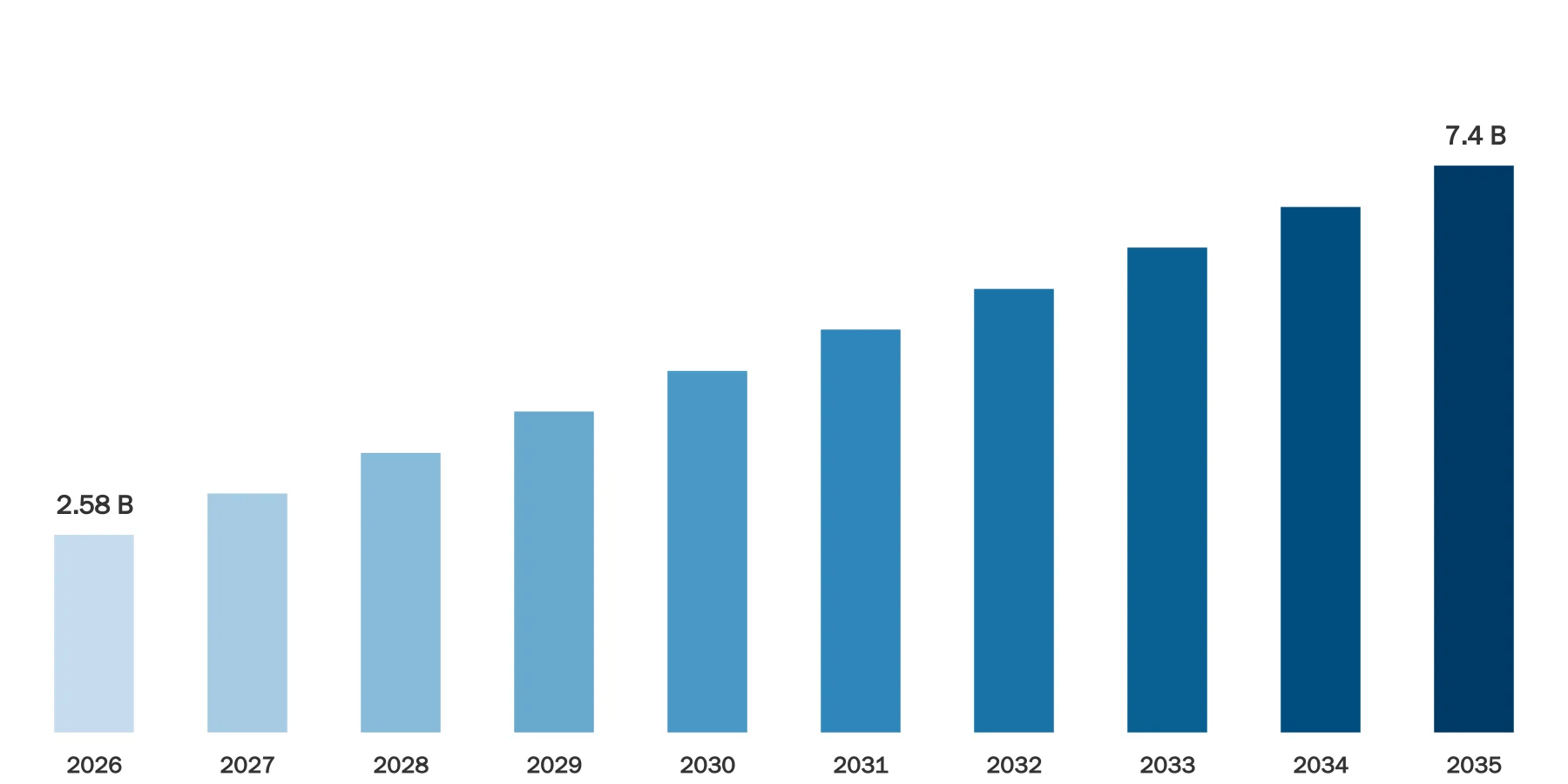
Source: Econ Market Research
The method of carrying out chemical reactions between reactive chemicals in a single, flowing stream is referred to as flow chemistry. It is frequently employed in diazotization, halogenation, oxidation, and hydrogenation reactions. The mixture of substances is pumped into the vessel and passed via a pipe, chamber, or Microreactor that is temperature-controlled. The resultant compound, which is obtained by collecting the reaction',s steam, is then used in later flow reactor loops to produce the desired product. Flow chemistry offers quicker, safer, and more scalable reactions as well as cleaner end products when compared to the batch reactors that are typically utilized. As a result, it has several uses in a variety of industries, including the petrochemical, chemical, and medicinal ones.
Market Growth
The enormous reactive capabilities that plug flow is gifted with have increased the need for flow chemistry on the global market. Instead of occurring in batches or sections of the stream, chemical reactions in flow chemistry are carried out constantly in a single stream. Numerous industries, including those in the chemical, pharmaceutical, and petrochemical sectors, have benefited from flow chemistry, which has recently fueled the expansion of the flow chemistry market on a global scale. Compared to other reactors, pressurizing flow reactors is simpler, and this propensity leads to faster reactions. Therefore, flow chemistry',s success is partly due to the admirably quick reactions that can be started with it. Another important feature of flow chemistry is reaction selectivity, which aids in producing products that are cleaner and more efficient for a variety of industries. This aspect has fueled the expansion of the worldwide flow chemistry market, along with the chemical industry',s increasing investments in modernizing the flow chemistry framework.
Market Dynamics
Market Drivers
The primary factors driving the market expansion are flow chemistry's low emissions and safety-focused production method. The demand for more environmentally friendly and sustainable production methods is fueling the expansion of the flow chemistry market. Additionally, flow chemistry solves both environmental and safety concerns by reducing the waste produced in chemical reactions during the manufacturing process. Other growth-promoting technology developments include the creation of highly automated flow synthesis systems combined with machine learning (ML) and next-generation sustainable manufacturing solutions. These innovations help keep the process moving smoothly and avoid any obstructions. Additional variables are foreseen, such as significant research and development (R&D) efforts and the adoption of supportive government policies encouraging the use of biofuels.
Market Restraints
The adoption of such systems is anticipated to be constrained by the high cost of the R&,D spending requirement and the high cost of Micro Reactor systems (MRT). This aspect is anticipated to limit the market expansion of flow chemistry. The limited uptake of this technology in developing nations is anticipated to restrain market expansion. There are fewer businesses that employ these systems. The COVID-19 epidemic caused the price of oil to crash, which reduced chemical industries', advantage in terms of feedstock costs. As a result, the chemical industry',s need for reactors, which accounts for a sizable portion of its earnings, decreased. Additionally, the petrochemical and pharmaceutical industries experienced same consequences, which had a detrimental influence on market expansion.
Market Opportunities
There may be opportunities in the near future due to the expanding usage of flow chemistry in the manufacturing of bulk chemicals, biofuels, and nanoparticles. They are extensively employed in the continuous manufacture of nanostructures that are used in photovoltaic, displays, and biochemical sensing. Therefore, it is anticipated that the growing use of flow chemistry in bulk chemicals and nanoparticles will promote the growth of the flow chemistry market. For the chemical and petrochemical industries in the Middle East, flow chemistry technology holds enormous potential. The petroleum sector is adopting flow chemistry more and more.
Competitive Landscape
Along with an analysis of the industry's competitive landscape, the following major players have been profiled:
AM Technology
Chemtrix BV
Corning Inc.
Ehrfeld Mikrotechnik GmbH
FutureChemistry Holding B.V.
HEL Ltd.
Lonza Group AG
Milestone Srl (Koch Media GmbH)
Parr Instruments Company
Syrris Ltd (Asahi Glassplant Inc.)
ThalesNano Inc.
Regional Analysis
By 2022, North America would have controlled more than 38.05% of global revenue. One of the main elements driving the industrial growth in the area is the rise in chemical and pharmaceutical manufacturing as well as the rise in research and development spending in flow chemistry, particularly in continuous processes.
The greatest CAGR of 13.6% is anticipated for the APAC region during the projection period. Because of the rising need for generic medications and the bright future for the chemical and petrochemical industries, an increase in government spending on pharmaceutical production is projected to accelerate industry growth in the area. The pharmaceutical business in Europe is concentrating on medical R&,D by upholding, sustaining, and expanding a strong regulatory and incentive framework that supports innovation. Because flow chemistry makes medication production simple and affordable, more European pharmaceutical businesses are implementing this technology.
Segment Analysis
Reactor Type Insights
High adoption, straightforward construction, efficient temperature management, affordability, and suitability for two-phase runs are factors causing the category to flourish. Additionally, the use of CSTR in water and wastewater applications is expected to stimulate industrial expansion.
One of the reactors that is most frequently used for gas phase reactions is the plug flow reactor, also known as the tubular reactor. These reactors have a low total cost of manufacture, which is projected to increase demand, thanks to their lack of moving parts, high conversion rate per reactor volume, simple mechanism, and low maintenance requirements. Due to its small footprint, lower capital requirements, and ability to safely perform highly reactive and hazardous processes, Microreactor are likely to see an increase in demand in the pharmaceutical and fine chemical industries.
Application Insights
Due to the rising use of green technologies like flow chemistry to cut greenhouse gas emissions, the chemicals segment dominated the market and accounted for over 38.0% of worldwide revenue in 2022. Additionally, a rise in the demand for speciality chemicals from the automotive sector is anticipated to have a favorable effect on industry development.
Many pharmaceutical corporations have been working to keep the academic and commercial sectors of the industry in close contact. New methods for producing chemicals and APIs are likely to be introduced in the academia and research sector, which is anticipated to increase demand for reactors in this sector throughout the projected period. The creation of nanoparticles, biofuels, and perfumes are further applications. As flow chemistry in the transesterification process may shorten the duration and cost, resulting in high production and profit, and increasing demand for flow chemistry, the use of continuous manufacturing in the production of biofuels is gradually gaining favor.
Recent Developments
In May 2020, Intavis Bioanalytical Instruments Assets were acquired by CEM, and the latter company',s instrumentation line now falls within its global sales, service, and support purview.
Flow Chemistry Market Report Scope & Segmentation
| Attributes | Details |
|---|---|
Market Size (Current) | US$ 2.58 Billion in 2026 |
Market Size (Forecast) | US$ 7.4 Billion in 2035 |
Growth Rate | CAGR of 12.2% from 2026 to 2035 |
Forecast Period | 2026 – 2035 |
Base Year | 2025 |
Historical Data Available | Yes |
Regional Scope | Global |
Segments Covered | Application Outlook
Reactor Type Outlook
|
Frequently Asked Questions
Common questions about this report
The study period covers historical insights and forecast projections for the period 2026-2035.
About the Author
Market research expert with years of industry experience

Dipali Bhingare serves as the Market Research Director at Econ Market Research. With a focus on translating complex global economic shifts into actionable business intelligence, she oversees the strategic direction of comprehensive market studies. Her work empowers organizations to navigate volatile industries through data-driven forecasting and deep-dive competitive analysis.
Related Reports
Explore more market insights from the same category