

Flexible Packaging Market
Flexible Packaging Market Size, Share, Trends, Growth, and Industry Analysis, By Material (Plastic (PE, PP, PET), Paper, Aluminum Foil, Bioplastics), By Type (Pouches (Stand-up, Flat), Bags andamp; Sacks, Films andamp; Wraps), By Application (Food andamp; Beverage, Pharmaceutical, Personal Care, Industrial), Regional Analysis and Forecast Period 2026-2035
Flexible Packaging Market Overview
As per Econ Market Research analysis, Global Flexible Packaging Market size stood at US$ 240.16 Billion in 2026 and is projected to reach US$ 349.93 Billion by 2035, growing at a CAGR of 3.9% over the forecast period 2026–2035. 2025 is taken as the base year.
Flexible Packaging Market Size 2025-2035 (USD Billion)

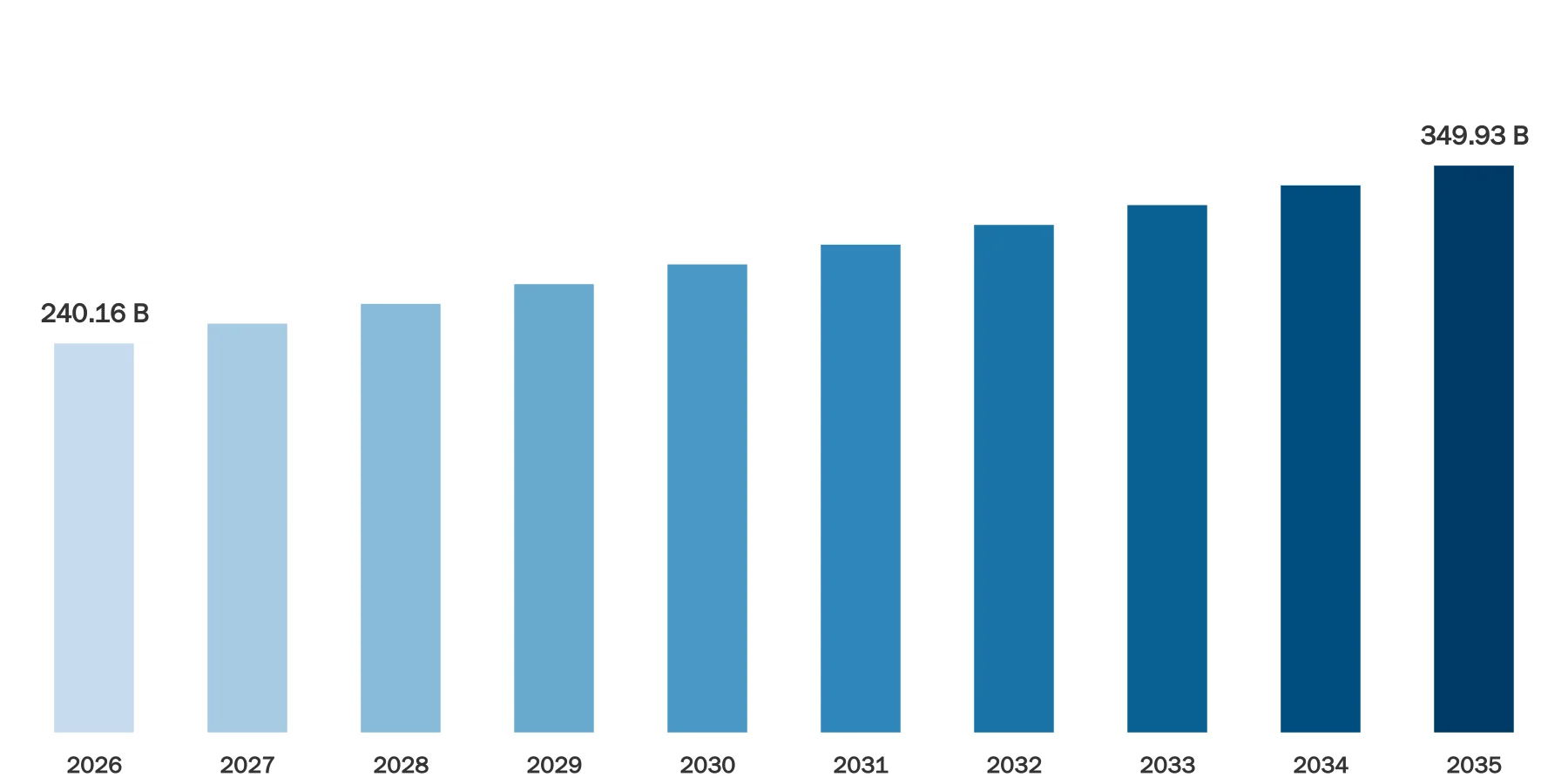
Source: Econ Market Research
Flexible Packaging materials normally are made of plastic, paper, or foil alone or in combination. Their application is used for products as food, beverages, Personal Care, and domestic. What makes the appeal for flexible packaging strong is because it is lightweight, save on costs, and even preserve freshness and product quality, hence its increased application by both manufacturers and consumers.
The flexible packaging market has grown rapidly in recent years, mainly due to increasing consumer needs for convenience, sustainability, and product safety. Such innovations in materials and technologies have LED to the availability of eco-friendly options-such as biodegradable or recyclable packaging-and accommodate environmentally conscious consumers.
Moreover, the growth of e-commerce has increased the demand for flexible packaging solutions that protect items during shipping but are appealing to customers. As other companies in other industries realize the benefits of flexible packaging, market growth is likely to remain high, allowing manufacturers and suppliers to innovate as consumer preferences change.
Dynamic Insights
One of the major drivers for packaging innovations is the ever-growing demand for convenient, ready-to-eat food products with consumers demanding a packaging solution that increases shelf life but does not sacrifice the quality of the product. E-commerce has further added a new dimension to packaging innovations with versatile solutions to ensure items are protected during shipping and provide an enhanced user experience.
Online shopping, therefore, has forced manufacturers to be innovative in packaging designs that are not only functional but also aesthetically pleasing. On the downside, markets are influenced by stiff regulatory policies governing the utilisation of packaging material as well as environmental concerns.
Since consumers will weigh factors based on environmental aspects in consuming consumer goods, it obligates companies to become the greener and leaner plastic corporation. It leads to investment in either biological or reusable material. Sustainable use of inputs is sought in the sector. Otherwise, fluctuations in raw materials prices affect variable costs when running the operations of enterprises and hence profit.
Drivers Insights
Growing Demand for Convenience Foods
The growing preference among consumers for convenience food serves as a major factor positively driving the flexible packaging industry. Busy lifestyles increase readiness among consumers to purchase foods that are ready-to-eat and on-the-go. Flexible packaging solutions accommodate those needs by providing consumers with lightweight, resealable, and carry-with-ease solutions to enhance the freshness and quality of products. For instance, pouches and bags are portioned, usually designed for easy opening and resealing. Thus, they can accommodate snacks, frozen meals, and other fast foods. Increasing food delivery and takeaway business creates more demand because of their reliance on flexible packaging to ensure safe transportation.
Sustainability and Eco-Friendly Solutions
Another significant driver is the growing emphasis on sustainability in packaging materials. Consumers are increasingly aware of environmental issues, prompting a shift toward eco-friendly products. Flexible packaging manufacturers are responding by developing biodegradable, recyclable, and compostable materials.
Innovations such as plant-based plastics and reduced material usage not only meet consumer preferences but also align with regulatory pressures aimed at reducing plastic waste. Companies adopting sustainable practices often gain a competitive advantage, appealing to environmentally conscious consumers and enhancing brand loyalty.
Restraints Insights
Regulatory Challenges
The flexible packaging market is experiencing stringent regulatory pressures presently on account of food safety, material composition, and environmental concerns. Governments worldwide have made laws quite stringent on the use of materials for packaging, particularly in terms of standards for food contact substances and a ban on phthalates and bisphenol A, commonly referred to as BPA.
This can lead to additional expenses in terms of time and cost for manufacturers, impacting efficiency and profitability in operations. Other changes that have had an effect of uncertainty within the market setting include new regulations. An increase in regulations creates fear within the market and triggers potential interferences with their supply chain and compliance expense.
Fluctuating Raw Material Prices
Raw materials for the flexible packaging industry include plastics, paper, and aluminum. Fluctuations in the price of these materials have a great impact on the production cost and profit margin of the manufacturers. Price volatility occurs due to geopolitical tensions, trade tariffs, and supply chain disruptions. It becomes challenging for companies to keep stable prices for their products. This unpredictability might discourage investment in new technologies and innovations and will impede the growth of the market.
Opportunities Insights
Technological Innovations
The flexible packaging market presents substantial opportunities for technological advancements. Innovations such as smart packaging, which incorporates sensors to monitor freshness and quality, are gaining traction. These technologies can provide valuable data to both manufacturers and consumers, enhancing product safety and reducing waste.
Additionally, advancements in printing technology allow for more vibrant and customizable packaging designs, helping brands stand out on shelves. By investing in research and development, companies can leverage these innovations to create new products that cater to evolving consumer preferences and enhance user experience.
Segment Analysis
By Material
Four primary materials dominate flexible packaging: these are plastic, paper, metal, and others. Plastic is used the most because it is flexible, is lightweight, and offers excellent barrier properties to preserve the fresh nature of products and exclude external influences. The three most commonly used plastics found in flexible packaging are polyethylene and polypropylene among others.
Paper is becoming more acceptable in that it is an environmentally friendly option that not only provides recyclable materials but also biodegradable products, which appeal to environmentalists. Metal is preferred by most companies because of the strength of the metal and integrity preserved during the packaging of their products, especially within the food and beverage industries.
By Product Type
Product type segment includes pouches, bags, films, wraps, tubes, and laminates, with pouches being increasingly used because it holds either liquids or solids, giving the consumer an option of resealing to ensure easy use of the consumer goods. Bag is the primary packaging material for snack or pet food products besides other items, film is the wrapping essential to avoid damage caused by the storage or transportation conditions.
Wraps are used for extra protection in food to preserve freshness. Tubes are used, especially in the dispensing of creams and pastes, where the product is to be used for personal care and cosmetic purposes. Laminates combine different materials to give barrier properties, often tailored to specific products.
By End-Use Industry
End-use industries for flexible packaging are food and beverages, healthcare, personal care and cosmetics, household care, industrial applications, and others. The largest consumer of flexible packaging is the food and beverages segment, as materials used in this segment require preservation of freshness, an extension of shelf life, and enhancement of product visibility on shelves.
The healthcare industry uses flexible packaging for medical supplies, pharmaceuticals, and devices as hygiene and safety are of key importance. Personal care and cosmetics use flexible packaging of creams, gels, and others to be convenient to use and attractive in appearance. Household care products include the cleaning and detergents that demand rigid and utility-based packaging.
By Application
The flexible packaging market is broadly categorized into two types based on application: retail packaging, non-retail packaging, and medical packaging. Retail packaging is designed to catch the consumer',s attention and enhance the shopping experience, and it often has eye-catching designs and branding to catch the product',s attention in the stores.
This segment is the most sensitive of the food and beverage industries, where packaging must be both functional and appealing enough to sell more. Non-commercial packaging refers to large-volume packaging and logistics solutions intended to shield goods during transportation and storage but would cost manufacturers less.
The medical segment has a specialty type of packaging that is considered safe, sterile, and suitable for regulatory compliance. Packaging includes medical device packaging, pharmaceutical packaging, and laboratory supplies for which product integrity is a concern. Diverse application segments, in combination, have showcased the varied needs of the market as they cater to varied needs of both consumers and industries in driving requirements of innovative flexible packaging solutions.
Regional Analysis
North America, Europe, Asia-Pacific, Latin America, and the Middle East &, Africa. North America is one of the prominent regions in the flexible packaging market, primarily due to its advanced technology, strong consumer demand for convenience foods, and a robust e-commerce sector. The market in this region is growing due to the major packaging manufacturers', presence and its focus on sustainability.
Europe follows with stringent regulations on packaging waste and environmental issues having led to switch to eco-friendly solutions. Consumers in Europe increasingly demand Sustainable Packaging solutions, allowing for innovations in recyclable and biodegradable materials. Growth for the flexible packaging market is witnessing its fastest progress in the Asia-Pacific region, above all due to rapid urbanization and increasing disposable incomes and changes in consumer lifestyles.
The two countries that are leading this growth are China and India, where demand for packaged food and beverages has only accelerated. The growing e-commerce sectors of these countries also open doorways for dynamic packaging solutions. Latin America is increasing market as food and beverage manufacturers now realize the value of flexible packaging in emerging markets. It will come at a speed that is increasingly rapid due to rapid industrialization and consumer base. Demand for flexible packaging solutions is therefore picking up speed in this region, especially the Middle East &, Africa.
Competitive Landscape
Amcor plc, Sealed Air Corporation, Ball Corporation, Mondi Group, and Constantia Flexibles are few major companies that have a captive hold on the market through their diversified portfolios, technological innovation, and distribution network. The companies invest continually in research and development in packaging solutions that cater to customer needs while adapting to requirements such as sustainability and creating environmentally friendly materials.
Strategic collaborations, mergers, and acquisitions are common as companies expand their market presence and capabilities. Besides these key players in the market, large numbers of small and medium-sized enterprises are trying to penetrate the competitive landscape, the focus here is on some very niche markets and niche products.
More entrenched competition stems from the entry of the new firms into the market due to use of new technology and green practices to reap their market share. Increased adoption of digital printing, smart packaging technologies to supply differentiator benefits to customers and added value. In contrast, regional players usually provide solutions to specific local market needs or adapted to local preferences and regulatory environment.
List of Key Players:
Amcor plc
Mondi Group
Huhtamaki Flexible Packaging
Sonoco Products Company
Sealed Air
DS Smith
Berry Global
Constantia Flexibles
Bemis Manufacturing Company
UkrMetal
ProAmpac
Wipak Group
FlexPak Services
Transcontinental Inc.
Coveris Holdings
American Packaging Corporation
InterFlex Group
FLEX-PACK ENGINEERING, INC.
Innovia Films
Cosmo Films
Recent Developments:
April 2024, Start-up Papair has partnered with Harbour Investment Holding to enhance the production of its paper bubble wrap, PapairWrap, and to advance the creation of additional packaging solutions.
January, 2023, Constantia Flexibles, a prominent global manufacturer of flexible packaging, entered into a joint venture (JV) agreement for its operations in India with Premji Invest and SB Packagings. This partnership aims to enhance Constantia Flexibles', growth and value creation in the Indian market.
Global Flexible Packaging Report Segmentation
Flexible Packaging Market Report Scope & Segmentation
| Attributes | Details |
|---|---|
Market Size (Current) | US$ 240.16 Billion in 2026 |
Market Size (Forecast) | US$ 349.93 Billion in 2035 |
Growth Rate | CAGR of 3.9% from 2026 to 2035 |
Forecast Period | 2026 – 2035 |
Base Year | 2025 |
Historical Data Available | Yes |
Regional Scope | Global |
Segments Covered | By Material
By Type
By Application
|
Frequently Asked Questions
Common questions about this report
The study period covers historical insights and forecast projections for the period 2026-2035.
About the Author
Market research expert with years of industry experience

Related Reports
Explore more market insights from the same category