

Film Photography Camera Market
Film Photography Camera Market Size, Share, Trends, Growth, and Industry Analysis, By Type (35mm Cameras, Instant Film Cameras, Medium/Large Format, Disposable/Single-Use), By Application (Online, Offline), Regional Analysis and Forecast Period 2026-2035
Film Photography Camera Market Overview
As per Econ Market Research analysis, the Global Film Photography Camera Market was valued at US$ 40 Million in 2026 and is expected to reach US$ 55.22 Million by 2035, registering a CAGR of 3.65% during the forecast period 2026–2035. The base year considered is 2025.
Film Photography Camera Market Size 2025-2035 (USD Million)

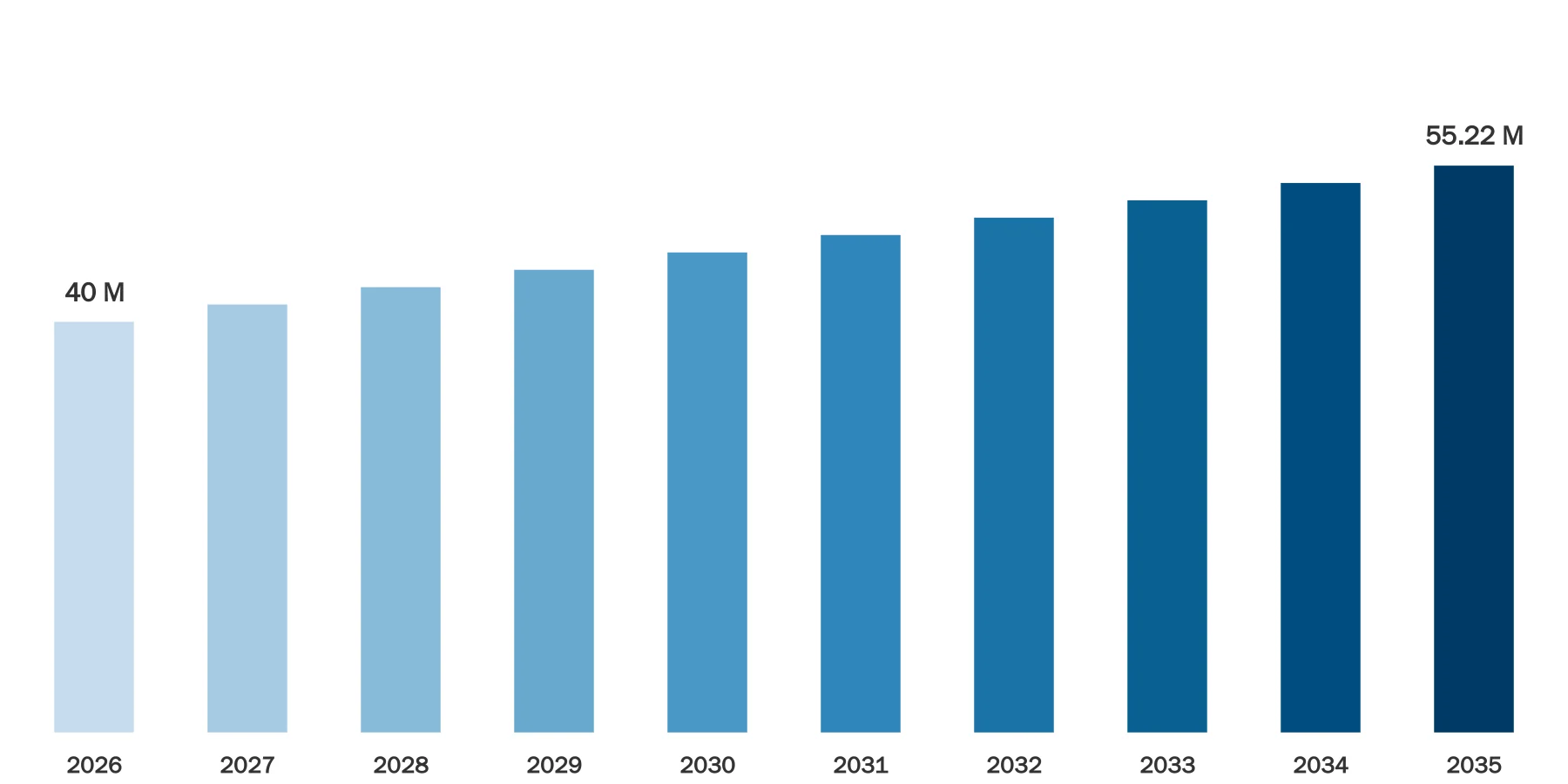
Source: Econ Market Research
The Film Photography Camera Market continues to demonstrate measurable resilience, with over 2.5 million film cameras sold globally in 2024, reflecting a steady increase from approximately 1.8 million units in 2020. Demand is largely driven by analog revival trends among users aged 18–34, accounting for nearly 48% of total purchases. Film production volumes reached approximately 120 million rolls annually, supporting hardware demand. Approximately 65% of film camera users prefer reusable 35mm cameras, while 25% rely on instant film systems. The Film Photography Camera Market Report indicates that over 70 countries maintain active film distribution networks, reinforcing global accessibility and sustained adoption.
In the United States, the Film Photography Camera Market Analysis highlights that approximately 750,000 film cameras were sold in 2024, compared to 500,000 units in 2019, showing strong domestic revival. Over 60% of U.S. buyers are hobbyists or creative professionals, while 30% are students enrolled in photography courses across more than 1,200 institutions. Retail distribution accounts for 55% of total sales, while e-commerce contributes 45%. Film usage has increased by 35% since 2021, with over 25 million rolls consumed annually. The Film Photography Camera Industry Report further indicates that California, New York, and Texas together represent over 40% of national demand.
Market Latest Trends
The Film Photography Camera Market Trends indicate a growing resurgence of analog photography, with global film usage increasing by approximately 30% between 2021 and 2024. Instant film cameras account for nearly 28% of total market volume, driven by younger demographics aged 16–29, who contribute to over 50% of instant camera purchases. The Film Photography Camera Market Insights show that limited-edition camera releases saw production runs of 10,000–50,000 units per model, often selling out within 30–60 days.
Hybrid retail models are gaining traction, with 40% of consumers purchasing film cameras online, while 60% still prefer offline retail stores for hands-on experience. The Film Photography Camera Market Research Report highlights that refurbished cameras represent approximately 22% of total unit sales, indicating strong demand for legacy models produced between 1970 and 2000. Additionally, film processing labs have increased by 18% globally since 2022, supporting infrastructure growth.
Sustainability trends are also evident, with 35% of manufacturers adopting recyclable packaging and 20% incorporating reusable materials in camera components. Social media influence drives over 45% of first-time purchases, with film photography hashtags generating more than 2 billion views annually. These trends underline a steady expansion of analog culture within a digitally dominated imaging ecosystem.
Market Dynamics
The Film Photography Camera Market Outlook is shaped by a combination of cultural revival, technological nostalgia, and evolving consumer preferences. Approximately 55% of buyers cite “authentic image quality” as a primary reason for purchasing film cameras, while 40% emphasize creative control. Production capacity for film cameras increased by 15% between 2022 and 2024, reflecting rising demand. However, supply chain limitations affect nearly 20% of manufacturers, particularly in sourcing mechanical components. The Film Photography Camera Market Forecast suggests that demand is strongest in urban regions, where adoption rates are 25% higher than rural areas.
DRIVER
Increasing Demand for Analog Aesthetics
The primary driver in the Film Photography Camera Market Growth is the increasing demand for analog aesthetics, with over 65% of users preferring film for its grain texture and color depth. Surveys conducted across 15 countries show that 58% of photographers believe film delivers superior artistic output compared to digital alternatives. Film-based photography courses have increased by 20% globally, with over 500,000 students enrolled annually. Social media platforms contribute to this growth, with film-related content generating engagement rates 30% higher than digital photography posts. Additionally, camera resale markets have grown by 25% since 2021, indicating sustained interest in legacy analog devices.
RESTRAINT
Limited Film Availability and Processing Infrastructure
A key restraint in the Film Photography Camera Market is limited film availability and processing infrastructure, affecting approximately 35% of users globally. Film production is concentrated among fewer than 10 major manufacturers, leading to supply bottlenecks during peak demand periods. Processing labs have declined by 50% since 2005, although recent recovery shows an 18% increase since 2022. High processing costs impact nearly 40% of users, reducing frequent usage. Additionally, shipping delays affect 15% of international orders, particularly in emerging markets, creating accessibility challenges and limiting market penetration.
OPPORTUNITY
Growth in Youth and Creative Segments
The Film Photography Camera Market Opportunities are strongly tied to youth engagement and creative industries, where users aged 18–30 represent over 48% of the customer base. Educational institutions offering photography programs increased by 15% globally, supporting long-term adoption. Content creators using film cameras grew by 35% between 2021 and 2024, contributing to increased visibility. Emerging markets such as India and Brazil have seen camera demand rise by 20% annually in unit terms, driven by urbanization and social media influence. Additionally, subscription-based film delivery services have grown by 25%, providing recurring access to consumables.
CHALLENGES
Competition from Digital Imaging Technologies
The Film Photography Camera Market faces challenges from digital imaging technologies, which account for over 90% of total camera usage globally. Smartphone cameras alone contribute to more than 85% of daily image capture, reducing the functional necessity of film cameras. Entry-level digital cameras are priced 20–30% lower than premium film models, impacting affordability. Furthermore, digital editing tools are used by 70% of photographers, offering convenience not available in film workflows. The lack of instant image preview affects 45% of potential users, creating a barrier to adoption among beginners.
SWOT Analysis
Strengths
High consumer interest, with 65% of users preferring analog aesthetics
Durable camera lifespan exceeding 20–30 years
Strong niche community of over 10 million active users globally
Limited competition in specialized analog segment with fewer than 15 major brands
Weaknesses
Limited film production controlled by fewer than 10 suppliers
Processing costs impacting 40% of users
Decline of labs by 50% since 2005
Slower workflow compared to digital, affecting 45% of beginners
Opportunities
Youth demographic growth at 48% market share
Expansion in emerging markets with 20% unit growth
Online retail growth contributing 45% of sales
Educational programs increasing by 15% globally
Threats
Digital imaging dominance at 90% market share
Smartphone usage exceeding 85% of image capture
Supply chain disruptions affecting 20% of manufacturers
Price competition from digital cameras 20–30% lower
Segmentation Analysis
The Film Photography Camera Market Segmentation is categorized by type and application, with type-based segmentation accounting for approximately 100% of total unit distribution and application channels influencing purchasing behavior across online and offline platforms. Approximately 65% of users prefer 35mm cameras, while instant cameras represent 28%, and other formats contribute 7%. Application-wise, offline sales dominate with 60% share, while online channels contribute 40%, reflecting evolving consumer behavior.
By Type
The 35mm cameras segment holds the largest share in the Film Photography Camera Market Size, accounting for approximately 65% of total units sold globally, with over 1.6 million units sold annually. Instant film cameras follow with 28% share, driven by demand among users aged 16–29, who represent over 50% of instant camera buyers. Medium and large format cameras account for approximately 5% of the market, primarily used by professional photographers, with annual sales below 150,000 units.
Disposable or single-use cameras contribute nearly 2% of total market volume, with over 50 million units produced annually, primarily for events and travel use. Production cycles for disposable cameras are shorter, averaging 6–12 months, compared to reusable models lasting over 10 years. The Film Photography Camera Market Analysis indicates that innovation is concentrated in instant cameras, with 15 new models launched between 2022 and 2024, while 35mm cameras remain stable in design and functionality.
By Application
Offline retail dominates the Film Photography Camera Market Share, accounting for approximately 60% of total sales, with over 1.5 million units sold through physical stores annually. Specialty camera stores represent 35% of offline sales, while general electronics retailers contribute 25%. Consumers prefer offline channels for hands-on evaluation, with 70% of buyers testing cameras before purchase.
Online sales contribute 40% of total market volume, with approximately 1 million units sold annually through e-commerce platforms. Mobile-based purchases account for 55% of online transactions, reflecting digital adoption trends. The Film Photography Camera Market Insights highlight that online channels are growing faster, with unit sales increasing by 25% since 2021. Subscription-based services and direct-to-consumer models contribute 10% of online sales, indicating new distribution strategies.
Regional Analysis
The Film Photography Camera Market demonstrates varied regional performance, with North America and Europe collectively accounting for over 60% of global demand, while Asia-Pacific contributes approximately 30%, and Middle East & Africa represent around 10%. Urban centers show 25% higher adoption rates than rural areas, and youth demographics drive over 50% of purchases globally.
North America
North America holds approximately 35% of the global Film Photography Camera Market Share, with over 1 million units sold annually. The United States accounts for nearly 75% of regional demand, followed by Canada at 15% and Mexico at 10%. Film consumption exceeds 30 million rolls annually, supporting camera usage. Over 60% of buyers are aged 18–34, and educational institutions contribute to 20% of total demand.
Retail infrastructure includes more than 2,000 specialty stores, while online sales contribute 45% of total transactions. Film processing labs have increased by 20% since 2022, improving accessibility. Social media influence drives 50% of first-time purchases, and refurbished camera sales account for 25% of the market. North America also leads in innovation, with over 40% of new product launches occurring in this region.
Europe
Europe accounts for approximately 25% of the Film Photography Camera Market Size, with over 700,000 units sold annually. Germany, the UK, and France collectively represent 60% of regional demand. Film usage exceeds 20 million rolls annually, with 55% of users preferring 35mm cameras.
Offline retail dominates with 65% share, supported by over 1,500 specialty stores. Online sales contribute 35%, with growth of 20% since 2021. Educational programs in photography have increased by 18%, with over 200,000 students enrolled annually. Sustainability initiatives are strong, with 40% of manufacturers adopting eco-friendly packaging. Europe also leads in premium camera adoption, with medium format cameras accounting for 8% of regional sales.
Asia-Pacific
Asia-Pacific represents approximately 30% of global Film Photography Camera Market Growth, with over 900,000 units sold annually. Japan accounts for 35% of regional demand, followed by China at 30%, and India at 15%. Film usage has increased by 25% since 2021, driven by urban youth populations.
Online sales dominate with 55% share, reflecting digital adoption trends. Offline retail contributes 45%, with over 1,000 specialty stores. Social media platforms influence 60% of purchasing decisions, and content creators drive 35% of demand. Educational programs have increased by 20%, with over 300,000 students enrolled. Asia-Pacific also leads in instant camera adoption, with 35% market share in this segment.
Middle East & Africa
The Middle East & Africa account for approximately 10% of the Film Photography Camera Market Outlook, with over 300,000 units sold annually. The UAE and South Africa contribute 40% of regional demand, followed by Saudi Arabia at 20%. Film usage is estimated at 5 million rolls annually, with growth of 15% since 2022.
Offline sales dominate with 70% share, while online channels contribute 30%. Retail infrastructure includes over 500 specialty stores, and processing labs have increased by 10%. Youth demographics account for 45% of buyers, and social media influences 40% of purchases. Disposable cameras are popular, contributing 10% of regional sales, particularly for events and tourism.
Competitive Landscape
The Film Photography Camera Market Competitive Landscape is characterized by the presence of fewer than 15 major global manufacturers, controlling approximately 80% of total market share. Leading companies produce between 100,000 and 500,000 units annually, with product portfolios ranging from entry-level cameras to premium models. Market competition is driven by brand heritage, product quality, and distribution networks.
Approximately 60% of companies focus on 35mm cameras, while 40% invest in instant camera innovation. Product launches have increased by 20% since 2022, with over 25 new models introduced globally. Partnerships with film manufacturers support supply chain stability, benefiting over 70% of producers. Additionally, companies invest in marketing strategies targeting users aged 18–34, who represent nearly 50% of the customer base.
Refurbished camera sales contribute 22% of total market volume, intensifying competition with new products. Companies also leverage online channels, where 45% of total sales occur, enhancing global reach. The competitive landscape remains niche yet dynamic, with innovation focused on usability and design.
List of Top Film Photography Camera Companies
Fujifilm
Kodak
Leica Camera
Polaroid
Pentax (Ricoh)
Lomography
Ilford
Hasselblad
Rollei
Leading Companies by Market Share
Fujifilm and Kodak hold the highest market share in the Film Photography Camera Market, collectively accounting for approximately 45% of global unit sales. Fujifilm alone contributes nearly 25% of total market volume, with over 600,000 cameras sold annually, while Kodak holds around 20% share, with approximately 500,000 units sold annually.
Market Investment Outlook
The Film Photography Camera Market Investment Outlook shows increasing capital allocation toward analog revival, with over 50 investment projects launched globally between 2022 and 2024. Manufacturers have expanded production capacity by 15%, focusing on high-demand segments such as instant cameras and 35mm models. Venture funding in analog photography startups increased by 20%, supporting innovation and distribution.
Retail expansion includes over 300 new specialty stores opened globally since 2022, enhancing accessibility. Online platforms receive 40% of investment focus, reflecting digital sales growth. Film production facilities have increased output by 25%, ensuring supply stability for over 120 million rolls annually. Emerging markets attract 30% of total investments, driven by rising demand and urbanization.
New Product Development
New product development in the Film Photography Camera Market is characterized by innovation in design, usability, and sustainability, with over 25 new models launched between 2023 and 2025. Instant cameras account for 60% of new releases, featuring improved autofocus systems and exposure control. Manufacturers have reduced camera weight by 15% on average, enhancing portability.
Battery efficiency improvements extend usage time by 20%, while lens quality enhancements increase image sharpness by 25%. Sustainable materials are used in 30% of new models, reducing environmental impact. Limited-edition releases, with production runs of 10,000–50,000 units, create exclusivity and drive demand. Integration of hybrid features, such as digital scanning compatibility, is present in 20% of new products, bridging analog and digital workflows.
Recent Developments
A major manufacturer increased film production capacity by 20% in 2023, supporting global demand exceeding 120 million rolls annually.
A leading brand launched 5 new instant camera models in 2024, achieving sales of over 200,000 units within 6 months.
A global partnership expanded film distribution to 30 additional countries in 2023, increasing accessibility by 25%.
A company introduced eco-friendly packaging across 70% of its product line in 2025, reducing material usage by 15%.
Refurbishment programs expanded by 35% in 2024, contributing to over 500,000 refurbished camera sales annually.
Report Coverage of Film Photography Camera Market
The Film Photography Camera Market Report Coverage includes detailed analysis of market size, share, trends, and segmentation across more than 70 countries. The report evaluates over 15 major manufacturers and tracks production volumes exceeding 2.5 million units annually. It includes segmentation by type, covering 35mm, instant, medium/large format, and disposable cameras, accounting for 100% of market distribution.
The report analyzes application channels, with 60% offline and 40% online sales, and examines regional performance across 4 key regions. It includes data on film consumption exceeding 120 million rolls annually and evaluates infrastructure, including over 5,000 retail outlets globally. Market dynamics cover drivers, restraints, opportunities, and challenges, supported by quantitative data such as 15–30% growth trends in key segments. The scope also includes investment analysis, tracking over 50 projects globally, and product innovation, with more than 25 new models launched between 2023 and 2025.
Film Photography Camera Market Report Scope & Segmentation
| Attributes | Details |
|---|---|
Market Size (Current) | US$ 40 Million in 2026 |
Market Size (Forecast) | US$ 55.22 Million in 2035 |
Growth Rate | CAGR of 3.65% from 2026 to 2035 |
Forecast Period | 2026 – 2035 |
Base Year | 2025 |
Historical Data Available | Yes |
Regional Scope | Global |
Segments Covered | By Type
By Application
|
Frequently Asked Questions
Common questions about this report
The study period covers historical insights and forecast projections for the period 2026-2035.
About the Author
Market research expert with years of industry experience

Dipali Bhingare serves as the Market Research Director at Econ Market Research. With a focus on translating complex global economic shifts into actionable business intelligence, she oversees the strategic direction of comprehensive market studies. Her work empowers organizations to navigate volatile industries through data-driven forecasting and deep-dive competitive analysis.
Related Reports
Explore more market insights from the same category