Farming Game Market Overview
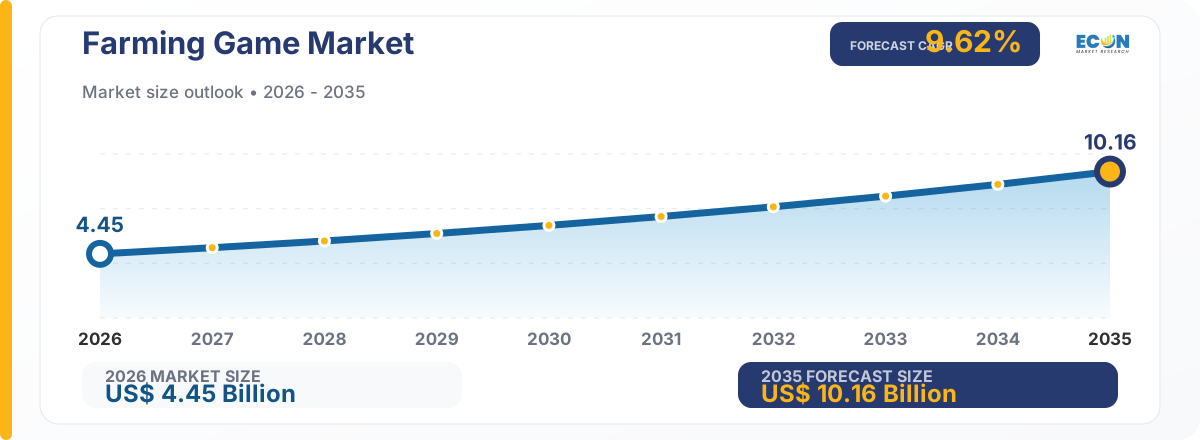
As per Econ Market Research analysis, the Global Farming Game Market size amounted to US$ 4.45 Billion in 2026 and is anticipated to grow to US$ 10.16 Billion by 2035, recording a CAGR of 9.62% during 2026–2035. The base year taken for analysis is 2025.
The appeal of strategy and simulation games has propelled the agricultural game market',s notable expansion. In order to construct and grow their virtual farms, players manage resources, livestock, and crops through agricultural operations. From casual players to simulation aficionados, these games appeal to a broad audience because they combine relaxation and strategic challenge. Using realistic farming simulations and engrossing gaming mechanics, developers have successfully captured the allure of agriculture and rural life. Farming games are set to grow in the future thanks to new features, multiplayer choices, and mobile accessibility, which will provide players a variety of interesting experiences.
Farming Game Dynamics
As a result of player desire for realistic simulations, game makers are encouraged to innovate and compete by improving graphics and gaming mechanics. Multiplayer modes and mobile adaptations are examples of trends that increase accessibility and draw in new audiences. Player engagement and developer income are impacted by economic factors including price models and monetization tactics. Technological developments also make immersive experiences possible by integrating augmented and virtual reality. Moreover, game updates and expansions are greatly influenced by social media and community feedback. In general, player preferences, industry trends, and technical improvements all influence how the farming game business changes and grows.
Farming Game Drivers
Realistic Simulation
The market for farming games is mostly driven by realistic simulation, as players want for immersive experiences that faithfully capture the difficulties and tasks of actual farming. Simulation games such as ",Farming Simulator", and ",Stardew Valley", are excellent in simulating agricultural activities like planting, harvesting, and caring for animals in great detail. The authenticity is enhanced by realistic mechanics, physics, and graphics, which give players a sense of satisfaction and success as they work through the challenges of managing a virtual farm. This authenticity increases player satisfaction and engagement, which fuels farming simulators', rise in popularity.
Social Interaction and Community Engagement
Players can cooperate, compete, and share experiences with friends and other enthusiasts thanks to features like cooperative gameplay, community-driven content production, and multiplayer modes. In-game activities, social media groups, and online forums all contribute to the feeling of community and promote player retention and word-of-mouth advertising. Farming games gain durability and depth from this social component, which draws a devoted following and maintains interest over time.
Restraints:
Extensive effort and experience are required to craft intricate graphics, gameplay systems, and simulations. The total costs also include continuing maintenance, upgrades, and support. Larger studios are exposed to more risk, and smaller developers find it difficult to enter the market due to this financial load. As a result, it may restrict market innovation and variety of goods.
Challenges in Monetization and Business Models
Although players anticipate excellent experiences, it can be challenging to strike the correct balance between player happiness and monetization. It',s challenging to implement fair and unobtrusive monetization strategies like in-game purchases or subscription models without upsetting players or jeopardizing the integrity of the gameplay. Furthermore, developers must continuously innovate and modify their monetization strategies according to the competitive landscape and player expectations, which further complicates the process of generating sustainable money.
Opportunities:
Integration of New Technologies
Technological innovations like Augmented Reality (AR) and virtual reality (VR) provide immersive experiences that can push the boundaries of gameplay. While AR provides for engaging interactions in the real world, VR allows users to fully immerse themselves in the farming environment. Developers can expand their creative and innovative horizons by using these technologies to differentiate their games in a crowded market, draw in new players, and increase player engagement.
Cross-Platform Compatibility and Cloud Gaming
In the farming game industry, cross-platform compatibility and cloud gaming provide promising prospects. A fluid gaming experience across platforms is crucial since gamers are increasingly accessing games on a variety of devices, including PCs, consoles, and mobile ones. Furthermore, cloud gaming platforms open up the possibility of instantaneous game access without requiring expensive gear, which broadens the market',s potential audience. Developers may enhance player accessibility and engagement and propel market growth by using cloud gaming and cross-platform interoperability.
Segment Overview
By Platform
Based on the platform, the global farming game market is divided into mobile, PC, and console. The mobile category dominates the market with the largest revenue share in 2023. Mobile games include farming simulations that are geared for tablets and smartphones. Simpler gaming mechanics, easy-to-use controls, and shorter playtime periods make these games ideal for playing while on the go.
Compared to their mobile equivalents, PC farming games are usually more intricate and captivating, with more realistic simulation components and varied gaming options. Games like ",console farming", are made for systems like Nintendo, Xbox, and PlayStation. They provide a compromise between the depth of PC games and the accessibility of mobile games.
By Genre
Based on the genre, the global farming game market is categorized into simulation, strategy, casual, role-playing games (RPG), and educational. The simulation category leads the global farming game market with the largest revenue share in 2023. The goal of simulation farming games is to replicate the genuine experience of farm management. Typical game play includes planting and harvesting crops, caring for animals, handling money, and growing their farming businesses.
The main themes of strategy farming games are resource management and strategic decision-making. In order to increase productivity and revenue, players must organize and manage their farming activities. A wide range of players can enjoy the laid-back pace and simplified gameplay features of casual farming games. Farming simulation is combined with aspects of character development, narrative, and exploration in role-playing games.
By Target Audience
Based on the target audience, the global farming game market is segmented into children &, families, teenagers &, young adults, and adults. The teenagers &, young adults segment dominates the farming game market. Teenagers and young adults who are looking for greater nuance and complexity in their gaming experiences are the target audience for farming games. These games attract to players seeking immersive and captivating gameplay because they frequently include social interactions, character advancement, and strategic components.
Family-friendly and kid-friendly farming games usually have bright visuals, easy-to-understand gameplay, and kid-friendly content. Adult-oriented farming games usually incorporate intricate management tools, realistic simulations, and complex gaming mechanics. These games are popular among gamers looking for a sophisticated and immersive gaming experience since they emphasize strategic decision-making, money management, and intricate agricultural systems.
Farming Game Overview by Region
The global farming game market is categorized into North America, Europe, Asia-Pacific, and the Rest of the World. North America emerged as the leading region, capturing the largest market share in 2023. The gaming community in the area is sizable and varied, with a particular fondness for the strategy and simulation genres. Considerable discretionary income is a factor in the high levels of consumer expenditure on gaming-related goods and services. Furthermore, North America is home to a large number of well-known game creators and organizations that consistently innovate and meet consumer wants.
Moreover, the extensive accessibility of farming games is guaranteed by the widely available gaming platforms, which include consoles, PCs, and mobile devices, thereby reinforcing North America',s leading position in the industry. Throughout the forecast period, Asia-Pacific is anticipated to post a significant CAGR. Numerous factors, particularly in emerging nations, can be ascribed to this growth, such as the rising use of smartphones and internet connectivity. The need for gaming material, especially farming games, is being driven by rising disposable incomes and a growing interest in gaming among younger people. Additionally, there are a lot of prospects for market expansion due to the region',s big population and cultural diversity.
Farming Game Competitive Landscape
In the global farming game market, a few major players exert significant market dominance and have established a strong regional presence. These leading companies remain committed to continuous research and development endeavors and actively engage in strategic growth initiatives, including product development, launches, joint ventures, and partnerships. By pursuing these strategies, these companies aim to strengthen their market position, expand their customer base, and capture a substantial share of the market.
Farming Game Market Leading Companies:
GIANTS Software
Stardew Valley
Playrix
Zynga
Natsume
Plinga
Kairosoft, and various others.
Farming Game Recent Developments
In July 2023, Iowa brothers buy $2 million worth of farms with income from Farming Simulator Playing Farming Simulator, Grant and Spencer Hilbert created popular YouTube channels. They now own and operate their own farms.
In May 2023, NeoGames takeover proposal and expanded on-market share buyback scheme NeoGames will be acquired by Aristocrat for an enterprise value of $1.8 billion. This acquisition will further Aristocrat',s online RMG strategy and spur growth.
In April 2023, Savvy Gaming Group To Purchase Top Games Company Scopely. Leading Video Game and Esports firm Savvy Games Group (",Savvy",), fully owned by the Public Investment Fund (",PIF",) of Saudi Arabia, has agreed to pay $4.9 billion to purchase Scopely. Leading game publisher and developer Scopely has a reputation for creativity and a library of popular mobile-only games. Through the acquisition, Savvy',s position in the world will be strengthened, and Scopely will be able to grow faster and accomplish its strategic goals.
Farming Game Market Report Segmentation
Farming Game Market Report Scope & Segmentation
| Attributes | Details |
|---|---|
| Market Size (Current)Current market valuation | US$ 4.45 Billion in 2026 |
| Market Size (Forecast)Projected market valuation | US$ 10.16 Billion in 2035 |
| Growth RateCompound Annual Growth Rate | CAGR of 9.62% from 2026 to 2035 |
| Forecast PeriodAnalysis timeline | 2026 – 2035 |
| Base YearReference year for analysis | 2025 |
| Historical Data AvailablePast market data availability | Yes |
| Regional ScopeGeographical coverage | Global |
| Segments CoveredMarket segments analyzed | By Platform
By Mode
By Revenue Model
|
Leading companies covered in this report
- Giants Software (Farming Simulator)
- Nintendo (Animal Crossing)
- Marvelous Inc. (Story of Seasons)
- Stardew Valley (ConcernedApe)
Frequently Asked Questions
Common questions about this report
The study period covers historical insights and forecast projections for the period 2026-2035.
About the Author
Market research expert with years of industry experience

Dipali Bhingare serves as the Market Research Director at Econ Market Research. With a focus on translating complex global economic shifts into actionable business intelligence, she oversees the strategic direction of comprehensive market studies. Her work empowers organizations to navigate volatile industries through data-driven forecasting and deep-dive competitive analysis.