Factory Automation and Industrial Controls Market Overview
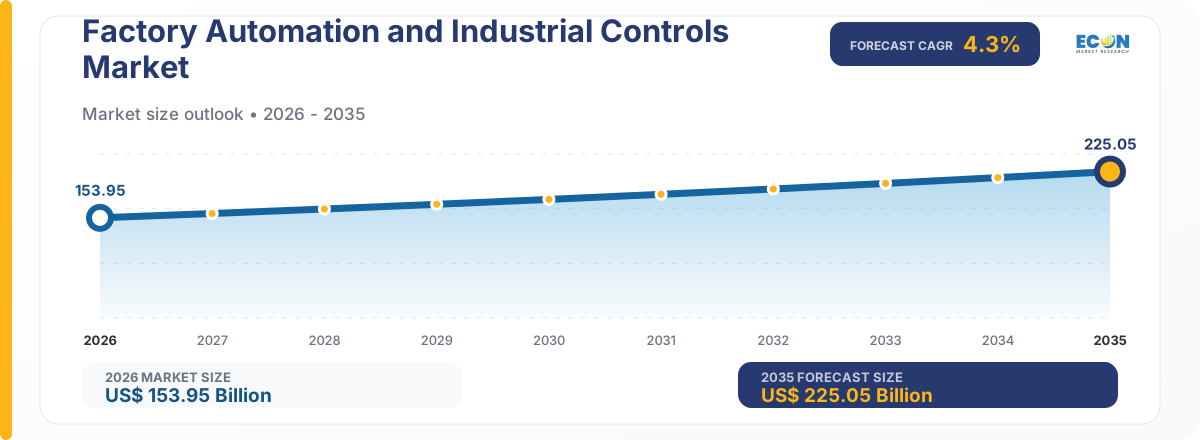
As per Econ Market Research analysis, the Global Factory Automation and Industrial Controls Market generated revenue of US$ 153.95 Billion in 2026 and is forecast to achieve US$ 225.05 Billion by 2035, at a CAGR of 4.3% during the study period 2026–2035. The base year considered is 2025.
Factory automation refers to the use of machines, control systems, and information technologies in order to reduce human intervention in production. Industrial controls, however, focus on the equipment and systems used in regulating machinery, processes, and systems in a factory environment. These include such components as sensors, controllers, and actuators, which are important for keeping industrial processes running smoothly. The demand for productivity, cost reduction, and quality improvement across industries has led to a rapid growth in this market. With increasing labor costs and a need for safer and more reliable operations, companies are adopting automation and control systems to meet the challenges.
Such technologies help optimize production lines, reduce human error, and improve overall operational efficiency. Major industries leading growth in the market are those related to autos, pharmaceutical, food and beverages, and electronic, which keep seeking innovative products that help smooth their operations processes and maintain positions in the industries. The increase in factory automation and industrial control is also related to the rising use of smart technologies, particularly Artificial Intelligence and IoT, for further expansion using intelligent solutions toward more efficient production worldwide.
Dynamic Insights
Manufacturers use automation systems to improve the efficiency of the production process, decrease labor costs, and provide higher-quality products. Industry 4.0 has led to the use of technologies such as IoT and AI that have further increased the trend of adopting automation, thus making possible real-time monitoring, predictive maintenance, and informed decisions. These technologies improve factory operations, increasing flexibility and responsiveness to market demand. However, high initial investment costs and the complexity of integrating automation systems with existing infrastructure pose a major challenge for companies.
Small and medium-sized enterprises (SMEs) may find it difficult to adopt such advanced solutions due to budget constraints. Moreover, a lack of skilled workers to operate and maintain automated systems can hamper market growth. However, the increasing trend of digital transformation across industries is expected to overcome these barriers, as businesses increasingly recognize the long-term benefits of automation, including reduced downtime and improved efficiency. As technology continues to evolve and become more affordable, the market is likely to witness broader adoption, especially in emerging economies where manufacturing industries are rapidly expanding.
Drivers Insights
Increasing Demand for Operational Efficiency and Cost Reduction
One of the primary drivers of the factory automation and industrial controls market is the increasing need for operational efficiency and cost reduction. Manufacturers are seeking ways to optimize production processes, reduce errors, and cut operational costs. Automation systems enable businesses to replace manual labor with machines, improving the speed and consistency of production.
By integrating control systems such as programmable logic controllers (PLCs) and robotics, companies can automate routine tasks, which leads to fewer errors, less downtime, and overall cost savings. These factors make automation particularly attractive to industries like automotive, electronics, and food processing, where efficiency and precision are critical to maintaining competitive advantages.
Advancements in Industry 4.0 and IoT Integration
The rapid evolution of Industry 4.0 technologies, such as the Internet of Things (IoT), artificial intelligence (AI), and Cloud Computing, is largely driving the growth of the factory automation and industrial controls market. IoT-enabled devices and sensors will allow for the real-time monitoring of production lines and the collecting of data. This will, in turn help businesses make proper decisions and predict potential failures.
AI-powered solutions are making automated systems smarter, thereby allowing predictive maintenance, process optimization, and smart manufacturing operations. This integration of advanced technologies is improving factory performance, reducing unplanned downtime, and allowing better resource management-all of which are contributing to the growth of the automation market.
Restraints Insights
High Initial Investment and Integration Costs
A major restraint for many companies, especially small and medium-sized enterprises (SMEs), is the high initial investment required to implement factory automation systems. The costs of purchasing automation equipment, installing the necessary control systems, and integrating them with existing infrastructure can be prohibitively expensive. Additionally, these systems often require specialized software and hardware, which adds to the upfront financial burden. Many businesses struggle with securing the necessary capital to make these investments, and the long-term payback period can make it challenging to justify the expense, particularly for companies operating on tight budgets.
Lack of Skilled Workforce for Automation Systems
Another challenge is the shortage of skilled workers who can manage, operate, and maintain automated systems. While automation can reduce the reliance on manual labor, it also requires specialized knowledge to operate and troubleshoot. Many industries face difficulties in finding qualified professionals with the expertise to handle advanced technologies like AI, robotics, and IoT-based systems. The lack of skilled labor in certain regions can slow the adoption of automation systems and lead to increased operational disruptions. Companies must invest in training programs or face the risk of operational inefficiencies and underutilized automation technologies.
Opportunities Insights
Integration with Artificial Intelligence and Machine Learning
The integration of artificial intelligence (AI) and machine learning (ML) into factory automation systems presents an exciting opportunity for the market. AI and ML can be used to enhance process optimization, predictive maintenance, and decision-making capabilities. By analyzing vast amounts of production data, AI algorithms can detect patterns, optimize workflows, and anticipate potential failures before they occur. This leads to fewer disruptions, lower maintenance costs, and improved efficiency. As AI technologies become more accessible and affordable, there is an opportunity for companies to leverage these capabilities to develop smarter, more adaptive factory automation systems that can drive higher productivity and profitability.
Segment Analysis
By Type of Automation:
The market for factory automation and industrial controls is primarily divided into two categories: Industrial Automation and factory automation. Industrial automation refers to the automation of complex industrial processes in large-scale facilities, such as chemical plants, oil refineries, and power plants. It involves the integration of various control systems and technologies to ensure efficient, reliable, and safe operations.
Factory automation focuses more on the mechanization of most manufacturing processes in a factory, such as assembly lines, packaging, and material handling. This field encompasses applying advanced robot arms, sensors, and control systems to automate repetitive work, eliminate human labor, minimize errors, and increase productivity. Both types of automation are increasing fast because of increased demand for cost minimization, safety, and efficiency across different industries.
By Control Systems:
Control systems in the factory automation and industrial controls market are important for managing and regulating manufacturing processes. The key systems in this segment include Programmable Logic Controllers (PLCs), Distributed Control Systems (DCS), Supervisory Control and Data Acquisition (SCADA), and Human Machine Interfaces (HMIs). PLCs are widely used for industrial automation due to their versatility, ease of programming, and ability to handle complex operations.
DCS is widely used in large, process-oriented industries such as oil and gas or chemicals, providing centralized control of multiple processes. SCADA systems enable real-time monitoring and data collection from remote locations, providing critical insights into the performance of industrial processes. HMIs are used to facilitate interaction between operators and machines, making it easier to control and monitor operations. These control systems help in working toward efficient, safe, and optimum production processes.
By End-User Industry:
The factory automation and industrial controls market caters to a wide range of end-user industries, including automotive, electronics and electrical, pharmaceuticals, food and beverages, chemicals, oil and gas, aerospace and defense, and others. In the automotive industry, automation helps streamline production lines, increase precision, and enhance quality control. Electronics and electrical industries rely heavily on automation to manage high-volume production and improve product consistency.
Pharmaceuticals require stringent quality control and regulatory compliance, making automation essential in their manufacturing processes. The food and beverage industry uses automation to enhance production speed, ensure hygiene, and improve packaging efficiency. Chemicals and oil &, gas industries benefit from automation in managing complex and hazardous processes. Aerospace and defense manufacturers use automation for precision and high-performance requirements.
By Component Type:
The key components of the factory automation and industrial controls market include sensors, actuators, controllers, drives, and many other devices. Sensors are vital to detect changes in temperature, pressure, humidity, or movement, thereby offering valuable data for optimizing operations. Actuators convert control signals into mechanical motion to open valves, move parts, or adjust machinery.
Controllers are the brains of the automation system and process inputs from sensors and then issue commands to actuators, ensuring that everything works correctly in the system. The drives are what control the movement of machinery in the form of motors and robots with input from controllers. These combine to create the integrated systems used to automate the production lines, controlling machinery, and ensuring smooth operation across industries. Other elements can include power supplies, communication devices, as well as specialized equipment designed specifically for unique automation requirements.
Regional Analysis
North America, especially the United States and Canada, therefore enjoys a market boom with the fast growth of technologies, such as robotics, artificial intelligence, and IoT. The region has a robust manufacturing base and, by extension, therefore, need for efficiency in operations that have been propelling growth for factory automation and industrial control systems. Especially the automobile, aerospace, and pharmaceuticals industries are part of this growth in which the companies increase adoption of automation to achieve better processes in production and quality outputs.
Europe, particularly Germany, the UK, and France, are leading the charge. Germany is a global leader in industrial automation. Its manufacturing industries, especially automotive and machinery, have been at the forefront of adopting automation solutions to enhance productivity and competitiveness. Furthermore, strict environmental regulations and the push for sustainability are driving the adoption of energy-efficient automation solutions. As of the Asia-Pacific region, fast industrialization is accelerating in China, India, Japan, and South Korea, and this is fueling demand for factory automation systems. The developing manufacturing sector in the region combined with cost pressures and the challenge to improve productivity has driven widespread adoption of industrial automation technologies. This region will see a growing demand for smart manufacturing, thus keeping the growth levels high.
The Middle East and Africa (MEA) region is also seeing more investments in automation through oil and gas, chemicals, and manufacturing industries looking for greater efficiency and cost reduction. Latin America is gradually coming up with Brazil and Mexico seeing a rise in the adoption of automation, particularly in the automotive and food processing industries.
Competitive Landscape
The key players in the global automation market include multinational companies like Siemens AG, ABB Ltd., Mitsubishi Electric Corporation, Rockwell Automation, Schneider Electric, and Honeywell International Inc. These companies lead the market with comprehensive automation solutions for industries such as automotive, food and beverages, chemicals, and pharmaceuticals. Their portfolios include advanced control systems, robotics, PLCs, SCADA systems, and sensors, enabling them to service a wide variety of industrial applications. These companies further invest in continuous innovation by spending a significant amount on R&,D to incorporate the latest technologies in the form of artificial intelligence, machine learning, and IoT into their automation solutions.
Apart from such industry giants, several regional players are really performing some great work to conquer this marketplace. Companies like Emerson Electric Co., Yokogawa Electric Corporation, and Bosch Rexroth AG keep coming with specialized solutions equipped to the precise needs of the kind of industries like oil and gas, energy, and manufacturing. Another characteristic of the competitive environment is strategic partnerships and acquisitions. Due to efforts to strengthen their market presence and extend their portfolios of available products, leaders in this domain are seemingly establishing partnerships with smaller, technology-driven firms to enhance their capabilities in smart manufacturing, predictive maintenance, and process automation.
The competitive landscape will be further determined by pricing strategies, customer service, and geographical reach. Companies are shifting their focus towards providing end-to-end solutions that range from the initial consultation and system design to implementation and after-sales support, in order to differentiate themselves in a competitive market. As more and more industries adopt digital transformation strategies, competition is likely to increase, as companies will aim to meet the growing demand for smarter, more efficient, and sustainable automation solutions.
List of Key Players:
Kawasaki Heavy Industries, Ltd.
Honeywell International, Inc.
Schneider Electric
Emerson Electric Co.
Mitsubishi Electric Corporation
OMRON Corporation
Siemens AG
ABB Ltd.
Rockwell Automation, Inc.
Yokogawa Electric Corporation
Factory Automation &, Industrial Controls Report Segmentation
Factory Automation and Industrial Controls Market Report Scope & Segmentation
| Attributes | Details |
|---|---|
| Market Size (Current)Current market valuation | US$ 153.95 Billion in 2026 |
| Market Size (Forecast)Projected market valuation | US$ 225.05 Billion in 2035 |
| Growth RateCompound Annual Growth Rate | CAGR of 4.3% from 2026 to 2035 |
| Forecast PeriodAnalysis timeline | 2026 – 2035 |
| Base YearReference year for analysis | 2025 |
| Historical Data AvailablePast market data availability | Yes |
| Regional ScopeGeographical coverage | Global |
| Segments CoveredMarket segments analyzed | By Product
By Component
By End-User Industry
|
Frequently Asked Questions
Common questions about this report
The study period covers historical insights and forecast projections for the period 2026-2035.
About the Author
Market research expert with years of industry experience

Dipali Bhingare serves as the Market Research Director at Econ Market Research. With a focus on translating complex global economic shifts into actionable business intelligence, she oversees the strategic direction of comprehensive market studies. Her work empowers organizations to navigate volatile industries through data-driven forecasting and deep-dive competitive analysis.