

Enterprise Knowledge Graph Market
Enterprise Knowledge Graph Market Size, Share, Trends, Growth, and Industry Analysis, By Component (Software, Services), By Model Type (Property Graphs, Triple Stores (RDF)), By Application (Semantic Search & Enterprise Knowledge Management, Recommendation Systems, Fraud Detection & Risk Analytics, Customer 360 & Personalization, Supply Chain & Operational Intelligence, Others), By Deployment Mode (Cloud, On-Premises), By Organization Size (Small & Medium Enterprise, Large Enterprise), By End Use (BFSI, Healthcare & Life Sciences, Retail & E-commerce, IT & Telecommunications, Manufacturing, Government, Others), Regional Analysis and Forecast Period 2026-2035
Enterprise Knowledge Graph Market Overview
As per Econ Market Research analysis, the Global Enterprise Knowledge Graph Market was estimated at US$ 3.5 Billion in 2026 and is forecast to attain US$ 19.61 Billion by 2035, expanding at a CAGR of 21.10% between 2026 and 2035. The base year for the study is 2025.
Enterprise Knowledge Graph Market Size 2025-2035 (USD Billion)

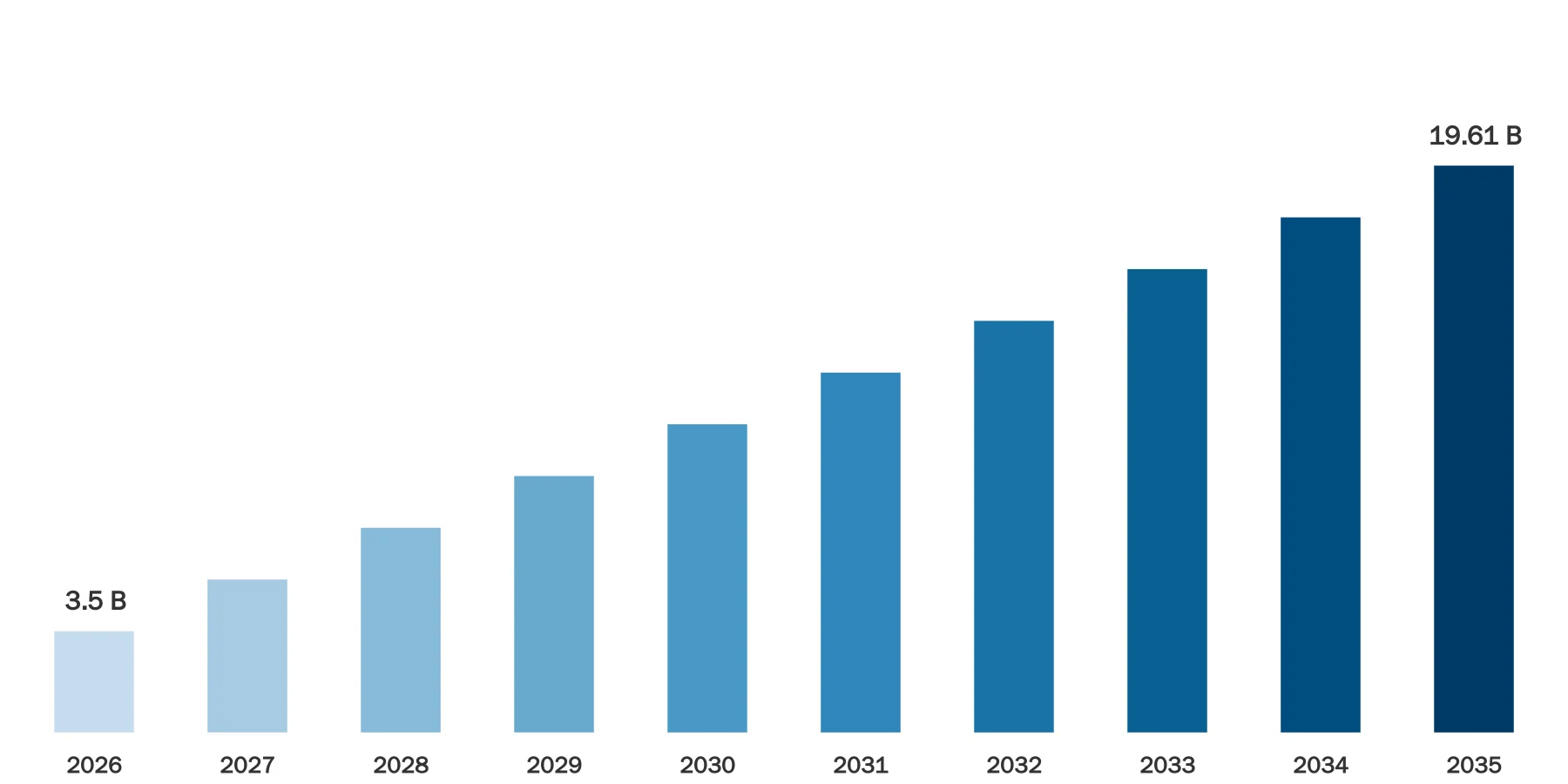
Source: Econ Market Research
The Enterprise Knowledge Graph Market is rapidly expanding as over 65% of large enterprises integrate semantic data frameworks to manage structured and unstructured data across 10+ internal systems. Enterprise knowledge graphs enable linking of billions of data points, with typical deployments handling 5–20 billion nodes and 50–200 billion relationships. Around 72% of organizations report improved data discovery speed by at least 40% using knowledge graph platforms. Industries such as BFSI and healthcare contribute to more than 45% of adoption, driven by the need for real-time analytics within 2–5 seconds latency. The Enterprise Knowledge Graph Market Report highlights growing deployment in AI-driven applications.
In the USA, the Enterprise Knowledge Graph Market accounts for nearly 38% of global adoption, with over 8,000 enterprises implementing graph-based data platforms across sectors. Approximately 70% of Fortune 500 companies utilize knowledge graph technologies for customer insights and fraud detection systems processing over 1 million transactions per day. The Enterprise Knowledge Graph Industry Analysis shows that 60% of U.S. firms integrate graph databases with AI models, improving query efficiency by 30–50%. Government and defense sectors contribute to 15% of demand, leveraging graphs to manage petabyte-scale datasets exceeding 5 PB in size across intelligence applications.
Market Latest Trends
The Enterprise Knowledge Graph Market Trends indicate a sharp rise in AI-integrated graph systems, with over 68% of enterprises embedding machine learning algorithms into knowledge graph pipelines. Graph neural networks (GNNs) are now used in 40% of deployments, enabling predictive insights from datasets exceeding 10 billion relationships. The Enterprise Knowledge Graph Market Insights reveal that hybrid architectures combining relational databases and graph engines are adopted by 55% of organizations, improving query response time by 25%.
Another major trend in the Enterprise Knowledge Graph Industry Report is the use of knowledge graphs in Generative AI, where 52% of large enterprises utilize graph-based context layers to enhance large language model outputs by 35% accuracy improvements. Cloud-based graph deployment is increasing, with 64% of implementations hosted on cloud infrastructure supporting 99.9% uptime and handling millions of concurrent queries per hour.
The Enterprise Knowledge Graph Market Forecast also highlights increased focus on Data Governance, with 58% of companies implementing graph-based lineage tracking systems that map over 100,000 data assets per enterprise. Additionally, real-time analytics adoption has surged, with systems capable of processing over 500,000 events per second becoming standard in industries like telecom and finance.
Market Dynamics
The Enterprise Knowledge Graph Market Dynamics are shaped by rising data complexity, increasing AI adoption, and the need for real-time decision-making. Over 80% of enterprise data is unstructured, driving demand for graph-based contextualization. More than 67% of organizations report challenges in integrating 5+ data silos, pushing adoption of knowledge graphs. The Enterprise Knowledge Graph Market Analysis indicates that scalability to handle datasets exceeding 10 TB to 5 PB is a key requirement influencing adoption.
DRIVER
Increasing Demand for Data Integration and Contextual Intelligence
The primary driver in the Enterprise Knowledge Graph Market Growth is the increasing demand for unified data integration, with enterprises managing data from 20–50 different sources. Knowledge graphs enable integration of structured, semi-structured, and unstructured data, improving operational efficiency by 35%. Around 75% of enterprises report improved decision-making accuracy when using contextual data relationships. Additionally, industries such as retail process over 2 million customer interactions daily, requiring graph systems that support real-time analytics under 3 seconds latency. The rise of AI-driven analytics platforms has further accelerated adoption, with 65% of enterprises linking knowledge graphs to machine learning workflows handling millions of data queries per day.
RESTRAINT
High Complexity in Implementation and Integration
A major restraint in the Enterprise Knowledge Graph Market is the complexity of implementation, with 48% of enterprises citing difficulties in integrating graph systems with legacy infrastructure. Initial deployment requires mapping of millions of entities and relationships, often taking 6–18 months for full-scale implementation. Approximately 55% of IT teams report skill gaps in semantic technologies such as RDF and SPARQL. Data migration challenges also arise when transitioning from relational systems managing terabytes of structured data to graph environments. Additionally, maintaining data quality across 10+ data pipelines increases operational overhead by 20–30%, limiting adoption among mid-sized enterprises.
OPPORTUNITY
Expansion of AI and Machine Learning Integration
The Enterprise Knowledge Graph Market Opportunities are strongly tied to AI expansion, with 72% of enterprises planning to integrate knowledge graphs with AI systems by 2027. Graph-based AI improves recommendation accuracy by 30–45%, particularly in e-commerce platforms handling over 500,000 product SKUs. The use of knowledge graphs in fraud detection enables analysis of millions of transaction patterns within seconds, reducing fraud incidents by 25%. Furthermore, the growth of IoT ecosystems generating billions of data points daily creates opportunities for graph-based contextualization. Enterprises leveraging AI-driven graphs report 50% faster anomaly detection in network monitoring systems.
CHALLENGES
Data Privacy and Security Concerns
Data privacy remains a significant challenge in the Enterprise Knowledge Graph Market, with 62% of enterprises concerned about compliance with data regulations. Knowledge graphs often aggregate data from multiple sources, increasing exposure to vulnerabilities across 10–20 integration points. Cyber Security risks are heightened as graph databases may store billions of interconnected records, making them attractive targets for breaches. Around 40% of organizations report difficulties in implementing encryption across graph layers. Additionally, maintaining access control across thousands of nodes and relationships requires advanced governance frameworks, increasing system complexity and operational costs by 15–25%.
SWOT Analysis
Strengths
Ability to process billions of nodes and relationships efficiently in real time
Improves data discovery speed by 40–60% across enterprise systems
Supports integration of 10+ heterogeneous data sources seamlessly
Enhances AI model accuracy by 30–45% through contextual linking
Weaknesses
Implementation timelines ranging from 6 to 18 months
Requires specialized expertise, with 55% skill gap prevalence
High infrastructure demands for datasets exceeding 10 TB
Complexity in maintaining data consistency across multiple pipelines
Opportunities
AI integration adoption expected in 72% of enterprises
IoT ecosystems generating over 1 billion data points daily
Increasing cloud adoption at 64% deployment rate
Expansion in healthcare and BFSI contributing 45% of demand
Threats
Data privacy concerns affecting 62% of organizations
Rising cyberattacks targeting databases with billions of records
Competition from traditional data warehouses used by 50% of enterprises
Regulatory compliance requirements increasing operational overhead by 20%
Segmentation Analysis
The Enterprise Knowledge Graph Market Segmentation includes components, model types, applications, deployment modes, organization sizes, and end-use industries. Over 65% of enterprises adopt integrated solutions combining software and services. Property graphs dominate with 55% usage, while RDF graphs account for 45%. Applications such as recommendation engines and fraud detection together contribute 50% of deployments. Cloud deployment leads with 64% share, while large enterprises account for 70% adoption due to their data complexity exceeding 10 TB.
By Component
The Enterprise Knowledge Graph Market by component is divided into software and services, with software accounting for approximately 68% of implementations. Graph database platforms manage datasets exceeding 5–20 billion relationships, supporting query execution within milliseconds to seconds. Services, including consulting and integration, contribute 32%, with enterprises spending 6–12 months on deployment projects. Over 60% of organizations require ongoing support for managing 10+ data pipelines. Software platforms are widely used for AI integration, with 70% of enterprises embedding analytics tools. Services are critical for industries handling petabyte-scale datasets, ensuring optimized performance and scalability.
By Model Type
Property graph models hold around 55% share, primarily due to their flexibility in handling complex relationships across millions of nodes. RDF models account for 45%, widely used in semantic web applications managing structured data sets exceeding 1 billion triples. Property graphs enable faster traversal speeds by 30–40%, making them suitable for real-time analytics. RDF models are preferred in regulatory environments, with 50% of government applications utilizing them. Enterprises often deploy hybrid models, with 35% combining RDF and property graphs to support diverse data structures.
By Application
Applications such as recommendation engines and fraud detection dominate with over 50% share. Knowledge graphs improve recommendation accuracy by 35%, especially in e-commerce systems managing hundreds of thousands of SKUs. Fraud detection systems analyze millions of transactions per second, reducing anomalies by 25%. Data integration and master data management applications contribute 30%, while search and discovery applications account for 20%. Enterprises using knowledge graphs for search report 50% faster query resolution, enhancing user experience across platforms handling millions of queries daily.
By Deployment Mode
Cloud deployment leads with 64% market share, supporting scalability for datasets exceeding 10 TB and enabling 99.9% uptime. On-premise deployment accounts for 36%, primarily used in industries with strict data regulations managing sensitive datasets exceeding 5 PB. Cloud platforms handle millions of concurrent queries per hour, while on-premise systems offer enhanced security controls across 10+ internal networks. Hybrid deployment is growing, with 40% of enterprises combining cloud and on-premise solutions to balance scalability and security.
By Organization Size
Large enterprises dominate with 70% adoption, driven by data volumes exceeding 10 TB and the need to integrate 20+ data sources. SMEs account for 30%, with adoption increasing as cloud-based solutions reduce infrastructure costs by 25%. Large organizations process millions of daily transactions, requiring advanced analytics capabilities. SMEs typically handle smaller datasets under 1 TB, focusing on specific applications such as customer analytics. Around 55% of SMEs report improved operational efficiency after implementing knowledge graph solutions.
By End Use
BFSI and healthcare collectively contribute 45% of demand, with systems processing millions of transactions and patient records daily. Retail and e-commerce account for 20%, leveraging knowledge graphs for recommendation engines handling hundreds of thousands of products. IT and telecom contribute 15%, managing billions of network events daily. Government and defense sectors represent 10%, utilizing graphs for intelligence analysis across petabyte-scale datasets. Manufacturing and others account for 10%, focusing on supply chain optimization involving thousands of interconnected data points.
Regional Analysis
The Enterprise Knowledge Graph Market Outlook shows strong regional variation, with North America holding approximately 38% share, Europe 25%, Asia-Pacific 28%, and Middle East & Africa 9%. Adoption is driven by data volumes exceeding terabytes to petabytes, with over 60% of enterprises globally investing in graph-based systems.
North America
North America dominates the Enterprise Knowledge Graph Market with 38% share, driven by over 8,000 enterprise deployments. Around 70% of Fortune 500 companies use knowledge graphs for analytics involving millions of data queries daily. The region has over 60% cloud adoption, enabling systems to process billions of relationships. BFSI and healthcare sectors contribute 50% of regional demand, with fraud detection systems analyzing 1 million transactions per day. Government agencies manage datasets exceeding 5 PB, utilizing graph technologies for intelligence and security applications.
Europe
Europe accounts for 25% of the Enterprise Knowledge Graph Market Share, with strong adoption in countries managing large-scale regulatory datasets. Around 65% of enterprises focus on data governance, using graphs to track over 100,000 data assets. The manufacturing sector contributes 20% of demand, leveraging knowledge graphs for supply chain optimization involving thousands of components. Healthcare applications process millions of patient records, improving diagnostic accuracy by 30%. Cloud adoption stands at 55%, supporting scalable graph implementations.
Asia-Pacific
Asia-Pacific holds 28% share, driven by rapid digital transformation across 10+ emerging economies. Enterprises in the region process billions of daily transactions, particularly in e-commerce platforms managing over 500,000 SKUs. Around 68% of organizations adopt AI-integrated knowledge graphs, improving operational efficiency by 40%. Telecom companies analyze millions of network events per second, enhancing service reliability. Government initiatives support data integration across multiple sectors, driving adoption in smart city projects handling terabytes of real-time data.
Middle East & Africa
The Middle East & Africa region accounts for 9% share, with increasing adoption in sectors managing large-scale infrastructure projects. Around 50% of enterprises focus on data integration across 10+ systems, improving efficiency by 25%. Oil and gas industries utilize knowledge graphs to analyze millions of sensor data points daily. Government initiatives drive adoption in smart city projects handling billions of data interactions annually. Cloud deployment stands at 45%, enabling scalable solutions for growing data volumes.
Competitive Landscape
The Enterprise Knowledge Graph Market Competitive Landscape is characterized by the presence of over 50 major technology providers offering graph database platforms and services. Approximately 60% of the market is controlled by leading players providing scalable solutions capable of handling billions of nodes and relationships. Companies compete based on query performance, with leading platforms achieving response times under 1 second for complex queries. Around 70% of vendors integrate AI and machine learning capabilities into their offerings, enhancing analytics accuracy by 30–40%.
Strategic partnerships account for 45% of market activities, enabling integration with cloud platforms supporting millions of concurrent users. Product innovation is significant, with over 100 new feature updates annually across platforms. Open-source adoption is growing, with 35% of enterprises using community-driven graph technologies. Competitive differentiation is also driven by scalability, with top platforms supporting datasets exceeding 5 PB and processing over 500,000 queries per second.
List of Top Enterprise Knowledge Graph Companies
IBM
Microsoft
Amazon Web Services (AWS)
Oracle
Google
Neo4j
Progress Software
TigerGraph
Stardog
Franz Inc.
Ontotext
Altair
Leading Companies by Market Share
IBM and Microsoft collectively account for approximately 30% of the Enterprise Knowledge Graph Market Share, with deployments across thousands of enterprises. IBM supports graph systems managing billions of data relationships, while Microsoft integrates graph capabilities into cloud platforms handling millions of queries per hour.
Market Investment Outlook
The Enterprise Knowledge Graph Market Investment Outlook shows increasing funding in AI-driven graph technologies, with over 200 investment deals recorded globally between 2023 and 2025. Around 65% of investments focus on cloud-based platforms capable of handling datasets exceeding 10 TB. Venture capital firms prioritize startups developing graph analytics tools that improve data processing speed by 40%.
Enterprise spending on knowledge graph integration projects ranges across 6–12 months implementation cycles, with 55% of budgets allocated to software and 45% to services. Investments in AI-integrated knowledge graphs are rising, with 70% of enterprises planning upgrades to support machine learning workflows processing millions of data points daily. Additionally, government funding supports large-scale projects handling petabyte-level datasets, particularly in smart city and defense applications.
New Product Development
New product development in the Enterprise Knowledge Graph Market is focused on scalability and AI integration, with over 120 new product releases between 2023 and 2025. Vendors are developing graph platforms capable of processing over 1 million queries per second, improving performance by 35%. AI-driven features such as automated entity extraction now achieve accuracy rates of 85–95%, enabling faster data integration.
Cloud-native graph solutions are being enhanced to support multi-region deployments across 10+ data centers, ensuring 99.9% availability. Real-time analytics capabilities allow systems to process 500,000 events per second, supporting applications in finance and telecom. Additionally, low-code and no-code interfaces are being introduced, reducing implementation time by 20–30%. Security enhancements include encryption protocols protecting billions of data relationships, addressing growing concerns about data privacy.
Recent Developments
In 2023, a major provider launched a graph platform supporting over 5 billion nodes and 50 billion relationships, improving query speed by 40%.
In 2024, a cloud-based knowledge graph solution introduced AI integration, achieving 90% accuracy in entity recognition across datasets exceeding 1 billion records.
In 2023, an enterprise platform added real-time analytics capabilities processing 300,000 events per second for financial applications.
In 2025, a vendor launched a hybrid graph model supporting both RDF and property graphs, increasing flexibility by 35%.
In 2024, a new security framework was introduced, encrypting 100% of graph data layers and reducing breach risks by 25%.
Report Coverage of Enterprise Knowledge Graph Market
The Enterprise Knowledge Graph Market Report Coverage includes detailed analysis of market segments, regional performance, competitive landscape, and technological advancements. The report examines data volumes ranging from terabytes to petabytes, with enterprises managing billions of nodes and relationships. It covers over 10 industry verticals, including BFSI, healthcare, retail, and telecom, representing 80% of total demand.
The Enterprise Knowledge Graph Market Research Report provides insights into deployment models, with cloud adoption at 64% and on-premise at 36%. It evaluates 50+ key companies, analyzing their product offerings and performance metrics such as query speed and scalability. Additionally, the report includes analysis of 200+ investment activities and 100+ product innovations. Market trends such as AI integration, real-time analytics, and data governance are examined using quantitative metrics, ensuring comprehensive insights for B2B decision-makers.
Enterprise Knowledge Graph Market Report Scope & Segmentation
| Attributes | Details |
|---|---|
Market Size (Current) | US$ 3.5 Billion in 2026 |
Market Size (Forecast) | US$ 19.61 Billion in 2035 |
Growth Rate | CAGR of 21.10% from 2026 to 2035 |
Forecast Period | 2026 – 2035 |
Base Year | 2025 |
Historical Data Available | Yes |
Regional Scope | Global |
Segments Covered | By Component
By Model Type
By Application
By Deployment Mode
By Organization Size
By End Use
|
Frequently Asked Questions
Common questions about this report
The study period covers historical insights and forecast projections for the period 2026-2035.
About the Author
Market research expert with years of industry experience

Related Reports
Explore more market insights from the same category