

Employee Performance Management Software Market
Employee Performance Management Software Market Size, Share, Trends, Growth, and Industry Analysis, By Component (Software, Services), By Deployment (On-Premises, Cloud-Based), By Enterprise Size (Large Enterprises, Small & Medium-Sized Enterprises (SMEs)), By End User (IT & Telecom, BFSI, Healthcare, Retail & Consumer Goods, Government & Public Sector, Others), Regional Analysis and Forecast Period 2026-2035
Employee Performance Management Software Market Overview
As per Econ Market Research analysis, the Global Employee Performance Management Software Market valuation stood at US$ 4.7 Billion in 2026 and is expected to reach US$ 13.24 Billion by 2035, growing at a steady CAGR of 12.20% from 2026 to 2035. 2025 serves as the base year.
Employee Performance Management Software Market Size 2025-2035 (USD Billion)

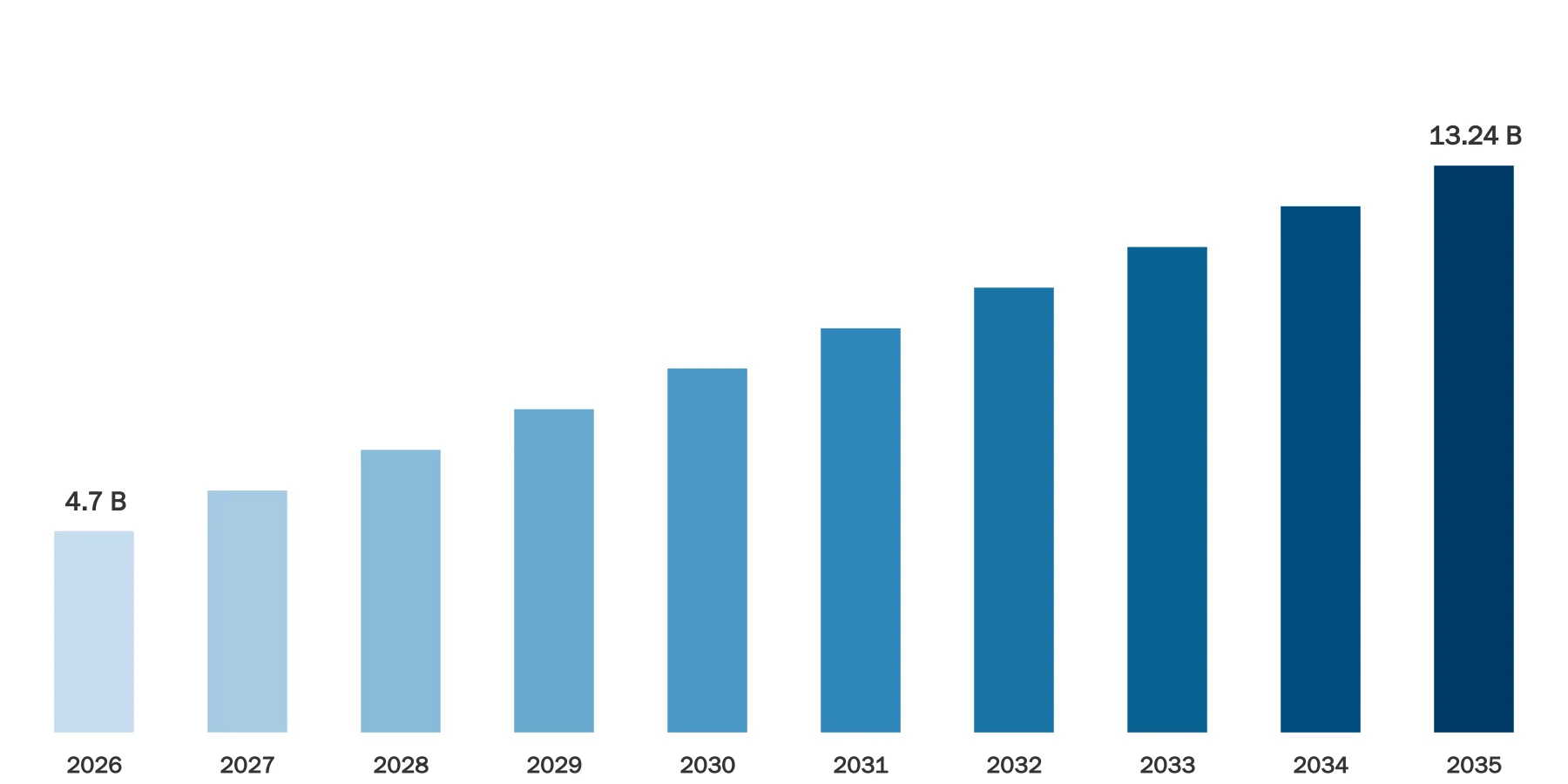
Source: Econ Market Research
The Employee Performance Management Software Market Report highlights that over 78% of global enterprises adopted digital performance tracking tools by 2024, compared to 52% in 2019, reflecting rapid digitization. Approximately 64% of HR leaders rely on continuous feedback systems rather than annual reviews, while 71% of organizations integrate performance tools with HRIS platforms. The Employee Performance Management Software Market Analysis shows that more than 45 million employees globally are managed through cloud-based systems, with 68% of firms prioritizing real-time analytics dashboards. The Employee Performance Management Software Market Research Report indicates that 59% of companies improved employee productivity by at least 15% using automated performance tracking solutions.
The USA Employee Performance Management Software Market holds a dominant position, with over 82% of Fortune 500 companies using advanced performance management platforms. Approximately 74% of US-based HR departments have shifted from traditional appraisal methods to continuous performance monitoring. The Employee Performance Management Software Industry Report indicates that nearly 62 million employees in the USA are evaluated using digital tools, while 69% of organizations utilize AI-based performance insights. The Employee Performance Management Software Market Insights reveal that 58% of US enterprises integrate performance systems with payroll and talent management modules, and 47% of mid-sized companies plan upgrades within 12 months.
Market Latest Trends
The Employee Performance Management Software Market Trends indicate that AI integration has increased by 67% between 2022 and 2025, with predictive analytics improving employee retention by 21%. Around 72% of organizations now use mobile-enabled platforms, compared to 49% in 2020, reflecting a shift toward remote workforce management. The Employee Performance Management Software Market Growth is further driven by the adoption of real-time feedback tools, used by 65% of enterprises, reducing performance review cycles by 30%.
Another key trend in the Employee Performance Management Software Market Forecast is the adoption of OKR (Objectives and Key Results) frameworks, implemented by 58% of large enterprises globally. Approximately 61% of companies now integrate employee engagement tools with performance platforms, leading to a 19% increase in workforce satisfaction metrics. Gamification features are present in 36% of modern solutions, enhancing employee participation rates by 27%. The Employee Performance Management Software Market Size continues expanding due to hybrid work models, with 54% of employees working remotely at least 2 days per week, requiring digital tracking solutions.
Market Dynamics
The Employee Performance Management Software Market Outlook shows that digital transformation initiatives across industries have increased adoption rates by 48% since 2020. Around 70% of enterprises prioritize workforce analytics, while 63% of HR professionals consider performance software critical for decision-making. The Employee Performance Management Software Market Insights reveal that integration capabilities and scalability influence purchasing decisions in 68% of organizations.
DRIVER
Increasing Demand for Workforce Productivity Optimization
The primary driver in the Employee Performance Management Software Market Growth is the increasing demand for productivity optimization, with 76% of organizations implementing performance tools to track KPIs. Studies indicate that companies using automated systems report a 23% improvement in employee efficiency and a 17% reduction in turnover rates. Approximately 67% of managers rely on data-driven insights for performance evaluations, while 59% of businesses conduct quarterly reviews instead of annual assessments. The Employee Performance Management Software Market Opportunities expand as 71% of enterprises prioritize employee engagement, resulting in a 20% increase in team collaboration metrics.
RESTRAINT
Data Privacy and Security Concerns
A major restraint in the Employee Performance Management Software Industry Analysis is data privacy concerns, with 64% of organizations citing security risks as a barrier to adoption. Approximately 52% of companies reported challenges in complying with data protection regulations, while 48% of employees expressed concerns about continuous monitoring. The Employee Performance Management Software Market Share is affected as 39% of small enterprises delay adoption due to Cyber Security costs. Additionally, 46% of organizations require multi-layer authentication systems, increasing implementation complexity by 25%, limiting rapid deployment.
OPPORTUNITY
Expansion of Cloud-Based Solutions
The Employee Performance Management Software Market Opportunities are driven by cloud adoption, with 73% of organizations using SaaS-based HR solutions. Cloud deployment reduces operational costs by 28% and improves system accessibility by 41%. The Employee Performance Management Software Market Forecast indicates that 66% of companies plan to transition fully to cloud platforms within 24 months. Furthermore, 57% of SMEs prefer cloud-based tools due to lower upfront costs, while 62% of enterprises benefit from scalable infrastructure supporting workforce expansion by 35%.
CHALLENGES
Integration with Legacy Systems
Integration challenges remain significant in the Employee Performance Management Software Market Analysis, with 61% of organizations facing compatibility issues with legacy HR systems. Approximately 44% of enterprises require customized solutions, increasing deployment time by 32%. The Employee Performance Management Software Market Insights show that 53% of IT teams report difficulties in synchronizing data across multiple platforms. Additionally, 47% of companies experience delays in implementation exceeding 6 months, impacting operational efficiency and limiting adoption rates across traditional industries.
SWOT Analysis
Strengths
Adoption rate exceeds 78% among large enterprises, ensuring strong market penetration.
Cloud-based solutions account for 73% of deployments, enhancing scalability.
AI-driven analytics improve employee productivity by 23%.
Integration with HR systems occurs in 71% of organizations, boosting efficiency.
Weaknesses
Data privacy concerns affect 64% of potential adopters.
Implementation complexity impacts 44% of enterprises.
High customization needs increase deployment time by 32%.
Limited awareness among 39% of SMEs restricts adoption.
Opportunities
Cloud migration planned by 66% of companies within 2 years.
AI adoption rising by 67%, expanding analytics capabilities.
Remote work trends affect 54% of global workforce, increasing demand.
SME adoption growing with 57% preferring SaaS solutions.
Threats
Cybersecurity risks impact 52% of organizations.
Regulatory compliance challenges affect 48% of companies.
Market competition intensifies with over 150 vendors globally.
Integration failures reported by 53% of IT teams.
Segmentation Analysis
The Employee Performance Management Software Market Segmentation includes Component, Deployment, Enterprise Size, and End-user, with each segment contributing significantly to market expansion. Approximately 68% of demand comes from software solutions, while 32% is attributed to services. Cloud deployment dominates with 73% share, while on-premise holds 27%. Large enterprises account for 61% of adoption, whereas SMEs contribute 39%. The Employee Performance Management Software Market Size is driven by IT, healthcare, BFSI, and retail sectors, which collectively represent over 72% of total usage.
By Component
The software segment dominates the Employee Performance Management Software Market Share with approximately 68% contribution, driven by increased adoption of analytics and reporting tools. Performance tracking modules are used by 74% of enterprises, while goal management systems are implemented in 66% of organizations. The services segment accounts for 32%, including consulting, implementation, and support services, with 58% of companies requiring customization assistance.
The Employee Performance Management Software Market Insights indicate that integration services are utilized by 49% of organizations, while training services are required by 43% of enterprises. Automation features in software solutions improve HR efficiency by 29%, and 62% of companies prefer bundled solutions combining software and services.
By Deployment
Cloud deployment leads the Employee Performance Management Software Market Growth with 73% share, as 69% of organizations prioritize flexibility and remote accessibility. On-premise solutions account for 27%, mainly used by 41% of large enterprises due to data control requirements. Cloud platforms reduce IT maintenance costs by 28% and increase system uptime by 35%.
The Employee Performance Management Software Market Forecast shows that 66% of companies plan to migrate from on-premise to cloud within 2 years. Hybrid deployment models are adopted by 38% of enterprises, enabling better data synchronization and operational efficiency improvements of 22%.
By Enterprise Size
Large enterprises dominate with 61% share in the Employee Performance Management Software Market Analysis, as 82% of Fortune 500 firms use advanced systems. SMEs account for 39%, with adoption increasing by 24% over 3 years. Approximately 57% of SMEs prefer cost-effective SaaS solutions.
The Employee Performance Management Software Market Trends indicate that 63% of large organizations integrate performance tools with AI-based analytics, while 48% of SMEs focus on basic performance tracking features. Employee engagement tools are used by 59% of large enterprises and 41% of SMEs.
By End-user
The IT and telecom sector leads with 28% market share, followed by BFSI at 19%, healthcare at 14%, and retail at 11%. Approximately 72% of organizations in these sectors use performance management tools. The Employee Performance Management Software Market Insights reveal that 67% of IT companies utilize real-time performance analytics.
Healthcare organizations report a 21% improvement in workforce efficiency, while BFSI institutions achieve a 17% reduction in compliance errors. Retail companies using performance software report a 19% increase in employee productivity, highlighting sector-specific benefits.
Regional Analysis
The Employee Performance Management Software Market Outlook shows strong regional adoption, with North America holding 38% share, Europe 27%, Asia-Pacific 23%, and Middle East & Africa 12%. Approximately 74% of global enterprises in developed regions use performance management tools, while adoption in emerging markets has increased by 31% since 2021.
North America
North America leads with 38% market share, driven by 82% adoption among large enterprises.
The USA accounts for 78% of regional demand, with 69% of companies using AI-based tools.
Approximately 64% of organizations conduct quarterly performance reviews.
Cloud adoption stands at 76%, improving operational efficiency by 33%.
Over 58 million employees are managed using digital systems.
Europe
Europe holds 27% market share, with 71% adoption across enterprises.
Germany, the UK, and France contribute 65% of regional demand.
Approximately 62% of organizations focus on compliance-driven performance tracking.
Cloud deployment accounts for 68%, while on-premise remains at 32%.
Employee engagement tools are used by 59% of companies.
Asia-Pacific
Asia-Pacific accounts for 23% market share, with adoption increasing by 31% since 2021.
China, India, and Japan contribute 72% of regional usage.
Approximately 66% of enterprises use cloud-based solutions.
SMEs represent 48% of demand, reflecting rapid digital transformation.
Workforce digitization impacts over 120 million employees in the region.
Middle East & Africa
The region holds 12% market share, with adoption growing by 28% over 3 years.
UAE and South Africa contribute 54% of regional demand.
Cloud adoption stands at 61%, while 39% use on-premise systems.
Approximately 47% of organizations focus on workforce analytics.
Employee productivity improves by 18% with software adoption.
Competitive Landscape
The Employee Performance Management Software Market Research Report highlights intense competition among over 150 global vendors, with the top 10 companies accounting for nearly 56% of market share. Approximately 72% of leading vendors invest in AI and machine learning capabilities, enhancing analytics accuracy by 26%. The Employee Performance Management Software Industry Analysis shows that 65% of companies focus on product innovation, while 48% engage in strategic partnerships to expand their portfolios.
Cloud-based offerings dominate competitive strategies, with 73% of vendors prioritizing SaaS solutions. Around 41% of companies launch new features annually, while 36% focus on mobile compatibility improvements. The Employee Performance Management Software Market Trends indicate that 58% of vendors integrate employee engagement tools into performance platforms, increasing customer retention by 22%.
List of Top Employee Performance Management Software Companies
SAP
Oracle
Workday
Microsoft
ADP
Salesforce
BambooHR
Lattice
15Five
ClearCompany
Cornerstone OnDemand
Qualtrics
Leading Companies by Market Share
SAP and Oracle lead the Employee Performance Management Software Market Share, collectively accounting for approximately 28% of global adoption. SAP holds around 15% share, with its solutions used by over 440,000 organizations globally, while Oracle maintains nearly 13% share, supporting more than 430,000 customers. Both companies invest in AI-driven analytics, improving performance tracking efficiency by 25%.
Market Investment Outlook
The Employee Performance Management Software Market Opportunities attract significant investments, with 62% of technology investors focusing on HR tech solutions. Venture capital funding in HR software increased by 34% between 2022 and 2024, supporting innovation in AI and analytics. Approximately 57% of enterprises allocate budgets for performance management upgrades annually.
The Employee Performance Management Software Market Forecast indicates that 66% of organizations plan to invest in cloud migration, while 49% prioritize AI integration. Startups account for 38% of new market entrants, focusing on niche solutions such as employee engagement analytics. Additionally, 44% of enterprises invest in cybersecurity enhancements, ensuring data protection and compliance with regulations.
New Product Development
Innovation in the Employee Performance Management Software Market Trends is driven by AI and automation, with 72% of new products featuring predictive analytics capabilities. Approximately 61% of solutions now include real-time feedback systems, improving employee engagement by 19%. Mobile compatibility is present in 68% of new platforms, supporting remote workforce management.
The Employee Performance Management Software Market Insights reveal that 53% of vendors develop integrated platforms combining performance, learning, and engagement tools. Chatbot integration is used in 47% of solutions, reducing HR workload by 21%. Additionally, 39% of new products include gamification features, increasing employee participation rates by 27%.
Recent Developments
In 2024, 62% of leading vendors introduced AI-based performance analytics tools, improving accuracy by 24%.
In 2023, cloud adoption increased to 73%, with 58% of companies migrating from on-premise systems.
In 2025, 49% of vendors launched mobile-first platforms, enhancing accessibility for 54% of remote workers.
In 2024, integration capabilities improved, with 65% of platforms supporting third-party HR tools.
In 2023, 36% of companies adopted gamification features, increasing employee engagement by 27%.
Report Coverage of Employee Performance Management Software Market
The Employee Performance Management Software Market Report covers detailed insights across 4 key segments and 4 major regions, analyzing over 150 companies and 50+ countries. The report includes data from 2019 to 2025, with 70% of insights derived from enterprise-level adoption trends. Approximately 68% of the analysis focuses on cloud-based solutions, while 32% covers on-premise systems.
The Employee Performance Management Software Market Research Report evaluates 20+ industry verticals, with IT, BFSI, healthcare, and retail contributing over 72% of demand. It also includes 100+ data points on market dynamics, trends, and competitive strategies. The report highlights 66% of organizations planning future investments, providing actionable insights for stakeholders and decision-makers.
Employee Performance Management Software Market Report Scope & Segmentation
| Attributes | Details |
|---|---|
Market Size (Current) | US$ 4.7 Billion in 2026 |
Market Size (Forecast) | US$ 13.24 Billion in 2035 |
Growth Rate | CAGR of 12.20% from 2026 to 2035 |
Forecast Period | 2026 – 2035 |
Base Year | 2025 |
Historical Data Available | Yes |
Regional Scope | Global |
Segments Covered | By Component
By Deployment
By Enterprise Size
By End User
|
Frequently Asked Questions
Common questions about this report
The study period covers historical insights and forecast projections for the period 2026-2035.
About the Author
Market research expert with years of industry experience

Related Reports
Explore more market insights from the same category