E-learning Services Market Overview
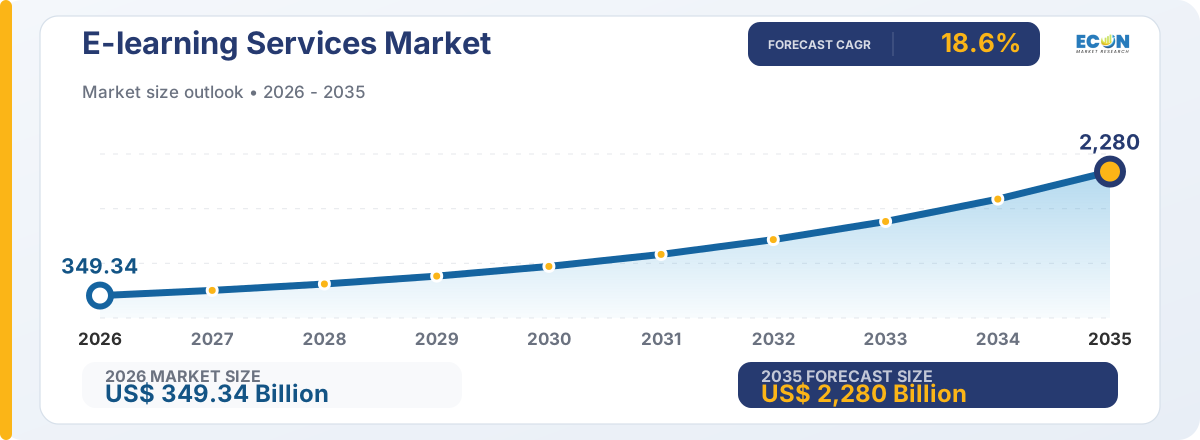
As per Econ Market Research analysis, the Global E-learning Services Market was recorded at US$ 349.34 Billion in 2026 and is projected to expand to US$ 2280 Billion by 2035, registering a CAGR of 18.6% over the forecast period. The base year used is 2025.
With the help of digital technologies, the e-learning services market has quickly developed into a vibrant industry that is revolutionizing education. E-learning services provide a flexible and easily available learning environment that includes a variety of online courses, virtual classrooms, and interactive educational materials. With the introduction of cutting-edge technology like virtual reality and Artificial Intelligence, the industry is growing and offering individualized and interesting learning opportunities. E-learning services provide professional training, academic pursuits, and skill development for learners worldwide, catering to a variety of industries. This revolutionary approach to education is gaining a lot of traction, revolutionizing the conventional learning environment and enabling people to study anything, anywhere, at any time.
E-learning Services Market Dynamics
The desire for flexible and remote learning solutions, the increased emphasis on continuous skill development, and technical improvements are some of the reasons driving the market',s dynamic rise for e-learning services. The COVID-19 epidemic, increasing internet penetration, and the availability of mobile devices have all hastened the uptake of e-learning.
The industry is growing as a result of corporate training programs and a move in university settings toward online learning. Furthermore, the market dynamics are further shaped by the integration of artificial intelligence and data analytics for individualized learning experiences, which creates a flexible and dynamic ecosystem to fulfill the varied educational demands of learners worldwide.
E-learning Services Drivers
Technological Advancements
Cutting-edge technologies like virtual reality, interactive multimedia, and artificial intelligence are integrated to provide tailored and captivating learning experiences in addition to improving the overall quality of instructional content. These developments provide learners with interactive tools by enabling immersive simulations, real-time assessments, and adaptable learning platforms. Technology is essential to the development of e-learning because it makes learning more flexible, accessible, and successful while also satisfying the varied needs of professionals and students in a world that is becoming more digitally connected and digitalized.
Remote Learning Demand
Remote learning tackles issues brought on by geographical limitations and worldwide incidents like the COVID-19 epidemic. It is driven by the demand for flexible and accessible education. Its allure is that it allows students to learn from any location, eliminating geographical restrictions. To facilitate ongoing education, skill development, and professional training, organizations, companies, and individuals are looking for e-learning solutions more and more. With a focus on convenience and adaptability in the face of changing cultural and economic factors, the growing demand for remote learning highlights a fundamental shift towards digital education.
Restraints:
Lack of Technological Infrastructure
Online educational content distribution and accessibility are impeded in areas with obsolete hardware, insufficient bandwidth, and poor internet connectivity. The potential reach of e-learning efforts is limited by the digital gap, which further impairs disparities in educational opportunities. Since a strong infrastructure is essential to the efficacy of e-learning services, closing these technological disparities will be the challenge in ensuring that all students have fair access to high-quality education. Expanding and improving technology capabilities is a must to overcome this limitation, especially in underprivileged or isolated locations.
Limited Interaction and Engagement
Online learning environments might not have the same face-to-face interaction and collaboration aspects that some students find crucial in traditional classroom settings. Students may become less engaged and motivated if they don',t receive timely feedback or have opportunities to form personal connections. This task is especially pertinent to themes that call for debates or practical experiences. In order to build an online learning environment that is more dynamic and participatory, e-learning systems should integrate interactive features, virtual collaboration tools, and interesting material to solve these restrictions.
Opportunities:
Integration of Emerging Technologies
Artificial intelligence, Augmented Reality, and virtual reality are examples of advances that can be incorporated to improve education through immersive content, tailored learning routes, and interactive simulations. These technological advancements provide dynamic and adaptable learning environments that accommodate different learning preferences.
Developing interesting and useful teaching materials that go beyond conventional approaches and promote greater comprehension and memory retention is an opportunity. Strategic integration of emerging technologies allows service providers to offer state-of-the-art, future-ready solutions that suit the changing needs of a diverse and tech-savvy learner population as e-learning continues to advance.
Partnerships with Educational Institutions
By working together, e-learning service providers can offer a blended learning approach by smoothly integrating their platforms into existing academic systems. Providers can increase their reach and influence by partnering with schools, colleges, and universities, which gives them access to a vast and diverse student base. Collaborative efforts that integrate cutting-edge e-learning technologies with conventional teaching techniques can improve education overall. As institutions embrace digital transformation and e-learning companies gain credibility and widespread use within the education sector, such partnerships establish a symbiotic connection that benefits both parties.
Segment Overview
By Type
Based on type, the global e-learning services market is divided into custom e-learning, responsive e-learning, micro e-learning, translation &, localization, game-based learning, and rapid e-learning. The custom e-learning category dominates the market with the largest revenue share in 2023. Relevance is ensured by customizing e-learning to meet individual or corporate needs. Responsive e-learning maximizes accessibility by smoothly adjusting to different devices.
Bite-sized modules are the mainstay of micro-e-learning, providing quick and focused knowledge acquisition. Language barriers are eliminated by using translation and localization services to make material available worldwide. Engagement is increased via game-based learning by using gamified and interactive strategies. Quick content creation is emphasized in rapid e-learning, which is perfect for dynamic learning environments.
By Technology
Based on the technology, the global e-learning services market is categorized into artificial intelligence, augmented reality and virtual reality, big data, and cloud computing. The cloud computing category leads the global e-learning services market with the largest revenue share in 2023. The utilization of cloud computing facilitates easy access to instructional materials, encouraging cooperation and adaptability. By tailoring information to each learner',s needs, artificial intelligence (AI) makes personalized learning experiences possible. Virtual reality (VR) and augmented reality (AR) improve engagement by offering dynamic, immersive simulations. Performance analysis and individualized learning paths benefit from data-driven insights made possible by big data analytics.
By End-Users
Based on end-users, the global e-learning services market is segmented into K-12, higher education, corporates, government, and vocational. The government segment dominates the e-learning services market. E-learning is used by government organizations to provide public sector training programs. E-learning modules that are job-specific and practical are beneficial for vocational segments. This division shows how e-learning is flexible enough to accommodate a wide range of learning needs in K&ndash,12, higher education, corporate, government, and vocational contexts. It also shows how adaptable e-learning is across educational levels and industries. Businesses use e-learning to train their staff, which promotes professional development and skill enhancement.
By Learning Method
Based on the learning method, the global e-learning services market is divided into blended learning, mobile learning, virtual classrooms, and simulation. The blended learning category dominates the market with the largest revenue share in 2023. Blended learning offers a comprehensive educational experience by fusing digital and conventional classroom methods.
The goal of mobile learning is to provide instructional content via tablets and smartphones in a way that is flexible and accessible. By utilizing internet platforms, virtual classrooms enable dynamic, real-time learning experiences that are not limited by geography. Through virtual experiences, learners are immersed in real-world circumstances through simulation-based learning, which improves skills.
E-learning Services Overview by Region
The global e-learning services market is categorized into North America, Europe, Asia-Pacific, and the Rest of the World. North America emerged as the leading region, capturing the largest market share in 2023. The growth of the industry is facilitated by the region',s well-established educational institutions as well as a strong corporate emphasis on ongoing learning. Furthermore, the existence of significant e-learning service providers and a tech-savvy populace encourage innovation and advance North America.
The region',s standing is further strengthened by government measures that support digital education, positioning it as a center for e-learning innovations and a frontrunner in defining the direction of Online Education. Throughout the forecast period, Asia-Pacific is anticipated to post a significant CAGR. This prediction is supported by elements including the quickening pace of digital transformation, the growing popularity of the internet, and the rise in the number of tech-savvy students. E-learning services are becoming more and more popular in the region due to the growing desire for flexible and easily available education as well as an increased emphasis on skill development. The region',s strong growth is facilitated by government measures that foster digital education and the growing e-learning ecosystem.
E-learning Services Competitive Landscape
In the global e-learning services market, a few major players exert significant market dominance and have established a strong regional presence. These leading companies remain committed to continuous research and development endeavors and actively engage in strategic growth initiatives, including product development, launches, joint ventures, and partnerships. By pursuing these strategies, these companies aim to strengthen their market position, expand their customer base, and capture a substantial share of the market.
E-learning Services Market Leading Companies:
McGraw Hill
SAP SE
IBM Corporation
upGrad Education Private Limited
NIIT Inc.
Adobe
LinkedIn Corporation
Docebo
Coursera Inc.
BYJU&rsquo,S
edX LLC
Udemy, Inc.
Udacity, Inc, and various others.
E-learning Services Recent Developments
In December 2023, Curriculum Associates, a vendor of exams, data management tools, and print and online teaching materials based on research, purchased the AI speech recognition startup SoapBox Labs.
In November 2023, William Brown',s prestigious UK-based e-learning company has been successfully acquired by US private equity firm High View in a multiseven-figure deal. This strategic partnership takes William Brown',s entrepreneurial success to new heights and marks a turning point in the e-learning industry.
In March 2023, With the help of LDC, international online learning solutions provider Omniplex Learning, which enables businesses to plan, develop, and deliver efficient and captivating digital learning, has purchased the IT and digital transformation training division of Good e-learning.
In January 2023, A Nordic learning-as-a-service company called Eduhouse buys all of the shares in GoLearn, a Danish e-learning provider. Eduhouse begins its journey towards the broader European market with the extension of its e-learning services into the Danish market. Verdane, an equity investor, supports the deal. Plesner provided Verdane and Eduhouse with legal advice.
E-learning Services Market Report Segmentation
E-learning Services Market Report Scope & Segmentation
| Attributes | Details |
|---|---|
| Market Size (Current)Current market valuation | US$ 349.34 Billion in 2026 |
| Market Size (Forecast)Projected market valuation | US$ 2280 Billion in 2035 |
| Growth RateCompound Annual Growth Rate | CAGR of 18.6% from 2026 to 2035 |
| Forecast PeriodAnalysis timeline | 2026 – 2035 |
| Base YearReference year for analysis | 2025 |
| Historical Data AvailablePast market data availability | Yes |
| Regional ScopeGeographical coverage | Global |
| Segments CoveredMarket segments analyzed | By Provider
By Deployment
By Application
By End-User
|
Leading companies covered in this report
- Skillsoft
- Pearson
- McGraw Hill
- SAP Litmos
- Adobe
- LinkedIn Learning
- NIIT Ltd
- Cornerstone OnDemand
Frequently Asked Questions
Common questions about this report
The study period covers historical insights and forecast projections for the period 2026-2035.
About the Author
Market research expert with years of industry experience