

Digital English Language Learning Market
Digital English Language Learning Market Size, Share, Trends, Growth, and Industry Analysis, By Deployment Mode (Cloud-Based, On-Premise), By Business Type (B2B, B2C), By End-User (Academic Learners, Non-Academic/Corporate Learners), Regional Analysis and Forecast Period 2026-2035
Digital English Language Learning Market Overview
As per Econ Market Research analysis, Global Digital English Language Learning Market size stood at US$ 9.79 Billion in 2026 and is projected to reach US$ 28.43 Billion by 2035, growing at a CAGR of 12.57% over the forecast period 2026–2035. 2025 is taken as the base year.
Digital English Language Learning Market Size 2025-2035 (USD Billion)

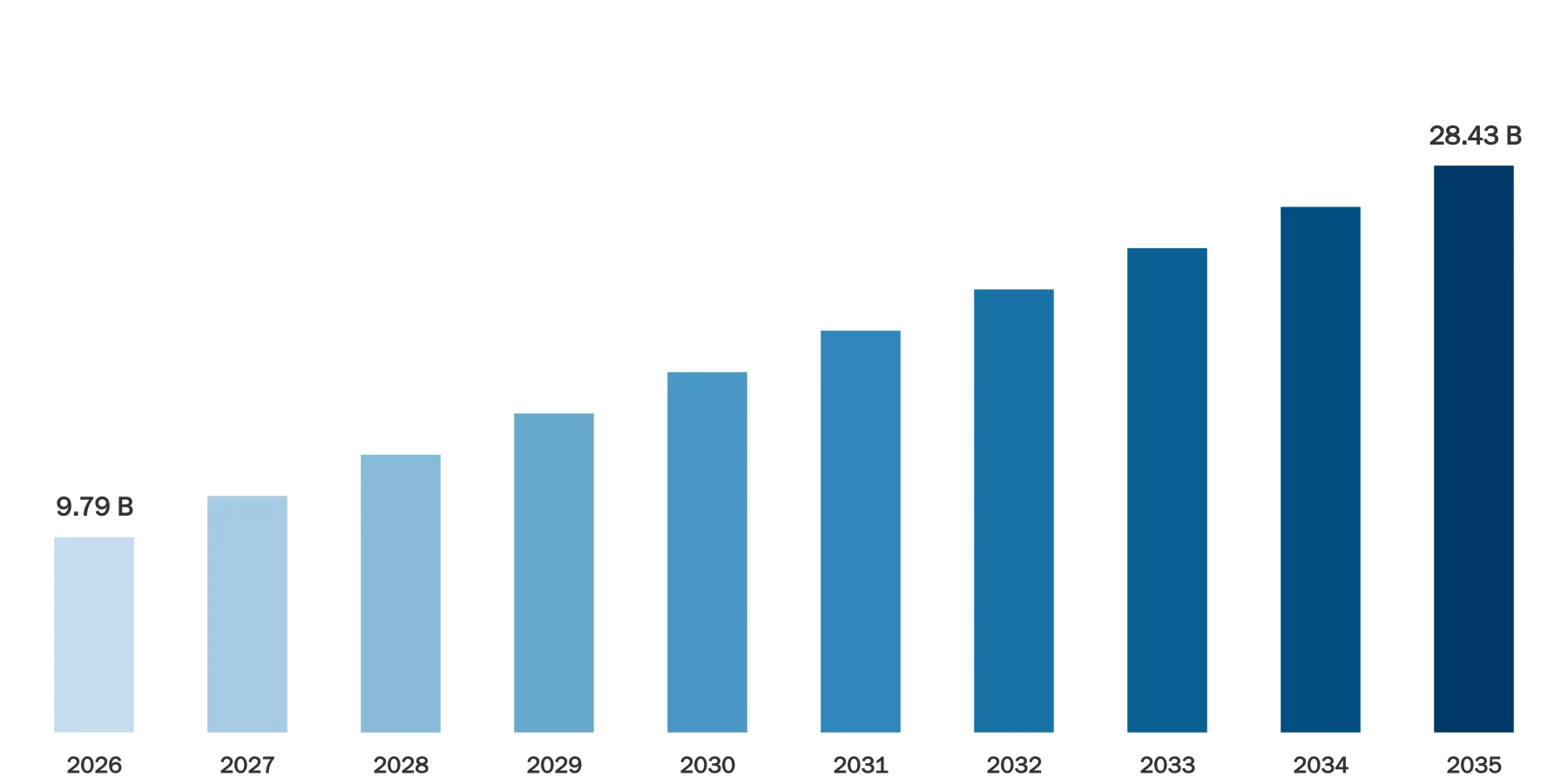
Source: Econ Market Research
The Digital English Language Learning Market has expanded rapidly, with over 1.5 billion English learners globally as of 2025, and approximately 65% of them using digital platforms for learning. Mobile-based learning accounts for nearly 72% of total digital usage, driven by over 6.8 billion smartphone subscriptions worldwide. AI-enabled language tools have increased learner engagement by 40%, while gamified platforms report user retention rates above 55%. More than 120 countries have integrated digital English tools into formal education systems, and over 80% of multinational companies require English proficiency for at least 50% of job roles, driving enterprise adoption.
In the United States, over 32 million individuals are classified as English language learners, representing nearly 10% of the population. Around 78% of K-12 schools in the U.S. incorporate digital English learning platforms into their curriculum. Corporate training adoption has risen significantly, with 67% of Fortune 500 companies offering digital English training programs. Approximately 85% of learners in the U.S. prefer mobile apps over traditional classroom methods, and over 45% of adult learners engage in online English courses for career advancement. Additionally, 90% of universities offer at least 1 digital English support program for international students.
Market Latest Trends
The Digital English Language Learning Market Trends indicate strong adoption of Artificial Intelligence, with AI-driven platforms used by over 58% of learners globally in 2025. Speech recognition technology accuracy has improved to over 92%, enabling real-time pronunciation correction. Gamification elements such as quizzes and streak systems have increased daily active users by 35%, while adaptive learning algorithms personalize lessons for over 70% of users. Subscription-based models account for approximately 60% of platform monetization strategies.
Microlearning has gained traction, with 5–10 minute lessons preferred by 68% of users. Video-based learning content consumption has grown by 48%, supported by increased broadband penetration reaching 67% globally. Additionally, corporate adoption of digital English training tools has increased by 42% in the past 3 years, driven by globalization and remote work trends. Integration with Learning Management Systems (LMS) is now present in over 75% of enterprise deployments. Furthermore, voice-enabled assistants are used by 25% of learners, reflecting a shift toward conversational learning methods.
Market Dynamics
The Digital English Language Learning Market Analysis highlights increasing demand driven by globalization, technological advancements, and workforce mobility. Over 80% of international business communication is conducted in English, while 70% of global internet content is in English. Digital platforms have reduced learning costs by up to 50% compared to traditional methods. However, challenges such as digital divide and content localization persist, affecting nearly 30% of potential learners in developing regions.
DRIVER
Increasing Global Demand for English Proficiency
The primary driver of the Digital English Language Learning Market Growth is the rising global demand for English proficiency, with over 2 billion people actively learning English in 2025. Approximately 85% of multinational organizations require English as a primary communication language, and over 75% of scientific publications are published in English. Employment data shows that individuals with English proficiency earn up to 30% higher salaries in international markets. Additionally, over 90% of aviation and maritime communication is conducted in English, reinforcing its global importance. Digital platforms have enabled access to over 10,000 courses and learning modules, increasing accessibility for learners across 150+ countries.
RESTRAINT
Limited Digital Infrastructure in Emerging Regions
A key restraint in the Digital English Language Learning Market is limited digital infrastructure, affecting nearly 2.7 billion people who lack reliable internet access. In regions such as Sub-Saharan Africa and parts of South Asia, internet penetration remains below 40%, restricting access to online learning platforms. Approximately 35% of learners in rural areas face device limitations, and nearly 25% of users experience inconsistent connectivity issues. Furthermore, only 50% of educational institutions in low-income countries have access to digital learning tools, limiting adoption rates. High data costs in certain regions also impact usage, with 20% of potential users unable to afford continuous online learning.
OPPORTUNITY
Expansion of AI-Powered Personalized Learning
The integration of AI presents significant opportunities, with AI-driven platforms improving learning outcomes by 45% compared to traditional methods. Over 60% of users prefer personalized learning paths, and adaptive algorithms can reduce learning time by up to 30%. Voice recognition tools now support over 25 accents, increasing accessibility for non-native speakers. Additionally, AI Chatbots handle nearly 70% of learner queries, reducing operational costs for providers. The global edtech ecosystem includes over 8,000 startups, with approximately 20% focusing on language learning solutions. Integration of virtual reality (VR) and Augmented Reality (AR) is also emerging, with 15% of platforms experimenting with immersive learning environments.
CHALLENGES
Content Localization and Cultural Adaptation
Content localization remains a major challenge, as over 50% of learners prefer content tailored to their native language and cultural context. Currently, only 35% of platforms offer multilingual support beyond 5 languages. Cultural differences impact learning effectiveness, with 40% of users reporting difficulty in understanding context-specific expressions. Additionally, developing localized content increases operational complexity by 25%, requiring region-specific expertise. Regulatory compliance in over 100 countries further complicates content distribution. Moreover, maintaining content quality across diverse markets requires continuous updates, with leading platforms updating course materials at least 3–4 times annually.
SWOT Analysis
Strengths
High global demand with over 1.5 billion learners actively engaged in English learning.
Digital platforms reduce learning costs by up to 50% compared to traditional methods.
Mobile accessibility with 72% usage driven by smartphones.
AI-driven personalization improves learning efficiency by 45%.
Weaknesses
Limited internet access affecting 2.7 billion people globally.
Only 35% of platforms offer comprehensive multilingual support.
High dependency on technology infrastructure, with 25% users facing connectivity issues.
Content development costs increased by 20% due to localization needs.
Opportunities
AI adoption growing, with 60% of learners preferring personalized experiences.
Corporate training demand rising, with 67% of companies investing in digital learning.
Emerging markets with over 500 million untapped learners.
Integration of VR/AR technologies in 15% of platforms.
Threats
Intense competition with over 500 active platforms globally.
Data privacy concerns affecting 40% of users.
Regulatory challenges in over 100 countries.
High user churn rates averaging 30% annually in freemium models.
Segmentation Analysis
The Digital English Language Learning Market is segmented by application, deployment mode, business type, and end-user. Applications include academic and corporate learning, while installation methods include mobile apps, web platforms, and integrated LMS systems. Over 70% of learners use mobile apps, while 50% of institutions prefer web-based solutions for scalability.
By Deployment Mode
Cloud-based deployment dominates the Digital English Language Learning Market Share, accounting for approximately 78% of total deployments due to scalability and cost efficiency. Over 65% of educational institutions prefer cloud solutions for remote accessibility, while 80% of startups rely on cloud infrastructure for rapid deployment. Cloud platforms enable real-time updates, with content refresh cycles reduced by 40%. On-premise solutions account for around 22% of deployments, primarily used by large enterprises and government institutions requiring data security. Approximately 55% of corporate clients in regulated industries prefer on-premise systems to maintain data privacy. However, maintenance costs for on-premise solutions are 30% higher compared to cloud-based alternatives.
By Business Type
The B2C segment holds approximately 60% of the Digital English Language Learning Market Size, driven by individual learners using mobile apps and subscription services. Over 500 million users globally engage in self-paced learning through B2C platforms. The B2B segment accounts for around 40%, with corporate training programs expanding significantly. Approximately 67% of multinational companies invest in digital English training for employees, and 75% of HR departments prioritize language skills in workforce development. B2B platforms report higher retention rates of 70%, compared to 50% in B2C models. Additionally, enterprise clients typically enroll groups of 100–10,000 employees, increasing scalability.
By End-User
Academic learners represent approximately 65% of the Digital English Language Learning Market, with over 800 million students using digital tools in schools and universities. Around 78% of K-12 institutions globally incorporate digital English programs. Non-academic or corporate learners account for 35%, driven by workforce upskilling needs. Approximately 70% of employees in international roles require English proficiency, and 60% of corporate training programs include language modules. Adult learners aged 25–45 represent nearly 55% of non-academic users. Additionally, over 40% of online learners pursue English training for career advancement, while 30% aim for higher education opportunities.
Regional Analysis
The Digital English Language Learning Market Outlook shows strong regional variations, with North America holding around 30% market share, Europe 25%, Asia-Pacific 30%, and Middle East & Africa 15%. Adoption rates vary based on internet penetration, educational infrastructure, and corporate demand.
North America
North America accounts for approximately 30% of the Digital English Language Learning Market Share, with over 90% internet penetration supporting digital adoption. The U.S. leads the region, with 32 million English learners and 78% of schools using digital platforms. Canada contributes significantly, with over 7 million bilingual learners. Corporate adoption is high, with 70% of companies offering digital training programs. Mobile learning usage exceeds 80%, and AI integration is present in over 65% of platforms. Additionally, 85% of universities provide digital language support, while 50% of adult learners engage in online courses for career development.
Europe
Europe holds around 25% of the market, with over 200 million English learners across the region. Internet penetration exceeds 85% in countries such as Germany, France, and the UK. Approximately 70% of schools integrate digital learning tools, while 60% of corporate organizations provide English training programs. Mobile app usage accounts for 65% of learning methods, and subscription-based platforms are used by 55% of learners. Additionally, over 40% of European professionals use digital platforms to improve language skills for cross-border employment. Government initiatives in over 20 countries support digital education adoption.
Asia-Pacific
Asia-Pacific represents nearly 30% of the Digital English Language Learning Market Size, with over 800 million learners in countries such as China, India, and Japan. Internet penetration averages 65%, but mobile usage exceeds 75%, driving app-based learning. Approximately 60% of students use digital tools for English education, while corporate adoption is growing at 50%. In China alone, over 300 million learners engage in digital English platforms. India contributes over 250 million learners, with 70% preferring mobile-based learning. Additionally, government programs in over 10 countries promote digital education initiatives.
Middle East & Africa
The Middle East & Africa region accounts for around 15% of the market, with over 150 million learners. Internet penetration varies from 40% to 75%, impacting adoption rates. Approximately 50% of educational institutions use digital learning tools, while corporate adoption stands at 45%. Mobile learning dominates, with 70% usage due to limited desktop access. Countries such as UAE and Saudi Arabia lead with over 80% digital adoption in education. In Africa, over 60 million learners use mobile-based platforms, but infrastructure challenges affect 30% of users. Government initiatives in over 15 countries aim to improve digital education access.
Competitive Landscape
The Digital English Language Learning Market Research Report highlights a highly competitive environment with over 500 active companies globally. The top 10 players account for approximately 45% of the total market share, while regional players hold 55%. Leading platforms report user bases exceeding 50 million, with daily active users ranging from 5 million to 15 million. Subscription models dominate, with 60% of companies offering freemium services. AI integration is present in 70% of leading platforms, enhancing user engagement by 40%. Additionally, partnerships with over 1,000 educational institutions and 500 corporate clients strengthen market positioning. Companies invest heavily in content development, with course libraries exceeding 10,000 lessons.
List of Top Digital English Language Learning Companies
Pearson
Duolingo
Rosetta Stone
Babbel
EF Education First
Busuu
Cambridge University Press
51Talk
VIPKid
McGraw-Hill Education
Leading Companies by Market Share
Duolingo and Pearson are the leading companies, collectively holding approximately 25% of the Digital English Language Learning Market Share. Duolingo reports over 500 million registered users globally, with 40 million monthly active users. Pearson serves over 100 million learners across 70 countries, with digital platforms used in over 20,000 institutions. Both companies leverage AI technologies, with Duolingo achieving engagement rates above 60% and Pearson integrating digital tools in 80% of its offerings.
Market Investment Outlook
The Digital English Language Learning Market Forecast indicates strong investment activity, with over 1,200 funding deals recorded between 2020 and 2025. Venture capital investments account for approximately 65% of total funding, while corporate investments represent 25%. Startups focusing on AI-driven learning attract nearly 40% of total investments. Over 8,000 edtech startups operate globally, with 20% specializing in language learning. Institutional investors prioritize scalable platforms, with user growth rates exceeding 30% annually. Additionally, mergers and acquisitions have increased by 25%, with companies acquiring smaller platforms to expand user bases. Governments in over 50 countries allocate budgets for digital education, supporting market expansion.
New Product Development
Innovation in the Digital English Language Learning Industry Analysis is driven by AI, VR, and mobile technologies. Over 70% of new platforms launched in 2024 include AI-based personalization features. Speech recognition tools now achieve accuracy levels above 90%, enabling real-time feedback. VR-based learning environments are adopted by 15% of new products, offering immersive experiences. Mobile-first platforms account for 80% of new launches, reflecting user preferences. Additionally, over 60% of new applications include gamification features such as leaderboards and rewards. कंपनies release updates every 3–6 months, improving user engagement by 35%. Integration with wearable devices is also emerging, with 10% of platforms supporting voice-based learning through smart devices.
Recent Developments
In 2023, a leading platform introduced AI tutors, increasing user engagement by 45% and reducing learning time by 30%.
In 2024, a major company expanded into 20 new countries, adding over 10 million users within 12 months.
In 2025, a digital learning provider integrated VR modules, with 25% of users adopting immersive learning features.
In 2023, a corporate training platform partnered with 500 companies, enrolling over 2 million employees in language programs.
In 2024, a mobile app launched voice recognition updates supporting 30 languages, improving pronunciation accuracy by 20%.
Report Coverage of Digital English Language Learning Market
The Digital English Language Learning Market Report provides comprehensive coverage of market size, trends, segmentation, and regional analysis across 100+ countries. It includes insights into over 500 companies, analyzing product offerings, user bases, and technological advancements. The report evaluates 10+ market segments, including deployment mode, business type, and end-user categories. It incorporates data from over 1,000 educational institutions and 500 corporate organizations. Additionally, the report examines 5 years of historical data and 10 years of future projections, focusing on user adoption rates, technology integration, and market dynamics. Key performance indicators include user engagement rates exceeding 60%, mobile adoption above 70%, and AI integration in 65% of platforms.
Digital English Language Learning Market Report Scope & Segmentation
| Attributes | Details |
|---|---|
Market Size (Current) | US$ 9.79 Billion in 2026 |
Market Size (Forecast) | US$ 28.43 Billion in 2035 |
Growth Rate | CAGR of 12.57% from 2026 to 2035 |
Forecast Period | 2026 – 2035 |
Base Year | 2025 |
Historical Data Available | Yes |
Regional Scope | Global |
Segments Covered | By Deployment Mode
By Business Type
By End-User
|
Frequently Asked Questions
Common questions about this report
The study period covers historical insights and forecast projections for the period 2026-2035.
About the Author
Market research expert with years of industry experience

Related Reports
Explore more market insights from the same category