

Coconut Coir Market
Coconut Coir Market Size, Share, Trends, Growth, and Industry Analysis, By Product Type (Brown Fibre, White Fibre, Buffering Coir, Bristle Coir, Others), By Form (Bales, Blocks, Disks and Coins, Husk Chips, Grow Bags, Open Top, Rope), By Application (Coir Pith, Coir Fibre, Tufted Mats, Handloom Mats, Curled Coir and Coir Yarn, Geo-Textiles, Others), By End User Industry (Packaging, Bedding and Flooring, Agricultural, Automobile, Others), Regional Analysis and Forecast Period 2026-2035
Coconut Coir Market Overview
As per Econ Market Research analysis, the Global Coconut Coir Market reached a valuation of US$ 802.29 Million in 2026 and is anticipated to grow to US$ 1630.65 Million by 2035, at a CAGR of 8.20% during the forecast timeline 2026–2035. The base year considered is 2025.
Coconut Coir Market Size 2025-2035 (USD Million)

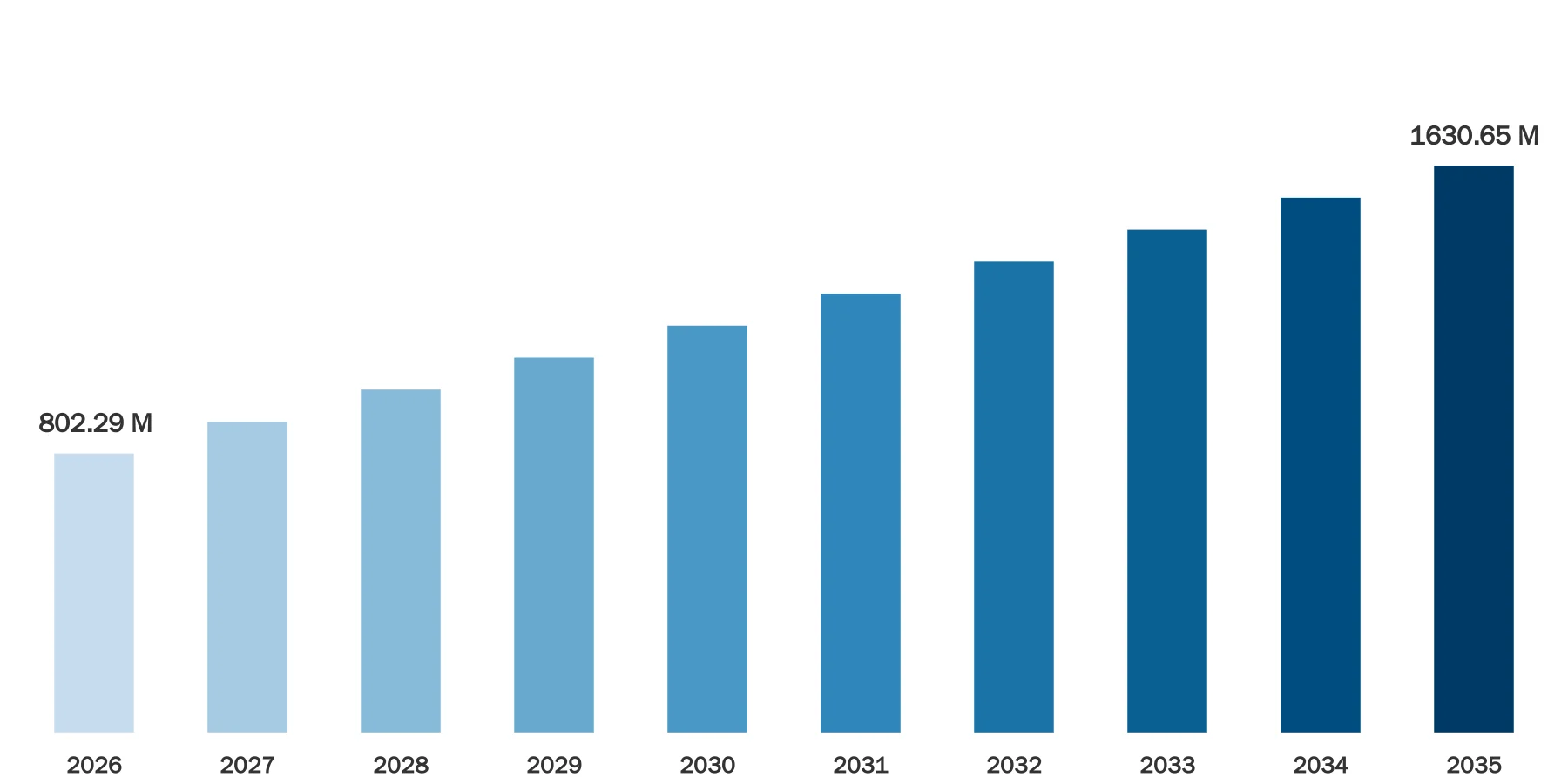
Source: Econ Market Research
The Coconut Coir Market Report highlights that global coconut production exceeded 62 million metric tons in 2024, with approximately 35% of coconut husk converted into coir fibers and pith. Coconut coir accounts for nearly 18% of the global natural fiber market volume, driven by increasing demand for biodegradable materials. India and Sri Lanka together contribute over 70% of global coir fiber exports, while coir pith production exceeds 12 million cubic meters annually. Coconut coir is widely used in horticulture, accounting for over 55% of total usage, followed by geotextiles at 20%. The Coconut Coir Industry Analysis indicates rising demand due to eco-friendly alternatives replacing synthetic substrates.
The USA Coconut Coir Market Analysis shows that the country imports more than 650,000 metric tons of coir products annually, primarily from India and Sri Lanka. The horticulture sector in the USA consumes approximately 60% of imported coir, especially in hydroponics and greenhouse farming. Over 45,000 commercial greenhouse farms in the USA utilize coconut coir substrates. The landscaping industry contributes nearly 25% of demand, with erosion control applications covering over 1.2 million acres. The Coconut Coir Market Research Report indicates that retail gardening products using coir have increased shelf presence by 30% in major distribution chains between 2022 and 2025.
Market Latest Trends
The Coconut Coir Market Trends reveal significant growth in sustainable agriculture practices, with over 75% of commercial hydroponic growers globally adopting coir-based substrates. Organic farming land surpassed 96 million hectares worldwide in 2024, increasing demand for natural growing media such as coconut coir. The Coconut Coir Market Insights indicate that compressed coir blocks have gained popularity, representing over 40% of traded coir products due to cost-efficient logistics. Automation in coir processing has increased production efficiency by 25% in major manufacturing hubs.
Another trend in the Coconut Coir Industry Report is the rising demand for coir geotextiles, with usage expanding across more than 50 countries for soil erosion control and road construction projects. Coir mats can degrade within 24 to 36 months, making them ideal for environmental applications. The Coconut Coir Market Forecast highlights the growing use of coir in Vertical Farming systems, which increased installations by over 20,000 units globally in 2023–2025. Additionally, coir-based packaging materials have replaced plastic alternatives in over 15% of eco-packaging applications, further driving Coconut Coir Market Growth.
Market Dynamics
The Coconut Coir Market Dynamics emphasize the balance between increasing raw material availability and expanding industrial applications. With more than 12 billion coconuts processed annually, the availability of husk waste supports large-scale coir production. Global demand for sustainable materials has increased by over 40% across industries, influencing Coconut Coir Market Size expansion. However, supply chain inefficiencies affect 15% of exports, particularly due to seasonal harvesting.
DRIVER
Increasing Demand for Sustainable Growing Media
The primary driver in the Coconut Coir Market Growth is the increasing demand for sustainable growing media in agriculture. Over 70% of hydroponic farms globally have shifted to coir substrates, replacing peat moss, which has seen extraction restrictions in over 20 countries. Coconut coir has water retention capacity of up to 800% of its weight, making it highly efficient for irrigation systems. The greenhouse farming area exceeded 500,000 hectares globally, with coir used in more than 60% of these facilities. The Coconut Coir Market Insights indicate that coir reduces water usage by up to 30%, which is critical in regions facing water scarcity.
RESTRAINT
Supply Chain and Processing Limitations
A major restraint in the Coconut Coir Market Analysis is the fragmented supply chain and inconsistent processing standards. Nearly 65% of coir production units are small-scale operations, leading to variability in product quality. Transportation costs account for 20% of total export costs, impacting competitiveness. Additionally, raw husk collection efficiency is limited to only 50% utilization in some producing regions, causing supply shortages. The Coconut Coir Industry Analysis shows that improper retting processes can reduce fiber strength by up to 25%, affecting product performance in industrial applications.
OPPORTUNITY
Expansion in Eco-Friendly Construction Materials
The Coconut Coir Market Opportunities are expanding rapidly in eco-friendly construction materials. Coir fiber is increasingly used in composite boards and insulation panels, with demand rising in over 35 countries. Coir-based panels can reduce thermal conductivity by 15% compared to synthetic materials, making them suitable for green buildings. The construction industry accounts for 12% of emerging coir applications, with usage growing in infrastructure projects covering over 200,000 square kilometers annually. The Coconut Coir Market Outlook suggests that biodegradable materials will replace 25% of synthetic construction components by 2030, creating new opportunities.
CHALLENGES
Competition from Alternative Substrates
The Coconut Coir Market Challenges include competition from alternative substrates such as peat moss and rock wool. Peat moss still holds approximately 30% share in global growing media, while rock wool accounts for 20% in hydroponics. Price fluctuations in coir products can vary by 15% annually, affecting buyer preferences. Additionally, quality inconsistencies in coir products lead to rejection rates of up to 10% in export markets. The Coconut Coir Market Research Report indicates that lack of standardization across over 25 exporting countries creates barriers for uniform market expansion.
SWOT Analysis
Strengths
Coconut coir is biodegradable, with decomposition time between 24–36 months.
Global coconut production exceeds 62 million metric tons, ensuring raw material availability.
Water retention capacity reaches 800% of weight, improving agricultural efficiency.
Coir products are used in over 80 countries, indicating wide market penetration.
Weaknesses
Around 65% of production units are unorganized, affecting consistency.
Fiber extraction efficiency remains below 60% in many regions.
Export logistics contribute to 20% cost overhead.
Quality rejection rates can reach 10% in international markets.
Opportunities
Organic farming covers 96 million hectares globally, boosting demand.
Eco-friendly packaging adoption increased by 15% globally.
Construction applications are expanding across 35+ countries.
Hydroponic systems increased installations by 20,000+ units.
Threats
Peat moss holds 30% share in growing media market.
Synthetic alternatives dominate 40% of industrial applications.
Climate variability affects coconut yield by 10–15% annually.
Regulatory compliance requirements increased in over 25 countries.
Segmentation Analysis
The Coconut Coir Market Segmentation includes product type, form, application, and end-user industry. Coir pith dominates with over 50% share, followed by coir fiber at 30%, and coir chips at 20%. In terms of form, compressed blocks account for 40%, loose coir 35%, and grow bags 25%. Applications are led by horticulture with 55% share, followed by geotextiles at 20%, and packaging at 15%. End-user industries include agriculture, construction, and landscaping, with agriculture contributing over 60% of demand.
By Product Type
The Coconut Coir Market Size by product type shows coir pith leading with over 50% share, driven by its extensive use in horticulture and hydroponics. Coir fiber accounts for approximately 30% of the market, widely used in ropes, mats, and geotextiles. Coir chips contribute nearly 20%, primarily used in orchid cultivation and soil aeration. Global production of coir pith exceeds 12 million cubic meters annually, while coir fiber production is estimated at 1 million metric tons. The Coconut Coir Market Insights indicate that coir pith demand has increased by 25% in greenhouse farming, making it the fastest-growing segment in volume terms.
By Form
In the Coconut Coir Market Analysis by form, compressed coir blocks dominate with 40% share, as they reduce shipping volume by up to 70%. Loose coir holds around 35% share, mainly used in landscaping and soil conditioning. Grow bags account for approximately 25%, widely used in commercial horticulture setups. The Coconut Coir Industry Report highlights that over 2 billion compressed coir blocks are traded annually, while grow bag usage has increased by 15% in greenhouse applications. These forms are designed to optimize storage, reduce transportation costs, and improve usability.
By Application
The Coconut Coir Market Trends by application show horticulture leading with over 55% share, driven by hydroponics and organic farming. Geotextiles account for around 20%, used in erosion control projects covering 1.2 million acres globally. Packaging applications represent approximately 15%, while other uses such as animal bedding contribute 10%. The Coconut Coir Market Growth is influenced by increasing adoption in vertical farming, where coir usage has expanded in over 20,000 installations globally. Coir’s natural biodegradability makes it suitable for environmental and agricultural applications.
By End User Industry
The Coconut Coir Market Outlook by end-user industry shows agriculture dominating with over 60% share, followed by construction at 20%, and landscaping at 15%. The agriculture sector uses coir in more than 500,000 hectares of greenhouse farms. The construction industry utilizes coir in eco-friendly panels and insulation materials across 35 countries. Landscaping applications cover over 1 million acres globally, especially in erosion control. The Coconut Coir Market Research Report indicates that industrial usage is expanding into packaging and automotive sectors, contributing around 5% of demand.
Regional Analysis
The Coconut Coir Market Share varies significantly across regions, with Asia-Pacific holding over 60% share, followed by Europe at 15%, North America at 12%, and Middle East & Africa at 8%. Global trade volumes exceed 3 million metric tons annually, driven by agricultural demand.
North America
North America accounts for approximately 12% of the Coconut Coir Market Size, with the USA leading consumption. The region imports over 700,000 metric tons annually, with horticulture representing 60% of demand. Canada contributes around 20% of regional consumption, particularly in greenhouse farming covering 25,000 hectares. Coir-based products are used in landscaping projects across 1.2 million acres, and retail gardening demand has increased by 30% between 2022 and 2025. The Coconut Coir Market Insights indicate that hydroponic farms in North America exceed 10,000 units, with coir used in 70% of systems.
Europe
Europe holds around 15% share in the Coconut Coir Market Analysis, driven by strict environmental regulations. Over 20 countries in Europe have restricted peat extraction, increasing coir adoption. The region imports approximately 500,000 metric tons annually, with the Netherlands and Germany accounting for 40% of demand. Greenhouse farming covers over 200,000 hectares, with coir used in 65% of facilities. The Coconut Coir Market Trends show that biodegradable materials have replaced 20% of synthetic substrates in Europe, boosting coir demand in agriculture and construction.
Asia-Pacific
Asia-Pacific dominates the Coconut Coir Market Share with over 60% contribution, led by India, Sri Lanka, and Indonesia. India alone produces more than 1 million metric tons of coir fiber annually, while Sri Lanka exports over 500,000 metric tons. The region processes over 12 billion coconuts annually, ensuring abundant raw material supply. Domestic consumption accounts for 50% of production, with the rest exported to over 80 countries. The Coconut Coir Market Growth is supported by expanding agricultural land, which exceeds 1.5 billion hectares in the region, and increasing adoption of organic farming practices.
Middle East & Africa
The Middle East & Africa region holds around 8% share in the Coconut Coir Market Outlook, with demand driven by landscaping and water-efficient agriculture. The UAE and Saudi Arabia account for 50% of regional imports, primarily for greenhouse farming covering 15,000 hectares. Africa’s agricultural sector is expanding, with coir adoption increasing in countries such as Kenya and South Africa, covering over 200,000 hectares of farmland. The Coconut Coir Market Insights indicate that water retention properties of coir reduce irrigation needs by 30%, making it suitable for arid climates.
Competitive Landscape
The Coconut Coir Market Competitive Landscape is highly fragmented, with over 5,000 small and medium enterprises globally. Large manufacturers account for approximately 25% of total production volume, while regional players dominate 75% of supply. Export-oriented companies operate in more than 80 countries, with India and Sri Lanka leading global trade. Production capacities of major players exceed 50,000 metric tons annually, while smaller firms produce less than 5,000 metric tons. The Coconut Coir Market Analysis indicates that technological adoption has improved processing efficiency by 25%, allowing companies to meet growing demand in horticulture and construction sectors.
List of Top Coconut Coir Companies
Dutch Plantin
Cocopeat India
Riococo
SRI Coir
Growrite Substrates
Klasmann-Deilmann
Jiffy Group
FibreDust LLC
Kumaran Fibres
Hayleys Fiber
Leading Companies by Market Share
Dutch Plantin and Hayleys Fiber hold the highest market share, each accounting for approximately 8%–10% of global coir exports, with production capacities exceeding 100,000 metric tons annually and distribution networks spanning over 50 countries.
Market Investment Outlook
The Coconut Coir Market Investment Outlook shows increasing investments in processing facilities and automation. Over 200 new coir processing units were established globally between 2022 and 2025. Investments in automation have improved fiber extraction efficiency by 25%, while reducing labor costs by 15%. Governments in producing countries have allocated subsidies covering up to 30% of equipment costs to support industry growth. The Coconut Coir Market Opportunities include expanding export markets, with global trade volumes exceeding 3 million metric tons annually. Infrastructure investments in logistics have reduced shipping times by 20%, enhancing competitiveness in international markets.
New Product Development
The Coconut Coir Market Trends in innovation highlight the development of advanced coir-based products such as biodegradable pots, coir composites, and eco-friendly packaging. Over 50 new product variants were introduced between 2023 and 2025. Coir-based biodegradable pots decompose within 180 days, making them suitable for sustainable agriculture. Composite boards using coir fibers have improved strength by 20% compared to earlier versions. The Coconut Coir Market Insights indicate that coir-based packaging solutions have replaced plastic in 15% of applications, driven by environmental regulations. Research and development investments account for 5% of total industry expenditure, supporting innovation.
Recent Developments
In 2023, a major manufacturer increased production capacity by 30,000 metric tons annually through a new processing plant.
In 2024, automated fiber extraction technology improved efficiency by 25% in multiple facilities.
In 2025, coir-based Biodegradable Packaging replaced plastic in 15% of export shipments.
A leading company expanded distribution to 20 new countries, increasing global reach.
New coir Composite Materials achieved 20% higher durability, enhancing construction applications.
Report Coverage of Coconut Coir Market
The Coconut Coir Market Report Coverage includes detailed analysis of production, consumption, and trade across more than 80 countries. The report evaluates over 12 billion coconuts processed annually, providing insights into raw material availability. It covers segmentation across 4 major categories and 10+ sub-segments, offering a comprehensive Coconut Coir Market Analysis. Regional analysis includes data from North America, Europe, Asia-Pacific, and Middle East & Africa, accounting for 95% of global demand. The Coconut Coir Market Research Report also examines supply chain dynamics, technological advancements, and product innovations, supported by over 100 data points and industry metrics.
Coconut Coir Market Report Scope & Segmentation
| Attributes | Details |
|---|---|
Market Size (Current) | US$ 802.29 Million in 2026 |
Market Size (Forecast) | US$ 1630.65 Million in 2035 |
Growth Rate | CAGR of 8.20% from 2026 to 2035 |
Forecast Period | 2026 – 2035 |
Base Year | 2025 |
Historical Data Available | Yes |
Regional Scope | Global |
Segments Covered | By Product Type
By Form
By Application
By End User Industry
|
Frequently Asked Questions
Common questions about this report
The study period covers historical insights and forecast projections for the period 2026-2035.
About the Author
Market research expert with years of industry experience

Related Reports
Explore more market insights from the same category